On February 18, 2026, FreightWaves founder Craig Fuller reported that ICE agents in sprinter vans are showing up at truck stops and rounding up undocumented drivers, collecting more than 30 in a single two-hour sweep at one location. In a follow-up post, Fuller warned shippers directly: if your driver is arrested, your cargo will be stranded at an unknown location, unsecured, and likely unrecoverable.
The freight industry reacted as if this were breaking news. It isn’t. Professionals have been sounding the alarm for years, not because they predicted the exact moment ICE would roll sprinter vans into a Pilot, but because the legal infrastructure for such enforcement has existed for decades and has been expanding at an unprecedented rate. It’s called the 287(g) program, and if you don’t know what it is, you are already behind.
The 287(g) Program and Why This Was Always Coming
Section 287(g) of the Immigration and Nationality Act authorizes the Department of Homeland Security to deputize state and local law enforcement officers to perform the functions of federal immigration agents. This is not a new program. The first agreement was signed in 2002 with the Florida Department of Law Enforcement. What is new is the scale.
As of February 18, 2026, ICE has signed 1,427 Memorandums of Agreement for 287(g) programs covering 40 states. To put that number in perspective: during Trump’s first term in 2019, only 45 of these agreements were signed. Over 1,130 were signed in 2025 alone. The program has gone from a niche enforcement tool to a nationwide apparatus.
There are three operational models under 287(g), and the one that should concern every motor carrier in America is the Task Force Model:
Task Force Model (TFM), 809 agencies: This is the one that matters most for trucking. Under the TFM, deputized officers can stop, question, and make arrests for immigration violations during their routine policing duties. That means the state trooper who pulls your driver over for a pre-trip inspection deficiency, the officer working a weigh station, or the local deputy responding to a fender bender in a truck stop parking lot, if they operate under a 287(g) TFM agreement, they have the authority to act as immigration enforcement on the spot.
Warrant Service Officer Model (WSO), 465 agencies: Trains and authorizes officers to serve and execute administrative immigration warrants within jails and correctional facilities.
Jail Enforcement Model (JEM), 152 agencies: Allows officers to screen individuals booked into local jails for immigration status and issue detainers to hold them for ICE.
Add those together: 1,427 agencies across 40 states now have some form of deputized immigration enforcement authority. DHS is actively recruiting more staff through a new reimbursement program that covers salary and benefits for participating agencies. This is not slowing down. It is accelerating.
What This Means for Trucking
It is no longer just ICE agents at truck stops who can take your driver off the road. Under the Task Force Model, any deputized local or state officer encountered during a routine traffic stop, roadside inspection, weigh station check, or crash response can initiate immigration enforcement action.
Your driver doesn’t have to be at a truck stop. Your driver doesn’t have to be targeted in a sweep. Your driver just has to be pulled over for a burned-out marker light in one of the 809 jurisdictions operating under a TFM agreement, and the officer has the authority to question immigration status and make an arrest.
This is why we at TruckSafe have long advocated that carriers must properly screen and qualify their drivers from both compliance and risk perspectives. The 287(g) infrastructure didn’t appear overnight. We watched it grow. We warned our clients. And now the freight industry at large is waking up to a reality we’ve been preparing for all along.
Compliant Is Not Defensible
Meeting the minimum regulatory requirements for driver qualification does not make you defensible. It makes you compliant. Those are two very different things.
Compliant means you checked the boxes required under 49 CFR Part 391. You pulled an MVR. You got a medical card. You ran a pre-employment drug test. You have a driver qualification file.
Defensible means that when a plaintiff’s attorney deposes your safety director after a catastrophic crash, or when ICE arrests your driver, and your shipper’s $200,000 load of pharmaceuticals is sitting unattended at a Love’s in Midland, Texas, you can demonstrate that your hiring process was thorough, objective, consistently applied, and designed to identify risk before it materialized.
The carrier that simply meets the minimum standard is the carrier that gets destroyed in litigation. The carrier that builds a defensible screening program is the one that survives.
The Real-World Consequences Are Already Here
We work with some of the largest Fortune 500 companies in the world. We recently worked with a client whose non-domiciled CDL driver was pulled over at a weigh station in Texas and arrested. The load was stranded. The shipper was furious. The insurance company started asking questions. The carrier was left scrambling to explain how this driver ended up behind the wheel of its truck in the first place.
This pattern will accelerate not only because of ICE sweeps at truck stops, but also because the 809 Task Force Model agencies can now initiate immigration enforcement during any routine encounter with a CMV driver within their jurisdiction. The consequences extend far beyond the immediate disruption:
Cargo claims. The shipper files a claim for the full value of the stranded, potentially spoiled, or stolen freight. Your cargo insurance may or may not cover a load abandoned due to a driver’s arrest.
Authority risk. Repeated incidents of this nature attract the attention of the FMCSA. Compliance reviews follow. Conditional ratings follow. Authority revocation follows.
Insurance exposure. Your insurer will audit your hiring practices. If they find gaps, and they will find gaps, expect non-renewal, premium increases, or policy rescission.
Litigation exposure. If that driver was involved in a crash before or after the arrest, the plaintiff’s attorney will use your inadequate screening as evidence of negligent hiring. Nuclear verdicts start here.
Broker and shipper fallout. Freight brokers are already starting to vet carriers more aggressively. Shippers will demand proof of defensible hiring practices as a condition of doing business.
What a Defensible Driver Screening Program Looks Like
This is the standard for hiring. Each of these steps should be completed before a driver is dispatched on their first load.
1. Complete and Signed Driver Application (49 CFR §391.21)
The application must be complete, signed, dated, and include all driver-specific disclosures required by regulation. Gaps in employment history must be investigated and documented. A half-completed application is not a minor oversight; it is the first red flag a plaintiff’s attorney will wave in front of a jury.
2. Motor Vehicle Record (MVR) Review (49 CFR §391.23)
Pull MVRs from every state where the driver has held a license in the past three years. Review for license class, endorsements, restrictions, suspensions, moving violations, DUIs, and accident history. This review must be conducted by a designated reviewer and signed off under 49 CFR §391.27. Do not accept the driver’s word for their driving history. Verify everything.
3. FMCSA Pre-Employment Screening Program (PSP) Report
The PSP report gives you federally reported crash and inspection data. Review crash history, inspection history, and out-of-service events. Cross-reference PSP findings with the MVR. Patterns of non-compliance visible in PSP data are patterns that will eventually show up in your CSA scores.
4. FMCSA Drug & Alcohol Clearinghouse Query (49 CFR Part 382)
This is a pre-employment query with the driver’s written consent. Any unresolved violation in the Clearinghouse is an automatic disqualifier. Do not skip this step. Do not delay this step. Do not dispatch a driver before this query is completed and cleared.
5. CDL Verification and Medical Certificate Validation
Verify the CDL matches the equipment type the driver will operate. Confirm the medical certificate is current and issued by a physician listed on the National Registry of Certified Medical Examiners (NRCME). Compare the CDL and medical card against the driver’s self-certification in the state licensing system. If the medical card was issued for less than the standard 24-month term, document the reason.
6. Employment Verification (49 CFR §391.23)
Verify the driver’s employment history for the past three years. Contact previous employers directly. Document the responses. If a previous employer does not respond, document your attempts to reach them. Gaps in employment history must be explained and verified to the greatest extent possible.
7. Continuous Monitoring via Samba Safety or Equivalent
Annual MVRs are the regulatory minimum. They are not sufficient. Implement continuous license monitoring through a provider such as Samba Safety that delivers near-real-time alerts for license status changes, new violations, suspensions, and revocations. A driver can lose their license on a Monday, and you may not know until the following year’s MVR pull, unless you have continuous monitoring in place.
8. Pre-Employment Drug Test (49 CFR §382.301)
Required before the driver’s first dispatch. Not negotiable. Not deferrable. The test must be conducted through a DOT-compliant collection site and reviewed by a Medical Review Officer. If positive, the driver does not dispatch. Period.
9. Road Test Certification (49 CFR §391.31)
A qualified evaluator must conduct and sign off on a road test before the driver is dispatched. This verifies that the driver can safely operate the equipment. The evaluator’s qualifications should be documented. If the driver fails, document the failure, any coaching provided, and the retest process.
The Missing English Language Proficiency Assessment
This is where most carriers fail completely.
49 CFR §391.11(b)(2) requires that every CMV driver be able to read and speak English sufficiently to converse with the general public, understand highway traffic signs and signals, respond to official inquiries, and make entries on reports and records. This is a federal requirement. It is not optional. And most carriers do not assess it at all.
Think about what happens when a driver who cannot communicate effectively in English encounters a deputized 287(g) Task Force officer during a roadside inspection. The inability to respond to basic questions doesn’t just raise immigration flags; it’s already an independent FMCSA violation. You’ve now given that officer two reasons to take enforcement action, and you’ve given a plaintiff’s attorney a devastating exhibit for the negligent hiring claim that follows.
An English Language Proficiency evaluation should be a standard part of every carrier’s onboarding process. At TruckSafe, we developed a structured ELP assessment that includes two components:
Verbal Response Assessment: Eight scenario-based questions that evaluate comprehension, clarity, vocabulary, and the driver’s ability to communicate effectively in real-world driving situations, interactions with law enforcement, weigh station inspectors, shippers, and receivers.
Sign Recognition Assessment: Ten traffic signs are presented to the driver, who must identify and explain each sign’s meaning. This is not a reading test; it is a comprehension test.
The results are scored using a consistent rubric, documented, and filed in the driver qualification file. Drivers who do not pass may be offered coaching and a retest, but they will not be dispatched until they demonstrate proficiency.
This is not about discrimination. This is about safety. A driver who cannot read a hazmat placard, understand a detour sign, communicate with a first responder at a crash scene, or complete a Driver Vehicle Inspection Report is a danger to themselves and the public. And a carrier that dispatches a driver without assessing their English proficiency exposes itself to catastrophic liability.
Building an Objective Driver Criteria Policy
Beyond the individual screening steps, every carrier needs a written, objective driver-criteria policy that clearly defines what qualifies or disqualifies a driver for employment. This policy must be applied consistently across the board, no exceptions for drivers who are “really experienced” or “came highly recommended.”
Your driver criteria policy should establish clear, measurable standards for the following:
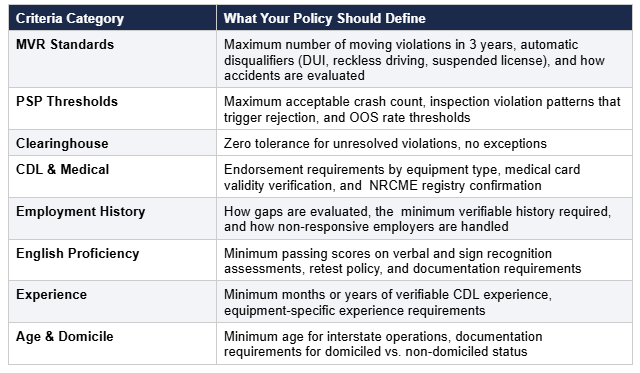
The entire point of an objective policy is to remove subjectivity from the hiring decision. When your policy says a driver with two or more moving violations in the past 12 months is automatically disqualified, that standard applies to every applicant. When a plaintiff’s attorney asks why you hired a driver with a problematic history, your answer is simple: our policy did not disqualify them, and here is the documentation to prove it.
The Day 1 to Dispatch Workflow
For carriers looking to implement this, here is the workflow we recommend. No driver moves a truck until every step is completed and documented:
- Application submitted, reviewed for completeness, signed, and dated
- All consent forms signed and retained (FCRA, Clearinghouse, Safety)
- FMCSA Drug & Alcohol Clearinghouse query completed and cleared
- MVR pulled from all applicable states and reviewed by the designated reviewer
- PSP report pulled and reviewed for crash and inspection history
- CDL and medical certificate validated against the NRCME registry
- English Language Proficiency assessment administered and scored
- Employment verification completed for a three-year history
- Multiple employer disclosure form signed if the driver holds a second job
- Pre-employment drug test completed with a negative result confirmed
- Pre-hire policy training assigned and completed
- Road test administered by a qualified evaluator and signed off
- Continuous monitoring enrollment (Samba Safety or equivalent) is activated
- Final approval granted, driver added to compliance tracking system
- Onboarding checklist signed and filed inthe driver qualification file
If any step produces a disqualifying result, the process stops. The driver does not dispatch. The documentation of why is retained. This protects you both operationally and legally.
1,427 Reasons to Get This Right
Craig Fuller’s posts about ICE at truck stops got 48,000 views and nearly 3,000 likes in a matter of hours because the freight industry was caught off guard. But nobody should have been caught off guard. The 287(g) program has been expanding for years. The deputization of local law enforcement for immigration enforcement across 40 states and over 1,400 agencies has been a matter of public record. The only question was when the freight industry would feel the impact directly.
Even if you set the immigration enforcement issue aside entirely, the underlying principle remains the same: carriers who do not screen their drivers rigorously are carriers who are exposed to catastrophic risk from every direction, regulatory, legal, operational, and financial. A non-domiciled driver arrested at a weigh station today could have been a driver involved in a fatal crash tomorrow. The screening process that would have flagged one problem would have flagged the other.
The question is not whether you can afford to build a defensible screening program. The question is whether you can afford not to.
Brokerage Compliance Symposium
The day before F3. Every compliance issue you face - fraud exposure, carrier liability, FMCSA rules, cargo theft, insurance gaps - navigated by attorneys and operators defining best practices in a changing industry.
F3 Awards Dinner
The night before F3. FreightTech100 companies honored. FreightTech 25 and Shipper of Choice winners revealed live. Cocktail reception into dinner and live music - 300 industry leaders in one purpose-built room.
F3: Future of Freight Festival
Industry-defining keynotes, rapid-fire technology demos, and industry leaders networking in experiences across Chattanooga - plus the inaugural F3 Awards Dinner featuring the FreightTech and Shipper of Choice reveals.
The day before F3. Every compliance issue you face - fraud exposure, carrier liability, FMCSA rules, cargo theft, insurance gaps - navigated by attorneys and operators defining best practices in a changing industry.
The Signal at Chattanooga Choo Choo • Chattanooga, TN Register NowThe night before F3. FreightTech100 companies honored. FreightTech 25 and Shipper of Choice winners revealed live. Cocktail reception into dinner and live music - 300 industry leaders in one purpose-built room.
The Signal at Chattanooga Choo Choo • Chattanooga, TN Register NowIndustry-defining keynotes, rapid-fire technology demos, and industry leaders networking in experiences across Chattanooga - plus the inaugural F3 Awards Dinner featuring the FreightTech and Shipper of Choice reveals.
The Signal at Chattanooga Choo Choo • Chattanooga, TN Register Now