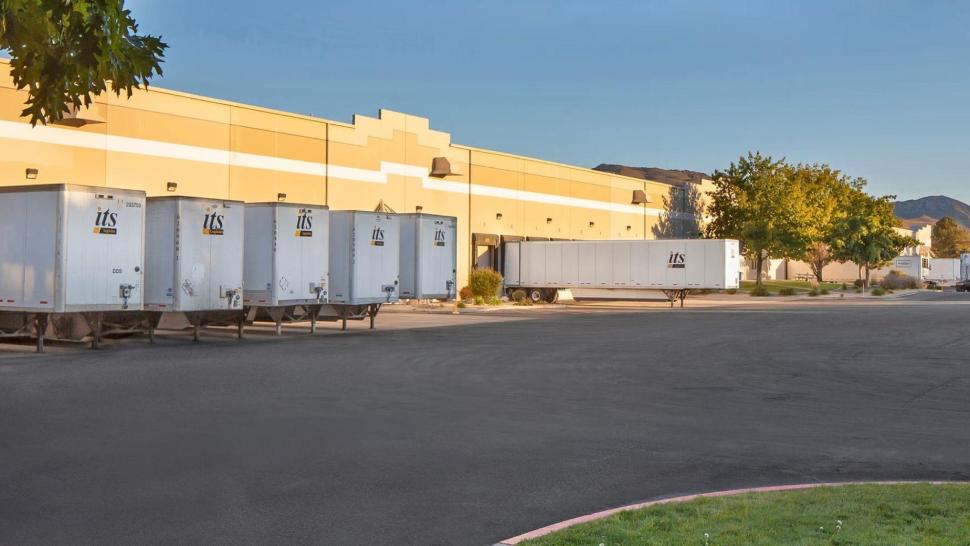
The freight market is perched on the edge of a capacity-driven precipice. For shippers who spent three years enjoying rock-bottom transportation rates, the good times are ending. Freight demand remains the wildcard. Any sudden spike will not draw the same carrier response as in years past.
In an interview with FreightWaves, Ryan Martin, president of distribution and fulfillment at ITS Logistics, discussed inventories, trailer strategy and shipper budgets amid tightening capacity.
“Pain is ahead on the transportation side,” Martin said. “We’ve been seeing the signs building for months. Shippers don’t typically believe it until they start to feel the pain.”
That pain is already showing up in the data. Driver exits, carrier closures, increased regulatory scrutiny on non-domiciled operators and surging fuel costs are stacking up. For large retailers and brands still budgeting for a flat year in transportation spend, this could be their reckoning.
The Great Inventory Cleanup
Understanding the current situation requires looking back a few years. The post-pandemic inventory overhang is finally clearing, but not without consequences. Martin has watched brands wrestle with a harsh new math problem: products that once cost a dollar now run $1.52, turning excess inventory into a cash-flow drain.
“Every customer is pushing for better inventory turns due to the cost of inventory increasing, whether that be through tariffs, transportation rates, etc.,” said Martin “Customers need to manage their turns much closer from a cash flow standpoint and be a lot more on point with what they buy.”
The math is unforgiving. During the pandemic, companies could not manufacture fast enough. Everyone bought massive amounts of product. It arrived in waves and kept selling — until it didn’t. By 2022 and 2023, inventories had ballooned, warehouse space overflowed, and brands sat on mountains of merchandise they could not move without taking losses.
“Retailers don’t want to heavily discount items (upwards of 50%-75% plus) just to move the inventory as it sits on the balance sheet as a cash equivalent,” continued Martin. “So they will sit on it, moth ball it for some time and then it typically only moves when a new buyer or General Merchandise Manager comes in and gets the grace to liquidate that destressed inventory, since they didn’t purchase it in the first place, they don’t own the loss when its sold.”
The result has been aggressive SKU rationalization. One brand ITS works with is cutting 50% of its product catalog after finally calculating true carrying costs. Martin used a lean-manufacturing metaphor to describe what is happening across the industry.
“The water level lowers. You can see the rocks in the stream,” he said. “Right now, we’ve been so focused on that, that’s why warehouse capacity increased over the past couple of years.”
The cleanup has exposed a pattern Martin saw repeatedly during his 11 years on the retail side. When division managers and merchandise buyers miss their buys, they do not get a free pass to write off the inventory. The reckoning comes when leadership changes.
“Whatever they buy is all theirs,” Martin said. “And it’s their responsibility to sell it. That’s why the General Merchandise Managers for these retailers have some of the biggest jobs in the sector — they control millions, if not billions, of dollars in spend.”
The winners in this environment are wholesalers such as TJX Companies, Ross and Dollar General, which buy distressed inventory when brands finally pull the trigger on markdowns.
“Those that go out and buy this distressed inventory, they do very well in these markets,” Martin said.
The Cheerios vs. Gas Theory
Consumer behavior remains the biggest wildcard. Martin has developed a theory about what truly drives purchasing decisions, and it has little to do with grocery prices.
“No one could ever tell you what the box of Cheerios cost yesterday at the grocery store was even though it went up 50%,” he said. “It doesn’t resonate. When you go to the pump, that resonates with everyone.”
It is simple psychology, and it is powerful. Fuel serves as a universal economic anchor. Everyone fills up on a consistent basis, and the price stares back within minutes. When that number climbs, anxiety follows — even among consumers who do not technically need to worry.
“It’s a few purchases that everyone knows. Everyone knows the baseline,” Martin said. “And when it increases like it is today, you start getting a little nervous even if you don’t need to.”
When fuel hit $7 or $8 per gallon in certain regions, e-commerce purchases dropped noticeably, especially for higher-end items. Mother’s Day provided a brief pop, but the underlying anxiety persists.
“We definitely saw a dip, and I’ve known enough people and talked to enough people that there was a dip across e-com,” Martin said. “There was definitely a dip especially for higher-end purchases just because of the impact of fuel.”
The numbers create a troubling paradox: U.S. revolving credit card debt has reached record levels above $1.2 trillion while consumer sentiment remains weak. Martin finds himself in unfamiliar territory.
“We’re in this weird scenario that we haven’t been in, at least in my lifetime, because usually consumer sentiment typically follows GDP growth,” he said. “But I think most people have gotten used to this spending on credit cards.”
If the fuel situation does not improve, Martin warned, it could have a detrimental impact on the overall economy and consumer purchasing.
Trailers as Table Stakes
While shippers scramble with inventory, ITS Logistics is doubling down on its drop-trailer fleet. Adam Angle, who leads trailer operations and equipment at ITS, said the company doubled its fleet from 2024 to 2025 and projects reaching about 13,000 ITS trailers by year-end — potentially more after synergies from Echo Global Logistics’ acquisition of ITS, which closed in March.
“It’s definitely at times table stakes to have assets in these conversations,” Angle said of drop-trailer capabilities. The strategy goes beyond simply having equipment. In addition to its decaled trailers, the company maintains access to roughly 300,000 trailers through partner carriers — flexibility that customers increasingly demand.
“DropFleet isn’t just about ITS owning trailers. It’s about building a universal, flexible trailer ecosystem that adapts to how each customer operates—without sacrificing execution or network efficiency,” Angle said. “A big driver of that evolution is the universal pool concept, which allows us to flex both the number and frequency of destinations we serve through one integrated solution.”
The technology inside those trailers has evolved far beyond basic GPS. Internal cameras now show shippers when loads are only 70% full, opening conversations about efficiency. Redundant concealed tracking provides cargo security and a way to recover assets if theft occurs.
“When we’re able to harvest that data, extract it and go back to the customer with, ‘Hey, your volume’s only 70%’ — that’s when it starts to open their eyes that that kind of technology is available and can strategically help their supply chain get more efficient,” Angle said.
The fleet expansion comes as ITS pushes into cross-border operations. The company already moves freight in and out of Canada, and Mexico service is expanding through the Echo integration.
The Market Coiled for a Snap
Load tender volumes mirror 2019 levels, yet capacity continues to leave the market. Both Martin and Angle see a coiled spring ready to release.
“We continue to see supply leaving the market for a multitude of reasons,” Angle said. “That’s the reality and I that’s what the pain is right now, and I think it will continue to tighten. You’re seeing all-time highs in spot market rates, and that’s without any meaningful pick-up in demand yet.”
The dynamic creates a precarious situation. If demand suddenly spikes — driven by stabilizing fuel prices and still-low inventory levels — the market could shift violently.
“If gas prices get back in line, inventories being low, this could be a real interesting peak season,” Angle said.
“As power capacity tightens, the ability to aggregate trailing capacity becomes a real competitive advantage,” Angle continued. “DropFleet lets us capture and reuse trailing capacity across thousands of carriers instead of relying on a few. That’s how you protect service when disruption hits or markets flip.”
For shippers who budgeted flat, the next rate-guide cycle could bring what Martin calls cascading rate-guide failures. Three years of soft markets have bred complacency.
“It’s been three years of down. I’ve been a shipper, so I know that they’re not blind to the market shifting,” Martin said. “They know it’s coming, but they’re trying to push it off as long as they can.”
The consequences could be severe. Shippers have likely already built budgets, bonus structures and internal approvals around a flat transportation spend assumption.
“They’re going to get challenged from a budgetary perspective this year if rates continue to increase,” Martin said. “It’s already happening, but it might just be the tip of the iceberg.”
Brokerage Compliance Symposium
The day before F3. Every compliance issue you face - fraud exposure, carrier liability, FMCSA rules, cargo theft, insurance gaps - navigated by attorneys and operators defining best practices in a changing industry.
F3 Awards Dinner
The night before F3. FreightTech100 companies honored. FreightTech 25 and Shipper of Choice winners revealed live. Cocktail reception into dinner and live music - 300 industry leaders in one purpose-built room.
F3: Future of Freight Festival
Industry-defining keynotes, rapid-fire technology demos, and industry leaders networking in experiences across Chattanooga - plus the inaugural F3 Awards Dinner featuring the FreightTech and Shipper of Choice reveals.
The day before F3. Every compliance issue you face - fraud exposure, carrier liability, FMCSA rules, cargo theft, insurance gaps - navigated by attorneys and operators defining best practices in a changing industry.
The Signal at Chattanooga Choo Choo • Chattanooga, TN Register NowThe night before F3. FreightTech100 companies honored. FreightTech 25 and Shipper of Choice winners revealed live. Cocktail reception into dinner and live music - 300 industry leaders in one purpose-built room.
The Signal at Chattanooga Choo Choo • Chattanooga, TN Register NowIndustry-defining keynotes, rapid-fire technology demos, and industry leaders networking in experiences across Chattanooga - plus the inaugural F3 Awards Dinner featuring the FreightTech and Shipper of Choice reveals.
The Signal at Chattanooga Choo Choo • Chattanooga, TN Register Now