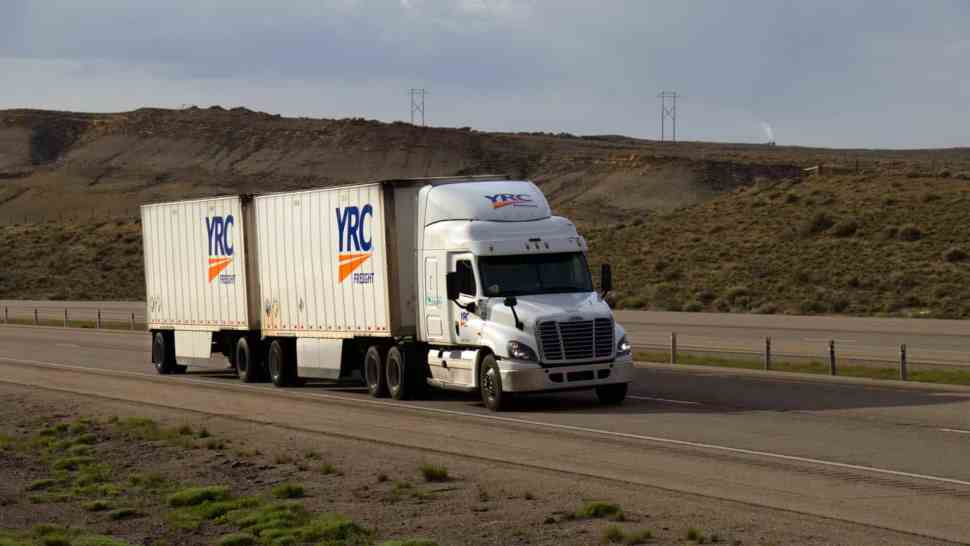
Less-than-truckload (LTL) carrier YRC Worldwide’s (NASDAQ:YRCW) long-haul unit and its two key regional units could go out of business by the end of May should unionized workers vote down a tentative five-year collective-bargaining agreement early next month, the head of the Teamsters union’s freight division has warned.
Ernie Soehl told the rank-and-file on a nationwide conference call on the evening of April 10 that customers will pull their freight from the three units should members vote down the contract on May 3, the date when the results are to be announced. If customers react in such a manner, long-haul carrier YRC Freight and regional carriers Holland and New Penn Motor Express will likely not last until May 31, the date a two-month extension to the existing agreement is set to expire, Soehl said.
YRC’s shippers are closely monitoring the status of the contract talks, Soehl said. Should the tentative agreement be rejected, “it is my personal opinion, and the opinion of the (negotiating) committee, that we will not make it to May 31,” he said. Shippers threatened to pull business in the days leading up to the tentative agreement at the end of March, and some accounts have already defected, Soehl added. The extension was designed to keep the business stable while the rank-and-file reviews the proposal and votes on it.
Soehl’s blunt assessment means that for the third time in less than a decade, YRC’s unionized workers will vote on an agreement as if the company’s fate depended on it. In 2010, faced with the strong prospects of YRC going out of business, the rank-and-file ratified a contract calling for punishing pension cuts and 15 percent wage reductions. Then in 2014, the members approved a memorandum of understanding (MOU) which effectively extended the terms of the 2010 agreement, although it did call for wage increases, albeit off the reduced base. The members rejected management’s first proposal, leading the company to warn that there “was no plan B” and that liquidation could be the result of a “no” vote. YRC’s lenders had conditioned future financing latitude strictly on a successful extension of the 2010 compact.
Now the threat of a contract rejection leading to the company’s dissolution comes from the union’s leadership. A rejection would be tantamount to the members authorizing a strike against YRC, Soehl said. But a strike would likely never come to pass because there would be no business left by the time a walkout took place, he added.
Neither YRC nor a spokesman for the union’s freight division responded to requests for comment.
About 24,000 Teamsters are employed at YRC, according to company estimates. (other estimates put it as high as 30,000 members. That includes members in a fourth unit, Reddaway, which is governed under a separate labor contract. YRC is one of the last – and the largest – truckers that were part of the once-mighty Teamsters’ freight division. At its peak prior to deregulation in the late 1970s, the division boasted more than 500,000 members. Since truck deregulation occurred in 1980, mergers, bankruptcies and the advent of non-union carriers have decimated the union contracts. The division has around 50,000 members today.
The contract proposal, which has received near-unanimous backing from local leaders, calls for a $4 per hour wage increase for most workers, spread out over five years, with a $1 per hour increase that would be effective immediately. The contract would be retroactive to April 1, 2019. That translates to an 18 percent increase for most workers over the contract’s life. The contract eliminates the current MOU, and no longer pegs wage increases to the lower thresholds. “A dollar is a dollar, not 85 cents,” Soehl said on the call.
YRC agreed to increase its annual contributions to the members’ health and welfare fund. The current pension levels would remain the same; the 2010 agreement froze pension contributions for a couple of years and resumed them at about 25 percent of prior levels.
The proposal restores one week’s paid vacation for workers that had earned four weeks vacation or more. That concession was made in 2010 and extended in the MOU. All unionized workers will get the additional one week’s pay, which will add 14,000 hours of pay per year, Soehl said.
The agreement establishes a class of non-Commercial Driver License driver who would handle local cartage rather than having YRC contract out the work to a non-union vendor. It also protects the higher wage for a CDL driver performing non-CDL driver functions. The pact prohibits the use of autonomous vehicles or drones for transporting freight. It allows, for the first time, the Holland regional unit to use purchased transportation, but caps the utilization to 8 percent of Holland total annual miles driven. It also empowers union negotiators to unilaterally curb or eliminate the purchased transportation programs at Holland and YRC Freight, where it has been in effect, on a limited scale, for five years.
Soehl said the union has extracted all the financial juice it could squeeze out of Overland Park, Kansas-based YRC. The company, Soehl said, doesn’t have another penny to spend beyond what it has agreed to in the five-year pact.
Brokerage Compliance Symposium
The day before F3. Every compliance issue you face - fraud exposure, carrier liability, FMCSA rules, cargo theft, insurance gaps - navigated by attorneys and operators defining best practices in a changing industry.
F3 Awards Dinner
The night before F3. FreightTech100 companies honored. FreightTech 25 and Shipper of Choice winners revealed live. Cocktail reception into dinner and live music - 300 industry leaders in one purpose-built room.
F3: Future of Freight Festival
Industry-defining keynotes, rapid-fire technology demos, and industry leaders networking in experiences across Chattanooga - plus the inaugural F3 Awards Dinner featuring the FreightTech and Shipper of Choice reveals.
The day before F3. Every compliance issue you face - fraud exposure, carrier liability, FMCSA rules, cargo theft, insurance gaps - navigated by attorneys and operators defining best practices in a changing industry.
The Signal at Chattanooga Choo Choo • Chattanooga, TN Register NowThe night before F3. FreightTech100 companies honored. FreightTech 25 and Shipper of Choice winners revealed live. Cocktail reception into dinner and live music - 300 industry leaders in one purpose-built room.
The Signal at Chattanooga Choo Choo • Chattanooga, TN Register NowIndustry-defining keynotes, rapid-fire technology demos, and industry leaders networking in experiences across Chattanooga - plus the inaugural F3 Awards Dinner featuring the FreightTech and Shipper of Choice reveals.
The Signal at Chattanooga Choo Choo • Chattanooga, TN Register Now