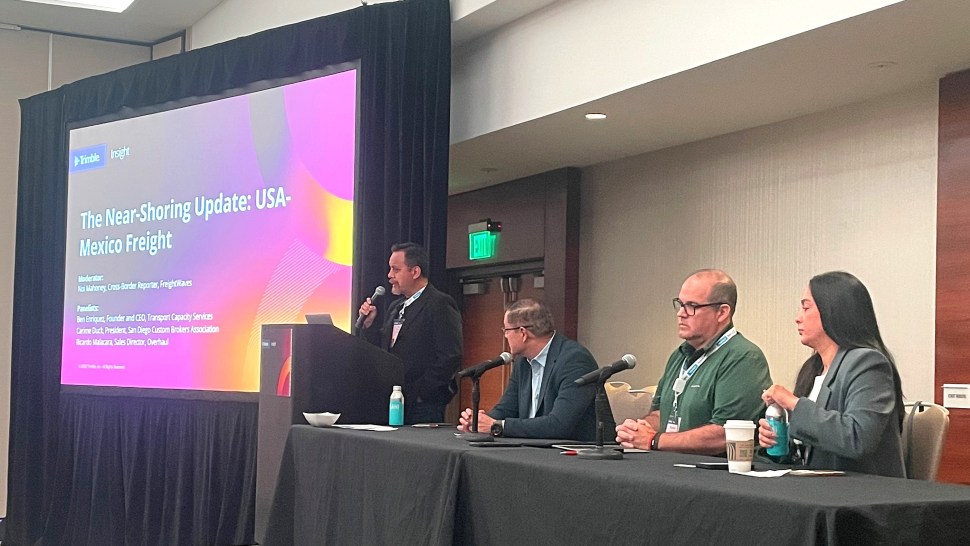
SAN DIEGO — Nearshoring continues to drive freight between the U.S. and Mexico, but a shrinking pool of cross-border drivers, tougher customs enforcement and increasingly sophisticated cargo theft could make moving that freight more difficult and expensive, industry executives said Tuesday.
The challenges were discussed during “The Nearshoring Update: USA-Mexico Freight” at Trimble Insight 2026 in San Diego.
The panel featured Ben Enriquez of Transport Capacity Services; Carime Duck, a licensed customs broker and president of the San Diego Customs Broker Association; and Ricardo Malacara, sales director at cargo-security technology provider Overhaul.
Trimble Insight 2026 Conference was held Sunday through Tuesday, included 1,200 attendees and featured more than 200 information sessions and product demonstrations.
Enriquez said nearshoring hasn’t disappeared despite tariffs and geopolitical uncertainty that have dominated headlines over the past year.
“The reality is that nearshoring, the ball was already rolling,” Enriquez said. “There were already manufacturing plants and expansions being done, and they continue to happen.”
Enriquez pointed to continued growth in two-way U.S.-Mexico commerce as evidence of the integration between the countries’ manufacturing sectors. He said many products, particularly automotive components, can cross the border multiple times during production.
Companies are taking a more cautious approach because of uncertainty surrounding the United States-Mexico-Canada Agreement (USMCA), he said, but “nearshoring is a reality.”
Related: Trimble keeps freight business sale on the table while unveiling new AI tools
Driver enforcement puts pressure on cross-border capacity
At the same time that freight demand is growing, Enriquez said the supply of drivers capable of handling cross-border shipments is coming under pressure.
Enforcement involving Mexican B-1 visa drivers, non-domiciled commercial driver’s licenses and English-language requirements has changed the economics and operating models of cross-border trucking companies, he said.
B-1 drivers generally can transport international freight into the U.S. and return with international cargo but cannot engage in domestic point-to-point transportation, known as cabotage.
Enriquez said stepped-up enforcement against drivers accused of improper domestic moves has removed drivers from the market. Combined with restrictions affecting non-domiciled CDL holders, that is reducing the pool of drivers available to both cross-border and domestic carriers.
Some Mexican trucking companies that established U.S. operations to provide door-to-door service are retreating to the traditional model of transferring trailers or freight to U.S. carriers at the border because they can no longer find enough drivers, Enriquez said.
“The market has changed in a lot of ways, and these issues are making it lose a lot of drivers,” he said.
Rising fuel expenses are putting additional pressure on small and midsize trucking companies, particularly those that must pay for fuel immediately but wait 30 to 45 days to receive payment from customers.
The result, Enriquez said, is that some fleets are reducing the number of trucks they operate because they lack either drivers or sufficient working capital.
“We are seeing that the volume is increasing,” Enriquez said, even as cross-border trucking supply contracts.
Duck said the capacity crunch is already showing up in Southern California during the fall peak shipping season.
Driver availability has become more difficult and trucking rates are increasing, she said, with fuel costs contributing to repeated price increases.
Malacara said reduced capacity can also create security vulnerabilities.
“The lack of capacity on drivers and trucks that can do cross-border increases the operation, increases the dwell times, increases the handoffs, which in turn increases the risk,” he said.
Freight waiting for drivers can end up at transfer locations that may not be secure, while companies under pressure to find capacity can take risks when hiring unfamiliar carriers or drivers.
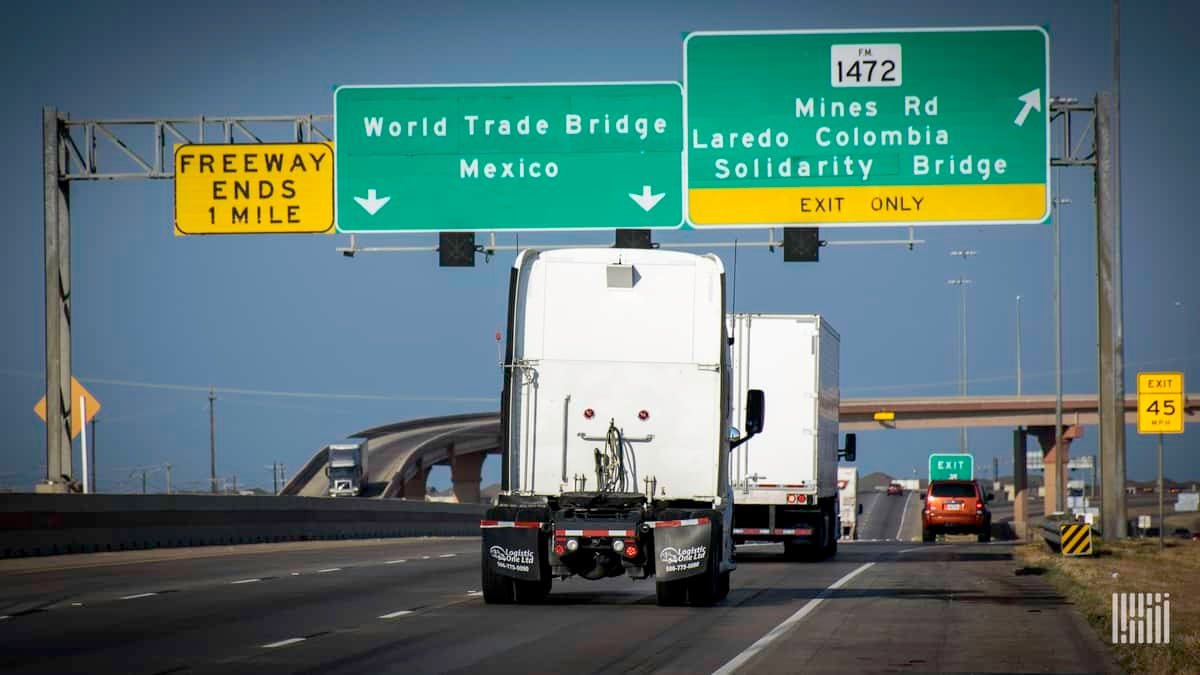
Nearshoring concentrates cargo-theft risk
Nearshoring has also concentrated more freight on Mexico’s existing transportation infrastructure, particularly through the Bajío manufacturing region of central Mexico, Malacara said.
Road, rail, airport and port infrastructure haven’t expanded as quickly as manufacturing investment, resulting in greater volumes of valuable cargo traveling along many of the same corridors.
“Concentrating freight, concentrating high-value moving goods in the same highway has increased the risk for all the shippers and all the cargo owners,” Malacara said.
Malacara said cargo theft has shifted geographically, with theft decreasing in some traditional hot spots while increasing in the Bajío region. He cited an 11% year-over-year increase in theft there, with about 80% of incidents involving violence or threats of violence.
The thieves targeting commercial freight are increasingly organized and technologically capable, he said.
“This is not a casual activity,” Malacara said. “These are organized, or these are structured organizations that plan, that have technology.”
Criminal groups use GPS jammers, plan routes and operating times and can sometimes obtain inside information identifying valuable shipments, he said.
Food and beverages remain the most frequently stolen products because they are easy to resell and difficult to trace, followed by construction materials, auto parts and electronics. Pharmaceuticals are also becoming a more prominent target, Malacara said.
Simply putting a GPS device on a trailer isn’t enough protection, he said, because thieves equipped with signal jammers can defeat basic tracking systems within seconds.
Companies instead need plans specifying what happens when tracking is disrupted, which authorities should be contacted and how security partners should respond.
“You need to stop treating the GPS, the dot in the map, as your guide,” Malacara said.
Customs compliance becomes part of nearshoring strategy
Duck said companies considering manufacturing in Mexico also need to reconsider a basic assumption about USMCA: Making a product in Mexico doesn’t automatically make the product eligible for preferential tariff treatment.
“You need to look at your supply chain,” Duck said.
A manufacturer might assemble furniture in Mexico, for example, while sourcing materials from another country that prevent the finished product from qualifying under USMCA rules of origin.
Duck said customs specialists should therefore be involved much earlier in sourcing, engineering and manufacturing decisions — a process she described as “classification engineering.”
“There needs to be someone who understands the customs side or the supply chain aspect of it and be in the conversations of engineering and manufacturing of these products,” she said.
Record keeping is becoming increasingly important as customs authorities demand more information about classifications, sourcing decisions and transactions, she added.
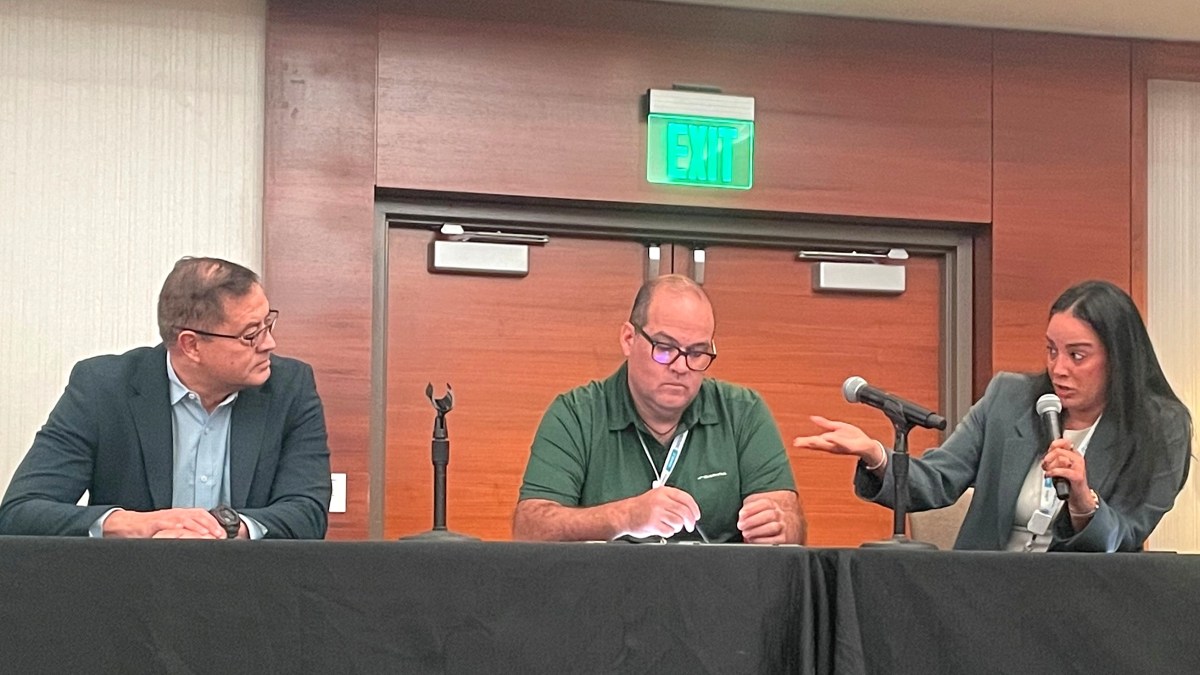
AI moves from reaction to prevention
Technology and artificial intelligence are increasingly being deployed to manage that growing complexity.
Duck said Customs is using AI as part of enforcement efforts, while customs brokers are adopting the technology as a secondary compliance check to identify missing information and clerical mistakes.
Transportation providers are also automating shipment updates, providing brokers with nearly instantaneous notifications when trucks leave ports or cross the border.
“I don’t see like it’s taking jobs,” Duck said. “I think it’s giving us more visibility.”
Malacara said Overhaul uses AI to analyze millions of data points to identify higher-risk lanes, times, commodities and shipments.
The technology can trigger warnings to drivers entering high-risk locations, detect possible GPS jamming and identify potential fraud involving DOT numbers, bills of lading and invoices.
For cargo security, Malacara said the objective should increasingly be prevention rather than recovering freight after it has already disappeared.
“For us, a recovered load, it’s a sign of our job not being well done,” he said.
Related: AI’s buzz in trucking is justified: Trimble panel
Shippers urged to secure capacity now
Enriquez said shippers should use the current environment to diversify their carrier networks rather than depending on a single transportation provider.
With trucking companies reducing capacity and nearshoring continuing to expand, carriers and shippers should begin strengthening relationships before freight demand accelerates again, he said.
“I think right now, the name of the game is secure capacity and form partnerships,” Enriquez said.
He said the emergence of more mini-bids over the past several months suggests shippers are already reassessing their transportation networks.
“As a shipper, I would recommend you to get more arrows on your quiver and make sure that you have all your capacity covered,” Enriquez said.
Duck offered a similar recommendation on the compliance side: Companies should understand every participant in their supply chains before a disruption occurs and maintain regular communication with brokers, shippers, receivers and transportation providers.
Malacara’s advice centered on security.
“Do not leave your security plan for last,” he said.
Security plans should be tailored by lane, commodity, day and time and continually updated as criminal tactics and geographic risks change.
“It has to be a recurring event where somebody at your organization is thinking about the risk of moving cargo within Mexico, within the U.S., and crossing the border,” Malacara said.
Why it matters: Nearshoring may be generating more cross-border freight just as carriers face tighter driver availability, higher operating costs and security risks, increasing the importance of securing transportation capacity before demand accelerates.
Brokerage Compliance Symposium
The day before F3. Every compliance issue you face - fraud exposure, carrier liability, FMCSA rules, cargo theft, insurance gaps - navigated by attorneys and operators defining best practices in a changing industry.
F3 Awards Dinner
The night before F3. FreightTech100 companies honored. FreightTech 25 and Shipper of Choice winners revealed live. Cocktail reception into dinner and live music - 300 industry leaders in one purpose-built room.
F3: Future of Freight Festival
Industry-defining keynotes, rapid-fire technology demos, and industry leaders networking in experiences across Chattanooga - plus the inaugural F3 Awards Dinner featuring the FreightTech and Shipper of Choice reveals.
The day before F3. Every compliance issue you face - fraud exposure, carrier liability, FMCSA rules, cargo theft, insurance gaps - navigated by attorneys and operators defining best practices in a changing industry.
The Signal at Chattanooga Choo Choo • Chattanooga, TN Register NowThe night before F3. FreightTech100 companies honored. FreightTech 25 and Shipper of Choice winners revealed live. Cocktail reception into dinner and live music - 300 industry leaders in one purpose-built room.
The Signal at Chattanooga Choo Choo • Chattanooga, TN Register NowIndustry-defining keynotes, rapid-fire technology demos, and industry leaders networking in experiences across Chattanooga - plus the inaugural F3 Awards Dinner featuring the FreightTech and Shipper of Choice reveals.
The Signal at Chattanooga Choo Choo • Chattanooga, TN Register Now