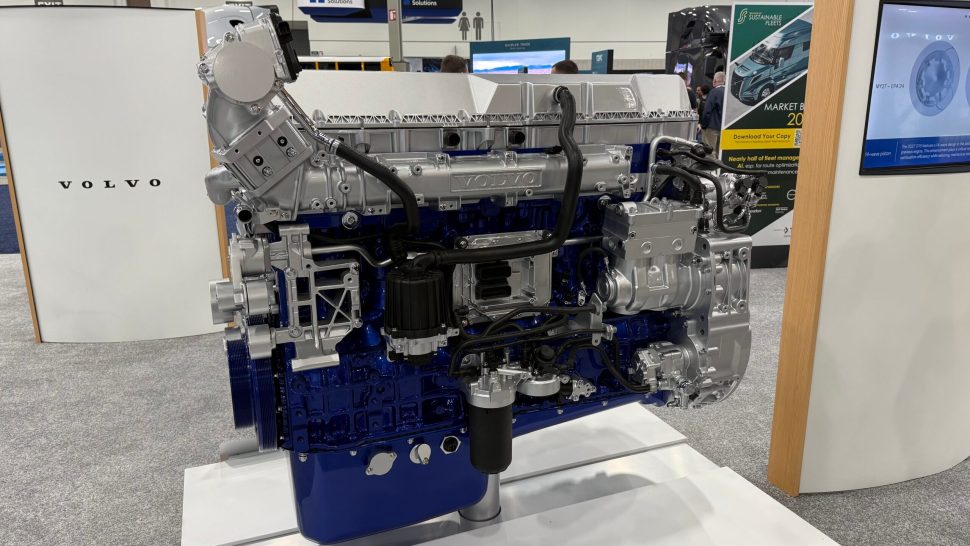
The trucking industry’s countdown to the Environmental Protection Agency’s 2027 emissions standards is accelerating. Volvo Trucks North America is betting its next-generation D13 engine can deliver cleaner air without sacrificing performance and reliability for its fleet customers.
Volvo Trucks North America has introduced a completely redesigned D13 engine that reduces nitrogen oxide emissions by 83% and particulate matter by 50%. The company notes it is also Volvo’s cleanest engine ever.
“This engine is our most fuel-efficient and reliable engine ever and delivers on every front for our customers: lower emissions, strong performance, and compatibility with the fuels and systems fleets already use,” said Peter Voorhoeve, president of Volvo Trucks North America. “The 2027 standards build on technology the industry knows well, and we have aligned our production, supply chain and dealer network so customers have what they need from day one.”
Expanded Power From a Redesigned Block
The new engine pushes ratings up to 540 horsepower and 1,950 lb.-ft. of torque, offering fleets additional options for heavy-haul, B-train operations in Canada and demanding vocational applications. Engine braking performance increases to 630 braking horsepower, up from 500 in legacy models.
At the foundation is a fundamental redesign of the block itself. Volvo switched to compacted graphite iron, increasing tensile strength by 75% over the previous platform.
“That allows us to maintain or increase cylinder pressures,” said Duane Tegels, Volvo Trucks product marketing manager, in an interview with FreightWaves. “So we brought our compression ratio from 18:1 up to 20:1. We’re squeezing that fuel just a little bit more, trying to get every little bit of energy out of it.”
The company also introduced a 14-wave piston design, doubling the wave count from the previous generation. The injector fires directly at one of those waves, splitting fuel in a pattern intended to improve air-fuel mixture and reduce soot.
“Soot is a result of incomplete burn from fuel,” Tegels said. “By changing that design, we reduced the amount of soot that we’re putting into the aftertreatment system, which also affects how many regeneration cycles you have.”
The transmission has been refined to measure input torque more precisely, keeping the engine in its sweet spot longer.
“How it shifts is going to be amazing,” Tegels said. “It’s going to be very seamless; it’s going to pull all the way through the shift. The driver’s going to feel a little bit more acceleration.”
Fuel Economy Varies by Application
Fuel economy gains will depend on the type of operation. Fleets running regional haul or vocational operations with the Variable Geometry Turbo platform will see roughly 4% improvement in fuel economy. Long-haul customers currently running turbo-compounding units will maintain the same efficiency they have today, according to Volvo.
The turbo-compounding unit will sunset in 2027, replaced by a swing-blade VGT design that delivers equivalent performance through the higher compression ratio and refined turbocharger technology.
The engine supports renewable diesel (R100) and biodiesel blends up to B20, providing added flexibility as alternative fuels become more widely available.
Electrical Upgrades Target Component Life
Volvo added a 48-volt alternator alongside the existing 24-volt system, paired with a crankshaft decoupler — essentially an improved harmonic balancer — that stabilizes voltage at idle, protecting alternator components and extending aftertreatment life.
“When you spike voltage up and down, it takes out rectifiers and diodes in alternators,” Tegels said. “So this helps give us clean voltage at low idle and improves the life expectancy of the aftertreatment.”
Two grid heaters — one before the diesel oxidation catalyst and one before the selective catalytic reduction system — increase heat for catalyst conversion, washing out soot and hydrocarbons before the SCR handles NOx reduction. The system builds on aftertreatment technology Volvo has refined over more than a decade in commercial use.
Serviceability Changes
The engine features an exterior-mounted high-pressure fuel pump for the common-rail system, eliminating the need to remove injector cups during injector replacement. The exhaust gas recirculation valve is now electrically actuated rather than hydraulically controlled.
“It gives us better feedback and knowing the position of it so we can mix exhaust gas in there based on cylinder temperature and pressures,” Tegels said.
A variable-displacement coolant pump reduces parasitic loss and provides dynamic cooling based on real-time engine demands. Closed crankcase ventilation runs on an electric motor instead of the oil pump.
The new engine will be available across all Volvo truck models when EPA 2027 standards take effect Jan. 1, 2027. Volvo’s dealer network, parts availability and training programs are also aligned to support adoption from day one.
Brokerage Compliance Symposium
The day before F3. Every compliance issue you face - fraud exposure, carrier liability, FMCSA rules, cargo theft, insurance gaps - navigated by attorneys and operators defining best practices in a changing industry.
F3 Awards Dinner
The night before F3. FreightTech100 companies honored. FreightTech 25 and Shipper of Choice winners revealed live. Cocktail reception into dinner and live music - 300 industry leaders in one purpose-built room.
F3: Future of Freight Festival
Industry-defining keynotes, rapid-fire technology demos, and industry leaders networking in experiences across Chattanooga - plus the inaugural F3 Awards Dinner featuring the FreightTech and Shipper of Choice reveals.
The day before F3. Every compliance issue you face - fraud exposure, carrier liability, FMCSA rules, cargo theft, insurance gaps - navigated by attorneys and operators defining best practices in a changing industry.
The Signal at Chattanooga Choo Choo • Chattanooga, TN Register NowThe night before F3. FreightTech100 companies honored. FreightTech 25 and Shipper of Choice winners revealed live. Cocktail reception into dinner and live music - 300 industry leaders in one purpose-built room.
The Signal at Chattanooga Choo Choo • Chattanooga, TN Register NowIndustry-defining keynotes, rapid-fire technology demos, and industry leaders networking in experiences across Chattanooga - plus the inaugural F3 Awards Dinner featuring the FreightTech and Shipper of Choice reveals.
The Signal at Chattanooga Choo Choo • Chattanooga, TN Register Now