Amerijet lost $33M in 12 months, downsizes Atlanta operation

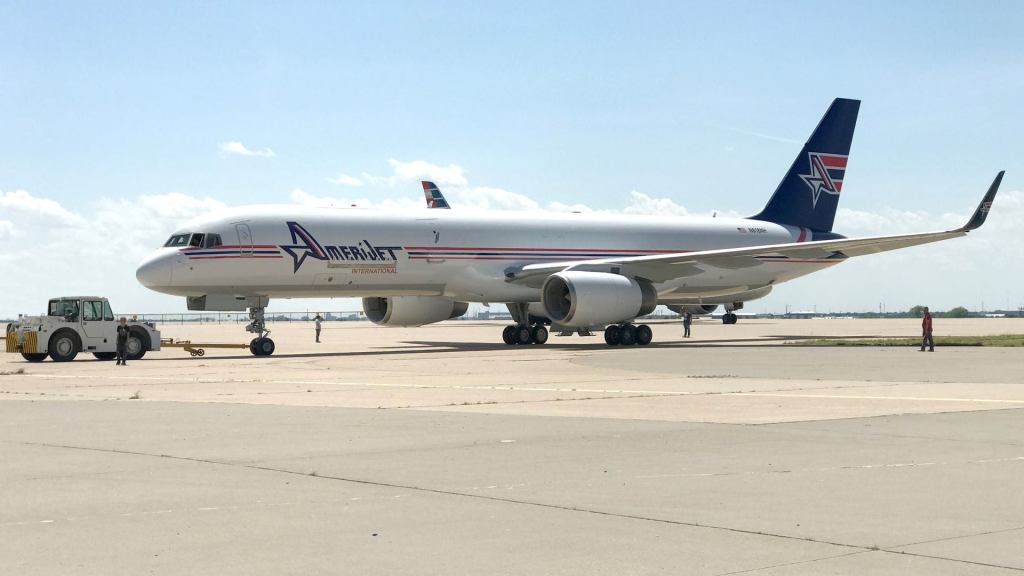
A blue-tailed Amerijet freighter sits on the tarmac on a sunny day with a small tractor by the nose.

Struggling freighter operator Amerijet International will outsource work from its small shipping station in Atlanta at the end of March in the latest attempt to reduce costs amid mounting financial losses driven by a prolonged downturn in freight markets and the end of some key contracts.

The Miami-based cargo airline will shutter the warehouse it operated a few miles from Hartsfield-Jackson Atlanta International Airport and outsource freight transfers to Worldwide Flight Services, a large airport ground handling agent, when the lease expires, Marketing Director Christine Richard confirmed.

The change will reduce headcount by four employees, who will have the opportunity to join WFS, she said in an email message. The warehouse supported Amerijet’s road feeder network, which operated to and from the company’s air hub at Miami airport. The WFS location on airport property will provide customers a more convenient location to drop and receive freight, Richard said.

Amerijet has taken a series of steps over the past year to regain its footing, culminating in the replacement of CEO Tim Strauss in October and a January restructuring that resulted in new ownership and the return of six Boeing 757-200 converted freighters to lessors after barely one year.

The company rapidly expanded during the unprecedented boom in air cargo fueled by the pandemic and had too much capacity when the market normalized and some large customers pulled their business.

In the 12-month period ending Sept. 30, Amerijet lost $33 million, according to data compiled by the U.S. Bureau of Transportation Statistics. Revenue decreased 10% to $542 million, outpacing cost reductions. Operating profit went from $22 million in the prior 12-month period to negative $10 million. Average monthly cargo volume through November is down 63% since the peak in July 2021 and revenue cargo traffic is nearly half the amount for 2021.

Amerijet’s workforce is also down from a high of nearly 1,100 at the end of 2022 to 951, according to the latest figures compiled by the Bureau of Labor Statistics.

In addition to getting rid of the 757 cargo jets, Amerijet has parked at least two of its flagship Boeing 767s. The Amerijet fleet currently stands at 14, down from a high of 22 in 2022, according to data from aviation analytics firm Cirium. Three 767-300 freighters are owned and controlled by Maersk Air Cargo, with Amerijet providing crews, maintenance and insurance for international flights. The 11 other 767s are leased and wear the Amerijet name.

Aircraft database Planespotters.com shows one 767-200 has been parked since December at Wilmington Air Park in Ohio. Another 767-200, which was operated by Amerijet on behalf of DHL Express and provided by DHL’s in-house airline, arrived Feb. 21 at the Pinal Airport boneyard in Marana, Arizona. Both aircraft were more than 40 years old.

FreightWaves previously reported that DHL had canceled its contract with Amerijet to fly scheduled service in its package delivery network and took back the aircraft it owned. Cirium data shows Amerijet was flying five 767-200s for DHL last year and none in 2024. DHL previously said it is still doing business with Amerijet, which suggests Amerijet fills in when called using its own aircraft.

Meanwhile, the U.S. Postal Service last year did not renew two contracts for daily service between Philadelphia and Sacramento, California, and Philadelphia and Ontario, California, as it shifts more mail to ground transportation for economic and environmental reasons. Amerijet continues to fly mail on a San Juan, Puerto Rico-to-Newark, New Jersey-to-Orlando, Florida-to-San Juan route.

The blow from two major customers was compounded by recessionary conditions in freight markets, with air cargo volumes contracting by more than 8% in 2022, and by double digits at the turn of the year, before bottoming out last summer and starting to recover.

New CEO Joe Mozzali informed employees in October that Amerijet was pulling all available levers to improve performance in a challenging market. 

“Every decision is being questioned to make sure that business units are making the right amount of net contribution. Everything’s under the microscope,” as it should be, said a former Amerijet manager who did not want to be identified. 

Before Strauss was dismissed, the all-cargo carrier also closed a small freight forwarding unit, laid off a handful of administrative staff and outsourced accounting functions to Trinidad and Tobago.

No pilots have been furloughed because of the reduced flying, but Amerijet appears to have stopped hiring new crew members, according to a current employee, who asked to remain anonymous to avoid any retaliation.

“Amerijet continues to pursue growth strategies to increase our top-line revenue. We continually evaluate measures to ensure our long-term viability and competitiveness,” said Richard.

Cargo airline Amerijet in distress sale, terminates 6 aircraft leases

Amerijet feels financial pinch as cargo business deteriorates
XPO provides favorable February update

A white XPO trailer at a terminal

Similar to other less-than-truckload carriers, XPO saw a notable year-over-year (y/y) improvement in volumes in February when compared to January.

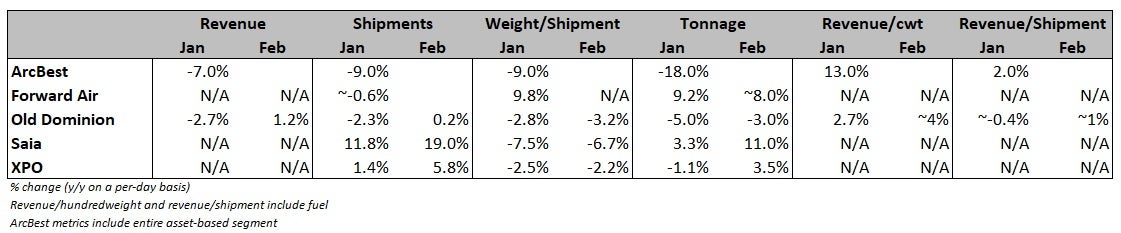
In a Tuesday update following the market close, the carrier said tonnage grew 3.5% y/y in February as a 5.8% increase in shipments was partially offset by a 2.2% decline in weight per shipment. The tonnage increase was an improvement from a modest decline in January.

Further, XPO (NYSE: XPO) was facing tougher tonnage comps than most peers. When stacking January and February growth rates for the past two years, XPO’s tonnage was up roughly 1.5% in each month, which was largely in line with Saia Inc. (NASDAQ: SAIA) and well ahead of double-digit declines at Old Dominion Freight Line (NASDAQ: ODFL).

Table: Company reports

XPO doesn’t provide revenue-based metrics in its intraquarter updates. The company guided to a roughly 10% y/y increase in yield (excluding fuel surcharges) for the first quarter during its fourth-quarter call a month ago.

Full-year guidance calls for yields to be up by mid- to high-single digits, with tonnage up by low-single-digits. Those forecasts are not dependent on a material positive inflection in the broader economy, management said.

Modest declines in weight per shipment have been a positive catalyst for yields.

Much is left to be determined in the first quarter, however, as the month of March typically accounts for half of the carrier’s quarterly result.

XPO normally sees 40 basis points of deterioration in its operating ratio from the fourth to the first quarter but plans to better that level this year. That implies a similar OR to the 86.5% result it produced in the fourth quarter, which would be roughly 300 bps better y/y.

For the full year, its OR is expected to improve by a total of 150 bps to 250 bps.

XPO recently acquired 28 terminals valued at $870 million from bankrupt Yellow Corp. (OTC: YELLQ). The additions will bring approximately 3,000 new doors to its network, 1,000 of which will not be incremental.

More FreightWaves articles by Todd Maiden

Norfolk Southern fires back at Ancora, gets Wall Street analyst’s support

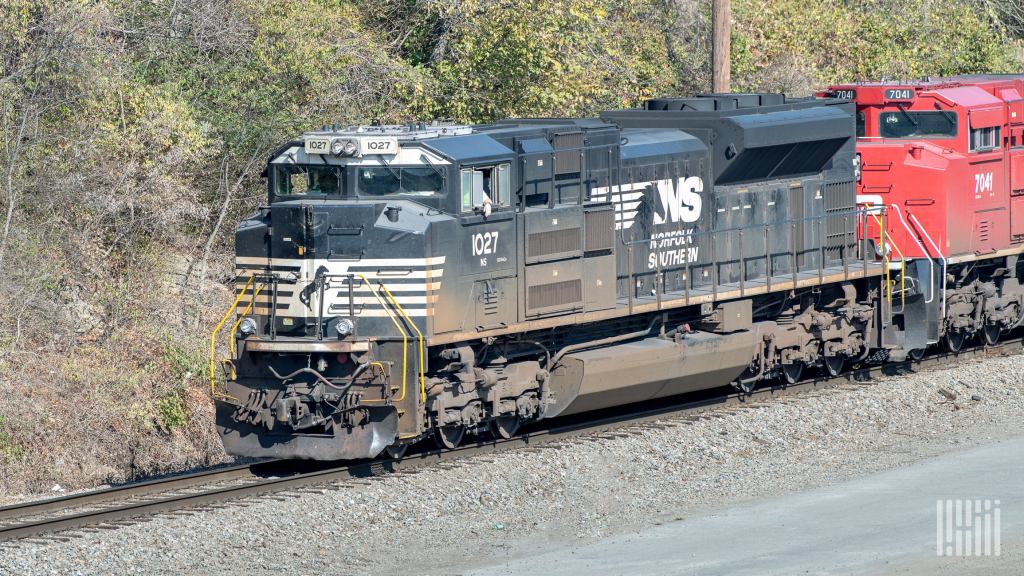
The sparring over the future of Norfolk Southern continues, with the railroad offering a detailed defense of its operations alongside a critique of Ancora Holdings’ recently renewed call for a quick change in management following a derailment late last week.

In the middle of the maelstrom at Norfolk Southern (NYSE: NSC), a leading Wall Street investment bank said the company’s finances were strong enough to increase its rating. The report from the transportation research team at UBS led by Thomas Wadewitz, moving its rating to Buy from Neutral, helped push the stock price Monday to a level just below NS’ 52-week high.

Norfolk Southern shot back at activist investor Ancora on Monday with a prepared statement that was aimed at, as the release’s headline said, correcting “false and misleading claims.”

The railroad’s statement focused on two charges leveled by Ancora in back-to-back statements released Friday and Saturday. Friday’s statement focused on the pay package of Norfolk Southern CEO Alan Shaw, which was made public in the railroad’s proxy statement filed with the Securities and Exchange Commission last week.

The second came after the derailment of several cars of a Norfolk Southern train in Lower Saucon Township in Pennsylvania, in the Allentown-Bethlehem area, that spilled diesel fuel and plastic pellets into the Lehigh River.

The Ancora statements could be boiled down to two key themes: For a railroad with safety issues, such as the East Palestine, Ohio, derailment last year, Shaw makes too much money; and the Pennsylvania derailment is another sign of lax safety at NS, demonstrating that Shaw should be replaced immediately.

Norfolk Southern said Ancora was “misrepresenting our safety record.” The railroad is taking the Pennsylvania derailment “seriously” but said it had resulted in “no harm to the community and no hazardous material concerns from the railcars.”

The railroad’s “mainline accident rate” was down 42% in 2023 compared to 2022, the statement said, and “the company’s … rate is the lowest it has been in years and is among the best of the North American Class 1 rails.”

The NS statement ticked off multiple points in defense of steps it had taken for a safer railroad.

The list included “enhanced employee training” and being the first Class 1 railroad to join the Federal Railroad Administration’s Confidential Close Call System. Norfolk Southern said it had hired Atkins Nuclear Secured as an independent safety consultant. “They have conducted a comprehensive safety assessment, and we are implementing changes based on their recommendations,” the railroad said.

Defending Shaw’s pay

It then shifted gears in its statement to defending Shaw’s pay package that exceeded $13.4 million in 2023, significantly higher than 2022 compensation of $9.8 million.

Among the defenses of the pay package:

  • It did not reach the maximum levels that it could have. There were incentives that the board decided should not be paid out to Shaw or other executives. 
  • It was adjusted so that insurance payouts as a result of the East Palestine derailment didn’t impact the level paid.
  • The comparison to 2022 is unfair because Shaw didn’t become CEO until May 2022.

Ancora is recommending that NS shareholders approve a slate of eight independent directors who have vowed to install former UPS executive Jim Barber Jr. as CEO and former CSX executive Jamie Boychuk as COO. Norfolk Southern has recommended that shareholders approve the 13 candidates for the board it has recommended.

UBS sees merchandise growth

The UBS report didn’t mention the proxy fight by Ancora at Norfolk Southern. The increase in the rating to Buy was driven primarily by UBS’ optimism about the prospects for the railroad’s merchandise business.

Norfolk Southern’s operating ratio in its merchandise business, which UBS estimates was 65% in 2023, could improve to 55% by 2026, according to the report. Merchandise is rail business that isn’t coal or intermodal.

CSX (NASDAQ: CSX), the Class 1 competitor for Norfolk Southern in the eastern U.S., moves about 30% more carloads per train in its merchandise activities, according to UBS.

“If NSC bridges the gap with CSX on this metric, it would translate to a 20% reduction in merchandise train starts, which is a key driver of cost on a railroad,” UBS wrote. “We conclude that lower [train and engine] crew expense from reduced starts would result in about 400 basis points of margin improvement in NSC’s merchandise segment.” That also has a knock-on effect of reductions in other expenses, which would add several hundred more basis points in cost reductions, UBS added.

Norfolk Southern stock closed Friday at about $257.50. It rose to a Monday close of $259.17 after the UBS report was published.

The railroad’s 52-week high was set Feb. 21 at $261.37. Its 52-week low was in October at $183.09. In trading Tuesday, the stock closed at $257.42, down $1.75 or 0.68%..

UBS has a new 12-month price target on Norfolk Southern of $302. Its previous target was $238.

More articles by John Kingston

ACF spurs small gain in zero-emission drayage trucks at Port of Long Beach

If truckers haul bread and cakes, is their business baking or trucking?

Live on stage: The complex relationship between a trucking job and life

Old Dominion Freight Line still waiting for market to turn

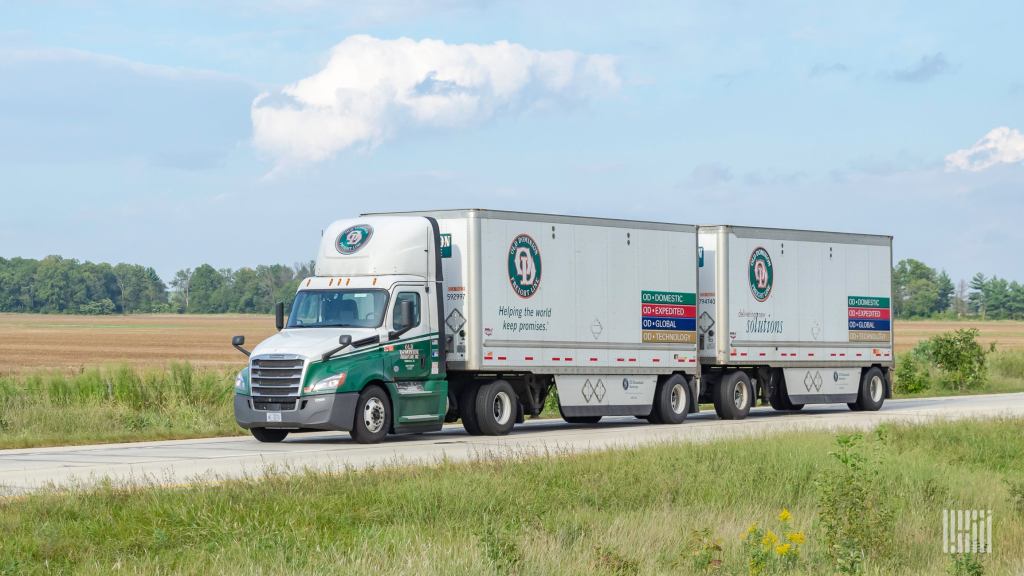
An Old Dominion tractor pulling two Old Dominion pup trailers on a highway

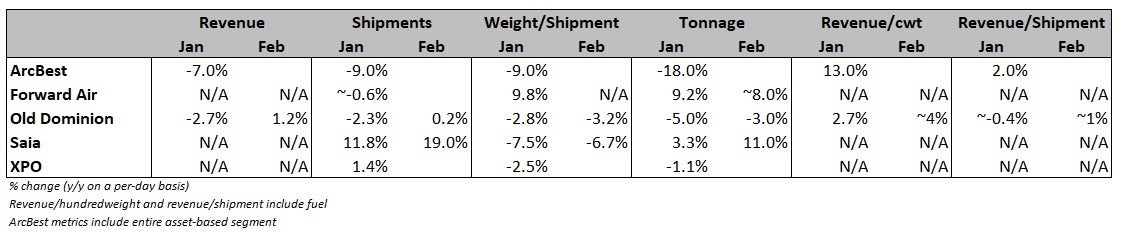
Old Dominion Freight Line reported a modest improvement in metrics during February but said market conditions “continue to reflect softness in the domestic economy.”

The less-than-truckload carrier saw revenue per day increase 1.2% year over year (y/y) during February, following a 2.7% decline in January. Tonnage was down 3% as a slight increase in shipments was offset by a 3.2% decline in weight per shipment. January saw a 2.3% decline in shipments while shipment weights were 3.2% lower.

January was a tougher-than-normal month for carriers as severe winter storms forced terminal closures, resulting in some shipments getting pushed to February. Old Dominion (NASDAQ: ODFL) also had an easier y/y tonnage comp in February (down 12.4% a year ago) compared to January (down 7.8%).

The carrier continues to see favorable yield results as it remains one of the most price-disciplined operators in the business. Revenue per hundredweight was 3.7% higher y/y for the first two months of the first quarter and 7.1% higher when excluding fuel surcharges.

“The increase in our LTL revenue per hundredweight was supported by a favorable pricing environment and our ongoing ability to deliver superior service at a fair price,” said Marty Freeman, Old Dominion’s president and CEO, in a Tuesday news release.

Table: Company reports

The lower shipment weights have been a contributor to the improving yield metrics.

On its fourth-quarter call at the end of January, Old Dominion said it had roughly 30% excess capacity to accommodate future volume growth. It hasn’t been adding terminals at a high clip like some of its competitors, which are seizing on an opportunity following the shutdown of Yellow Corp. (OTC: YELLQ).

Saia Inc. (NASDAQ: SAIA) reported Monday a 19% y/y jump in shipments during February, which followed a 12% increase in January. The company acquired 28 terminals from the bankrupt estate and plans to spend more than $500 million on real estate in 2024. It expects to increase door count by 12% to 14% during the year.

Old Dominion plans to leverage the $2 billion it has invested in real estate over the past decade to achieve its growth goals. The company has a track record of winning market share when the freight cycle turns positive. On the January call, it said it had outperformed market growth rates by 600 to 1,000 basis points on average in prior cycles, noting a midteens advantage during the 2021 freight boom.

“We believe our value proposition is unmatched in the marketplace, which provides us with a tremendous opportunity to win market share and produce strong, profitable growth once the macroeconomic environment begins to improve,” Freeman concluded.

The carrier has easier comps on the horizon than most of its peers. During the 2023 second quarter, it recorded midteen tonnage declines each month versus the industry, which was down only slightly.

Shares of ODFL were down 2.8% at 1:50 p.m. EST on Tuesday compared to the S&P 500, which was down 1.1%. Saia was up 3% at the time.

More FreightWaves articles by Todd Maiden

Check Call: ESG initiatives make a stand

people gathered around a desk of computers. Check Call news and analysis for 3pls and brokers
Gif: GIPHY

At the beginning of the year, one of my predictions for an area that companies would be focusing on was environmental, social and governance initiatives – turns out sustainability and reducing carbon emissions has made a splash.

Werner Enterprises has seen Vikram Mansharamani’s resignation from the company. Mansharamani, a member of the board of directors at Werner, attributed his resignation in part to Werner’s “unquestioned dedication to ESG considerations as a primary strategy.”

That’s a hot take in today’s landscape when more and more shippers, carriers and freight brokers are committing to ESG initiatives and are releasing their own carbon emissions data to the public. 

According to the NTT 3PL study, “Among shippers, 59% indicated their organization had an ESG program with defined goals and objectives, and 51% indicated their supply chain had an ESG program with defined goals and objectives. Just under half of 3PL providers, 45%, said their organization had an established ESG program.” 

The study also found that “76% of shippers and 80% of 3PLs agreed that the focus of shippers’ supply chains is mostly on the shipper organization itself and also on the most proximate supplier and customer organizations; 71% of shippers and 70% of 3PLs felt that the focus of supply chains is more ‘end-to-end’ and extends more deeply into supplier and customer networks.”

With all the progress that has been made on sustainability through the years, not being on board with that direction will not help a company maintain a competitive advantage. For those that are holding out and waiting to see if sustainability is actually worth it, just know it is. Shippers are wanting buy-in from partners, and those who aren’t coming up with a way to help and be a solution will struggle in the coming years.

SONAR TRAC Market Dashboard 

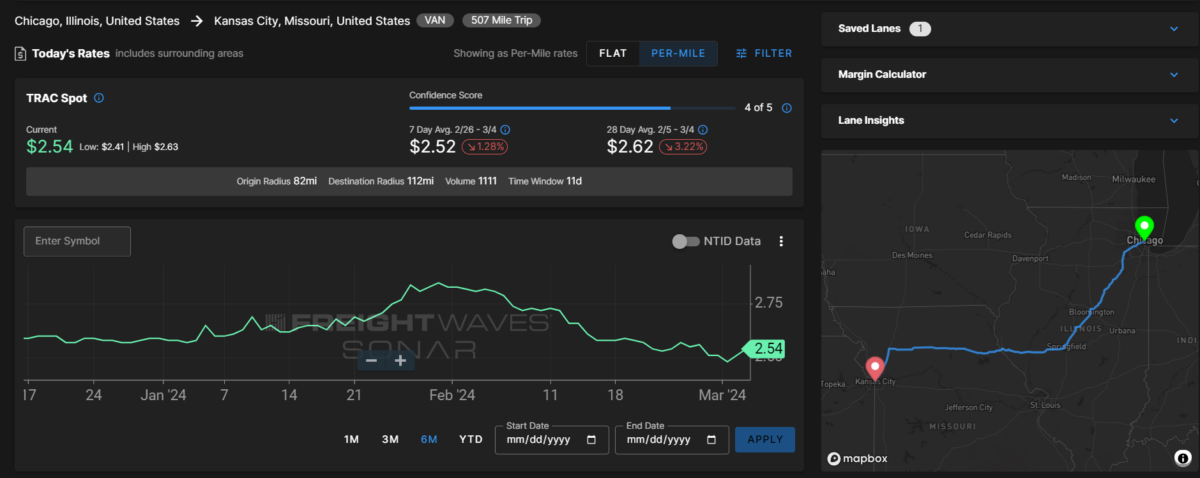
TRAC Tuesday. This week’s TRAC Lane goes from Chicago to Kansas City, Missouri. The 500-mile trip through the finest corn fields of the Midwest is running about $2.54 per mile and unlikely to stray far from that rate as outbound tender rejections have fallen to 2.91%, a 73-basis-point decrease week over week. Kansas City also has seen a falloff of outbound tender rejections, which have dropped 210 basis points w/w. As long as rejection rates continue to fall and outbound tender volumes stay consistent, spot rates will remain relatively stable, making it a low-priority coverage lane.

(GIF: GIPHY)

Who’s with Whom? The latest Teamsters union battle seems to be over before it begins. This time it was between the Teamsters and Anheuser-Busch. Negotiations had stalled a few weeks ago, though both sides were still coming to the table. A strike was authorized to start last Friday, but that option is no longer needed as the two parties have reached an agreement.

The full breakdown of the deal wasn’t released but the highlights include “Wage increases of $8 an hour over the five years of the deal” and “A $4-per-hour raise kicks in immediately.” A $2,500 ratification bonus is included, too. The agreement still has to be ratified, but given that the dissident Teamsters for a Democratic Union – which often criticizes deals that the union reaches – isn’t on the attack, ratification is expected to pass with little dissent.

According to an article by FreightWaves’ John Kingston, “Anheuser-Busch said the deal ‘builds even further upon our existing industry-leading package of wages, healthcare, and retirement benefits, and it includes significant commitments to job security.’”

The more you know 

Amazon rakes in $140 billion in annual fees from sellers, angering many with ‘crazy’ new fees 

O’Reilly invests in larger distribution centers

Borderlands Mexico: Texas-based customs broker expands cross-border footprint

Is the rate roller coaster about to turn?

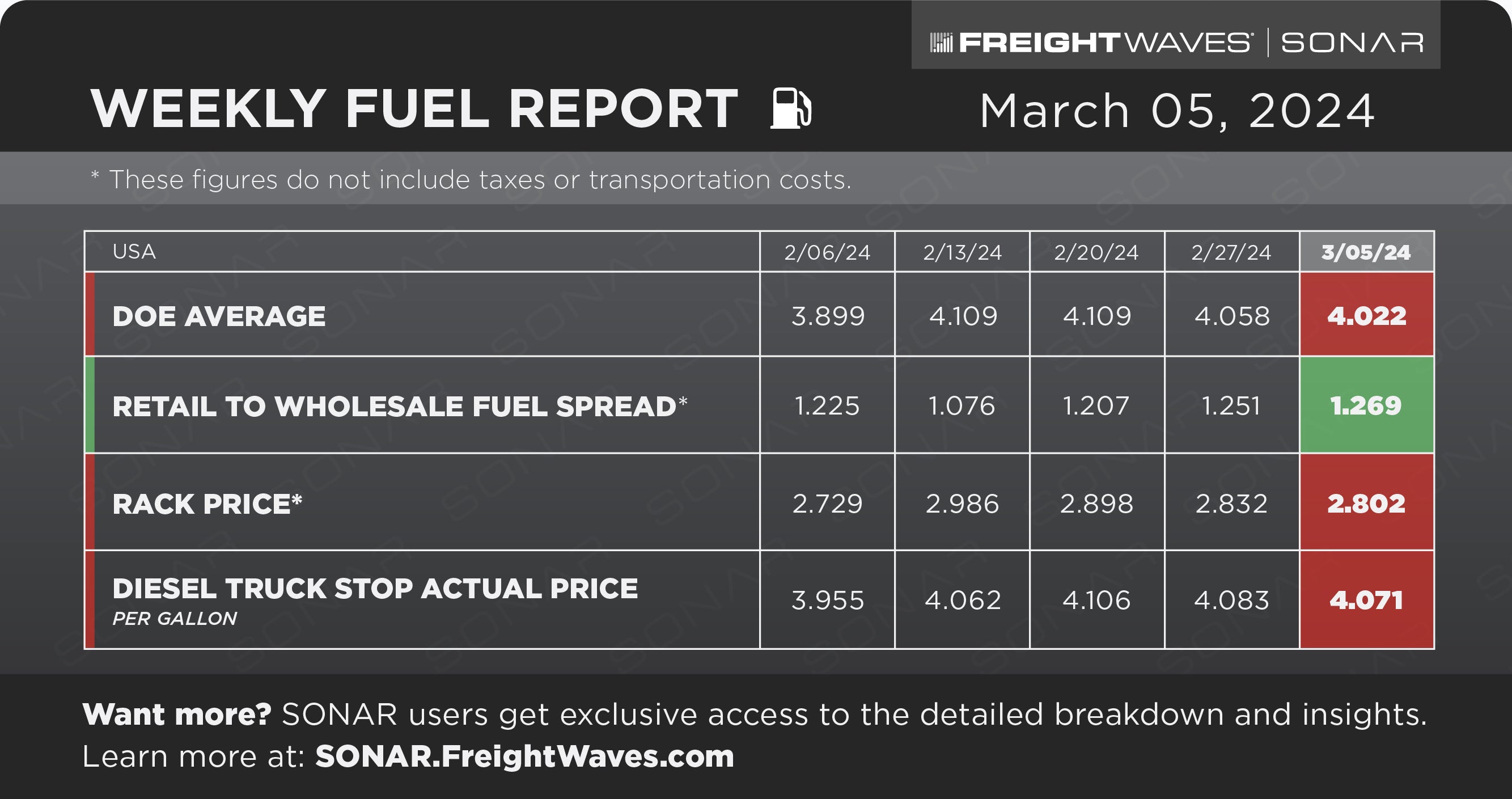
Weekly Fuel Report: March 05, 2024


Learn more at SONAR.FreightWaves.com

Dispute over ESG policies leads to a director departure at Werner

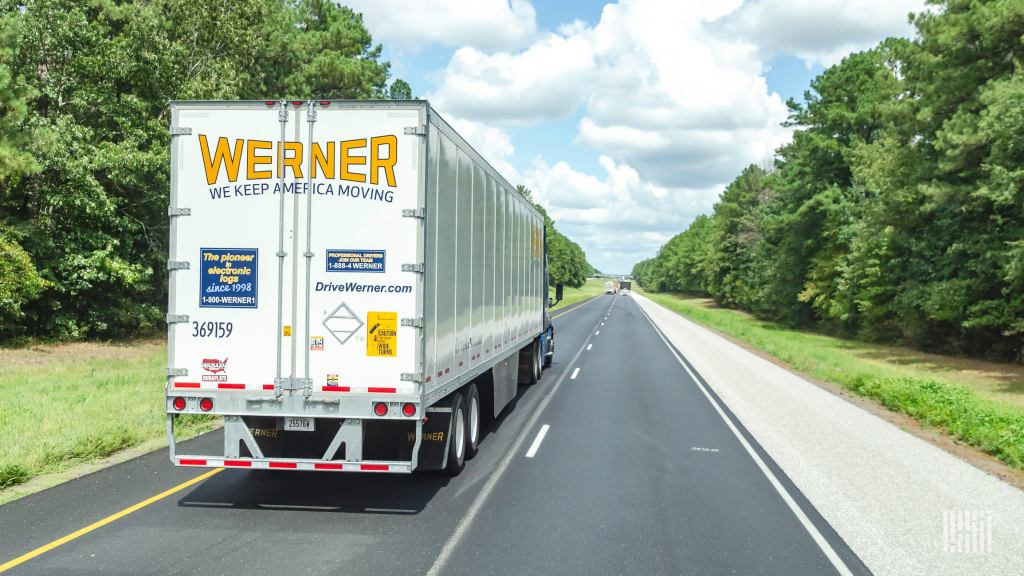
In a rare instance of internal board of directors disagreements jumping into public view, a director at Werner Enterprises has resigned, citing in part the truckload carrier’s “unquestioned dedication to ESG [environmental, social and governance] considerations as a primary strategy.”

Vikram Mansharamani’s resignation came before he faced the likelihood of not being be reelected to a second three-year term.

In a letter dated Feb. 27 and revealed publicly in a Werner (NASDAQ: WERN) Securities and Exchange Commission filing Friday, Mansharamani said he was resigning because “ongoing material disagreements with the board over policies and practices lead me to conclude I am no longer able to effectively serve as a director.”

In the brief letter, Mansharamani said the disagreements “center on repeated related party transactions, the unquestioned dedication to ESG considerations as a primary strategy, and the refusal to adequately consider differing perspectives.”

The letter provided no specifics on the nature of the “repeated related party transactions.”

Companies often adopt policies aimed at improving their performance against ESG goals and are sometimes rated on their ESG principles by agencies such as S&P Global and Moody’s.

The Mansharamani letter said the resignation was effective immediately. His term was up this year, and he would have needed to stand for reelection at the company’s annual meeting May 14. He was first elected to a three-year term in 2021.

According to Werner’s proxy statement from last year, Mansharamani was a lecturer at Harvard University for five years, 2017-2022. He taught at Yale University on finance and business ethics during the same period.  Mansharamani was also described as “an author, and his ideas and writings have appeared in Fortune, Forbes, the New York Times, and many other publications.”

He has a Ph.D. and two master’s degrees from MIT. His undergraduate degree is from Yale.

According to the 2023 proxy statement, Mansharamani was paid $62,500 in cash for his service as a director in 2022 and received stock awards valued at $100,000.

The resignation letter does not make reference to what Werner, in a filing with the SEC disclosing Mansharamani’s status, said was reluctance on the part of Werner’s directors to give Mansharamani a second term.

Werner’s 8-K filing said Mansharamani had told a nominating committee meeting on Feb. 19 that he was interested in a second term on the board of directors. 

But two days later, according to Werner, the carrier’s chairman and CEO, Derek Leathers, told Mansharamani that he “did not have the support of the nominating committee and that the nominating committee would not be recommending him … for reelection.”

According to Werner, the disagreement over “social responsibility and related corporate governance” had been discussed with the board.

“While the Company disagrees with Dr. Mansharamani’s statements, it carefully considers its policies and related practices and takes his report of ongoing material disagreements with the Board of Directors seriously,” Werner’s 8-K statement said. “The Company is proud of its commitment to stewardship, community engagement, and effective corporate governance.”

It also said that it was making an 8-K filing to give Mansharamani “the opportunity to respond as to whether he agrees with the statements made in this Form 8K and if not, the respects in which he does not agree.”

There is a long list of events that the SEC says require the filing of an 8-K. Some of the definitions turn on whether an event can be considered “material.”

But one of the occurrences that the SEC says should trigger an 8-K filing is the “departure of directors or certain officers.”

Werner has published a corporate responsibility report annually since 2020. In the latest report, released in November, the company lays out an ESG scorecard of ongoing and completed goals.

It includes such developments as “build a waste and energy scorecard that measures progress around waste reduction and electricity use” under Environmental, “launch a formalized supplier diversity program” under Social and “appoint a lead independent director” under Governance. 

That last goal was completed in February 2023 with the appointment of Scott Arves as lead independent director. Arves is a retired former director, president and CEO of Transport America, a truckload carrier that ultimately became part of TFI (NASDAQ: TFII).

More articles by John Kingston 

Deadline nears for fillings as Werner seeks review of nuclear verdict

Werner hit with more than $36 million jury award for failure to hire deaf driver applicant

A first for Werner: Small group of workers votes to unionize

IMC Logistics acquires California carrier American Pacific Transportation

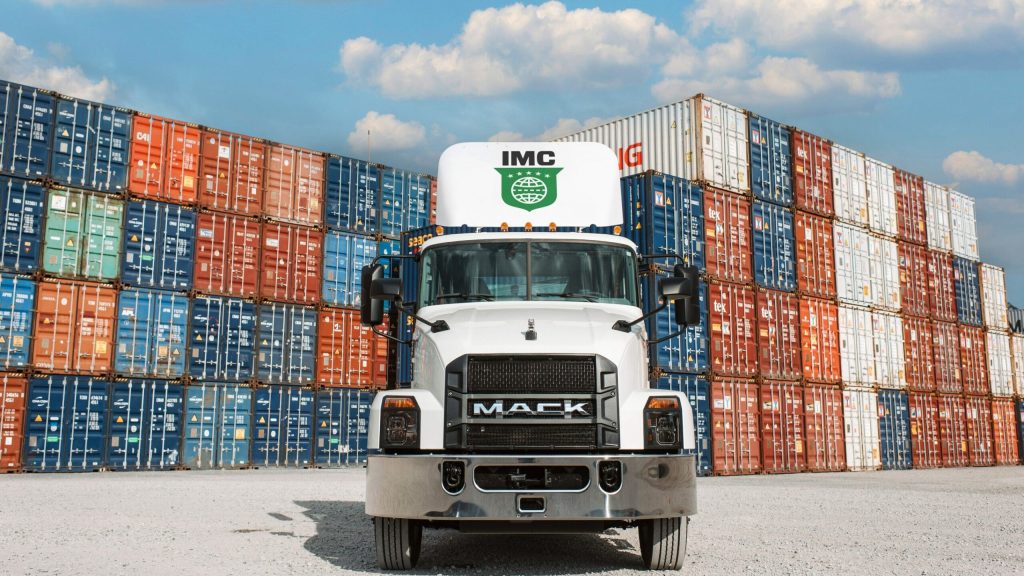
Memphis, Tennessee-based intermodal logistics provider IMC Logistics has acquired American Pacific Transportation, boosting the company’s drayage truck capacity across California.

“As a result of this acquisition, we will have more than 500 trucks in California, signifying our commitment to our customers in this region,” Joel Henry, IMC’s CEO, said in a news release.

American Pacific Transportation has locations in Calexico, Chino, Commerce, San Diego and Lompoc, California. The carrier has provided domestic rail and international harbor drayage, as well as regional truckload and dedicated distribution services, since 1976, according to IMC.

The acquisition includes American Pacific Transportation facilities in Lompoc and Calexico. Financial terms of the transaction were not disclosed.

Henry said the merger of the two companies should be “seamless.”

“We already have so much in common including 42 years of dedicated expertise, similar values, a commitment to customer service as our top priority, and an eagerness to provide superior care and capacity for our growing client base,” he said.

IMC Logistics was founded in 1982 by Mark and Melinda George. Today, the company is one of the largest marine drayage providers, with over 50 locations nationwide. IMC has more than 1,000 drivers and power units, according to the Federal Motor Carrier Safety Administration.

More articles by Noi Mahoney

Texas-based customs broker expands cross-border footprint

Shifting supply chains boost trade in California-Baja mega-region

Mass furloughs reported at BNSF Railway operations in 4 states

Truck driver sentenced for stealing rig hauling Mike’s Hard Lemonade

A New York truck driver was recently sentenced to six months in prison after pleading guilty to stealing a tractor-trailer loaded with 1,560 cases of Mike’s Hard Lemonade worth nearly $33,000.

Kelvin Garcia Liriano, 28, of New Rochelle, New York, was sentenced Friday in Westchester County Court in White Plains, New York, after pleading guilty to grand larceny in the second degree in November.

Once released from prison, Liriano will serve five years of supervised release and has been ordered to pay nearly $43,000 in restitution.

According to court documents, Liriano admitted to stealing a tractor-trailer full of Mike’s Hard Lemonade on March 21, 2023, from a parking lot near Interstate 87 in Yonkers, New York. Investigators state that Liriano drove the rig to Brooklyn, where it was later found abandoned and its cargo missing. Court records state that law enforcement arrested Liriano nearly a month later on April 17, 2023.

As of publication, Liriano’s defense attorney, Julie B. Schechter, had not responded to FreightWaves’ request for comment.

Do you have a news tip to share? Send me an email or message me @cage_writer on X, formerly known as Twitter. Your name will not be used without your permission.

Feds charge Illinois trucking company owner in alleged CDL fraud
Feds charge Massachusetts state troopers in alleged CDL bribery scheme
Ex-Slync CEO Chris Kirchner guilty of wire fraud, money laundering

Transportation prices up in February but capacity grows faster

Tractor-trailers at a warehouse

Transportation prices grew from depressed levels for a second time in as many months during February, a Tuesday supply chain report showed. However, the rate of growth in transportation capacity was higher, signaling a meaningful recovery in the freight cycle is not yet underway.

The subindex for transportation prices (57.6) increased 1.8 percentage points sequentially in February, according to data compiled in the Logistics Managers’ Index (LMI). Prior to January, the index had been in contraction territory since July 2022.

The LMI is a diffusion index. A reading above 50 indicates expansion while one below 50 signals contraction.

Upstream firms (60.9), like wholesalers and manufacturers, returned a stronger price indication than downstream firms (52.7) like retailers. The overall transportation pricing subindex slowed as February progressed. It registered a 62 in the first two weeks of the month compared to 52.4 in the back half of the month.

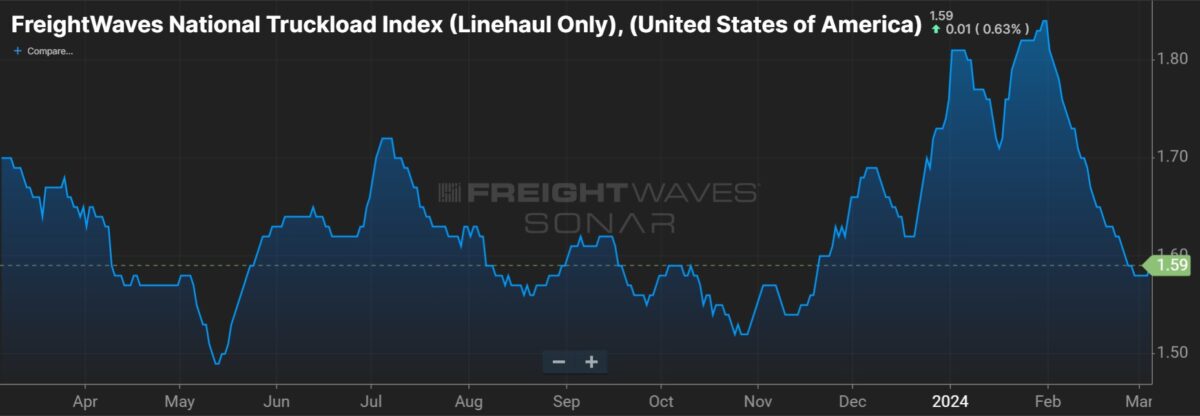
The trend was similar to the spike in truckload spot rates captured by FreightWaves SONAR. Severe winter storms in January forced many carriers to park trucks for several days, reducing overall capacity and providing a temporary lift in rates. The backlog of freight took a couple of weeks to unwind. As it unwound, so did spot rates.  

The LMI data also includes transportation rates from other modes, like ocean shipping, where rates have spiked due to the Red Sea conflict, drought conditions at the Panama Canal and the run-up to Lunar New Year.

Chart: (SONAR: NTIL.USA). The National Truckload Index (linehaul only – NTIL) is based on an average of booked spot dry van loads from 250,000 lanes. The NTIL is a seven-day moving average of linehaul spot rates excluding fuel. To learn more about FreightWaves SONAR, click here.

Transportation capacity (60.9) expanded further, up 6.4 points, as utilization (56.5) stepped 1.5 points higher.

The report said the growth rate in capacity outpacing the growth rate in pricing suggests “we have not yet entered a true growth period in the freight market.” However, an inflection appears to be on the horizon. Survey respondents returned a barely-positive reading of 50.5 for transportation capacity one year from now compared to a more pronounced jump in prices (77.1). The future take on prices was 3.4 points higher than last month’s expectation.

The outlook for transportation equipment utilization (68.3) a year from now was 6.4 points higher sequentially.

The overall LMI moved nearly 1 point higher to 56.5 in February, with all eight subcomponents of the index seeing expansion for a second consecutive month. February was the sixth time in seven months the index has been in expansion territory. However, the reading remained below the 62.4 all-time average for the 7.5-year-old data set.

Inventory levels (58.5) were up 5.7 points from January and have been in growth territory for three of the past five months. The report said this was “a clear sign that firms are restocking after running inventories down over the holidays.” Inventories grew 5 points faster at upstream companies (60.6).

“This is a marked shift for U.S. manufacturers and wholesalers who have been hesitant to increase inventories,” the report stated. “3PLs are also represented in this group, so the increase there may represent higher levels of turnover in general.”

It said retailers have returned to just-in-time inventory strategies but did see stock levels increase as well, returning a 55.6 reading.

The outlook for inventories one year from now was 60.1, which was 1.4 points lower than in January.

“The buildup of Upstream inventories is a positive sign for the logistics industry as it suggests we are now seeing more balance across multiple levels of the supply chain,” the report said.

Inventory costs were down 3.9 points but remained in expansion mode at 62.9.

Rising inventories are keeping warehousing metrics tight.

Warehouse capacity (52.8), remained in expansion territory, but the level of growth declined for a third straight month in February. Utilization (66.3) was 7.6 points higher and “likely reflective of the inventory buildup happening further up the supply chain.” Warehouse prices (64.2) grew by the same amount as they did in January.

Aggregate logistics prices — the sum of inventory costs, warehouse prices and transportation prices — were near a one-year high at 184.8 (150 equals equilibrium), but well off the all-time high of 271.3 that was set two years ago.

The LMI is a collaboration among Arizona State University, Colorado State University, Florida Atlantic University, Rutgers University and the University of Nevada, Reno, conducted in conjunction with the Council of Supply Chain Management Professionals.

More FreightWaves articles by Todd Maiden