Teamsters Canada warns rail strike looms over pay, hours at CN, CPKC

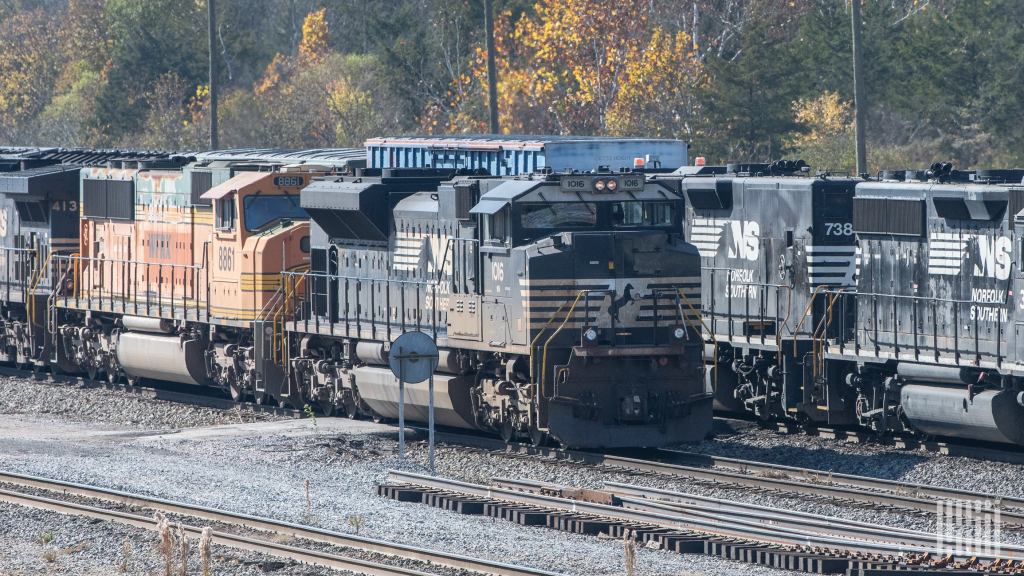
The union representing almost 9,300 workers at Canada’s two biggest rail operators says the railroads are pushing toward a work stoppage after negotiations have deadlocked over issues of working conditions and wage increases.

“CN and CPKC aim to eliminate all safety-critical rest provisions from our collective agreements,” François Laporte, national president of Teamsters Canada, said in a news release on Monday. “These provisions are necessary to combat crew fatigue and ensure public safety. We want to reach a negotiated settlement, but their demands are non-starters for the Teamsters.”

On Friday, Canadian National Railway Co. (CN) and Canadian Pacific Kansas City (CKPC) filed notices of dispute with the federal labor minister and requested the appointment of a conciliator for the bargaining process over a new collective bargaining agreement for train conductors, engineers and yard workers.

The notice of dispute starts the clock on a possible strike or lockout, which could occur in 81 days, or early May.

According to the Teamsters Canada Rail Conference (TCRC), the union that represents workers at both companies, CN and CPKC are effectively inviting a work stoppage.

“Canadian railroads don’t care about supply chains, farmers, or small businesses,” Paul Boucher, TCRC president, said in a statement. “They care about their bottom line, and squeezing everything they can out of their employees. If they need to manufacture a work stoppage to get there, they won’t think twice.” 

TCRC represents 6,000 conductors, conductor trainees, yard coordinators and locomotive engineers across CN’s network in Canada, as well as 3,200 locomotive engineers, conductors, and train and yard workers at CPKC in Canada. 

TCRC’s Rail Canada Traffic Controllers division also represents about 80 rail traffic controllers in Canada.

The collective bargaining agreements between TCRC workers and CN and CPKC expired Dec. 31.

Railroads push back against union accusations

CPKC (NYSE: CP) spokesman Patrick Waldron said the company has offered wage increases, quality-of-life improvements and predictable schedules with assigned days off, but that the railway and the union “remain far apart on the issues.”

“It is unfortunate that once again the TCRC–Train & Engine (T&E) division has chosen to grossly misrepresent the facts regarding our ongoing collective bargaining and the multiple proposals made by CPKC,” Waldron said in an email to FreightWaves. “The TCRC running trades leadership has again distorted the truth in an attempt to create a false narrative.”

CPKC has offered two options for renewed contracts that provide benefits for all workers, Waldron said.

According to Waldron, CPKC’s first option includes significant pay increases, as well as predictable days off through a simplified system.

CPKC’s second option offers competitive wage increases that are consistent with recent settlements and maintain the status quo for work rules within Transport Canada’s updated regulatory framework for rest, Waldron said. The second option does include an exception amending CPKC’s held-away-from-home provision for train crews.

“Our proposal recognizes the needs of our evolving workforce and the needs of our customers and Canada’s supply chains,” Waldron said. “Importantly, neither of these proposals, or anything CPKC has put forward, creates any risk to safety or employee well-being.”

Officials for CN (NYSE: CNI) said recent regulatory changes to worker rest provisions have made it harder to find available crews, necessitating a “modernization of the compensation model.”

“The union wants increases without the modernization of the compensation model that would support those increases,” CN spokeswoman Ashley Michnowski said in an email to FreightWaves.

Michnowski said under CN’s proposal, employees would work a scheduled 40-hour work week, with a minimum of 10 to 12 hours to rest between shifts and either two or three consecutive days off each week, which complies with the government’s Duty and Rest Period Rules in Canada.

“A scheduled railroad means a predictable railroad, and a predictable railroad is one that benefits customers and employees alike,” Michnowski said. “Our offer, which was refused by the union, guaranteed predictable schedules and consecutive days off for employees to specifically address work/rest balance, while keeping supply chains fluid.”

Wall Street not worried yet about rail strike

In a Tuesday note to clients, Deutsche Bank analyst Amit Mehrotra said CPKC and CN’s request for a federal conciliator in negotiations with the TCRC “is a fairly common development in these types of negotiations.”

“The bottom line is we don’t consider these items as meaningful for the outlook for CPKC and CN shares, though the timing is unfortunate given both companies have seen recent volume momentum which has begun to be reflected in the share price,” Mehrotra wrote. “If there is any work stoppage, which may not happen, it’s most likely (and rightfully) to be considered as an extraordinary event with limited impact to shares.”

More articles by Noi Mahoney

Trump-supporting truckers boycott loads to New York City
Border bridges blocked as former rail workers seek back pay

329 layoffs hit freight-related firms in Texas

Activist group wants former UPS exec Barber to run Norfolk Southern

Less than a month after taking a billion-dollar stake in railroad Norfolk Southern Corp. (NYSE: NSC) and vowing to oust CEO Alan Shaw, activist group Ancora Holdings Group on Tuesday proposed a new slate of directors at Norfolk Southern, as well as a new CEO, former UPS Inc. executive Jim Barber.

Ancora has also proposed that Jamie Boychuk, a former executive at CSX Corp. be appointed as COO, replacing Paul Duncan.

The proposed eight-member board slate includes former Ohio Gov. John Kasich; Barber; Samet Fahmy, a former top executive at Kansas City Southern; William Clyburn Jr., a former vice chairman at the Surface Transportation Board; and Alison Landry, a longtime transportation analyst.

Ancora also has an equity stake in freight broker C.H. Robinson Worldwide Inc. and has actively agitated for change at the Eden Prairie, Minnesota-based company.

Barber, who spent nearly 40 years at UPS, a major Norfolk Southern intermodal customer, was UPS’ COO when he retired in December 2019. Barber, who sits on Robinson’s board, was also in line for the CEO job there. The position was eventually awarded to Dave Bozeman, who left a top job at Ford Motor Co. to join Robinson.

In a statement unveiling its proposals at Norfolk Southern, Ancora said the railroad has exceptional workers and a strong customer base but suffers from the board’s “poor decisions with regard to the company’s leadership, safety priorities and strategy.” The railroad is still dealing with the fallout from the East Palestine, Ohio, derailment in 2023.

Since Shaw’s appointment, the railroad’s status as the industry’s worst-performing carrier has been reinforced by industry-worst operating results, sustained share price underperformance and a tone-deaf response” to the derailment, Ancora said.

The company said it has complained for months about management’s “equal parts unambitious and impractical” strategy, only to have its concerns fall on deaf ears at the railroad.

In a note, Jason H. Seidl, analyst at Cowen & Co., said that “we believe Barber to be respected by investors in the transportation sector, though not revered within railroading given the bulk of his experience is in parcel. Regardless of the potential CEO succession, we believe an activist involved in NSC may still lead to changes that close the gap between its U.S. Class I peers.”

Seidl added that Ancora’s proposed board “is robust in our view with representation of regulators, operators, technology, and finance experts while also being a significantly diverse arrangement. Given the challenged outlook facing NSC currently, we believe it is likely that the current Board will be under pressure.” While acknowledging that Norfolk Southern’s management has “faced external shocks that exacerbated weak performance, shareholders could look past the uncontrollables in favor of a fresh slate and revised strategy,” he wrote.

Are ocean spot rates past their peak?

2023 was a challenging year for ocean carriers, especially those that have spot exposure. They have seen significant slashes to revenue and profitability. 

Zim Integrated Shipping (NYSE: ZIM), a carrier with more spot exposure than some of the other large ocean carriers, saw a 61% year-over-year reduction in third-quarter revenue, and earnings before interest and taxes fell by $1.77 billion to a loss of $213 million. The Freightos Baltic Daily Index from China to the North American west coast in the third quarter was down 69% y/y.

Ocean spot market pricing was in decline for well over two years as the Drewry World Container Index – Global Composite peaked in September 2021 and then declined until October 2023, before stalling out the declines as ocean spot rates reached pre-pandemic levels.

The conflict in the Red Sea created by Houthi rebels firing on cargo vessels allowed ocean carriers to reap the benefits amid the sense of urgency and chaos. This created an environment that hadn’t been experienced since mid-2022, where ocean carriers were able to invoke a level of pricing power.

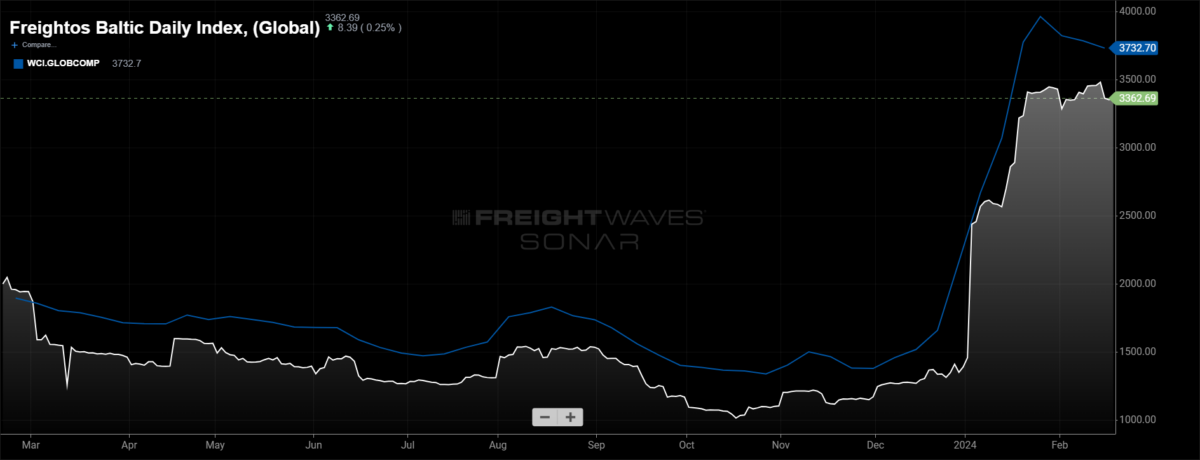
In the first six weeks after the Houthi attacks began, the Global Composite Index from Drewry increased by 170% to $3,732.70 per twenty-foot equivalent unit, which is the highest level the index has seen since September 2022. Likewise, the Freightos Baltic Daily Index – Global showed an increase from the beginning of December through the middle of January.

These rapid increases in spot rates will create a short windfall for carriers with the spot exposure, more than offsetting any increases in costs associated with rerouting around the Cape of Good Hope as opposed to navigating the Suez Canal. Ocean carriers that lean heavier into the contract market will likely not see boosts in a similar fashion as the increases in spot rates are unlikely to create significant or sustained upward pressure on contract pricing, but that won’t deter carriers from trying to generate more revenue. 

Hapag-Lloyd announced a “Peak Season Surcharge” that began on Jan. 21 until further notice for $480 per TEU and $600 per forty-foot equivalent unit.

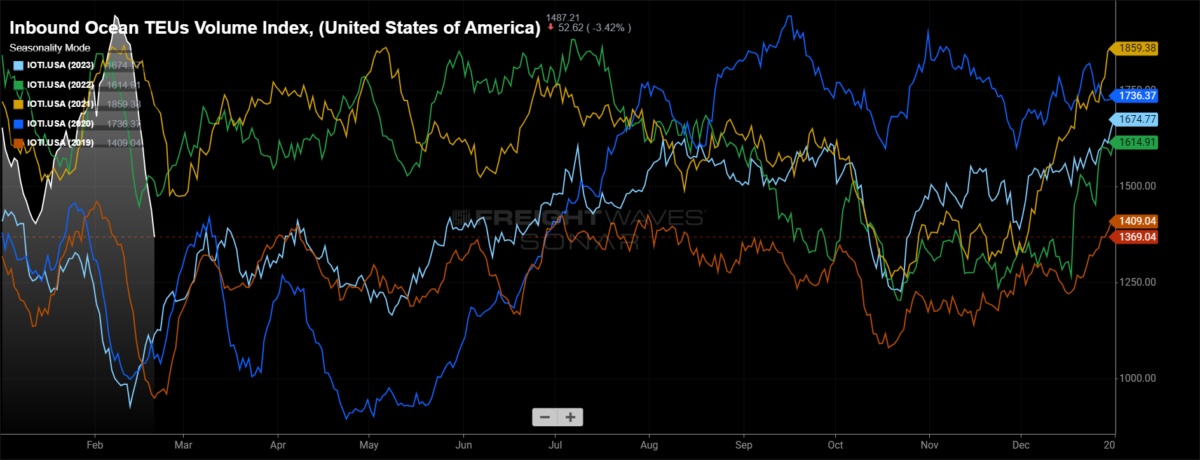
Ocean carriers are able to better deploy capacity for fluctuation to improve pricing conditions, but demand has to be there to justify long-term rate trends. Volumes from all global ports to the U.S. reached elevated levels as the pre-Lunar New Year pull forward was one of the strongest on record.

FreightWaves SONAR: Inbound Ocean TEUs Volume Index for the U.S., 2024 (white), 2023 (light blue), 2022 (green), 2021 (yellow), 2020 (blue) and 2019 (orange)
To learn more about FreightWaves SONAR, click here.

The Inbound Ocean TEUs Volume Index in SONAR reached one of the highest levels of all time ahead of the Lunar New Year holiday. The growth in volume from a year-over-year perspective is a signal that rate increases were appropriate given higher demand and that ocean carriers have reduced capacity.

With the Lunar New Year underway, the questions that are to be answered in coming weeks are how strong is demand following the holiday, and does it provide the footing needed to keep spot rates elevated into the stronger shopping periods of late March and early April?

FreightWaves SONAR: Freightos Baltic Daily Index – Global (white) and Drewry World Container Index – Global Composite (blue)
To learn more about FreightWaves SONAR, click here.

Since the beginning of February, global spot rates have suffered declines. While those declines are not severe, they are an indication that the pricing power experienced throughout January is coming to a close. The Drewry World Container Index – Global Composite has dropped by 6% since its near-term peak of $3,964.18 per FEU in the week of Jan. 25. The Freightos Baltic Daily Index – Global, is down a little over 1% during the same period.

With the Red Sea conflicts continuing and ocean carriers scheduling routes to continue around the Cape of Good Hope well into April, the recovery from the Lunar New Year will be pivotal for the direction in which ocean container spot rates move in the coming months.

The inventory correction cycle is largely in the rearview mirror, but with inventory running at healthier levels, shocks to the supply chain, whether from the demand side or the capacity front, can create pricing environments that change rapidly.

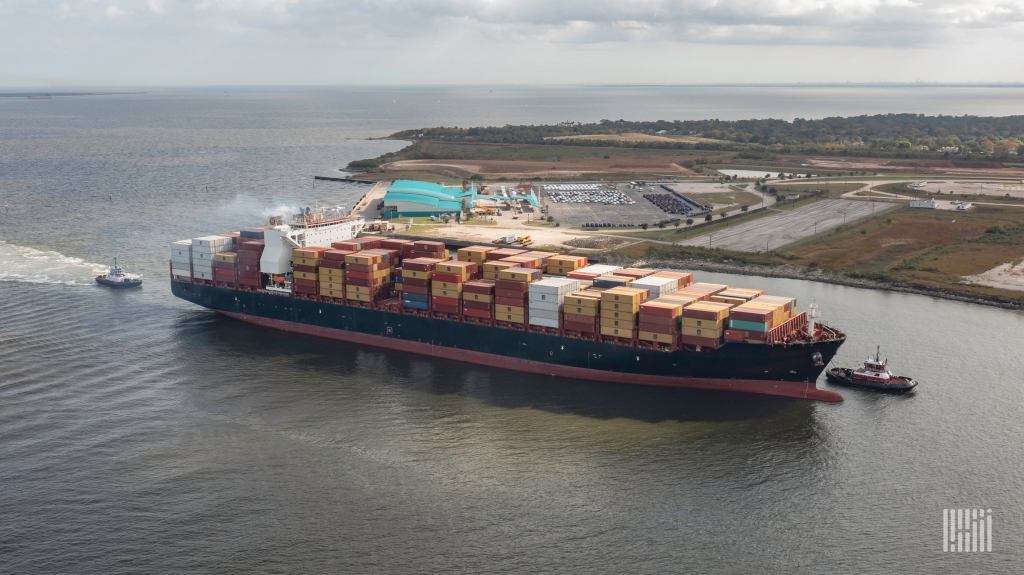
Take me to the ports

people gathered around a desk of computers. Check Call news and analysis for 3pls and brokers

Welcome back to Check Call. Conference season is upon us, and wrapping up conference season is the one and only FreightWaves Future of Supply Chain. If you haven’t yet decided on going or you want to go but are looking for the best deal on tickets, then you’re in luck. Check Call subscribers get a discount. Go here to buy tickets or use CheckCallFSC24 at checkout to get the best deal around. It’s in Atlanta so flights are going to be cheap and plentiful, and all the coolest people are coming so you better too.In this edition: Port roundup and the Teamsters are holding strong.

Gif: Tenor

The nation’s ports are places where very few truck drivers haven’t had to deliver into or pick up from. It’s time to look back and see how the ports performed last year and what the new year brings.

Starting off strong by breaking export records is the Georgia Ports Authority with an all-time high of $49.7 billion for 2023 – a $2.7 billion increase from the record in 2022. The top exports were civilian aircraft ($8.2 billion), motor vehicles ($3.1 billion), turbojets ($2.3 billion), poultry ($1.5 billion) and chemical woodpulp ($1.3 billion). The record-breaking ports were all across the state but most definitely include the heavy hitters of Hartsfield-Jackson Atlanta International Airport, the Port of Savannah and the Port of Brunswick.

Jumping into the future are the ports in Alabama as well as the Port of Cleveland. 

In Alabama, the Port of Mobile is building an intermodal container facility to help with rail connectivity to northern Alabama. Not only that but the port is going to redevelop a portion of an existing CSX facility in Decatur to expedite the new container facility. This is likely not the only major improvement coming to the Alabama ports as the port authority has more than $1 billion in capital projects underway across the state. Well done, Alabama. 

Moving north to Cleveland, we find the port most of us could see from our hotels at the Future of Supply Chain last year. It has received $32 million in both federal and state grants that will be used to modernize the port’s warehouse and upgrade electrical infrastructure. Basically the Port of Cleveland is about to get the biggest glow-up and become too cool for the rest of us. Realistically, though, the current warehouse is over 50 years old. Needless to say, warehousing and warehouse technology have changed just a bit in the past 50 years. Welcome to the 21st century, Cleveland. Happy to have you here. 

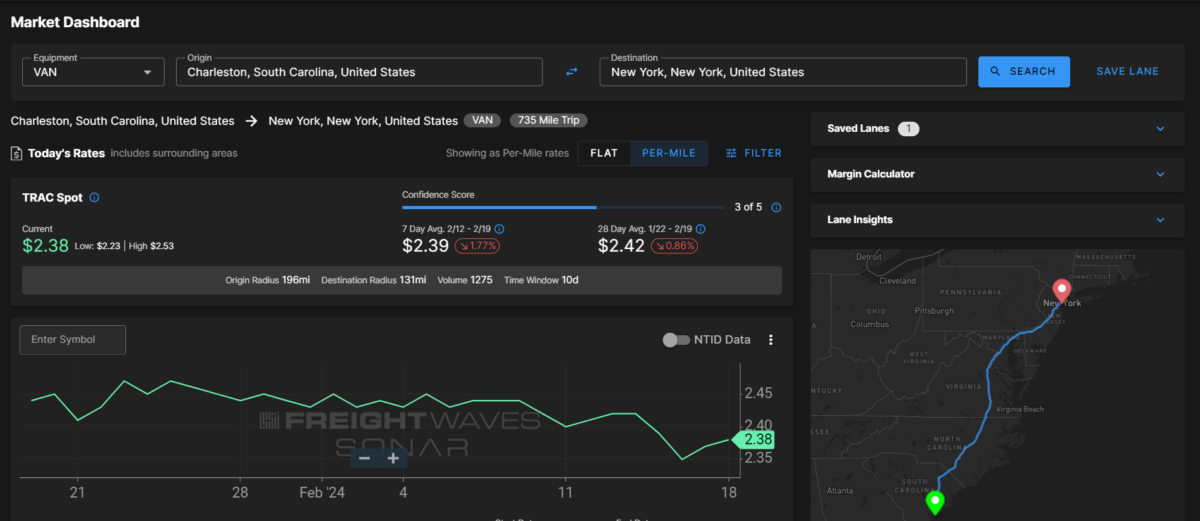
SONAR TRAC Market Dashboard

TRAC Tuesday. This week’s TRAC lane is from Charleston, South Carolina, to the Big Apple. The 735-mile journey up the East Coast is coming in at about $2.39 per mile. The rate per mile is down compared to the past 30 days, which makes sense given that the Outbound Tender Reject Index is at or below 5% in each market. When rejections are in this range, spot rates are typically on par with contracted freight. Not much is getting rejected.

That could change as some truck drivers have decided against hauling freight to New York City. It seems unlikely that this demonstration will have a large effect on the spot market and cause rates to increase, but it’s still something to note in case it becomes a problem for the already tricky-to-cover metropolitan area.

GIF: Tenor

Who’s with whom? The Teamsters have hit the headlines again, taking a strong chunk of the limelight last year, most notably with UPS, Yellow and the longshoremen. They’re back and ready to go for 2024.

First in the beverage world. The Teamsters have been kindly asked not to represent a group of beverage drivers in Wisconsin. There have been many successes for the Teamsters lately, so this action by workers at Keurig Dr Pepper in Wisconsin is surprising, especially considering the decision against Teamsters support was across multiple facilities. However, there is a possibility of a much larger strike in the beverage sector – something to note if there are a lot of beverage shippers on your account Rolodex.

Here are some of the wins for the Teamsters crew. Lately the union has brought home a W at US Foods (higher wages, better health benefits, better safety and pension, etc.) and at Ryder. Ryder workers in Perrysburg, Ohio, voted to be represented by the Teamsters Local 20. 

The beverage-sector question hanging in the balance is Anheuser-Busch. There has been a strike authorized by workers to start March 1, but negotiations are ongoing to hopefully prevent it.

The more you know

War risk exclusions by insurers heighten stakes in Red Sea attacks

Borderlands: Cross-border logistics firms expand operations into Mexico

GALLS Strengthens Commitment to Military and Defense with Strategic Acquisition of LVI

Live on stage: The complex relationship between a trucking job and life

New Jersey law disrupts carrier insurance market

The top three carrier expenses are fuel, maintenance and insurance – things that are crucial to the success of a trucking company but that have seen a drastic uptick in cost the past few years. A new law in New Jersey stands to dramatically increase the insurance cost for carriers. Joe Schreiner, Reliance Partners’ executive vice president of sales, was on a recent episode of WHAT THE TRUCK?!? to break down the implications of the law and its long-term impact on the industry.

“For the companies domiciled in the state of New Jersey, the state is saying you need to pull $1.5 million in liability coverage,” Schreiner said. “It’s going to be interesting to see how this trend goes across the country and how other states and insurance companies are going to respond to this as the majority of carriers are interstate carriers.”

Under the law, any vehicle over 26,000 pounds will have to carry $1.5 million in liability insurance compared to the $750,000 that is standard now.

There are still some gray areas in the law as to whether this applies just to carriers domiciled in New Jersey or if any carrier running in the state needs the additional coverage. That is assuming that other states don’t follow suit, which according to Schreiner is something that could happen sooner rather than later.

The long-term implications of this bill may be running some motor carriers out of business and forcing carriers to take on additional risk as a different way to finance their premiums.

Schreiner says: “The general rule of thumb for a motor carrier is if you have $1 million in coverage and you need another $1 million in coverage on top of that for your entire fleet, you’re looking at 40-60% of your primary auto liability limits are what you’re going to pay in excess. If you have $10,000 a truck for your first $1 million in coverage, you’re looking at $4-$6,000 on top of the $10,000 for the additional coverage.”

Insurance companies are also seeing rates rise as reinsurance and capacity for insurance hardens. “For an insurance company to now be able to go to their reinsurance and have to offer another half a million dollars in coverage, they’re going to have to take on more risk or pay more premiums to be able to offer that high of a limit,” according to Schreiner. 

Within the next year, there is a chance that more states will follow suit as more governments have pushed to raise insurance minimums. That combined with new regulations from the Department of Labor suggests the trucking industry is in for a tumultuous few years.

Click here to learn more about Reliance Partners.

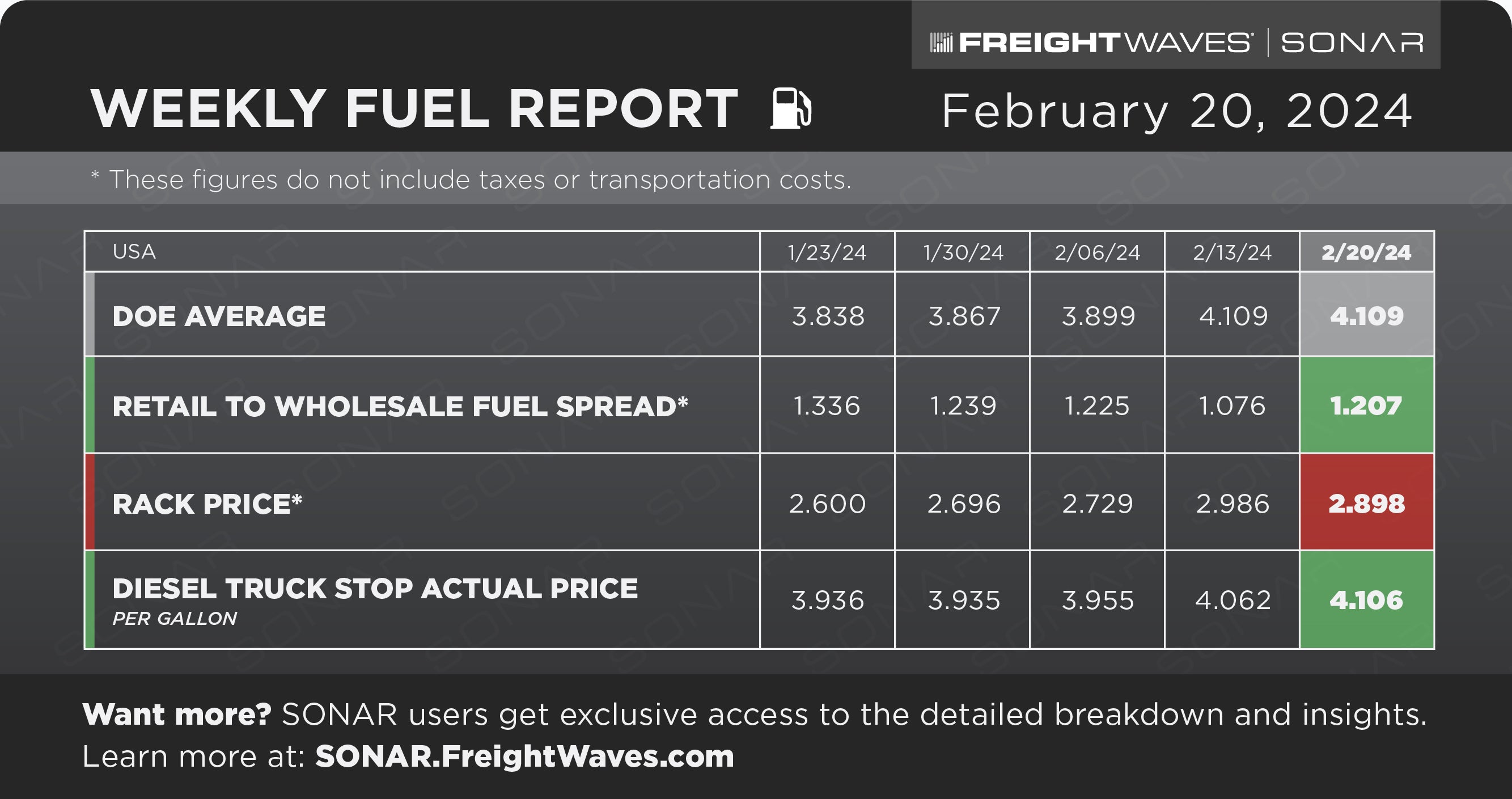
Weekly Fuel Report: February 20, 2024


Learn more at SONAR.FreightWaves.com

Volume weakness at Expeditors continues, but rate of decline slows

Expeditors International’s slide in volume continued in the fourth quarter but showed improvement by the end of the period.

Expeditors (NYSE: EXPD) does not disclose actual volumes in its quarterly earnings report. But the air- and ocean-focused brokerage and forwarder does provide volume changes from the year-ago period.

In North America, airfreight as measured in kilograms was down 6% in October and November 2023 but was up 3% in December. Ocean freight measured in forty-foot equivalent units was down 12% in October, 10% in November and 7% in December.

The end result was that airfreight volume declined 3% for the quarter. Ocean freight was down 10%.

Since no shipment volumes are disclosed by Expeditors, sequential comparisons can’t be made. But comparing the year-on-year declines in Q4 against those of the first three quarters of 2023 suggests that the slide in volumes that went on all year may be coming to an end.

In the third quarter, the year-on-year declines were 14% for airfreight and 15% for ocean. The second-quarter figures were negative 15% and negative 13%, respectively. The first quarter was negative 6% for airfreight and negative 26% for ocean freight.

Expeditors’ earnings per share at $1.09 were down 22% from a year earlier when they were $1.39. According to SeekingAlpha, the $1.09 figure came in 13 cents per share less than consensus. Revenue of $2.3 billion was off by just $10 million.

The reaction to the earnings on Wall Street was swift and negative. At 10:50 a.m., Expeditors’ stock was down 5.67% to $117.12, near the low of the day. In the past 52 weeks, Expeditors’ stock is up 4.4%. Its 52-week high is $131.17, recorded on Jan. 25.

The overall weakness led to significant declines in earnings and revenue. Fourth-quarter revenues of $2.277 billion were down 34% from a year earlier. The cost of transportation secured by Expeditors fell even more, down 38% to $1.51 billion from $2.43 billion. But the amount spent on transportation by Expeditors rose from the third quarter when it was $1.4 billion.

Operating income fell to just under $200 million, down 40% in the corresponding quarter of 2022.  

Expeditors does not have an earnings call with analysts. In comments released alongside the earnings, CEO Jeffrey Musser said Expeditors “continue[s] to face further market uncertainty due to the current conflicts in the Middle East and on the Red Sea.

“Further, volumes and capacity have remained uncertain due to additional capacity recently brought into the marketplace, while shippers have cautiously sought to avoid overextending their inventory levels. These factors created an environment where rates, which had fallen fairly significantly from the pandemic period, stabilized in ocean and, in the case of air, increased in the fourth quarter of 2023.”

In the quarter, salaries and “other operating expenses” declined 18%, down to $564.8 million from $686.3 million. That is significantly less than the decline in revenue.

In the prepared statement, CFO Bradley Powell said the company’s expenses are “still high when compared to our efficiency target and we are working to bring expenses down further.”

Expeditors is “not as efficient as we need to be for the current environment of excess capacity, weak demand, soft rates and economic uncertainty,” Powell said.

More articles by John Kingston

Teamsters ousted at Dr Pepper Wisconsin, face off against Anheuser-Busch

FMC upholds ruling upending current chassis pool system

Ryder continues shift toward less reliance on leasing, talks up Cardinal

Delta Cargo’s DeliverDirect offers ‘e-commerce delivery at the speed of flight’

delta cargo

In the e-commerce shipping sector, the efficient use of time can significantly impact business success. In an industry where time often equals money, moving goods quickly and reliably is crucial for customer retention and cost optimization.  

In an effort to address some of the frequent pain points of small parcel shippers, Delta Cargo and SmartKargo have partnered to create DeliverDirect, a practical solution for small parcel shippers. 

Delta Cargo’s DeliverDirect, powered by SmartKargo, provides “e-commerce delivery at the speed of flight” and is the first offering of its kind by a domestic US airline.

Chris Grey, Vice President of Business Development at SmartKargo, previously noted that traditional carriers typically have slower time in transit, sometimes taking as long as seven days for a ground movement. By using DeliverDirect, shippers can inevitably benefit from Delta’s unparalleled operational reliability. 

By tapping into a network of alternative carriers, shippers can also mitigate risks associated with disruptions in the logistics industry, ensuring a more resilient and adaptable supply chain.

In an era where consumers expect delivery faster than ever before, DeliverDirect is set to emerge as a transformative force in small-package delivery. 

How DeliverDirect works

Delta Air Lines operates a vast domestic network, with over 2,500 flights daily to numerous destinations, including major cities like New York and Los Angeles. 

“The space already exists on passenger aircraft,” Grey said. “We utilize that existing available space and put our customers’ small-parcel packages in the belly space of Delta’s passenger aircraft.”

This approach enables DeliverDirect to deliver packages to end customers quickly, with 1-day, 2-day, 3-day and other shipping solutions available.

Currently available nationwide for small parcel shippers with goods weighing up to 25 pounds, DeliverDirect serves various industries, including retail, pharmaceuticals, manufacturing and related sectors.

DeliverDirect positions itself as a partner to its customers, ensuring proactive communication throughout the entire package journey, facilitated by customizable technology that offers full visibility from pick-up to drop-off. 

“Small package shipping has always been on our radar and this innovation provides a transparent and simple option for shippers,” shares Alison Ricker, Managing Director of Global Sales at Delta Cargo.

Unlike traditional shipping providers, DeliverDirect allows continuous tracking of packages once in transit, including in the air. This advanced technology enables shippers to track the entire package journey from warehouse departure to the customer’s doorstep.

Shippers can also customize pick-up times, send notifications to end-consumers, receive proof-of-delivery photos, and more.

DeliverDirect prides itself on cost simplicity and transparency, further distinguishing itself by avoiding unnecessary or accessorial fees. This straightforward approach means no surprise costs or additional reconciliations. DeliverDirect also operates without the complexities of zone-based pricing, relieving shippers of the need for zone management and offering a streamlined and clear-cut shipping experience.  

Expanding delivery options beyond conventional carriers can provide businesses with heightened flexibility and efficiency in their supply chains. Alternative partners like DeliverDirect often offer specialized services that surpass the capabilities of the status quo.

Investing in partnerships that prioritize time and cost savings, without compromising quality of service, provides a foundation for effective growth strategies moving forward. The customer remains the driving force in this dynamic landscape, emphasizing the enduring importance of swift and efficient delivery.

To learn more about Delta Cargo DeliverDirect, visit its website.

White Paper: Q1 2024 Carrier Rate Report

FreightWaves’ Carrier Rate Report — presented in partnership with Trimble — provides a review of the previous quarter and a forecast for the coming months. Featuring responses from a carrier survey alongside SONAR data, the report is designed to provide intelligence that carriers can use to inform their strategies in the months ahead.

Key areas of exploration include:

  • A Coming Capacity Crunch?
  • Q4 2023 Earnings Roundup
  • Cause for Bullishness Ahead
  • FreightWaves Carrier Survey Takeaways

Complete the form below to download your complimentary copy.

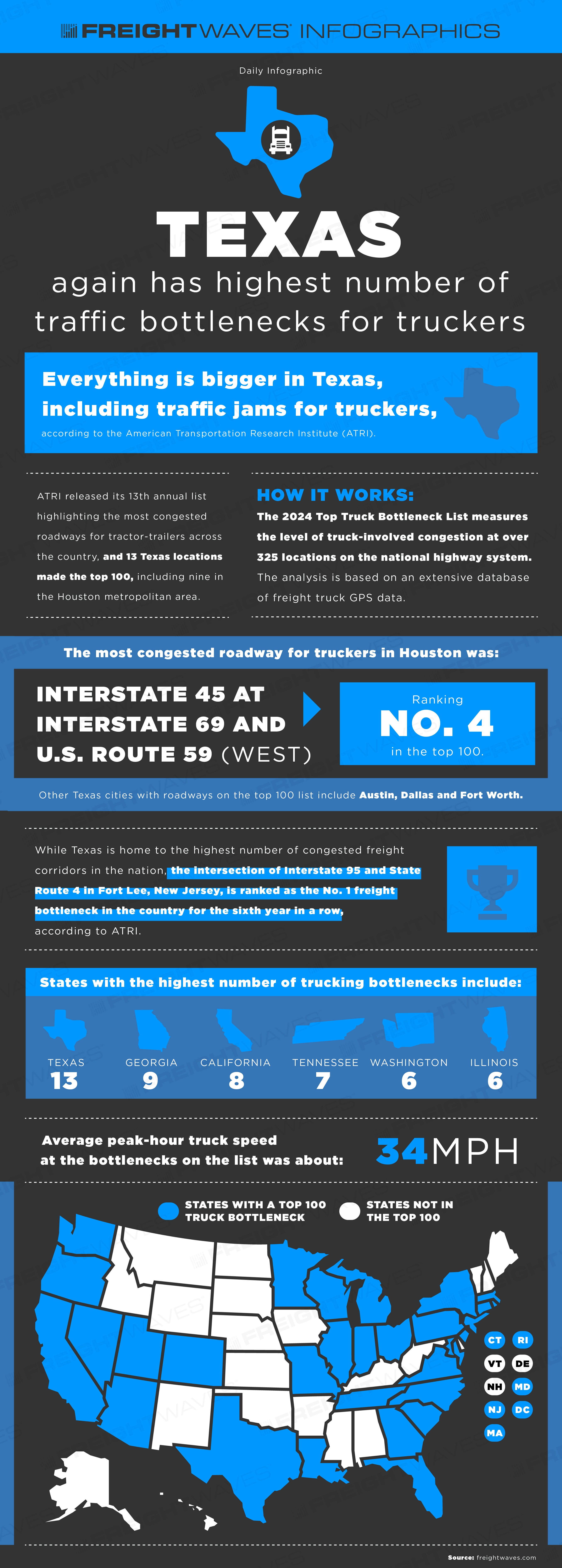
Daily Infographic: Texas again has highest number of traffic bottlenecks for truckers


To view more FreightWaves infographics, click here