Trade group wary of unfunded mandate to curtail fentanyl smuggling

Blue sign for AirCargo 2024 conference

LOUISVILLE, Ky. —  The Airforwarders Association is interacting with more international organizations to gain wider influence for issues important to U.S. logistics providers. Other priorities this year involve funding to improve airport cargo flows and preventing the White House and Congress from putting the onus on logistics providers for stopping cross-border shipments of fentanyl.

Executive Director Brandon Fried expressed concern during the general membership meeting here last week that the federal government may try to place an unfair level of responsibility on freight forwarding companies to identify and stop illegal shipments of the deadly opioid fentanyl, precursor chemicals and production equipment.

The White House last year promised greater effort to disrupt the trafficking, distribution and sale of fentanyl, including by stopping small packages with fentanyl being shipped in master consolidations into the United States. U.S. Customs and Border Protection is expanding efforts to get members of the trade community to voluntarily provide data that can help law enforcement identify, inspect and intercept suspicious packages.

The agency’s strategy for combating synthetic drugs includes working with express carriers, airlines and logistics companies to share information about suspicious commodities, potential transit routes and other data. It is offering training to customs brokers, carriers, importers and exporter trade associations to teach them how to identify primary ingredients used to make illicit synthetic narcotics.

“We need to be concerned about unfunded government mandates,” said Fried. “That’s not to say we’re not concerned [about the fentanyl crisis]. But when the White House issues proclamations saying transportation intermediaries could be the solution to the problem and members of Congress say the same thing, we agree we want to be helpful, but at the same time we don’t want unfunded mandates saying, ‘Hey, freight forwarders, you know all about those packages. You should be checking them for fentanyl before they come into the United States.’ For us, that’s a nonstarter.”

International advocacy

AfA officials say it’s important to engage globally because many government regulations and actions overseas, including for cargo security and hazardous material handling, have an increasing impact on freight intermediaries based in the U.S. that manage imports and exports. The trade group also hopes to learn how colleagues are adapting to changing conditions and give input on policy and standards being developed by international bodies.
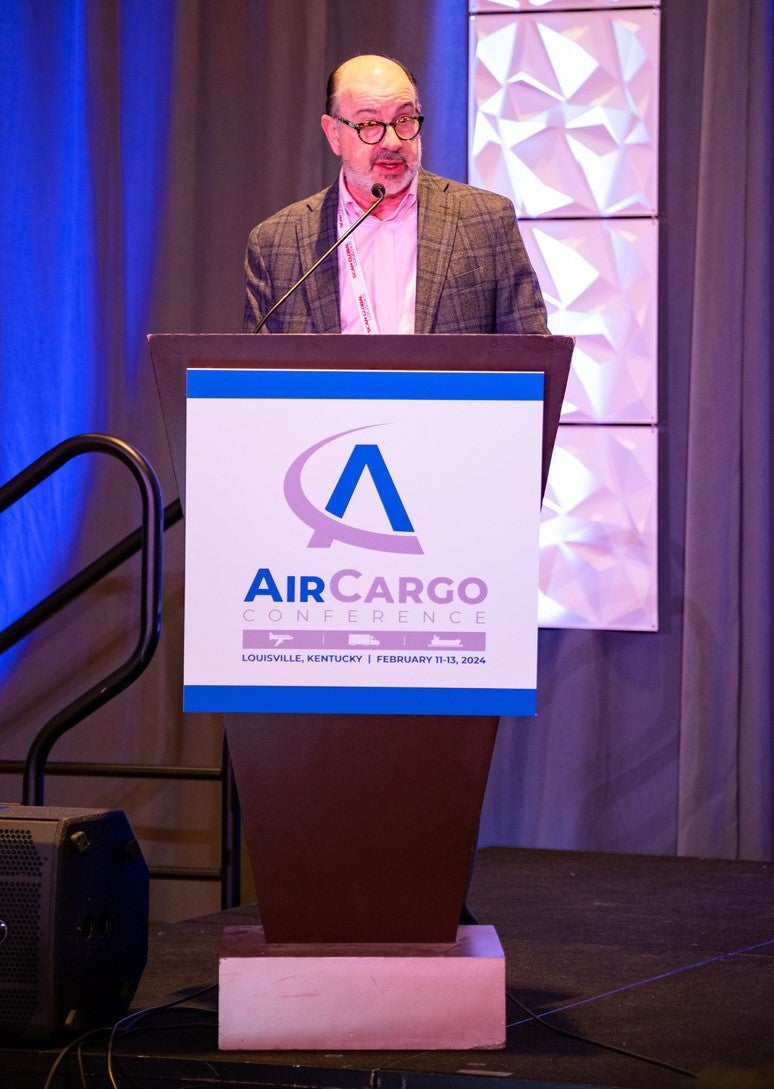
AfA Executive Director Bandon Fried. (Photo: AfA)

“It means I’m going to be spending a lot of time on airplanes, but it’s for a good cause,” Fried said in an interview during AirCargo 2024, a joint conference with trade associations representing airport executives and express motor carriers.

Last year Fried attended the Transport Logistics conference in Germany, the International Air Transport Association’s World Cargo Symposium in Istanbul, the International Federation of Freight Forwarders Associations’ (FIATA) World Congress in Brussels and The International Air Cargo Association’s executive summit — also in Brussels.

Similar trips are planned this year, starting with IATA’s annual cargo event next month in Hong Kong. Fried is scheduled to speak in April to the Canadian International Freight Forwarders Association in Toronto and plans to bring the entire board to Panama in September for the next FIATA World Congress.

The Airforwarders Association and the National Customs Brokers and Forwarders Associations of America (NCBFAA) joined FIATA in January through a joint membership and now hold one of two U.S. board positions in the organization. AfA is also participating in various FIATA subcommittees.

Another focus for the AfA is addressing the challenge of truck throughput at airports, where outdated infrastructure and lack of digital communications contribute to backlogs of more than two hours to transfer cargo in big cities.

The Airforwarders Association is pushing to get dedicated federal funding for cargo improvements at airports. Together with the NCBFAA, it is pushing legislation within the Federal Aviation Administration’s reauthorization bill that would require the Government Accountability Office to conduct a study that assesses the nation’s needs. With no clear timetable on when the FAA bill will come up for a floor vote, Sens. Maria Cantwell, D-Wash., and Michael Braun, R-Ind., are making direct requests to the GAO to study cargo infrastructure.

“We want funds granted by the federal government to address these cargo areas that haven’t had any substantial investment in infrastructure and technology in years. We are highly optimistic that once that study is completed that more legislation will be driven from it because people will understand the need and the adverse impact it’s having on commerce,” said Fried.

Super Bowl conflict

The tripartite conference overlapped with the Super Bowl for the third consecutive year, a circumstance that potentially dampened attendance because many people want to enjoy parties with friends and neighbors instead of being on a road trip.

Fried said conference organizers have made the best of a difficult hand by hosting watch parties for several hundred attendees.

“When we signed the agreement with Omni Hotels four years ago, the NFL didn’t have a 17-week season. And then they expanded it and put the Super Bowl right on the dates we were going to have the AirCargo conferences in 2022, 2023 and 2024,” he said in the interview.

AirCargo 2025 will be held next March at a new Loews Hotels in Arlington, Texas, situated between the Dallas Cowboys and Texas Rangers’ stadiums, that is still being finished. 

And there will be no conflict with the Super Bowl. 

Sea-air routes gain as bypass option for Red Sea shipping delays

Air cargo market: From ‘doom mongering’ to stability

Live on stage: The complex relationship between a trucking job and life

A truck driver’s life on the road has hit the stage with a drama by David Proctor, who gave up life behind the wheel to focus on being an actor and playwright.

“Grabbing the Hammer Lane:  a Trucker Narrative” is the end result of that transition by Proctor, and praise for the approximately one-hour, one-person play has been extensive.

The Orlando Performer, a website devoted to theater in Central Florida, said this of the play: “Patrons of this show should be prepared to feel a wide range of emotions. In the beginning, there is gentle humor and subtle light jokes scattered throughout. [Later], emotions soar between anger and sadness. It is genuinely moving. This show deals with addiction, forgiveness and loss and has a moral of ‘Tell the ones you are close to, that you love them.’”

The Roswell Cultural Arts Center outside Atlanta, which recently had Proctor perform the play, said he delivered a “spectacular performance that detoured life in the fast lane into the heart. This one-act play showcased rebellion, redemption, and the powerful roar of an 18-wheeler, captivating audiences with themes of rejection, regret, joy, and redemption.”

In the background to all of that is life behind the wheel, a job Proctor had for about 30 years.

Starting with FedEx, followed by many

In an interview with FreightWaves, Proctor said he began driving in 1996 with FedEx (NYSE: FDX). A long series of different employers followed — not unusual in the business — but Proctor retired in 2022 from Oakley Transport, based in Lake Worth, Florida. He said he had been a company driver his entire career.

Proctor said COVID killed both his parents within two months of each other. The end result, he said, is that “I took a long, hard look at what it cost me being on the road so long and the things I missed.”

His wife asked him if he wanted his children to be his only legacy, “or was it something else I wanted to leave behind as an artifact?”

The result was Proctor’s departure from the road and a change in focus, to writing “Grabbing the Hammer Lane.” He said he wrote the play in about three months and then “workshopped” it with a friend from the theater faculty at Georgia’s Kennesaw State University.

That work behind him, Proctor said the play was ready to be introduced. Its first performance was at the Orlando Fringe Festival last May.

Proctor said the festival is one that “showcases all the different genres, comedy, musicals, everything.” The dramatic nature of “Hammer Lane” meant that Proctor and his wife, who served as the producer, didn’t know what the reaction would be. Not to worry: It was named the best solo drama of the festival for 2023.

“We had folks coming out of the theater making comments like, ‘Man, I thought it was going to be about trucker stuff, but I was really surprised,’” Proctor said.

That performance was successful enough that Proctor was asked to repeat his performance in January at FestN4, which is produced by the Orlando Fringe Festival. It was that performance that led to the review by The Orlando Performer.

While the play may not be about trucking per se, the industry is never far from the action.

Proctor said when the theater goes dark, the audience can hear the sound of CB chatter, with the radio voice reaching out to “all my fellow road warriors.” The voice urges drivers to “grab the hammer lane,” but also cautions that if they are fortunate enough to have their parents still alive, “Give them a call today. Don’t put it off.”

Proctor is blunt about mental health challenges facing drivers. “It can be a very lonely existence,” he said. “There’s about 3.5 million truckers on the road today, and about 30% of them admit they suffer from some kind of depression because of the time spent away from family.”

Proctor said the play is “semi-autobiographical, because some of it does reflect my experiences on the road.”

As the actor, he plays two parts: a middle-aged truck driver named Matt, and Matt’s father. 

“Trucking is a direct rebellion by Matt against his father’s expectations,” Proctor said. “His father really wanted him to go in a different direction. And they have a falling out over it.”

Complicating matters is that Matt has an addiction: gambling. Other family secrets are revealed, and the various forces pulling at Matt eventually lead him to therapy, “to help him understand what decisions he has made that directed the course of his life, and the contentious relationship he has had with his father,” Proctor said.

Give my regards to close to Broadway

It may not be Broadway, but “Hammer Lane” is headed to New York. It will be one of a series of one-person performances produced during the spring season at United Solo on 42nd Street, one night only on April 11.

“Hammer Lane” is not likely to be the last play by Proctor with trucking as a theme. He said he is interested in “the crossroads between the theater and the trucking industry.”

“You normally don’t see the life and compelling stories of truckers reflected on stage,” Proctor said. “So this is a niche that I’m identifying, to develop a series of compelling plays that deal with life on the road.”

More articles by John Kingston

Teamsters ousted at Dr Pepper Wisconsin, face off against Anheuser-Busch

FMC upholds ruling upending current chassis pool system

Ryder continues shift toward less reliance on leasing, talks up Cardinal

Air Van acquires fellow 3PL G&C Cartage

Two white, last-mile trucks on a highway

Third-party logistics provider Air Van announced Monday it has acquired fellow Jacksonville, Florida-based company G&C Cartage.

Founded in 1971, G&C Cartage provides warehousing and transportation services to clients out of a lone facility with more than 35,000 square feet of space. The company recently underwent an overhaul, allowing it to reduce costs by more than one-third while doubling profitability.

Financial terms of the transaction were not provided.

Air Van said the additional space will allow it to achieve current growth initiatives and better serve its freight forwarding clients.

“In a market that has experienced drastic changes and uncertainty since the pandemic, the goal is to expand offerings and become the most efficient and reliable resource for customers,” a news release said.

Air Van specializes in final-mile delivery, in addition to providing transloading, consolidation and deconsolidation services, regional trucking, drayage, and short-term storage out of its customs-bonded facility.

More FreightWaves articles by Todd Maiden

Trump-supporting truckers boycott loads to New York City

Some truck drivers who support former President Donald Trump said they are refusing loads to New York City to protest the civil fraud judgment there that fined Trump $355 million last week.

In a video shared Friday on X by a driver known as Chicago Ray, the trucker said he had spoken to other truck drivers who also said they would refuse loads to the city.

“I’ve been on the radio talking to drivers for the last hour, hour-15 minutes. I’ve talked to at least 10 drivers. They’re going to start refusing loads in New York City starting Monday,” said Chicago Ray, who has 241,000 followers on X.

On Monday morning, Chicago Ray posted another video on X reiterating his support for Trump and boycotting loads to New York.

“I’m not going to encourage you, but if New York City is going to have a judge’s ruling like they’re ruling … I’m just saying I stand with Trump. I’m one of the millions of truckers that stand with Trump,” Chicago Ray said.

The call to boycott loads to New York City comes after Judge Arthur Engoron’s verdict on Friday that ordered Trump to pay $355 million in damages in the fraud case brought by the New York’s attorney general office. The judge also ruled that Trump is barred from doing business in New York for three years, and his sons Donald Trump Jr. and Eric Trump are barred for two years.

Trump posted support for the boycott on several social media platforms, including X and Truth Social.

It’s unclear how widespread the boycott will be or what impact it might have on deliveries to the city.

Chicago Ray’s videos seemed to gain some traction. His original video had over 7 million views but was deleted over the weekend. As of Monday morning, “Boycott NYC” and “Truckers for Trump” were trending on X.

Chicago Ray isn’t the only truck driver who has voiced opposition to the civil fraud ruling.

“I vow that I will not make one delivery to New York. NONE! Who’s with me? Truckers for Trump!” an account called The Disrespected Trucker tweeted on Friday.

Zayy The Truck Driver also posted on X that he would not be making deliveries to New York City. 

“I’ve been to NYC plenty of times, running shuttle routes from Atlanta to several breweries in NYC and Brooklyn. I stopped for two reasons; hellish driving and Covid restrictions, and now I have more reasons to never return there,” Zayy wrote. “I say this with absolute conviction, when the government continues to impose regulations on truckers, I don’t want to hear from you truckers who believe this boycott will do nothing.”

If the trucker’s boycott takes hold, it would show up in FreightWaves’ SONAR platform in several key data points. 

SONAR’s outbound tender reject index would show a tightening of capacity for loads originating from New York, while the inbound tender reject index would show a tightening of capacity for loads headed into New York. 

SONAR’s TRAC lane rate for Columbus, Ohio, to New York City would also show an increase in the average price per mile to move a dry van.

FreightWaves SONAR charts, inbound and outbound tender reject indexes.

The inbound and outbound tender reject indexes, and the TRAC rate for Columbus to New York City, show nothing as of noon on Monday.

Truck drivers supporting former President Donald Trump have reportedly turned down shipments to New York City. (X/@Chicago1Ray)

Weekly NTI Update: February 19, 2024


Learn more at SONAR.FreightWaves.com

Daily Infographic: When and where does distracted driving occur?


To view more FreightWaves infographics, click here

War risk exclusions by insurers heighten stakes in Red Sea attacks

a photo of a crude tanker

In early February, oil markets were lulled by hope of a now-unlikely ceasefire in the Israel-Hamas war. But a recent string of Houthi attacks have reignited concerns about the Red Sea crisis, raising the floor for tanker rates.

The Iran-aligned Houthis claimed responsibility for Friday’s attack on oil tanker M/T Pollux, which was bound for India. No injuries were reported.

This and other recent Houthi attacks, which followed a brief pause in early February, led major maritime insurer Steamship Mutual to issue an exclusion for all war risk claims in the Indian Ocean, Gulf of Aden and Southern Red Sea. 

According to S&P Global Commodity Insights, any new insurance issued for Red Sea routes could impact oil prices by $1 or more per barrel. The alternative of rerouting around Africa’s Cape of Good Hope is arguably less attractive, resulting in rising operational costs as well as higher vessel utilization.

Very large tankers see massive rate growth

While many tankers have already chosen the latter option, some have persisted in braving the Red Sea. Per data from Clarksons, Red Sea arrivals of crude tankers are currently 50% to 60% of where they were in the first half of December.

Clarksons also reported that the average rate on a very large crude carrier (VLCCs, or tankers that carry 2 million barrels of oil) going from the Middle East to China has risen to three-month highs at $66,600 per day. The average rate for VLCCs in Q1 thus far has tracked closer to $41,000 per day.

This growth has been incredible, given that VLCC rates averaged under $21,000 per day last quarter and a measly $8,700 per day in Q3.

Still, VLCC rates are not strangers to such extreme rate swings: In 2019, a series of attacks in the Middle East and U.S. sanctions on Chinese tanker owner Cosco spiked rates from $25,000 per day to over $150,000 per day over a six-month period.

Analysis from Bank of America reports that VLCC rates are expected to hold between $40,000 and $50,000 per day in March, before dropping to $35,000 to $40,000 over the second quarter.

Tanker demand could coast on oil market shakeup

Rising oil demand, however, might sustain tanker rates at current highs going forward. 

Oil prices have been largely unmoved by developments in the Red Sea so far, as fears of weak fundamentals and the ever-looming threat of a recession have outweighed geopolitical risks. In late January, prices refused to budge in response to a Houthi strike on a product tanker.

But some analysts are arguing that pricing targets are skewed by seasonal weakness. Per data from Standard Chartered, January’s global oil surplus weighing on prices is a natural occurrence. In fact, only three of the past 20 years have seen January report a net inventory draw.

StanChart notes that January’s surplus is far less than in previous years: Compared to the average build of 1.2 million barrels per day — and certainly 2023’s near-record build of 3.4 million — 2024 has seen only a meager build of 300,000 barrels per day.

In short, StanChart and the Energy Information Administration argue that February is headed for a considerable deficit that should shock markets back into bullishness.

When this deficit is recognized, it is unclear who will rush to rebalance it. U.S. exports of crude oil are already up 21.6% over 2023 in the year to date, shipping 24.6 million barrels per day. According to domestic producers, the rate of output growth is expected to slow in 2024 after a gangbusters 2023.

Saudi Arabia recently canceled plans to expand its oil production capacity, largely due to its discontent with stubbornly low prices but also because of a desire to withhold supply for future domestic demand.

The crackdown on Russia’s shadow fleet continues, as the U.S. imposed sanctions on four entities in early February for violating the G7’s price cap on Russian crude. Bank of America analysts note that such sanctions are likely to spur demand in the legal tanker market. A senior official in the U.K.’s price cap enforcement agency stated that “what we want to do is force volumes back into the G7 fleet.”

So, while tanker rate growth is currently expected to be transitory, it would not be a surprise if these gains were here to stay longer term.

Ports roundup: Georgia breaks export record with almost $50B in trade

The Georgia Ports Authority sets export record for the third year consecutive year; the Alabama Port Authority and CSX partner to launch a new intermodal facility; and the Port of Cleveland receives $32 million to modernize its facilities.

Georgia breaks export record with almost $50B in trade in 2023

For the third consecutive year, exports from the state of Georgia hit an all-time high, reaching $49.7 billion in 2023, according to the state’s Department of Economic Development.

The previous record for exports was $47 billion set in 2022. Top exports included civilian aircrafts ($8.2 billion), motor vehicles ($3.1 billion), turbojets ($2.3 billion), poultry ($1.5 billion) and chemical woodpulp ($1.3 billion).

“For the third year in a row, Georgia has broken every record when it comes to exports, bringing billions of dollars to communities all across the state,” Gov. Brian Kemp said in a news release. “With an estimated 87% of those exports coming from small businesses, these numbers are further evidence of just how Georgia means opportunity for all. International trade touches every county in the state, supporting jobs in logistics, manufacturing, agriculture and more.”

During 2023, the state’s top export markets were Canada ($7.6 billion), Mexico ($4.8 billion), China ($3.9 billion), Germany ($2.6 billion) and Singapore ($2.2 billion).

Georgia ranked seventh in the U.S. for dollar value of trade in 2023, facilitating more than $186 billion. Georgia ranked 12th in the country for dollar value of exports.

Trade facilities across the state include Atlanta International Airport, the Port of Savannah and  the Port of Brunswick. 

Pat Wilson, commissioner of the state’s department of economic development, said they work around the world to market Georgia products and Georgia-made goods.

“These representatives work with our Georgia-based export specialists to ensure that Georgia businesses have an advantage and our economy remains strong,” Wilson said.

Alabama Port Authority and CSX partner to build intermodal container facility

The Alabama Port Authority recently announced it will build an intermodal container facility to provide improved rail connectivity with the Port of Mobile and the northern parts of the state.

The newest intermodal container transfer facility (ICTF) is a partnership between the port authority and CSX Transportation. It will be built in the city of Decatur, according to a news release.

The Port of Mobile will redevelop a portion of an existing CSX facility in Decatur to help expedite the project. Another ICTF was announced in the city of Montgomery in 2022. Both projects are scheduled to be completed by 2026.

The ICTF at the Port of Mobile provides access to five Class I freight railroads and four shortline railroads.

“This project demonstrates our commitment to foster growth, connect markets and propel economic progress for the region,” Maryclare Kenney, CSX’s vice president of intermodal and auto, said in a statement. “The facility’s strategic location improves multimodal flexibility throughout the state and creates sustainable, dynamic, rail-to-truck transportation solutions for our customers.”

The Alabama Port Authority currently has more than $1 billion in capital projects underway across the state, including expanding the container terminal at the Port of Mobile and a project to deepen and widen the Mobile Ship Channel.

Other planned investments include constructing an interterminal connector bridge to create on-dock rail access at the Port of Mobile’s container terminal, as well as modernizing the port’s general cargo piers.

Cleveland port secures $32M for upgrades, modernization projects

The Port of Cleveland recently received $32 million in federal and state grants that it will utilize to modernize the port’s largest warehouse and upgrade electrical infrastructure at its general cargo terminal.

William Friedman, the port’s president and CEO, said the investments were critical to the port’s continuing operations, as well as sustainability.  

“These initiatives stand as a testament to our commitment to sustainable practices,” Friedman said in a news release. “True environmental stewardship requires translating words into meaningful, concrete actions.”

Part of the funds will be used for modernizing the Port of Cleveland’s Warehouse A, which is over 50 years old. (Photo: Jim Allen/FreightWaves)

The grants include $27.2 million from the U.S. Department of Transportation and $4.9 million from the Ohio Department of Transportation’s Maritime Assistance Program.

The funds will be used for modernizing the port’s Warehouse A, which is over 50 years old. The upgrades include adding structural steel repairs, a new overhead crane, window replacements, new concrete slab, updated lighting and a new roof. 

Funds will also be employed to develop an electrification master plan and installation of a new terminal electric feed at the port, in collaboration with Cleveland Public Power.

The latest funds are part of more than $93 million invested in the port’s infrastructure since 2015, with more than 75% of it covered by state and federal grants. The goal is to achieve net-zero greenhouse gas emissions by 2050, making Cleveland the first Great Lakes port to adopt such an ambitious plan, Friedman said.

“Through these measures approved today, we are actively decarbonizing and forging a path toward a greener and more sustainable future,” Friedman said.

More articles by Noi Mahoney

Border bridges blocked as former rail workers seek back pay

329 layoffs hit freight-related firms in Texas

Goodyear Tire ordered to pay $4M in back pay to Mexican workers

Borderlands: Cross-border logistics firms expand operations into Mexico

Borderlands is a weekly rundown of developments in the world of United States-Mexico cross-border trucking and trade. This week: Cross-border logistics firms expand operations into Mexico; Texas State Highway 130 toll road truck traffic up over 9%; Karat packaging opens new distribution facility in Arizona; and Pirelli opens Mexico training center, hits 50M-tire milestone.

Cross-border logistics firms expand operations into Mexico

Doubling down on nearshoring trends south of the border, Arrive Logistics and BlueGrace Logistics recently announced the opening of their first offices in Mexico.

Arrive’s new location in the Mexican city of Guadalajara is an 18,000-square-feet facility that will house both business development and carrier-focused teams specializing in cross-border solutions. The office will also include members of Arrive’s global services team and technology organization.

Guadalajara is in central western Mexico, about 330 miles from Mexico City.

Officials with Arrive Logistics said increased trade between the U.S. and Mexico has raised demand for localized resources to service the growing number of companies establishing manufacturing and transportation operations in the country.

Mexico was the top overall U.S. trading partner for 2023, with commerce between the two countries totaling $798 billion.

Jess Billedo, Arrive Logistics’ general manager of Mexico, will lead the Guadalajara office. 

“We look forward to strengthening relationships with local partners and providing a seamless connection to our entire North American operation at Arrive,” Billedo said in a news release

Austin, Texas-based Arrive Logistics provides freight brokerage, multimodal transportation and technology services, with 1,700 employees, 6,000 customers and 70,000 carriers in its network.

The Guadalajara office is Arrive Logistics’ second international location. The company opened an office in Toronto last year. Arrive has eight total locations across North America.

Florida-based BlueGrace Logistics also recently announced it has opened its first Mexico logistics center, which will also be located in Guadalajara.

BlueGrace’s Mexico logistics center will support cross-border freight services for full truckload, less-than-truckload, refrigerated, flatbed and intermodal, as well as managed logistics outsourcing.

Officials for BlueGrace said the Guadalajara location is aimed at the growing demands of shippers who continue to adopt nearshoring strategies.

“We’re excited to help our customers with their cross-border logistics needs and have begun facilitating the movement of freight in-and-out of the region,” Bobby Harris, BlueGrace Logistics founder and CEO, said in a news release. “Our bilingual team understands the local Mexico transportation authorities and regulations to help customers thrive in moving cross-border shipments.”

BlueGrace serves over 10,000 customers annually through its platform that provides connectivity with more than 250,000 carriers. BlueGrace is part of the technology portfolio of Warburg Pincus, a global private equity firm.

Texas State Highway 130 toll road truck traffic up over 9%

Truck traffic on the Texas State Highway 130 toll road increased 9.5% year over year (y/y) to 3.5 million transactions last year, compared to 2022, according to the company that operates the public-private thoroughfare in the Lone Star State.

Overall, SH 130 Concession Co. recorded 12.6 million vehicle transactions last year, a 10% y/y increase.

“Strong population growth throughout the central Texas region combined with an uptick in commercial and residential development directly along the SH 130 Corridor continues to lead more drivers to choose our roadway,” Adam Hesketh, CEO of SH 130 Concession Co., said in a news release.

State Highway 130 runs 91 miles through central Texas. Buda, Texas-based SH 130 Concession operates a private toll road that runs along a 41-mile stretch of the highway from just southeast of Austin south to Seguin, a town about 30 miles east of San Antonio.

The current rate for a typical tractor-trailer on the SH 130 Corridor with an electronic toll tag is $37.87.

SH 130 Concession Co. recently partnered with Caldwell County on a Department of Transportation grant application to build a travel plaza and truck parking facility along the roadway. The grant will provide $23 million to develop the project.

“As the growth in central Texas continues to accelerate, the company is committed to supporting the communities it serves through enhanced partnerships with economic developers, local stakeholders and regional organizations,” Hesketh said.

Karat packaging opens new distribution facility in Arizona

Karat Packaging Inc. recently announced it has signed a lease agreement for a 44,000-square-foot distribution center in Mesa, Arizona.

Karat (Nasdaq: KRT) is a specialty distributor and manufacturer of disposable foodservice products and related items. The facility is scheduled to open in the second quarter of 2024.

Karat also announced an expansion of its national sales force, with the addition of five sales representatives to further penetrate key U.S markets in the South, Midwest and Pacific Northwest.

“Our new distribution center will enable us to more efficiently serve customers in Arizona and New Mexico and enhance distribution productivity, as we continue to penetrate into this region,” Alan Yu, Karat’s CEO, said in a news release.

Chino, California-based Karat Packaging was founded in 2000. The company has nine facilities across the country and employs more than 700 workers. 

Pirelli opens Mexico training center, hits 50M-tire milestone

Pirelli recently celebrated the production of 50 million tires at its Silao plant in Guanajuato, Mexico. The manufacturing facility serves both local and North American markets, specializing in tires for various passenger vehicles.

Since the Silao factory’s inauguration in 2012, Pirelli’s total investment in the plant amounts to more than $900 million. Annual production has grown from a capacity of 1.5 million to 8.5 million tires. The facility employs about 3,200 workers.

The event also marked the opening of Pirelli Mexico’s first training center, aimed at developing local talent. The 10,000-square-foot center will offer courses on safety, quality, productivity, technology and environmental care.

“The opening of the new training center will boost the competitiveness of our Mexican employees,” Enrico Verdino, CEO of Pirelli Mexico, said in a news release. 

Milan, Italy-based Pirelli has 18 production plants and employs 31,000 people worldwide. The company produces tires for cars, motorcycles and bicycles.

More articles by Noi Mahoney

Border bridges blocked as former rail workers seek back pay

329 layoffs hit freight-related firms in Texas

Goodyear Tire ordered to pay $4M in back pay to Mexican workers

Dime Box, Texas Post Office 77853

Dime Box Texas Post Office

The Dime Box, Texas Post Office serves ZIP Code 77853. Photo by Jimmy Emerson, some rights reserved. Photo shared under the Creative Commons License.

Dime Box Post Office
1017 Stephen F Austin Blvd
Dime Box, TX 77853

Location at Google Maps