




Weekly Fuel Report: February 13, 2024

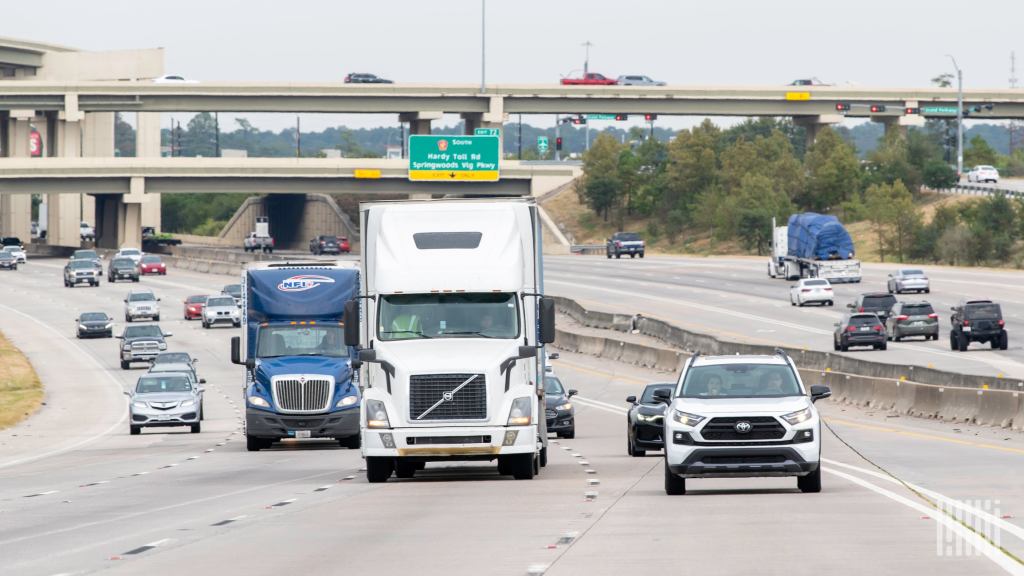
Everything is bigger in Texas, including traffic jams for truckers, according to the American Transportation Research Institute (ATRI).
ATRI released its 13th annual list Tuesday highlighting the most congested roadways for tractor-trailers across the country, and 13 Texas locations made the top 100, including nine in the Houston metropolitan area.
“Texans are no strangers to traffic congestion,” John D. Esparza, president and CEO of the Texas Trucking Association, said in a news release. “Unfortunately, all that congestion means that our state’s economy takes a hit as does our roadway safety and our environment.”
The 2024 Top Truck Bottleneck List measures the level of truck-involved congestion at over 325 locations on the national highway system. The analysis is based on an extensive database of freight truck GPS data. It uses several customized software applications and analysis methods, along with terabytes of data from trucking operations, to produce a congestion impact ranking for each location. The information is also used by policy planners to target infrastructure investment.
The most congested roadway for truckers in Houston was Interstate 45 at Interstate 69 and U.S. Route 59 (West), ranking No. 4 in the top 100. Other Texas cities with roadways on the top 100 list include Austin, Dallas, and Fort Worth.
While Texas is home to the highest number of congested freight corridors in the nation, the intersection of Interstate 95 and State Route 4 in Fort Lee, New Jersey, is ranked as the No. 1 freight bottleneck in the country for the sixth year in a row, according to ATRI.
States with the highest number of trucking bottlenecks include Texas (13), Georgia (9), California (8), Tennessee (7), Illinois (6) and Washington (6).
Average peak-hour truck speed at the bottlenecks on the list was about 34 mph, down 4% year over year from 2022. ATRI noted that average truck speeds at 62% of the bottlenecks were 45 mph or less.
“Traffic congestion on our National Highway System inflicts an enormous cost on the supply chain and environment, adding $95 billion to the cost of freight transportation and generating 69 million metric tons of excess carbon emissions every year,” Chris Spear, president and CEO of the American Trucking Associations, said in a statement. “The freight bottlenecks identified in this report provide an actionable blueprint for state and federal transportation officials on where to invest infrastructure funding most cost-effectively.”
329 layoffs hit freight-related firms in Texas
Goodyear Tire ordered to pay $4M in back pay to Mexican workers
FBI alleges Mexican cartel, Canadian truckers part of drug ring
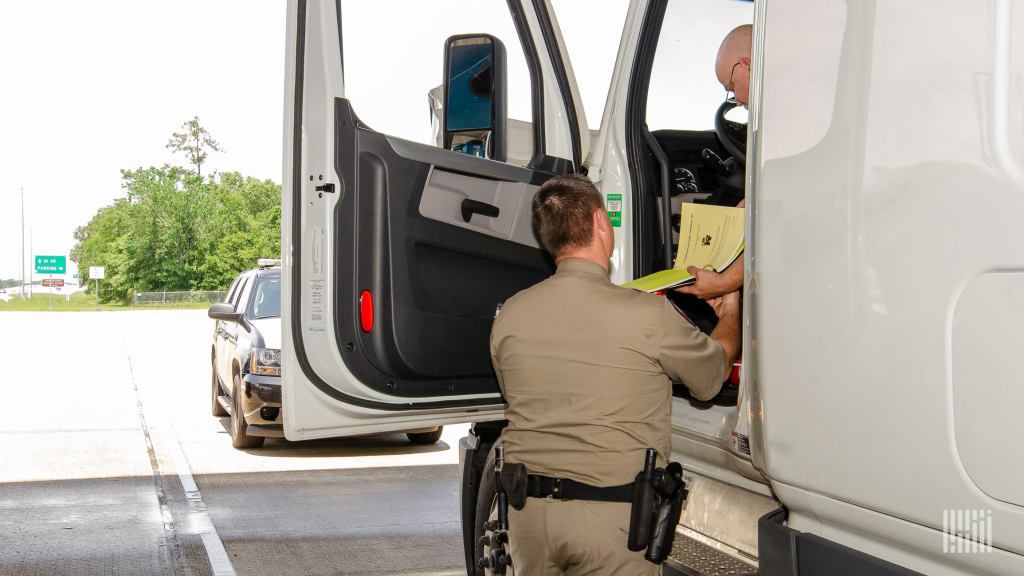
International Roadcheck will be May 14-16 this year, a few days earlier on the calendar than it was in 2023.
Legend holds that many truck drivers park their rigs for a few days to avoid stepped-up police activity during the event, which the Commercial Vehicle Safety Alliance (CVSA), which administers Roadcheck, describes as a “high-visibility, high-volume commercial motor vehicle inspection and regulatory compliance enforcement initiative that takes place over three days in Canada, Mexico and the United States.”
Each year’s inspections have a particular area of emphasis. This year the focus will be on tractor protection systems and the possession of alcohol and controlled substances.
CVSA describes the tractor protection systems as the tractor protection valve, trailer supply valve and anti-bleed back valve, “which may be overlooked during trip and roadside inspections.”
Referring to the Federal Motor Carrier Safety Administration’s Drug & Alcohol Clearinghouse, CVSA said the number of drivers with failed tests in that database has been increasing. “This year’s International Roadcheck will serve as a reminder to motor carriers to establish and strictly enforce clear policies to prevent controlled substance and alcohol possession or use in the workplace,” CVSA said in announcing dates for this year’s Roadcheck.
The standard inspection conducted is a 37-point procedure that CVSA spells out on its website. Last year, law enforcement authorities working under CVSA Roadcheck direction conducted 59,429 inspections during 72 hours. Of those, 36,021 were the full 37-point check.
During 2023’s Roadcheck May 16-18, the largest number of violations that resulted in an out-of-service (OOS) order was for brake systems, with 4,412 vehicles taken off the road. That represented 25.2% of all OOS violations. In the category of driver violations that led to an OOS order, 2,169 drivers were taken off the road for hours-of-service violations, 41.1% of all driver orders that led to an OOS declaration.
There is some evidence that International Roadcheck results in drivers staying home. Last year, the SONAR Outbound Tender Reject Index for the U.S., which had been flat to declining in the weeks before Roadcheck, took a notable move upward as Roadcheck was beginning. After a few days of elevated numbers — though at historically low levels given the state of the market — the OTRI began moving back to pre-Roadcheck numbers. OTRI is a percentage measurement of the number of contract loads rejected by contract carriers; a higher number suggests that capacity is tightening.

More articles by John Kingston
RXO looked to be avoiding the worst of the freight market, but no more
14-year-old case that brought ABC test to New Jersey was just settled
NJ insurers’ umbrella policies key to meeting new truck coverage minimums


For all the discourse about globalized trade being past its peak, maritime volume data at the start of 2024 sure looks strong. And if reports from shipbuilding companies are any indication, the sector should continue its growth into the end of the 2020s and beyond.
According to an article published last week by Yicai Global, production schedules at most of the country’s shipyards are booked through 2026. China’s shipbuilding output has grown dramatically since the early 2000s, when it accounted for around 10% of the global market share, to more than 50% (more than 43 million deadweight tons) in 2023. Its shipyards secured more than 65% of all new orders last year.
China holds a smaller share in certain high-value segments, such as LNG carriers, where it’s responsible for about 15% of the orderbook, with South Korea leading the market. But even that could be changing as steady technological improvements bolster orders for specialized vessels like chemical tankers, roll-on/roll-off carriers for automobiles and reefer ships. At the end of 2023, South Korean shipbuilders seemed to be having trouble meeting their annual targets.
In all, China, South Korea and Japan account for more than 90% of new cargo shipbuilding globally.
The increase in new shipbuilding orders is negative for rates, and it could also indicate a belief that trade will not be seamless in the coming years. Geopolitical tensions around key trade routes, like those in the Black Sea and the Red Sea, introduce challenges that could continue to lengthen shipping routes as companies aim to bypass conflict zones. Low water level projections in the Panama Canal are threatening future transits in a similar way. These situations help fuel the boost in shipbuilding, because longer routes mean more vessels are needed to transport the same amount of goods.
Zheng Yiming, director of the statistical information department at the China Association of the National Shipbuilding Industry, said that the primary challenges facing Chinese shipbuilders are steel prices and the yuan’s exchange rate against the U.S. dollar. The former headwind is eased by an increasing number of Chinese steelmakers capable of producing marine steel plates. The latter is in large part dependent on the country’s economic performance as a whole.
Interestingly, this vibrant long-distance maritime trade is having little trouble coexisting with the rise in North American nearshoring, particularly between Mexico and the U.S. The two were each other’s No. 1 trade partner in 2023.
Nearshoring and the push toward diversifying trade networks might not mean a reduction in the maritime trade. This pivot toward regional shipping complements broader international routes.
If current trends continue, the shipbuilding market is projected to experience significant growth by 2030. The global market, valued at approximately $150 billion in 2023, is expected to expand to around $192 billion by 2030, according to Coherent Market Insights.
This growth is driven by several factors, including increasing seaborne trade and the need for more environmentally friendly ships as the industry moves toward decarbonization.
Asia is expected to retain its dominance, supported by large production capacities and technological advancements.
The emphasis on building more environmentally friendly ships, such as those powered by LNG or equipped with advanced emission reduction technologies, is likely to also be a significant trend. This shift is partly due to regulatory changes aimed at reducing the maritime industry’s environmental impact. Similarly, the market’s growth is influenced by the expansion of trading lanes and replacement of aging fleets.
The median age of the containership fleet has increased significantly in recent years. According to a report from the Baltic and International Maritime Council in October 2023, the median age of the containership fleet has risen by approximately 4.3 years since 2010, reaching 14.2 years in 2023.
Now, nearly 21% of the fleet is over 20 years old, and the recommended service life is generally between 20 and 30 years. The report suggests that the average age of the fleet is expected to decline in the coming years as more ships are retired and containership newbuilds are delivered.

For the Insurance Council of New Jersey (ICNJ), a key word in the new law requiring minimum insurance coverage of $1.5 million for larger trucks is “umbrella.”
Gary La Spisa, vice president at the ICNJ, which represents insurance providers, worked with legislators to craft the bill that makes the New Jersey requirement the highest in the country.
In an interview with FreightWaves, La Spisa said his group sees it as a major victory that the law allows a fleet’s umbrella insurance coverage to provide for the $1.5 million in coverage, rather than requiring that figure for every individual truck. The insurance requirement bill was passed by the New Jersey Legislature last month and signed by Gov. Phil Murphy.
Umbrella policies cover insurance costs that might go beyond liability limits in other policies, such as personal or commercial automobile coverage.
“The number one request from the ICNJ and a number of our business association colleagues was addressing the fleet-level policies as opposed to vehicle-level policies, because anybody with multiple trucks is probably buying more than just a commercial auto policy,” La Spisa said. “They’re buying other types of insurance that provide liability protection. So we wanted to be sure that if the bill was enacted, it accounted for the way trucks are actually insured, as opposed to on a per-vehicle basis.”
La Spisa declined to put a number on the difference in cost for a fleet between a per-vehicle mandate and allowing umbrella coverage. But he said the group told legislators working on the bill that the higher insurance premiums to insure a fleet on a per-vehicle basis would be “exponential.”
Laying it out like that, La Spisa said, “is why I think they accepted that. I think they recognized that it was crucial that the bill actually reflected the way the fleets are insured.”
One aspect of the bill that La Spisa conceded he was not able to clarify was the impact of the new higher minimum on out-of-state vehicles that transit New Jersey.
The new truck minimums, for vehicles 26,001 pounds and up, were written into the state’s existing insurance law. That law says it applies to “every owner or registered owner of a motor vehicle registered or principally garaged in this State.” That would seem not to impact a company with trucks just driving through (and theoretically could incentivize a company to move across state lines to Pennsylvania or New York).
La Spisa suggested an ultimate ruling from the state’s motor vehicle department on that question of the law’s reach might be necessary.
Still to be determined
But other aspects of federal and state law might complicate that question.
New Jersey has a law known as the “deemer law.” In an online commentary, the law firm of Schwartz & Blackman said the deemer law “basically turns a non-New Jersey resident driver’s car insurance policy into a New Jersey policy, while the car is driven in New Jersey. A Pennsylvania or New York driver who is driving through New Jersey and gets into an accident in New Jersey will be subject to the deemer statute.”
But La Spisa said the deemer law has always been seen as applying solely to passenger vehicles. And in its commentary, Schwartz & Blackman said the deemer law “is very complex, and whether the deemer applies to your case depends on the facts and circumstances of the case.”
Another uncertainty comes in federal law 49 CFR 392.2, the motor carrier governance law that says all vehicles “must be operated in accordance with the laws, ordinances, and regulations of the jurisdiction in which it is being operated.” As one observer noted to FreightWaves, that raises the question of whether a regulator or a plaintiff’s attorney in a lawsuit over a New Jersey accident could use the new New Jersey law in a regulatory or civil action against an out-of-state carrier that had a lower limit.
The current federal limit is $750,000. It has not been changed since the passage of the Motor Carrier Act of 1980, which deregulated trucking. There is a federal push by two members of Congress to raise the limits.
The New Jersey Motor Truck Association has not issued a statement on the new insurance minimum in the state. The news section on its website makes no reference to it. A phone message left with the group had not been returned by publication time.
Recommendations on next steps
The law goes into effect July 1. La Spisa said that given the uncertainties that exist with the law, “I think the carriers that utilize independent agents and brokers should be in touch with them to make sure that the construction of their existing insurance already meets the standards.” La Spisa said he expects that most policies are likely to be in compliance already “for the vast majority of major operators.”
For smaller fleets or larger ones that may not be adequately covered, “they can work with their insurance carrier to get in compliance, whether they’re buying additional insurance or buying an umbrella or some other policy to meet the standards.”
La Spisa said ICNJ represents 90 insurance carriers that write numerous types of policies. And even though the law could mean new business for the group’s membership, La Spisa said ICNJ resists insurance mandates as a general rule.
“We were pleased that we were able to significantly limit the negative impact of this legislation,” La Spisa said. “There was consideration of applying the $1.5 million requirement to every commercial motor vehicle in the state of New Jersey.” Had that occurred, La Spisa said, “it would have been calamitous. We’re pleased that we were able to negotiate to a much narrower resolution.”
More articles by John Kingston
RXO looked to be avoiding the worst of the freight market, but no more
14-year-old case that brought ABC test to New Jersey was just settled
Plan to replace I-81 in Syracuse with urban boulevard gets court win
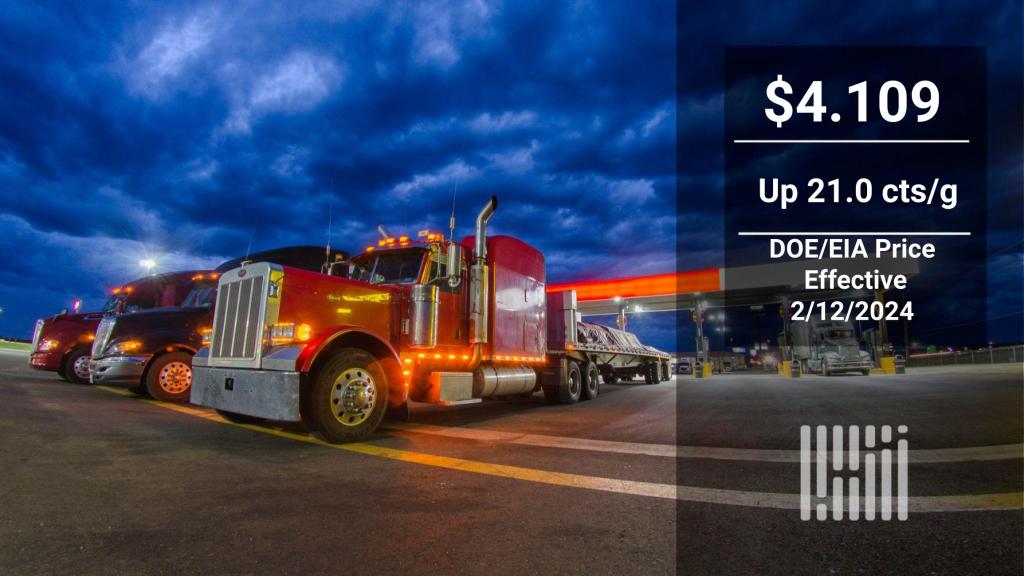
All three legs of the diesel market are going through extreme volatility, and it showed up in the weekly benchmark price used for most fuel surcharges.
The average weekly retail diesel price for ultra low sulfur diesel (ULSD) posted by the Department of Energy/Energy Information Administration rose 21 cents, to $4.109 a gallon. As large as the 21-cent jump was, it was only the sixth-largest since Russia invaded Ukraine almost two years ago.
However, it was the largest since a 22.2-cents-per-gallon increase posted July 31. It put the benchmark above $4 a gallon for the first time since Dec. 4 and wiped out all the declines in the price since then.
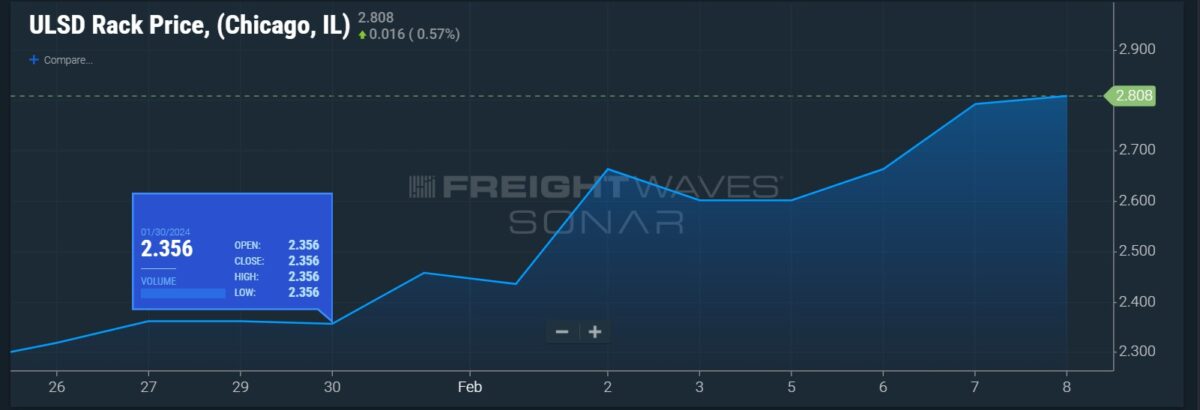
Retail prices are the end result of movement in the futures and wholesale markets. The latter take their cues from the former and then can add on or deduct additional movements depending on local market conditions.
In the futures market, ULSD on the CME commodity exchange climbed 30.42 cents between a $2.66 settlement on Feb. 2 and last Friday’s settlement of $2.9642 a gallon. ULSD on Monday reversed that slide, which had run five consecutive trading days, and fell 4.46 cents, to $2.9196 a gallon.
It was in some of the localized markets, however, where the craziest action was taking place.
In spot physical markets, trading for diesel is done for diesel transported on either a pipeline or on a waterborne carrier like a barge or cargo. Trading is conducted as a differential to the CME price, and volatility in the past two or three weeks has been extreme, according to data provided by DTN.
For example: ULSD on the Buckeye pipeline system was 45 cents less than the CME price on Jan. 26. By last Thursday, it rose to minus 5 cents before falling back Monday to minus 17 cents.
The Chicago market, which has been most directly hit by the outage at the BP Whiting refinery in Indiana, was negative 57.5 cents a gallon on Jan. 26. That rose to negative 9 cents a gallon Wednesday and was negative 18 cents Monday.
The Gulf Coast market was negative 9.5 cents a gallon on Jan. 24. On Monday it was negative 1.75 cents a gallon.
Those sorts of swings impact wholesale prices, which are then fed through to retailers. In this run of higher wholesale and futures prices, retailers have wasted no time increasing their numbers at the pump.
Variations in the price movements have been dramatic, according to the regional retail prices published each week by the DOE/EIA along with the national benchmark.
In the East Coast’s New England and Central Atlantic areas, which are fed by ULSD tied to the relatively steady New York Harbor price, prices last week rose only 2.6 cents and 4.2 cents a gallon, respectively. But in the Lower Atlantic, some of which would be fed by the volatile Buckeye system, prices were up 21.4 cents a gallon.
The Midwest was up 30.4 cents a gallon, not surprising given the outage at Whiting.
The relatively tame moves in the Gulf Coast led to a 16.3-cents-per-gallon increase there.
In California, the site of the highest prices in the country, the increase in the DOE/EIA price was just 12.9 cents a gallon. But that region may be primed for higher prices; the differential for ULSD meeting the state’s more stringent environmental specifications was minus 15 cents less than ULSD on CME on Jan. 26 but was plus 8.5 cents a gallon Monday.
Besides the outage at Whiting, diesel markets have been dealing once again with tight inventories.
U.S. stocks of ULSD in the week ended Feb. 2 fell to 118.9 million barrels, according to the most recent weekly inventory report of the EIA. That is a large drop for one week and comes after several weeks of increase off a recent low of 96.3 million barrels on Nov. 17.
The strength in the market can be seen in its spread over crude. On a straight front-month basis, ULSD on CME rose to more than $42 a barrel above the price of Brent, the world’s crude benchmark, last Friday. It fell back to about $40.60 Monday. Before that, it had not posted consecutive days more than $40 since late October.
In an article on diesel markets published last week, Reuters senior market analyst John Kemp quoted Emma Howsham, an analyst at Wood MacKenzie, saying that inventories in the key North West Europe market are expected to fall over the next two months. Howsham’s basis for the prediction was the start of refinery maintenance season later this month or into March, and “tight supply from key export hubs, and the Red Sea-Suez Canal disruption impact on flows into Europe.”
More articles by John Kingston
RXO looked to be avoiding the worst of the freight market, but no more
14-year-old case that brought ABC test to New Jersey was just settled
Plan to replace I-81 in Syracuse with urban boulevard gets court win
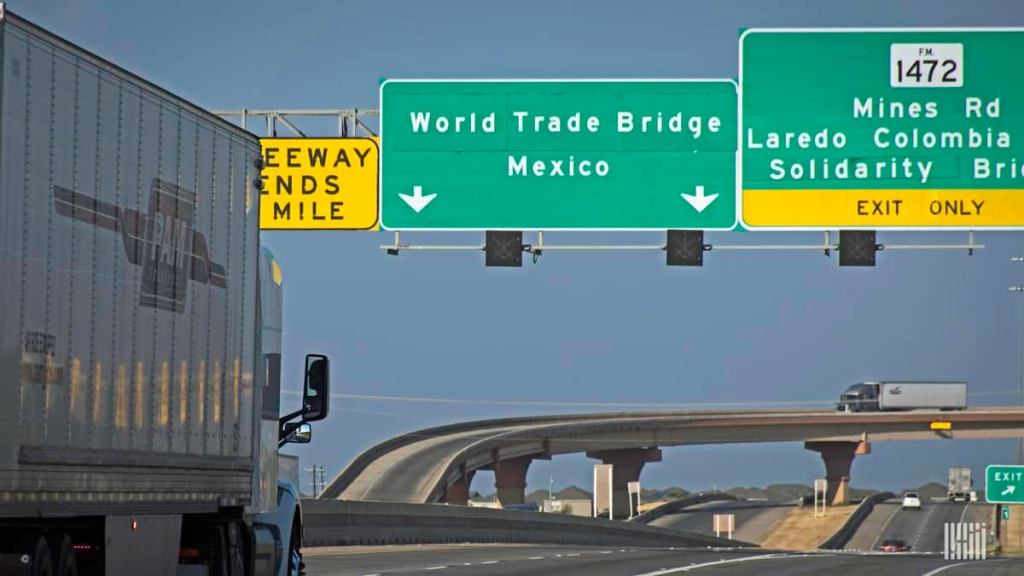
For only the second time in recent history, Mexico was the top overall U.S. trading partner for the year.
Mexico’s trade with the U.S. rose 2.5% year over year (y/y) to $798 billion in 2023, boosted by exports of gasoline and other fuels and imports of passenger vehicles.
Canada ranked No. 2, with two-way trade with the U.S. falling 2.37% y/y to $773.94 billion. China ranked third, with trade falling 16.73% y/y to $575.03 billion.
In addition, the port of entry in Laredo, Texas, was the No. 1-ranked international trade gateway in the U.S., totaling $320 billion. It was the first time Laredo was the nation’s No. 1 overall trade port for the year.
The majority of cross-border commerce in Laredo was with Mexico, totaling $312 billion in 2023. China ranked No. 2 for trade through Laredo at $1.8 billion last year.
Trade experts said Mexico’s emergence as a global trade power arises from the growth of nearshoring south of the border amid the continued strained U.S.-China trade relations.
“Mexico’s expanding manufacturing base has offered an alternative to producing in China,” according to research by Luis Torres, senior business economist in the San Antonio Branch of the Federal Reserve Bank of Dallas. “While data on recent nearshoring is thin and evidence of it is largely anecdotal, increased protectionism and related industrial policy are consistent with less global trade, more regional trade, and nearshoring and reshoring.”
The first time Mexico and the U.S. were top trading partners for the year was 2019, when commerce totaled $612.8 billion, compared to Canada’s $611.4 billion and China’s $555.6 billion.
Canada was the top trading partner of the U.S. from the 1970s through 2014. China earned the No. 1 ranking from 2015 through 2018. Canada regained the top spot in 2021 and 2022.
The top three imports from Mexico to the U.S. in 2023 were passenger vehicles ($44.7 billion) auto parts ($34.9 billion) and computer chips ($12 billion), according to Census Bureau data analyzed by WorldCity.
The top exports from the U.S. to Mexico were gasoline and other fuels ($36 billion), auto parts ($20.1 billion) and passenger vehicles ($232 million).
While Mexico ended 2023 as the top U.S. trading partner, ranking No. 1 for 10 of the past 12 months, Canada was the ranked No. 1 trade partner in December at $61.1 billion.
Mexico ranked No. 2 in December at $60.4 billion, while China was No. 3 at $46.1 billion. Mexico also ranked No. 2 in April.
The port of entry in Laredo has been the No. 1 international trade gateway in the U.S. for 11 consecutive months.
In December, Laredo’s total commerce was $24.4 billion. The Port of Los Angeles ranked No. 2 at $23.9 billion, while Chicago O’Hare International Airport was No. 3 and reported $22.7 billion in trade.
In 2023, more than 7.35 million cargo trucks crossed the U.S.-Mexico border, while over 6 million tractor-trailers crossed the U.S. and Canadian border.
Laredo was the No. 1 border crossing in the U.S. for trucks, with 2.93 million tractor-trailers last year. The port of entry in Otay Mesa, California, ranked No. 2 with over 1 million cargo truck crossings, while the Ysleta-Zaragoza International Bridge in El Paso, Texas, was No. 3 with 640,667 trucks.
The Ambassador Bridge in Detroit was the busiest port of entry on the Canadian border, handling 1.56 million cargo trucks in 2023, followed by the Peace Bridge in Buffalo, New York, with 892,838 truck crossings last year. The Blue Water Bridge connecting Port Huron, Michigan, with Sarnia, Ontario, ranked third with 782,260 trucks.
329 layoffs hit freight-related firms in Texas
Goodyear Tire ordered to pay $4M in back pay to Mexican workers
FBI alleges Mexican cartel, Canadian truckers part of drug ring
Digital freight marketplace CDL 1000 has expanded its market share into Los Angeles with the acquisition of competitor Next Trucking.
The Wall Street Journal reported the acquisition Monday morning, but the terms of the deal were not disclosed.
Next Trucking operates at the Los Angeles and Long Beach ports, an integral area for freight in the U.S. Currently, Chicago-based CDL 1000 lacks a presence there, and the acquisition seeks to rectify that. Founder and CEO Andrew Sobko told the Journal that the move makes the company one of the top three trucking players in Los Angeles and Long Beach.
Brookfield Growth and Mucker Capital financed the deal.
Next Trucking announced in June that it was looking for either additional capital or an exit. The news comes after a particularly harsh year in FreightTech with many major companies downsizing or forced to shut down.
This is a developing story. Check back here for details.
WASHINGTON — The Senate may soon consider a three-year tax package that includes financial benefits for both large and small trucking companies. It passed the U.S. House of Representatives with strong bipartisan support.
The Tax Relief for American Families and Workers Act of 2024, approved in the House by a vote of 357-70 on Jan. 31, allows accelerated depreciation for capital investments and provides more generous deductions for interest expenses — provisions that extend expiring benefits that were included in the 2017 Tax Cuts and Jobs Act, the signature tax bill passed by the Trump administration.
The legislation “advances several trucking priorities to promote much-needed investments in our supply chain, like restoring and extending 100% expensing for new equipment,” commented Ed Gilroy, the American Trucking Associations’ chief advocacy and public affairs officer, when the bill passed the House.
“We support this bipartisan effort that will pave the way for greater freight capacity, efficiency and innovation while strengthening small businesses and fostering good-paying jobs in the trucking industry.”
Under current law, the maximum a taxpayer may expense is $1 million of the cost of qualifying property placed in service for the taxable year. “The $1 million amount is reduced by the amount by which the cost of such property placed in service during the taxable year exceeds $2.5 million,” according to an explanation of the new tax plan.
The provision increases the maximum amount a taxpayer may expense to $1.29 million, reduced by the amount by which the cost of qualifying property exceeds $3.22 million. The $1.29 million and $3.22 million amounts are adjusted for inflation for taxable years beginning after 2024.
“The provisions related to expensing assets is exactly what is needed for someone buying a new truck or rig,” James Lucier, a tax policy expert and a principal with Capital Alpha Partners, a public policy research firm, told FreightWaves. “It would be quite helpful for independent truckers and small businesses involved in trucking.”
The new tax plan also extends the allowance of a 100% bonus depreciation deduction for property placed in service after Dec. 31, 2022, and before Jan. 1, 2026. That provision is particularly beneficial for owner-operators and other small carriers, according to Barry Fowler, founder of Taxation Solutions Inc., which specializes in tax provisions affecting smaller carriers.
“If you’re considering buying another truck, you can take that 100% depreciation expense in the first year — that’s definitely a benefit,” Fowler told FreightWaves.
He noted, however, that the potential for benefiting from that provision can depending on a person’s taxable income. “You may not want to take 100% depreciation expense if you’re in a lower tax bracket. That’s something a tax preparer can help you navigate.”
The legislation, which also has bipartisan support in the Senate, has a 34% chance of being enacted, according to GovTrack.us, a nonprofit organization that tracks pending legislation. Only about 21% of bills that made it past committee in the previous Congress were enacted into law, according to the group.
