
FMCSA checklist: A freight broker’s guide to spotting fraud

As a freight broker, you are on the front lines of ensuring safe, efficient and compliant transportation of goods. One critical aspect of your role involves conducting thorough Federal Motor Carrier Safety Administration checks. However, this process has risks, especially with the increase in fraud across the industry.

Essential checklist for spotting fraud

Inactive/revoked authority

Is the carrier operating with revoked authority? Big red flag for illegal activities. As a freight broker, you must be vigilant about the carriers’ authority status. Inactive or revoked authority can be a significant indicator of potential illegal activities. As part of your due diligence, it’s essential to regularly verify the authority status of your carriers to ensure compliance with regulations and to maintain the integrity of your operations.

Newly issued authority

New carriers are great, but zero history could spell trouble. As a freight broker, it’s essential to implement thorough procedures when onboarding carriers with newly issued authority to mitigate potential risks and ensure the smooth execution of transportation services.

  1. Verification of authority: Before engaging a carrier, verify its newly issued authority through the FMCSA database to confirm its authenticity and active status.
  2. Financial responsibility: Assess the carrier’s financial stability and compliance with regulatory requirements, especially in light of recent FMCSA regulations tightening financial responsibility standards for brokers and freight forwarders.
  3. Safety and compliance: Evaluate the carrier’s safety rating, insurance coverage and overall compliance with industry regulations to gauge its commitment to operational excellence and risk mitigation.

Insurance instability

Is the carrier changing insurers often? It could be hiding something. In the dynamic landscape of the freight industry, the stability of insurance arrangements holds substantial implications for the operations of freight brokers. The frequency of insurer changes by carriers can serve as a red flag, prompting brokers to exercise heightened vigilance and due diligence in their engagements. Understanding the underlying factors and regulatory considerations associated with insurance instability is paramount for safeguarding the interests of all stakeholders involved.

  1. Financial responsibility standards: Recent regulatory developments, such as the tightening of financial responsibility standards by the FMCSA, underscore the criticality of consistent and adequate insurance coverage within the broker-carrier relationship.
  2. Risk of noncompliance: Frequent insurer changes by carriers may raise concerns regarding their adherence to regulatory requirements, potentially exposing brokers to partnerships that lack the necessary financial security and compliance assurances.

Name/ownership shifts

Regular changes might be covering up a shady past. The frequent shifting of names or ownership within the freight industry can potentially obscure aspects of a carrier’s history. This pattern may indicate an attempt to conceal a problematic track record. As a freight broker, it is imperative to exercise heightened scrutiny when encountering such situations.

Inconsistent info

Mismatched details between carrier and FMCSA records? Proceed with caution. Identifying inconsistent information between carrier-provided details and FMCSA records demands a meticulous approach from freight brokers. Addressing such disparities is integral to upholding regulatory compliance and mitigating potential risks associated with opaque or inaccurate representations.

Double-brokering reports

Double brokering is a classic red flag in our industry. The prevalence of double brokering in the freight industry has become a significant concern, impacting brokers and carriers. Reports indicate a substantial increase in double-brokering cases. The impacts of double brokering are estimated to have caused annual losses of $500 million to $700 million. Be vigilant and proactive in identifying and reporting instances of double brokering. Implement robust measures to detect and prevent this fraudulent practice.

  1. Establish clear communication channels: Maintain open lines of communication with carriers and shippers to promptly identify any discrepancies or irregularities that may indicate double brokering.
  2. Implement comprehensive tracking systems: Utilize advanced load-tracking solutions to monitor and track freight, enabling the early detection of suspicious activities that may signal double brokering.

Rushed verifications

Are they pressuring you to bypass vetting processes? Why the hurry? The practice of rushed verifications in the freight industry poses significant risks. It can potentially lead to detrimental outcomes for brokers and other industry stakeholders. When carriers or other parties attempt to pressure brokers into bypassing essential vetting processes, it may indicate an intent to conceal unfavorable information or engage in fraudulent activities.

Outstanding fines

Unresolved penalties could indicate more profound issues. Unresolved penalties can reveal underlying problems such as financial instability, regulatory noncompliance or potential operational risks. Seek transparency from carriers about the nature of the fines, the steps taken to address them, and their overall commitment to regulatory compliance and financial responsibility.

Negative reviews/reports

Consistent bad reviews, especially for deceptive practices, must be addressed. Negative reviews can serve as a warning sign for potential partners. With reports of double brokering on the rise, it’s crucial for freight brokers to carefully consider negative feedback and reports, especially those related to deceptive practices, as they can provide valuable insights into the trustworthiness and reliability of carriers.

Confirm before revealing pickup number

Only provide the pickup number after the driver’s arrival and upon verification of the Department of Transportation/MC number on the truck. The DOT/MC number verification process is a fundamental aspect of ensuring the legitimacy and compliance of carriers in the freight industry. By confirming the DOT/MC number before revealing the pickup number, freight brokers can enhance security and minimize the potential for unauthorized or deceptive pickup attempts.

  1. Driver arrival confirmation: Only provide the pickup number upon the driver’s arrival to ensure that the carrier’s presence is validated before sensitive information is disclosed, adding an extra layer of security to the pickup process.
  2. DOT/MC number validation tools: Brokers can leverage the FMCSA’s Licensing and Insurance website to swiftly verify the authenticity and status of carriers’ DOT/MC numbers.
  3. Collaborative engagement: Open communication with carriers regarding the pickup process and the importance of DOT/MC number verification can foster a culture of compliance and transparency within the industry.

Last-minute driver changes

Be cautious of carriers that frequently change driver information at the last minute, as this could signal irregularities or unreliable operations. The prevalence of last-minute driver changes in the freight industry can indicate operational irregularities and potential unreliability. This practice can lead to disruptions, financial risks and operational inefficiencies for brokers and carriers.

  1. Operational disruptions: Last-minute driver changes can lead to delays and disruptions in freight pickup and delivery, impacting overall supply chain efficiency and customer satisfaction.
  2. Financial implications: Brokers and carriers may incur additional costs due to last-minute driver changes, such as rescheduling fees, idle time and potential loss of revenue from delayed or canceled shipments.
  3. Regulatory compliance: Last-minute driver changes can raise concerns about compliance with regulations, including driver qualifications, hours of service and safety protocols, potentially exposing brokers and carriers to regulatory risks.
  4. Risk mitigation strategies: Implementing robust risk mitigation strategies, such as thorough carrier vetting, clear contractual terms and proactive communication, can help brokers minimize the impact of last-minute driver changes on their operations.

Implementing a diligent verification process

Creating a standard operating procedure for FMCSA checks can significantly reduce the risk of fraud. This process should include step-by-step verification of all relevant documents and information. Incorporate technology where possible to streamline the process and maintain accuracy.

Training and awareness

Continuous training and staying informed about the latest trends in freight fraud are crucial. Attend workshops, webinars and other educational programs focusing on fraud prevention in the freight industry.

Networking and information sharing

Building a network with other freight brokers and industry professionals can be invaluable. Sharing experiences and information about fraudulent practices helps everyone stay one step ahead of scammers.

Conclusion

Following this checklist will protect your operations and contribute to the freight industry’s overall safety and integrity. Remember: Staying vigilant, informed and connected is your best defense against fraud.


Shipping and geopolitical risk: Don’t forget about Korean Peninsula

a map of Korean Peninsula

COVID steered shipping markets in 2020-2022. Geopolitics has steered markets ever since — and future war effects on ocean trade could be even more extreme than they are today.

Russia’s invasion of Ukraine rerouted crude oil, refined products, LNG, coal and grain trades. The Israel-Hamas war spawned attacks by Houthi rebels on vessels in the Red Sea, which have rerouted container ships, LNG carriers, liquefied petroleum gas (LPG) ships and, to an growing extent, refined product tankers.

The Middle East war could grow into a regional conflict that affects tanker traffic through the Strait of Hormuz. Venezuela could invade Guyana, curbing a promising new source of crude exports. China could invade Taiwan, leading to an economically cataclysmic war between China and the U.S.

And then there’s North Korea, which is increasingly allied with Russia.

The consensus is that a North Korean attack on South Korea and/or Japan is very unlikely — but it’s a known threat, definitely not a “black swan.” North Korea has fired missiles over Japan and North Korea’s state media said last Tuesday that the country’s leader, Kim Jong Un, no longer seeks reunification with South Korea and wants to subjugate its neighbor, through nuclear war if necessary.

A war in the region would be highly material to ocean shipping. South Korea and Japan are major exporters of goods to the U.S., and 40% of the world’s shipbuilding production is in those two countries — with almost all of the other yard capacity in China.

Warning on ‘decision to go to war’

A new warning has been issued by two highly regarded experts on North Korea: Robert Carlin, a former CIA and State Department lead analyst on North Korea, and nuclear scientist Siegfried Hecker.

“The situation on the Korean Peninsula is more dangerous than it has been at any time since early June 1950,” they wrote. “We believe Kim Jong Un has made a strategic decision to go to war.” They maintained that Western policymakers’ belief that North Korea would not dare to attack is “a grievous failure of imagination that could be leading to a disaster.”

“North Korea has a large nuclear arsenal, by our estimate, of potentially 50 or 60 warheads deliverable on missiles that can reach all of South Korea, virtually all of Japan (including Okinawa) and Guam. [Kim’s] recent words and actions point toward the prospects of a military solution using that arsenal.”

The New York Times and The Washington Post recently highlighted Carlin and Hecker’s warning. The New York Times noted that nuclear threats from North Korea are intensifying “while the world is preoccupied with other wars.”

South Korea and Japan’s share of US imports

According to Census Bureau data, the U.S. imported 7.46 million metric tons of containerized goods from South Korea in 2023, or 4.2% of total U.S. seaborne containerized imports. Last year’s U.S. imports from South Korea were valued at $51.3 billion or 5.7% of total value.

America’s imports from South Korea were led by motor vehicles, vehicle parts, electrical equipment and components, household appliances, chemical products and general-purpose machinery.

Imports from Japan totaled 4.47 million tons (2.5% of the total) in 2023, valued at $53.8 billion (5.9% of total import value).

Topping the U.S. import list from Japan were vehicle parts, chemical products, farm and construction machinery, engines, turbines, power transmission equipment, and electrical equipment and components.

South Korea and Japan’s share of shipbuilding

The hypothetical threat to shipbuilding is an even bigger variable for the broader shipping industry than the risk to seaborne goods volumes.

A war in the region that affected yard output would limit new capacity for ocean transport, supporting higher future freight rates.

According to Clarksons Research Services’ annual shipbuilding review, South Korea accounted for 26% of global newbuilding tonnage delivered last year. Japan accounted for 14%. China led the market by far, delivering 51% of new tonnage in 2023, with remaining countries’ yards delivering just 9%.

South Korea dominated LNG carrier deliveries in 2023, accounting for 83% tonnage. South Korean yards delivered 39% of tanker newbuilding tonnage, 33% of dry bulk tonnage and 29% of container-ship tonnage.

Clarksons expects South Korean yard output to increase this year, with Japan’s to increase by a lesser extent and Chinese output to remain stable.

In terms of new orders placed in 2023, 60% of contracted tonnage went to China, 24% to South Korea, 11% to Japan, and 5% to other countries.

Click for more articles by Greg Miller 

How Houthis shocked shipping; freight’s new magazine; retail tech – WTT

On episode 672 of WHAT THE TRUCK?!?, Dooner is talking to FreightWaves’ Rachel Premack about how the Red Sea conflict has massively changed shipping outlooks, costs, timelines and supply chain security.

Tecsys’ Guy Courtin tells us how their Shopify-powered order management system is helping transform Canadian fashion retailer Eclipse Stores’ supply chain.

Loyalty Logistics’ Sean Laidacker talks about reducing carbon footprints and bringing back trust to the industry.

FreightWaves’ John Kingston has breaking news on a decision in the Forward Air-Omni case. 

Plus, freight gets a new magazine; Flexport gets funding from Shopify; the Zyn craze; project44 v. FourKites; transforming Chinese restaurants; and more. 

Watch on YouTube

Subscribe to the WTT newsletter

Apple Podcasts

Spotify

More FreightWaves Podcasts

Forward Air, Omni reach settlement; merger to close soon

A white tractor pulling a white Forward Air trailer

WILIMINGTON, Del. — The merger dispute between Forward Air and Omni Logistics was settled just before opening arguments began on Monday. The deal is expected to close in the coming days.

With a Delaware courtroom filled with lawyers and potential witnesses, the trial to decide if a once-valued $3.2 billion transaction would proceed was delayed twice before the parties indicated a deal was reached.

For several weeks now, Forward (NASDAQ: FWRD) has been attempting to terminate the agreement it entered into in August after receiving push back from investors. Forward claimed Omni didn’t fulfill certain pre-closing tasks and that it misrepresented financial projections as justification for exiting the deal.

All along, Omni maintained that it acted in good faith and completed all pre-deal requirements. It filed suit against Forward at the end of October, asking a judge to compel Forward to carry through with the transaction.

A Monday statement from Forward Air showed the amended terms. The cash portion of the transaction is now just $20 million compared to $150 million previously, and the equity portion has been reduced to 35% compared to an initial equity distribution of 37.7%.

The new deal price is now closer to $2.1 billion compared to roughly $2.4 billion in recent weeks. The shares given to Omni’s stakeholders are fixed and valued on the current share price.

“We have always believed in the power of this acquisition and are pleased to have found a way forward,” said Tom Schmitt, Forward chairman, president and CEO, in a statement. “In recent days, we have engaged constructively with Omni to set a path forward that ends our legal dispute.”

The trial was originally slated to start Friday but was delayed by inclement weather, presumably leaving the parties the weekend to hash out details.  

There is no remaining litigation between Forward and Omni, the release said.

“We believe this highly compelling acquisition will deliver significant long-term shareholder value and we look forward to swiftly closing the transaction so we can begin to capitalize on the many exciting opportunities ahead,” Schmitt continued.

Shares of FWRD jumped nearly 20% in early trading on Monday as investors were learning an agreement had been reached. However, by 11:09 a.m. EST, shares were back to where they started the day as the settlement meant the deal was proceeding, and not terminated as some had hoped.  

Shares of FWRD are off more than 50% since the deal was first announced.

“Looking beyond this week, investors will need to digest what FWRD could be worth inclusive of Omni’s business and the significant deal-related debt burden, with uncertainty as to how much shareholder pressure will continue near-term after activists were unable to torpedo the deal,” Susquehanna Financial Group analyst Bascome Majors told clients in a Monday note.

Weekly NTI Update: January 22, 2024


Learn more at SONAR.FreightWaves.com

C.H. Robinson says eBOL collaboration now includes 10 major LTL carriers

A white tractor pulling two white LTL trailers

Third-party logistics provider C.H. Robinson announced Monday it uses electronic bills of lading with 10 of the top less-than-truckload carriers on its platform. It said it plans to implement the capabilities with an additional four carriers.

The digitization of the essential shipping document improves efficiency, minimizes errors and provides increased real-time visibility. C.H. Robinson (NASDAQ: CHRW) said 17,240 of its customers used the eBOL process last year, with even broader adoption expected in 2024.

“With truckload freight, there’s generally one origin and one destination and a customer has exclusive use of the trailer,” Greg West, vice president of LTL at C.H. Robinson, said in a news release. “With LTL, you can have up to 30 customers’ freight on a trailer, with 30 destinations and 30 sets of paperwork. That makes it so valuable to have a common eBOL everyone can use.”

The automated process allows for tracking numbers to be generated via API within seconds of a shipment’s tender. The driver only has to scan it upon arrival. The manual process required drivers to carry and apply stickers to paper bills of lading and to each pallet. At the end of the day, the driver had to manually enter all the tracking numbers in the carrier’s system before tracking could begin.

C.H. Robinson said it has an accuracy rating of 92% when it comes to predicting which LTL shipments will arrive on time.

The company said it is the first 3PL to adopt the eBOL process. The standards for their use were developed by the National Motor Freight Traffic Association’s (NMFTA) Digital LTL Council. The NMFTA is a trade group that manages the classification system used to universally code and identify each shipment in the LTL industry.

“Their pioneering collaboration with leading LTL carriers and embrace of the Council’s standards showcase a firm commitment to modernizing logistics for enhanced efficiency and real-time visibility,” said Paul Dugent, executive director of the NMFTA’s Digital LTL Council.

He expects C.H. Robinson’s eBOL initiative “to serve as a catalyst for broader industry adoption.”

Cold chain tech provider Grip Shipping launches fulfillment service

Cold chain technology provider Grip said Monday that it will open fulfillment centers in Texas, Florida, New Jersey and California. 

Grip launched its IT platform a year ago.

The company was founded by former ButcherBox executives Juan Meisel and Jimmy Cooper. In a statement, Meisel said that “most brands still ship their products the same way they have for decades: By handling their products to a carrier and hoping for the best.”

Meisel added that perishables D2C brands “need a logistics partner who can provide them with a world-class, dynamic shipping solution that allows them to better serve their customers and increase margins.”

Daily Infographic: Mexico top US trade partner in November


To view more FreightWaves infographics, click here

Matt Silver launches US-Mexico logistics tech startup Cargado

Founder and former CEO of Forager Matt Silver announced Monday the start of Cargado, a new venture aimed at creating a seamless platform for U.S.-Mexico cross-border logistics.

The startup, which has already secured $3 million in pre-seed funding, “will address the unique challenges of moving freight between the U.S. and Mexico using innovative new technology,” Silver said.

“There are a lot of other companies that are starting to look at either buying Mexican companies or investing in leadership, and we think right now is the perfect time for Cargado,” Silver told FreightWaves. “As more and more logistics providers get involved in Mexico, more trucking companies get involved, more shippers get involved, we believe that there’s going to be a need for more tailored software, more tailored technology, that helps support that entire process and the entire ecosystem.”

Silver declined to reveal how Cargado will specifically operate in the cross-border space for the moment, but he said the sector is ripe for logistics technology innovation.

“We have a deep understanding of the industry and how cross-border freight works, and we have a lot of relationships across the industry,” Silver said. “Our goal is to help connect everything and help bring everything online.”

Cargado officials plan to use the $3 million to build out the initial team and technology and launch the product at the end of first quarter to a select group of beta users.

From January through November, Mexico’s trade with the U.S. rose 2.79% year over year to $738.4 billion. (Photo: Jim Allen/FreightWaves)

Rylan Hawkins is the co-founder and chief technology officer of Cargado. Hawkins was one of the founding engineers at Convoy, where he served as general manager for two of their most successful programs — Convoy Go and Convoy for Brokers. Prior to working at Convoy, Hawkins was a senior program manager at Microsoft.

Hawkins said he was attracted to helping start Cargado after taking a trip with Silver to Laredo, Texas. The Laredo port of entry is currently the No. 1 international gateway for trade in the U.S.

“One of the first things we did was head down to Laredo, where it was made abundantly clear that the U.S. is really shifting its supply chain to Mexico from China,” Hawkins wrote in a LinkedIn post. “When starting a company, one of the things I’ve seen and learned is that it’s wonderful when you can join a market that has a natural current pulling you forward. Cross-border freight with Mexico seems to be just that.”

Cargado’s pre-seed round was led by Ty Findley, co-founder and general partner at Ironspring Ventures, and was supported by Zenda Capital, Nichole Wischoff of Wischoff Ventures, Proeza Ventures and Sahil Bloom, with contributions from dozens of other professionals across the logistics and technology sectors. FreightWaves founder and CEO, Craig Fuller also invested in the round.

“In order for the renewed attention on making North American supply chains more resilient to succeed, our close trade partners in Mexico have to also succeed in advancing their nearshoring supply chain capabilities,” Findley said in a statement. “Between Matt’s and Rylan’s experiences, there could not be a more tailor-made founding duo than them to take this on.”

More articles by Noi Mahoney

Nearshoring forecast to boost US-Mexico trade in 2024

Venture capital continues to flow into FreightTech startups

Mexico top US trade partner in November, Laredo No. 1 gateway

Will shippers’ confidence change when carriers regain pricing power?

Will 2024 bring a definitive end to the current freight recession?

That’s certainly the hope of the freight market writ large. Many carriers and brokers hobbled through 2023, and those still operating are anxiously awaiting any sign that pricing power is swinging back in their favor.

There are some indications that’s starting but not yet on a widespread or dramatic basis. The first quarter, after all, is historically a difficult one for freight. Adding to that is the fact that the final months of 2023 continued the tumult for the trucking and brokerage sectors, highlighted by a number of bankruptcies in both.

These factors have led to a present environment in which shippers continue to stand out as the vanguard of positivity. The Q1 2024 Freight Sentiment Indexes reveal a surge in shipper confidence, climbing to a record-high 13.58 from 9.79 in the preceding quarter. (Note that data only go back to Q4 2022.)

But this swell in shipper confidence poses a question, too: Will the optimism continue into the market recovery, or could shippers be caught off guard?


It should be mentioned that carriers are experiencing a cautiously optimistic recovery. Their sentiment has modestly ascended to 5.66 from 4.41 in Q4 of 2023. The group is far from out of the woods, however, with excess capacity still hanging over it like a dark cloud.

The mood of brokers, too, is showing signs of improvement in Q1, advancing to 9.96 from 8.78, in spite of the issues with fraud that the Transportation Intermediaries Association (TIA) is working to call attention to on a national level.

These freight sentiment indexes are represented on a scale between negative 100 and positive 100, where higher numbers suggest positive sentiment or growth and lower numbers suggest pessimism or contraction. FreightWaves sends the same survey questions to shippers, brokers and carriers. The results offer aggregated insights from hundreds of respondents into the industry’s health and expectations for the future.

Ultimately, the freight market experienced a lot of recalibrating in 2023. But it does seem to be well positioned to bounce back as 2024 progresses. Demand remained strong last year, even as consumers turned gloomy. Now, with inflation receding and moods lifting, there’s little reason to think that will change for domestic freight, even with tensions rising internationally.

Of course, it’s not all positive. Optimism is tempered by those persistently low tender rejections in the U.S. truckload space. Logic holds that this year will see upward movement on that front, but it’s difficult to predict when exactly capacity will right-size with demand. Furthermore, regulatory shifts impacting owner-operators inject additional unpredictability into the industry’s trajectory.

This quarter’s Freight Sentiment Indexes sketch a portrait of an industry near the turn. Shippers are riding a wave of optimism that — if they’re not careful — could leave some flat-footed when their logistics service providers inevitably start asking for more.

Note: Survey data was fielded during the first two weeks of January.

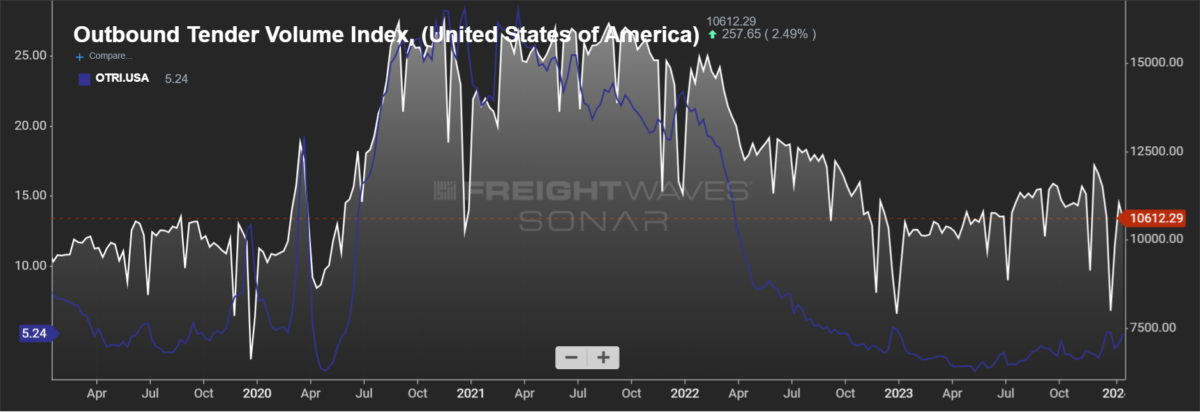
FreightWaves SONAR: Outbound tender volumes (OTVI.USA) trended up throughout 2023 but did little to budge historically low tender rejections (OTRI.USA). It’s likely that the rate of rejections will increase this year as capacity balances with demand.

Carrier sentiment: Gradual recovery as market shift nears

For Q1 2024, carriers exhibited a mixed sentiment. The sector continues to grapple with the excess capacity that has dampened margins for some 18 months now.

The near-term profitability index showed a slight improvement to -1.91 from -3.34 in the previous quarter, indicating a somewhat less pessimistic outlook. This change represents both quarterly and yearly improvement but still suggests carriers expect to be less profitable than in Q4 2023. That’s now been the case for six consecutive quarters, dating back to the first reading in Q4 2022.


Longer-term profitability, however, continued its upward trajectory, reaching 19.23 in Q1 2024 from 16.18 in Q4 2023, and significantly up from 11.16 in Q1 2023. This suggests a growing confidence in future conditions.

The near-term workforce sentiment shifted positively to 0.69 in Q1 2024 from -0.28 in Q4 2023, indicating a modest turnaround in workforce expansion plans, though this figure is lower than the 6.92 recorded in Q1 2023. Longer-term workforce sentiment also improved, moving to 7.88 in Q1 2024 from 6.74 in the previous quarter but again lower than Q1 2023’s 11.73.


Business investment sentiment slightly declined to 2.39 in Q1 2024 from 2.77 in Q4 2023, and that’s also a decrease from 8.69 in Q1 2023, reflecting a cautious approach to investment. 

The overall sentiment improved to 5.66 in Q1 2024 from 4.41 in Q4 2023, showing a more optimistic outlook compared to the previous quarter. It is somewhat surprisingly a hair lower than at this time last year.

Industry analysts and leaders suggest that 2024 will likely feature a realignment of supply and demand, dependent of course on the continuation of current economic and carrier exit trends.

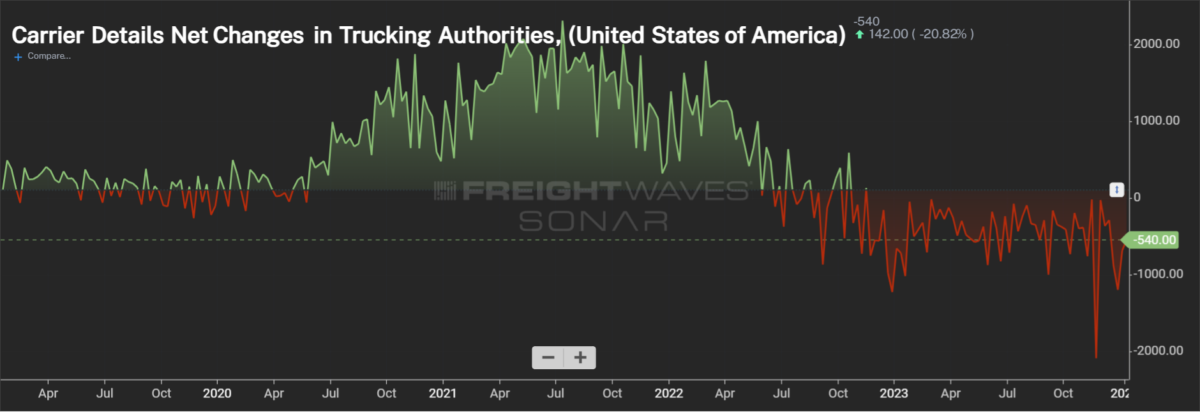
FreightWaves SONAR: The weekly net change in trucking authorities (CDNCA.USA) remained negative for all of 2023. That trend is unlikely to change in the first half of 2024.

Broker sentiment: Progress amid pressures

Overall sentiment improved to 9.96 in Q1 2024 from 8.78 in the previous quarter, and it’s also higher than the 6.97 recorded in Q1 2023. It’s a positive sign, though tough times don’t seem to have ended yet.

Brokers/3PLs showed a decline in near-term profitability, however, dropping to -2.01 from -1.03 in the previous quarter. While this represents a deterioration on a quarter-over-quarter (q/q) basis, the sector improved from -4.92 in Q1 2023. Longer-term profitability sentiment, meanwhile, increased to 28.49, up from 21.95 in Q4 2023 and significantly higher than 11.5 in Q1 2023, indicating a robust long-term outlook.


Near-term workforce sentiment showed a slight improvement to 0.45 in Q1 2024 from -1.17 in Q4 2023, but it is lower than 1.6 in Q1 2023. Longer-term workforce sentiment remained stable at 14.01, slightly down from 14.08 in the previous quarter but up from 11.88 in Q1 2023.

Business investment sentiment declined to 8.85 in Q1 2024 from 10.09 in Q4 2023, and down from 14.77 in Q1 2023, indicating a more cautious investment approach.

Confronting the escalating issue of fraud has become a paramount concern for the brokerage sector. TIA’s alert to Congress and the initiation of a quarterly white paper dedicated to fraud analysis highlight the trade group’s interest in addressing these risks head-on.


Shipper sentiment: Optimism that could come back to haunt

Shipper sentiment remains rosy. The sector’s overall metric improved to its highest level yet measured — 13.58 from 9.79 q/q, and from 10.64 in Q1 2023.

The sector exhibited an increase in near-term profitability sentiment to 11.92 in Q1 2024 from 9.8 in Q4 2023, and higher than 5.39 in Q1 2023, indicating a positive short-term outlook. Longer-term profitability sentiment also improved to 23.01 from 21.2 in Q4 2023 and from 22.17 in Q1 2023, showing continued confidence in future profitability.


Near-term workforce sentiment rose significantly to 4.86 in Q1 2024 from 0.53 in Q4 2023, and higher than 3.31 in Q1 2023, reflecting an optimistic approach toward workforce expansion. Longer-term workforce sentiment improved to 8.91 from 5.97 in the previous quarter, and up from 6.28 in Q1 2023. These glimmers of positivity likely have to do with macro data like improving consumer sentiment and the seemingly certain prospect of a soft landing for the U.S. economy.

Business investment sentiment likewise jumped to 19.2 in Q1 2024 from 11.47 in Q4 2023, and also up from 16.04 in Q1 2023, indicating a robust investment outlook. These readings are all very positive for freight demand in 2024.

Alternatively, this heightened optimism could have its pitfalls for shippers. The broader economic landscape remains fraught with uncertainties, and the shippers’ elevated confidence could lead to miscalculations or overextensions in a market still harboring volatility. And this year might be the last time shippers have the advantage in pricing power until 2026 or 2027, depending on how long the next cycle lasts.


Overall, Q1 2024 showed improvement in sentiment across most metrics for carriers, brokers/3PLs and shippers, with particular strength noted in the longer-term profitability and business investment segments.

This optimism is promising, but it could usher in its own set of challenges in an ever-shifting market. Right now, prudent shippers are fostering strong relationships with carrier partners and preparing their networks for a time likely not far away when they’ll be at the whim of provider demands.

Those that aren’t so proactive could soon find themselves left out in the cold.