




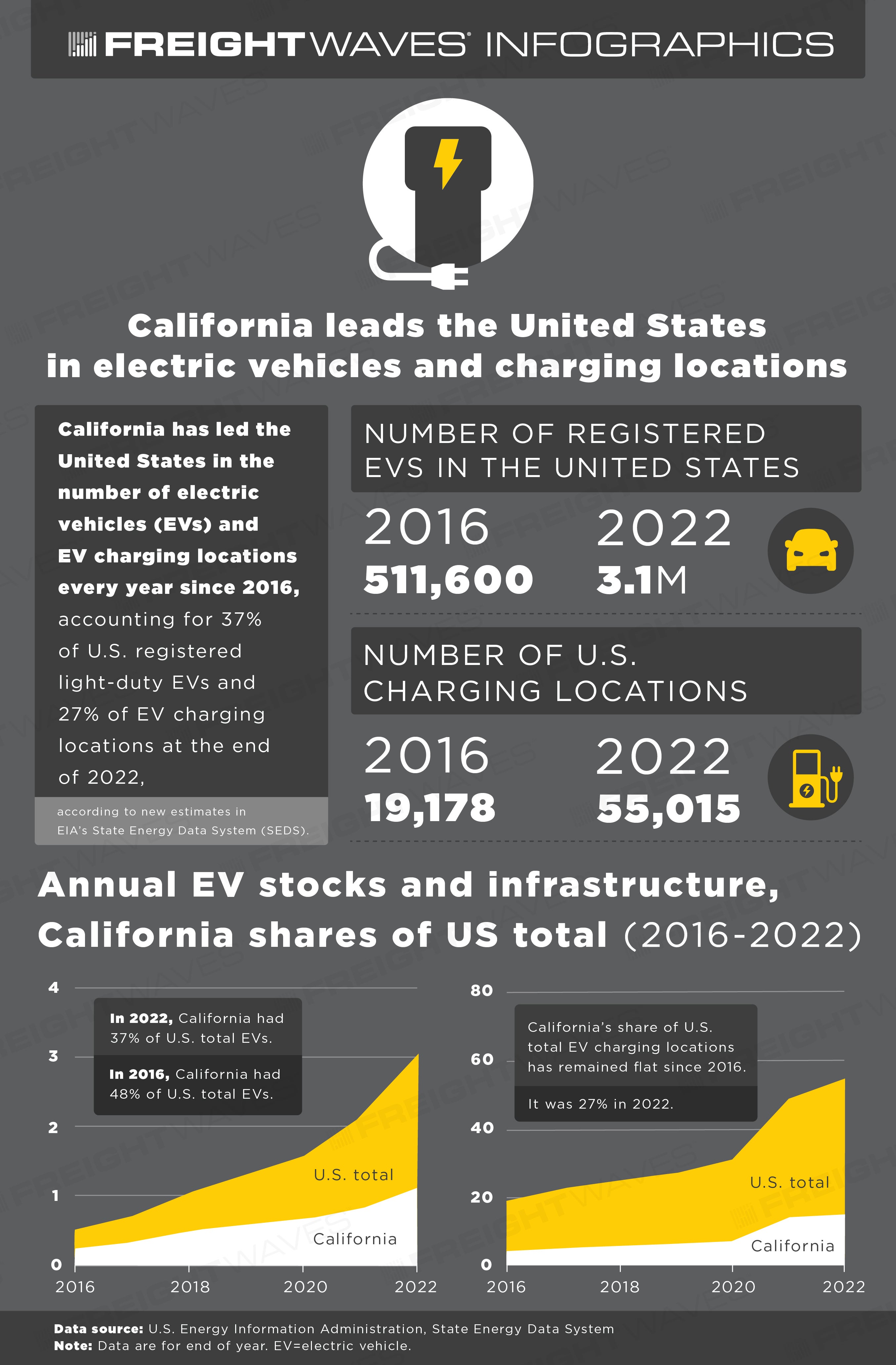
Daily Infographic: California leads the United States in electric vehicles and charging locations


Meaningful volume growth eluded heavy-duty electric trucks last year for several reasons: Charging infrastructure lagged; recalls for battery fires delayed getting many trucks on the road; and money problems imperiled two battery makers.
The news wasn’t all bad, however. Real estate developers invested in and began building electric charging depots. Single-charge driving range improved for early Class 8 electric offerings from two legacy OEMs. A battery-making startup focused on lithium-iron phosphate chemistry achieved more than 600 miles on a single charge, albeit in a passenger vehicle.
Despite the ongoing challenge of matching electric trucks with convenient and reliable charging, 2024 looks like it could shake off some of the growing pains of 2023.
Legacy truck makers will bring next-generation battery-electric trucks to the U.S. after European debuts this year. They have financial heft and engineering might from global operations,
Among the most promising are the eActros 600 from Mercedes-Benz Trucks, expected to offer 310 miles on a single charge. A conventionally styled Freightliner eCascadia will follow production for the second-generation eCascadia. Single-charge driving range improved from 150 miles to 230 miles.
Volvo Trucks North America advertises a range of 275 miles for the VNR Electric with six battery packs instead of four.
Peterbilt and Kenworth will benefit from a new DAF Trucks entry in Europe offering 310 miles on a single charge. That’s more than double the current range of the Peterbilt Model 579EV and the Kenworth T680E. They were among the earliest electric models offered for sale in the U.S.
The long-delayed Tesla Semi began limited production in 2023. It boasts a range of up to 500 miles between charging because it takes on electricity at 750 kilowatt hours. That’s nearly three times the rate of other electric trucks. One Semi covered 1,000 miles in a single workday in September. Tesla CEO Elon Musk’s prediction of 50,000 Semis being produced this year appears the stretchiest of stretch goals.
The North American Council for Freight Efficiency Run on Less Electric Depot studied 10 electric depots and their charging capabilities. It confirmed Tesla’s current charging efficiency dominance among heavy-duty trucks.
The Hyliion Hypertruck ERX natural gas-electric powertrain shown in Peterbilt Model 579 gliders disappeared from view late in 2023. The startup’s board of directors saw no path to profitability. Suppliers raised costs. Serious interest from fleets lacked for a more complex solution to zero-emission driving than a straight battery-electric.
Hyliion pivoted to using Karno generator technology purchased from GE for stationary electric generation. It will be a story to watch in 2024. A recent test using untreated natural gas directly from the Permian Basin showed the generator could achieve heat levels need to generate electricity with an ultra-low emissions profile.
California’s Hybrid and Zero-Emission Truck and Bus Voucher Project (HVIP) provides tens of millions of dollars to help fleets manage the higher upfront cost of acquiring electric trucks. Large fleets have gobbled up much of the money so far. But this will be the last year most will be eligible to get up to $168,000 per Class 8 battery-electric truck.
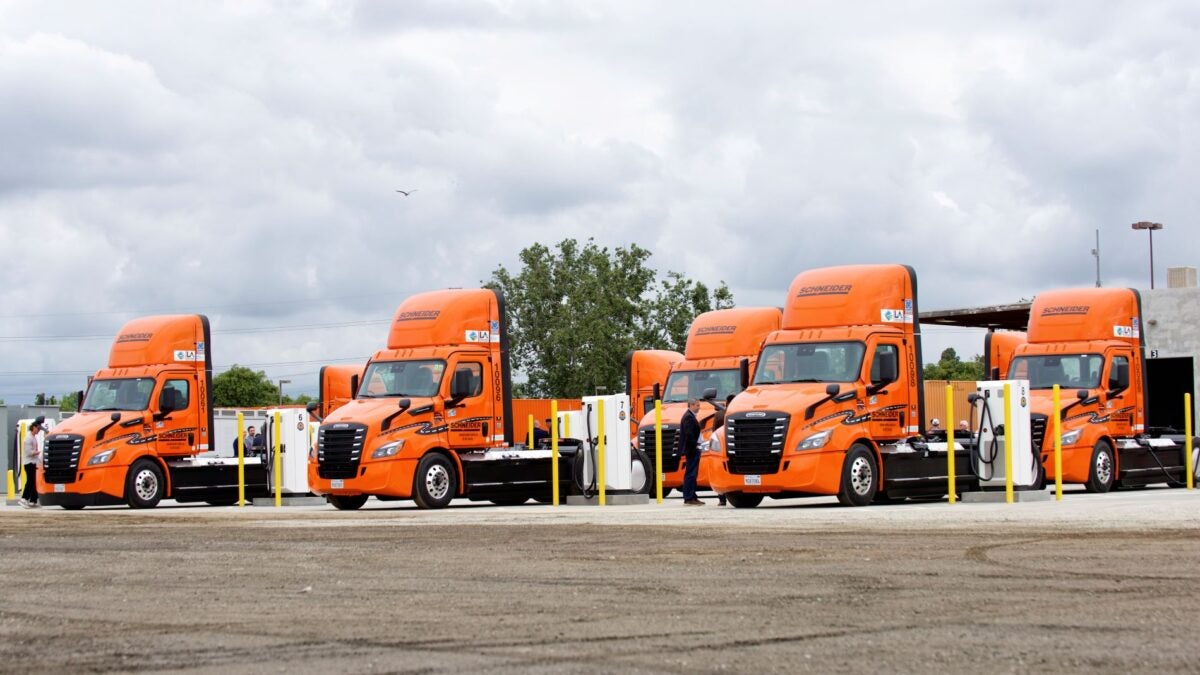
For example, Schneider acquired 50 Freightliner eCascadias through California’s Joint Electric Truck Scaling Initiative. The company added 42 more eCascadias by the end of the year.
HVIP vouchers applied to 30 of them. Environmental Protection Agency funds helped on five. The Volkswagen Environmental Trust that resulted from the “Dieselgate” emissions-cheating scandal in 2015 partially paid for seven.
The 92 electric trucks are among the tops among carriers but represent less than 1% of Schneider’s 10,200 tractors. In November, the Green Bay, Wisconsin-based company celebrated 1 million miles of electric driving. That’s impressive until comparing it to the 9.8 million freight miles Schneider’s fleet amasses every day.
Calstart administers HVIP for the California Air Resources Board. It is shifting the funds to smaller fleets and doubling the discounts available. That includes allowing vouchers to go to truck-as-a-service providers that bundle equipment, maintenance and electricity into a single monthly payment.
Large fleets might end up contracting some of their routes to these independent operators in lieu of buying outright. If the recently delayed Advanced Clean Fleets rule takes effect, fleets of 50 or more trucks will no longer qualify for HVIP incentives.
The exception is for companies that buy more than the required number of electric trucks. They would still qualify for HVIP vouchers for trucks beyond their required quota.
Ten states, including Maryland and Rhode Island in December, have adopted California’s Advanced Clean Truck rule. It requires manufacturers to make higher percentages of zero-emission trucks available over the next two decades.
Expect to see more medium-duty electric trucks this year. For starters, there are imports by Daimler Truck of the Rizon Class 4-5 models and Freightliner’s scaling of the Class 6 eM2 for hub-and-spoke deliveries. An electric chassis for utility and other vocational uses also is in the works.
Medium-duty trucks charge on either direct current or alternating current, so-called Level 2 charging. Level 2 is easier to set up for set routes and return-to-base operations in which trucks charge overnight.
Mack Trucks added Mexico to its markets for its MD Class 6 and 7 electric truck. They will be built alongside diesel-power MD Series trucks in Roanoke, Virginia. Navistar is selling its MV Electric Class 6 and 7 trucks. Production is in the process of moving to San Antonio from Escobedo, Mexico.
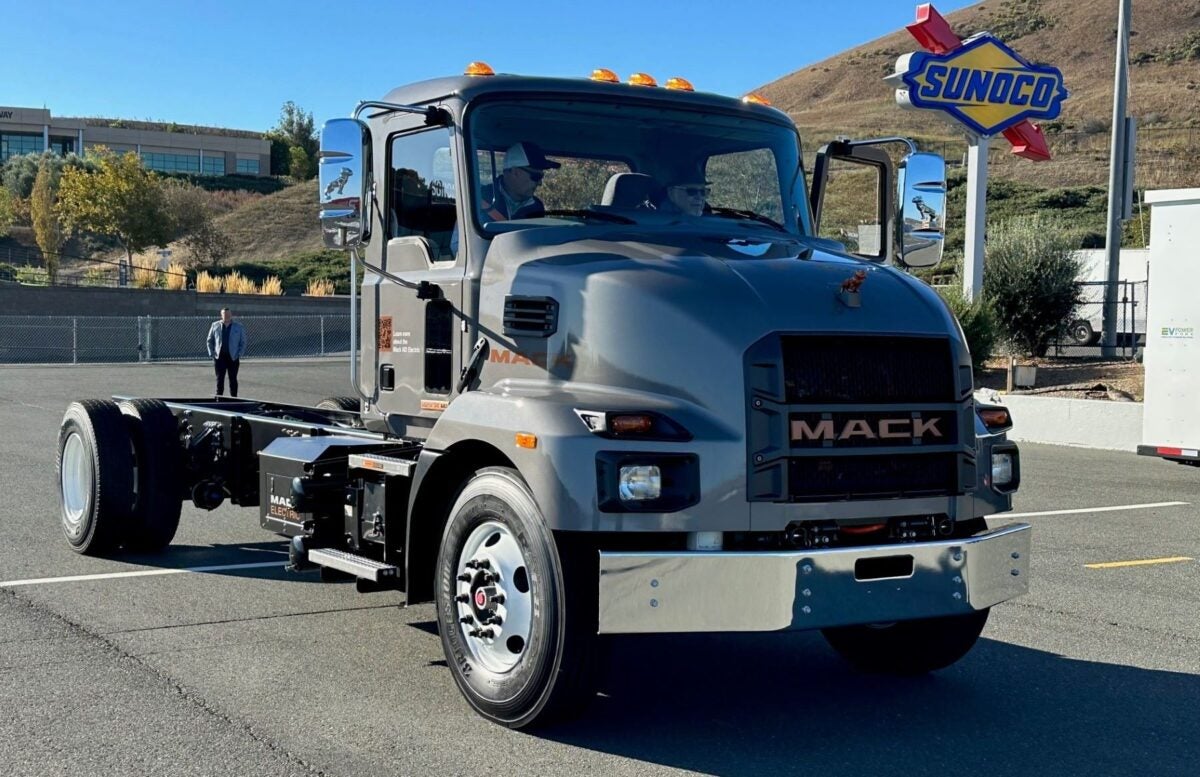
In addition to the Mack MD Electric, Isuzu revealed its first all-electric production model, the Class 5 N-Series EV, and Hino showed the Class 5 M5e cabover and Class 6 L6e conventional medium-duty truck models during Work Truck Week in Indianapolis.
Workhorse Group began early production of its ground up W56 electric step van after abandoning its problem-plagued C-Series electric vans. The oft-troubled company persuaded shareholders to authorize new stock. And it grew its dealership network to eight, including outlets in Southern and Northern California.
The company’s flagging stock price — trading at 37 cents a share Tuesday — brought a delisting warning from the Nasdaq in September. The increased share authorization from 200 million to 450 million shares could allow a reverse stock split that would artificially raise the share price.
Some of the nation’s largest real estate developers, including Prologis and CBRE, and a host of well-funded startups took a shine to electric trucks in 2023. They bought up land and worked with utilities to get multiple megawatts of electricity delivered to electric truck depots.
Fruition of some of those plans will come closer in 2024, though combined they fall far short of the 157,000 truck charging points the California Energy Commission estimated in 2021 would be needed to support 180,000 medium- and heavy-duty electric trucks and buses anticipated by 2030.
Schneider and NFI Industries created their own charging depots for drayage trucks. Schneider is close to fully energizing a 4.8-megawatt facility in El Monte capable of charging 32 trucks at one time. Delays in receiving switchgear delayed NFI’s depot in Ontario, California, until sometime this year.
Startup WattEV opened a public truck charging depot at the Port of Long Beach with plans to open three more in California in Bakersfield, San Bernardino and Gardena.
Forum Mobility supplied Hight Logistics with four electric trucks and charging in Long Beach. It expects to energize a depot capable of charging 90 trucks at one time near the Port of Oakland this year.
The $650 million Greenlane charging infrastructure joint venture of Daimler Truck North America, NewEra Energy and BlackRock Climate Infrastructure hired a chief executive in 2023. It plans medium- and heavy-duty truck electric charging and hydrogen fueling locations on the East and West coasts and the Texas Triangle formed by Austin, Dallas, Houston and San Antonio and connected by Interstates 45, 10 and 35.
The high-voltage batteries key to electric trucks lost two startup players in 2023. Romeo Power was liquidated and its assets sold to Mullen Automotive following Nikola Corp.’s purchase of the struggling company in August 2022. Fires in Romeo battery packs led to an expensive recall and Nikola’s halt in making battery-electric vehicles — at least for the near term.
Volvo Trucks North America also recalled heavy-duty electric trucks because of the possibility of battery fires.
Financially struggling Proterra Inc. entered Chapter 11 bankruptcy reorganization in August. Volvo Group paid $210 million to buy its battery business in November. Proterra supplies Volvo rival Daimler Truck North America’s Freightliner Custom Chassis and Thomas Built Buses as well as Nikola’s hydrogen-powered fuel cell electric truck.
An exception was Our Next Energy (ONE), a Michigan startup supplying lithium-iron phosphate batteries to medium-duty truck makers Motiv Power Systems and the Shyft Group. ONE’s focus on increasing driving range reached 608 miles on a single charge in a BMW iX SUV using a dual-chemistry battery.
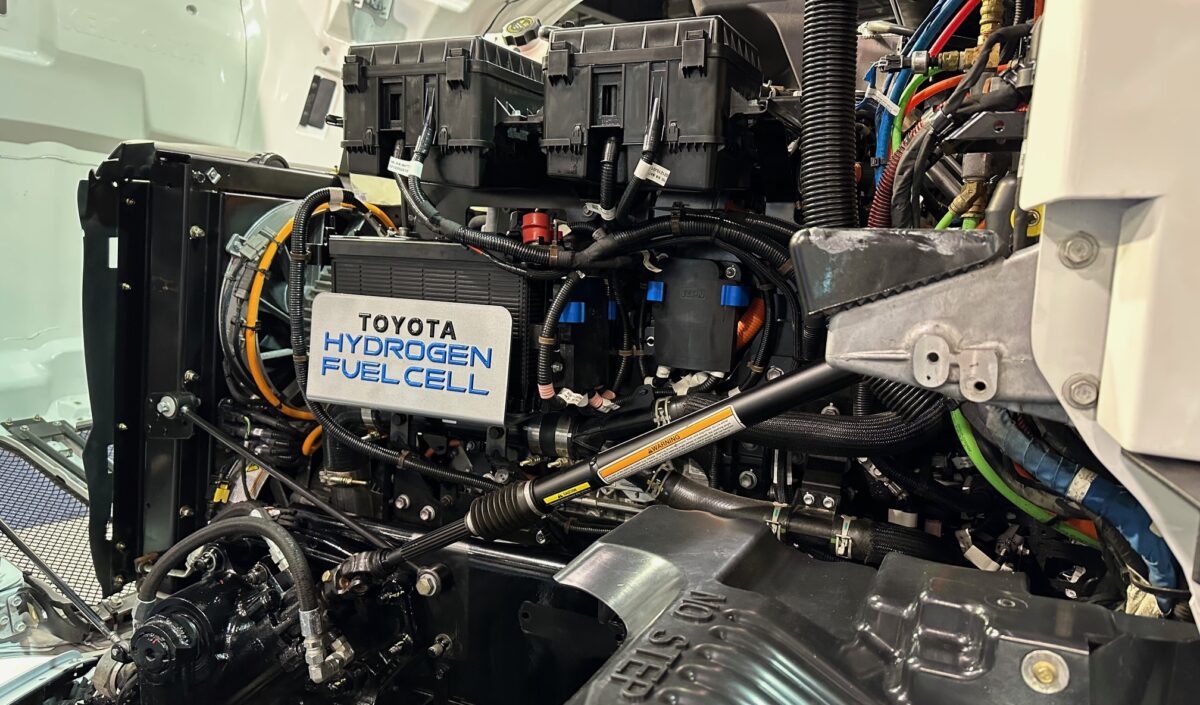
The number of hydrogen-powered fuel cell electric trucks sold can still be counted on fingers and toes. But that number should grow in 2024 as Nikola scales its Tre FCEV aimed at California, where a nascent hydrogen infrastructure exists.
Nikola became a customer of FirstElement Fuel’s hydrogen fueling station near Oakland as part of a 10-year partnership. It is building enough Hyla-branded stations with partners like Voltera to fuel trucks it sells. Most of those will join the move toward drayage electrification, which carry HVIP incentives of up to $288,000 per truck.
Other green shoots:
Federal investment in hydrogen-making hubs could significantly cut the price of hydrogen fuel, but rules from the Biden administration requiring use of renewables like solar and wind power to make green electricity could slow progress.
Nonetheless, Plug Power installed a megawatt electrolyzer at an Amazon distribution center in Colorado to make hydrogen fuel for 225 fuel cell forklifts used there.
Hyliion spikes powertrain business and lays off 175 employees
Nikola asks customers to return electric trucks at risk of fires

While the August demise of less-than-truckload carrier Yellow Corp. monopolized headlines in both mainstream and industry media in 2023 after the 99-year-old trucking firm filed for Chapter 11 bankruptcy protection — the largest filing in U.S. trucking history — a number of smaller trucking companies and brokerages also called it quits or sought bankruptcy protection after a brutal year in the freight industry. Other FreightWaves stories focused on fraud investigations and the mysterious disappearance of an Iowa truck driver, who was last seen by his family on Nov. 20.
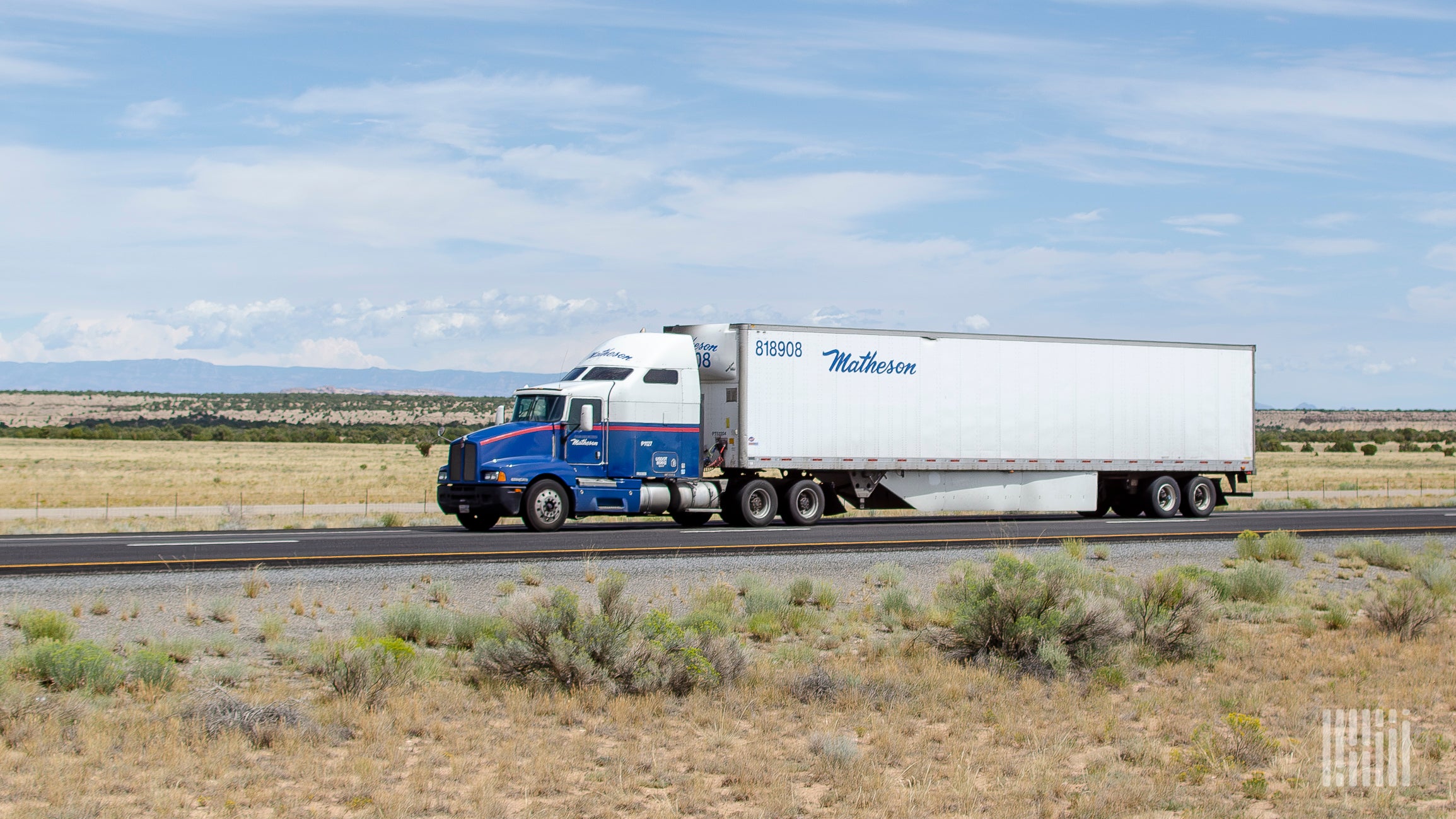
In December, U.S. Postal Service contractor Matheson Trucking and wholly owned subsidiaries Matheson Flight Extenders (MFE) and Matheson Postal Services (MPS) of Sacramento, California, announced plans to wind down operations on Jan. 31, 2024, after six decades in business.
Amid an ongoing financial dispute with the Postal Service, the Matheson entities laid off nearly 3,500 workers over a five-month period, a source familiar with the situation told FreightWaves.
MFE and MPS are wholly owned subsidiaries of Matheson Trucking. The family-owned entities, founded by Robert and Carole Matheson in 1962, filed for Chapter 11 bankruptcy in May 2022. MFE has been providing services to the Postal Service since December 1998. Read the story.
After two years of record growth during the COVID-19 pandemic, Jacksonville, Florida-based Surge Transportation, a digital freight brokerage, sought a buyer and slashed its rates and workforce nearly a year before it filed for bankruptcy protection in late July 2023.
While Surge had hoped to avoid bankruptcy, the company said it had no choice but to file its Chapter 11 petition to gain “breathing room” to allow a new business model — which seeks to raise rates, as well as reduce overhead expenses with fewer employees both in the U.S. and overseas — to “become established without the threat of creditor collection actions or being cut off by motor carrier factors.” Read the story.
Although Pittsburgh-based Elite Transit Solutions is now shuttered after its broker authority was involuntarily revoked by the Federal Motor Carrier Safety Administration in late November, many trucking companies that hauled freight for the brokerage had not been paid since May and no one’s answering the phones. While a number of laid-off employees were eventually paid, carriers weren’t so lucky. Read the story.
Nearly 120 ex-employees were owed about $800,000 in unpaid wages while around 1,300 trucking companies were owed almost $2.7 million after 40-year-old Montana-based Meadow Lark Agency and its affiliate, Meadow Lark Transport, filed for bankruptcy liquidation in early November. Read the story.
Meadow Lark’s broker authority was involuntarily revoked on Aug. 15, and its contract carrier authority was canceled on Oct. 28.
Since May, motor carriers claimed they had been fighting for months to get paid after hauling brokered loads for Meadow Lark.
On Oct. 12, FreightWaves reported that Meadow Lark Transport had abruptly shuttered operations. At the time, the company had 273 drivers and 337 power units, according to the FMCSA’s SAFER website. Meadow Lark’s broker authority was involuntarily revoked on Aug. 15, and its contract carrier authority was canceled on Oct. 28. Read the story.

In May, former Slync.io CEO Chris Kirchner was indicted on federal charges that he defrauded investors out of at least $25 million from the FreightTech startup he helped launch in 2017. Authorities allege he used the money to fund a lavish lifestyle, including a $16 million private jet. Kirchner’s trial is scheduled to start on Jan. 22 in the U.S. District Court for the Northern District of Texas in Fort Worth. Read the story.
While logistics visibility platform provider Slync had hoped that new management and a $24 million cash infusion in February would be enough to save the FreightTech company, the company is proceeding with an alternative option to a traditional bankruptcy and plans to wind down operations and sell off its technology.
The timing of Slync’s filing in October comes nearly three weeks after Kirchner filed suit against his former employer for legal fee advancement and indemnification in Delaware’s Court of Chancery. Kirchner sought to have Slync pay his legal bills in his ongoing fraud case after his assets were frozen by the feds. Read the story.
In late September, a federal judge ruled that Total Quality Logistics — the second-largest freight brokerage in the U.S. — violated federal law and owes overtime pay to thousands of former employees who worked more than 40 hours a week.
Judge Michael Barrett of the U.S. District Court for the Southern District of Ohio issued his ruling almost 18 months after a 12-day bench trial ended in early March 2022. He ordered TQL to pay overtime wages to the employees and an additional amount equal to the actual damages. Barrett also found Ken Oaks, chief executive and co-founder of TQL, personally liable. Read the story.

Iowa truck driver David Schultz, 53, of Wall Lake, Iowa, has been missing since early Nov. 21. Sarah Schultz told FreightWaves she last saw her husband around 7 p.m. on Nov. 20 when he dropped by the house to grab a change of clothes before heading out to pick up another load of pigs.
What happened next remains a mystery as local, county and state law enforcement agencies are still searching for answers — and Dave. Read the story.
Owner-operators Toni and Chris Murphy of New Egypt, New Jersey, share their story of a tech-savvy fraudster who stole their trucking company’s identity, posted loads using their Department of Transportation number, collected payment for those loads, then disappeared, leaving the Murphys to deal with the fallout. Their story resonated with carriers and brokers, who shared similar tales of dealing with identity fraud in 2023. Read the story.
In January, former trucking company co-owner Nolan DeWall, 39, of Cedar Falls, Iowa, was sentenced in the U.S. District Court for the Northern District of Iowa to a year and a day in federal prison.
DeWall had pleaded guilty seven months earlier to one count of bank fraud for his role in orchestrating an elaborate $250,000 check kiting scheme. He also faced unrelated charges in state court that he allowed more than 800 pigs to starve or freeze to death in his care in December 2021. Read the story.
A previously convicted fraudster, Franklin Ray, 52, of Canton, Michigan, was sentenced to more than 17 years in federal prison for his role in multiple fraud schemes, including bilking investors out of $40 million in a truck investment venture.
He was sentenced in late November in the U.S. District Court for the Southern District of New York after pleading guilty in March to four counts of wire fraud, including one count while he was released on bail.
Ray admitted that over a 10-month period — June 2021 until April 2022 — he defrauded 275 investors in CSA Business Solutions LLC, headquartered in Imlay City, Michigan, telling them he had 4,704 trucks and 4,909 drivers when he only had two trucks and four drivers. He purportedly told investors that he used the $40 million to purchase over 2,000 trucks. That wasn’t the case. Read the story.
Do you have a news tip or story to share? Send me an email or message me @cage_writer on X, formerly known as Twitter. Your name will not be used without your permission.

Kenworth Truck Co. veteran Jim Walenczak has been named general manager of the Paccar Inc. brand and vice president of the parent company.
Walenczak has worked at Paccar for 13 years. His previous responsibilities included Kenworth assistant general manager for sales and marketing. He also served in fleet, region and general sales manager positions at the century-old brand. He also was assistant general manager of operations at Paccar Parts.
Walenczak succeeds Kevin Baney. He will serve as Paccar senior vice president responsible for Kenworth, the Paccar Information Technology Division and Dynacraft, an advanced manufacturing business focused on parts assemblies.
“This is a dynamic and exciting time in the transportation industry. And I am honored to step into this new role at Kenworth at a time when we are building on our core values of quality, innovation and technology to create the transportation solutions our customers need and want,” Walenczak said in a news release.
Walenczak holds a Bachelor of Arts degree in marketing from Michigan State University. He has a Master of Business Administration degree from the University of Washington. He attended the Stanford Executive Program in 2023. Walenczak is based at Kenworth headquarters in Kirkland, Washington.
Kenworth celebrates century of truck making with special editions
Kenworth taps another former chief engineer as general manager

Short line rail operator Genesee & Wyoming (G&W) announced Tuesday that Grupo Mexico Transportes (GMXT) will become its partner in CG Railway LLC, a rail car-ferry operation linking ports in the U.S. and Mexico.
GMXT is purchasing Seacor Holdings Inc.’s stake in CG Railway. Seacor and G&W initially formed the joint venture in 2017 to own and operate CGR, which provides rail car-ferry service between the ports of Mobile, Alabama, and Coatzacoalcos, Mexico.
“This further strengthens our partnership with GMXT, a leader in rail transportation services in Mexico with a strong presence in the southern U.S., including 13 ports between the two countries,” Michael Miller, CEO for G&W North America, said in a news release.
Mobile-based CG Railway operates a U.S. Class III freight railroad and two ferry ships, transporting up to 10,000 carloads of commodities annually across the Gulf of Mexico.
CG Railway’s ferry service offers weekly trips between the ports of Mobile and Coatzacoalcos. The service gives shippers access to 13 ports in the U.S. and Mexico through rail interchanges in both countries.
“Their network access and expertise, coupled with G&W’s ability to deliver safe and customer-centric first- and last-mile rail service, will enhance CGR’s overall service offering while extending the reach of CGR’s efficient and secure rail service into and out of Mexico,” Miller said.
Terms of the agreement were not disclosed.
GMXT is a subsidiary of Grupo Mexico, the largest freight train company in Mexico. The conglomerate, which also includes rail company Ferromex, operates more than 6,835 miles of track that connects Mexican ports to major markets in the U.S. and Canada.
Grupo Mexico also recently purchased a 60% stake from Rail Ferry Investment Holdings Inc. in two Mexican companies providing maritime transport service for rail cars between the U.S. and Mexico.
Financial details of the transaction were not disclosed.
GMXT’s purchase of stakes in Golfo de Mexico Rail Ferry Holdings LLC and Rail Ferry Vessel Holdings LLC are also part of the company’s objective to capitalize on the $2.8 billion Interoceanic Corridor across the Isthmus of Tehuantepec from Mexico’s federal government.
“The acquisition allows GMXT to continue consolidating its position as a leading freight transportation company in the region, strengthening its commitment to Mexico and the south of the United States,” GMXT said in a news release.
The 188-mile corridor will include 10 new industrial parks along the railway connecting the country’s Pacific port of Salina Cruz with the Gulf Coast hub of Coatzacoalcos in Veracruz state.
A passenger rail component of the Interoceanic Corridor was launched on Dec. 22.
More articles by Noi Mahoney
Canadian trucking company suspended after multiple overpass crashes
Thieves spirit away 19,000 bottles of tequila from US distributor
Truck driver apprehended after 3-hour standoff on Texas highway
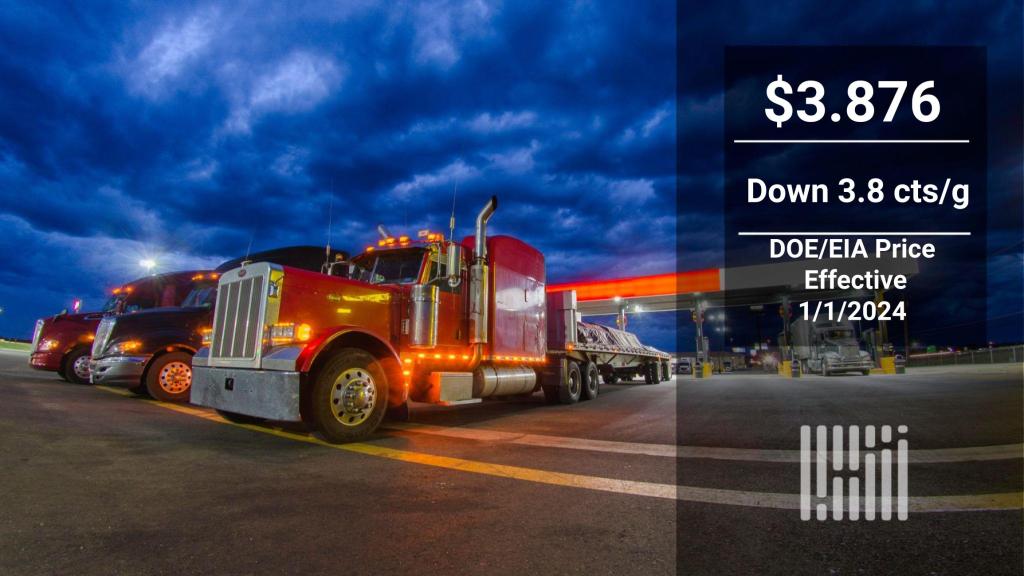
After an eight-week run of falling prices was interrupted a week ago by an increase, the weekly diesel benchmark price used for most fuel surcharges has moved down again.
In a price posted Tuesday but dated Jan. 1, the average weekly retail diesel price posted by the Department of Energy/Energy Information Administration declined by 3.8 cents, to $3.876 a gallon. It’s the ninth decline in the past 10 weeks and the 12th in the past 15. The decline offsets last week’s increase of 2 cents a gallon and brings the price down 75.7 cents from the $4.633-a-gallon where it stood on Sept. 18, the price posted by DOE/EIA before the run of mostly declines began.
After a surge of prices caused by a combination of short covering after a long decline, and concern about supply impacts from ship diversion away from the Red Sea and Suez Canal, markets trended downward over the final trading days of 2023 and the first day of 2024.
Ultra low sulfur diesel on CME reached a peak settlement of $2.7168 a gallon on Dec. 19, up from $2.5074 just four trading days earlier. Since then the price of ULSD declined seven of the next eight trading days, with the market settling Tuesday at $2.5258 a gallon, a drop of 19.1 cents from that Dec. 19 high.
The downward move in markets Tuesday came after prices moved higher at the start of post-New Year’s Day trading. West Texas Intermediate crude, the U.S. benchmark, traded as high as $73.64 a barrel before an ultimate $1.27 downward move from Friday’s settlement to $70.38 a barrel. With a low price for the day at $70.06 a barrel, trading swung more than $3.50 a barrel between low and high.
The fading of the Red Sea/Suez concerns came even as Maersk said Tuesday that it was going to continue to avoid that route following a new round of attacks by Houthi rebels on shipping.
There is a clear lack of bullish reaction to the Red Sea/Suez crisis in the oil markets, and Helima Croft, managing director and global head of commodity strategy at RBC Capital, suggested on CNBC Tuesday that such a view might be shortsighted.
“Oil market participants are essentially saying, ‘I will believe a disruption when I see it,’” Croft said. “So yes, you’ve had some run-up in prices. But given the importance of this region in terms of shipping of crude, it’s not really reflecting the ratcheting up of tensions.”
The run-up Croft referenced is in the rearview mirror. The price of Brent, the world crude benchmark, settled Tuesday on CME at $75.90 a barrel, down $5.18 a barrel from just four days earlier.
“Traders are saying, ‘Look, we’ve had problems in the Middle East before. Tell me why this is different,’” Croft said. “I think it’s materially different, but right now, we’ve had no major disruption of oil supplies.”
She noted that many traders “got burned” when the price of oil surged after Russia’s invasion of Ukraine almost two years ago, but the higher prices did not stick.
Brent peaked at a settlement of $123.89 a barrel on March 8, 2022, a few weeks after the invasion. But it dropped below $100 a barrel on Aug. 30 and has not returned to that level since.
More articles by John Kingston
SoCal warehouse emissions rule and possible impact on trucks upheld by judge
California holds off on only allowing zero-emission vehicles in drayage registry

Maersk, the world’s second-largest ocean carrier, gambled that a U.S.-led military force, Operation Prosperity Guardian, would allow safe passage through the Red Sea. That gamble has failed.
On Tuesday, Maersk said it will suspend Red Sea transits indefinitely and reroute ships around Africa’s Cape of Good Hope. The decision followed attacks on the container ship Maersk Hangzhou, which was struck by a Houthi rebel missile on Saturday and threatened by four Houthi boats on Sunday.
Armed guards on the Maersk Hangzhou exchanged fire with the Houthis, whose boats approached within 70 feet of the container ship before U.S. military helicopters intervened. After the Houthis fired on U.S. forces, the helicopters took out three of the four boats, killing 10 Houthi rebels.
The attacks in the Red Sea continue. U.S. Central Command confirmed that the Houthis fired two anti-ballistic missiles on Tuesday that landed in the vicinity of passing commercial ships. The Houthi spokesperson confirmed Wednesday that the missiles were targeting the container ship CMA CGM Tage.
As supply chain issues mount and missile launches persist, there is an increasing likelihood of ground strikes in Yemen by the U.S.-led coalition.
On Wednesday, the coalition gave a final warning to the Houthis: “Let our message now be clear: We call for the immediate end of these illegal attacks and release of unlawfully detained vessels and crews. The Houthis will bear the responsibility of the consequences should they continue to threaten lives, the global economy, and free flow of commerce in the region’s critical waterways.”
Intensified military action in the Red Sea is causing container shipping spot rates and some container shipping stocks to surge.
For cargo importers, the outlook is now clear: higher freight costs and longer delays. For liner profits, sentiment is increasingly bullish — but there are uncertainties.
Spot rates and surcharges are rising fast, but liner costs are also increasing due to much higher fuel consumption from longer voyages, as well as other expenses (offset by savings on canal tolls). Meanwhile, quarterly liner cargo volumes could be hard-hit in the near term as ships are tied up in diversions.
Maersk had 38 vessels scheduled to transit the Red Sea en route to Europe and the U.S. East Coast prior to Tuesday’s announcement, plus another 25 ships with routes labeled “to be determined.” These vessels will now presumably take the longer route.
Different spot rate indexes use different methodologies and come up with different rate assessments, but they all point to the same steep upward trend.
The Shanghai Containerized Freight Index (SCFI) spiked 40% in the week ending Friday, to 1,760 points, its highest level since October 2022. The SCFI has more than doubled since this October.
Linerlytica said Monday that the latest week marked only the fourth time since 2009 that the SCFI increased 40% or more in a single week.
“All long-haul routes recorded strong rate gains, led by Asia-Europe trades, with the elevated rates expected to hold through January and February as capacity will remain tight in the next six weeks,” said Linerlytica, which noted that 12% of global capacity is already being diverted and those numbers “will continue to rise after the latest Houthi attack.”
Platts, a division of S&P Global (NYSE: SPGI), put Tuesday’s spot rates on the North Asia-Mediterranean route at $5,000 per forty-foot equivalent unit, more than double rates of $2,300 per FEU on Dec. 26 and more than triple rates of $1,600 at the beginning of December.
Platts assessed North Asia-North Europe rates at $4,500 per day on Tuesday, up 150% from Dec. 26 and 221% from Dec. 1.

Most Asia-U.S. East Coast services rerouted from the Panama Canal to the Suez Canal due to Panama’s drought, meaning that Red Sea attacks are affecting rates in this lane as well. And even though Asia-West Coast services are not directly affected, they too are feeling a knock-on effect, according to Platts’ data.
Platts put Southeast Asia-U.S. East Coast rates at $4,100 per FEU, up 86% since the beginning of December, and Southeast Asia-U.S. West Coast rates at $2,900 per FEU, up 81%.
It assessed North Asia-U.S. East Coast rates at $3,800 per FEU, up 65% versus the beginning of December, and North Asia-U.S. West Coast rates at $2,800 per FEU, up 78%.
Xeneta tracks both short-term (spot) and long-term (contract) rates. According to its data, average short-term rates on the Far East-Mediterranean route had skyrocketed to $3,589 per FEU as of Tuesday, spiking 48% in just the past few days.
The short-term average in this lane is now more than twice the average long-term rates signed in the past three months of $1,504 per FEU.

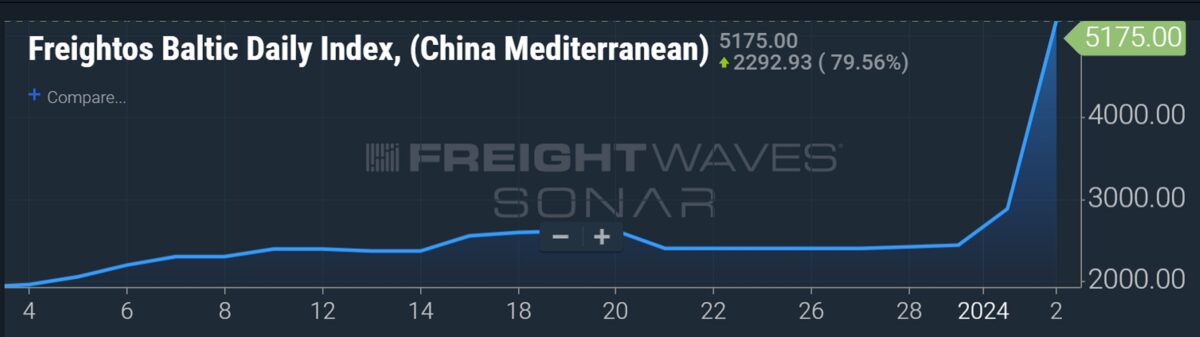
The Freightos Baltic Daily Index (FBX) also shows the extreme impact of Red Sea disruptions. As of Tuesday, the FBX China-Mediterranean rate was at $5,175 per FEU, up 80% from the day before and 2.6 times higher than rates at the beginning of December.
Trading shares of Zim (NYSE: ZIM) is the most popular way for stock pickers to bet on how spot shipping rates will affect future container liner earnings.
The Zim stock roller-coaster ride continued on Tuesday and Wednesday.
Between Dec. 1 and Dec. 22, Zim’s stock surged 60% as a result of sectorwide diversions around the Cape of Good Hope, a positive for spot rates. (Diversions reduce effective transport supply, pushing the balance of transport supply versus cargo demand in favor of liners.)
On Dec. 24, Maersk announced it would resume Red Sea transits under the protection of Operation Prosperity Guardian. When stock markets reopened after the Christmas holiday break on Dec. 26, Zim’s stock plunged as much as 18% in midday trading on more than quadruple average volume, on the assumption that fewer diversions would be negative for spot rates.
When markets reopened after the New Year’s holiday break this Tuesday, Zim’s stock jumped 13% on more than double average volume as a result of the deadly military action over the weekend and Maersk’s decision to not transit the Red Sea, after all. Zim’s stock gained a further 10% on Wednesday on more than triple average volume.
Click for more articles by Greg Miller
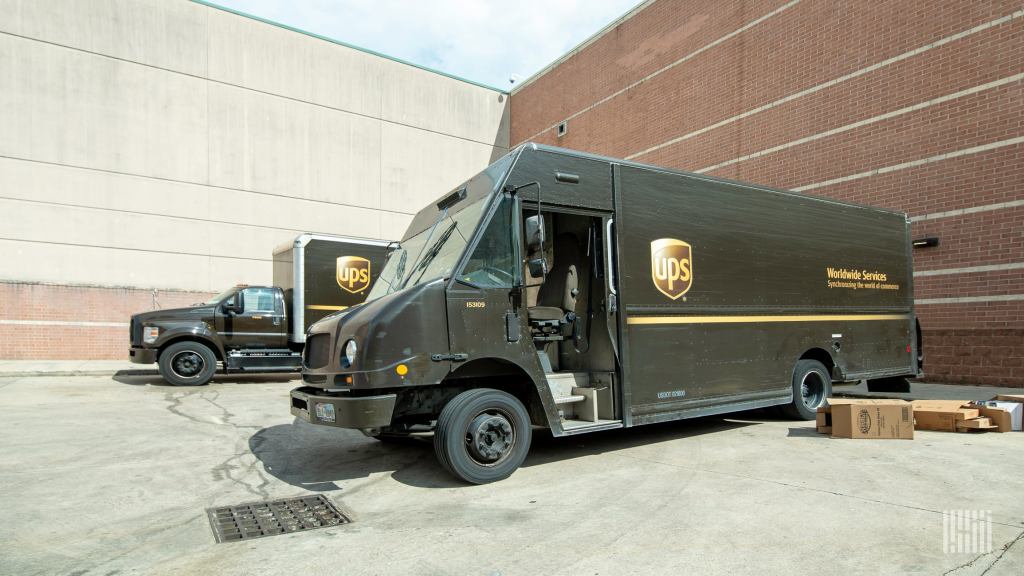
UPS Inc. said it will close its daytime package sorting operations at its Centennial ground hub in Louisville, Kentucky, on Feb. 16, citing reduced volumes.
In a statement, the Atlanta-based company (NYSE: UPS) said that “packages equal jobs, and we need to match capacity and the number of jobs with current package volume.”
The statement did not mention how many employees might be affected by the impending closure. Nor did it disclose package volumes at the daytime sort or how much they’ve declined.
In a Facebook post published last week when the news began circulating in Louisville, Teamsters Local 89, the local representing UPS workers in the area, said it did not know how UPS plans to execute the closure. The local has scheduled meetings with UPS management to discuss the plan. Local media outlets first reported news of the impending closure.
The local said, however, that it doesn’t expect a massive impact on its membership because the Centennial day shift sort is a relatively small operation and that most or all of its volume, as well as affected employees, could be absorbed by the larger sort operations at the facility.
Louisville is also home to UPS’ primary air cargo hub known as Worldport.

A Canadian trucking company has been ordered to cease operations after one of its drivers hit a highway overpass in the province of British Columbia on Thursday, causing infrastructure damage and delaying traffic for hours in the region.
The British Columbia Ministry of Transportation said it’s the sixth crash involving Chohan Freight Forwarders and an overpass in the past two years. A Chohan-driven truck also struck the same overpass in February 2022.
“This suspension is a result of the company’s unwillingness or inability to operate safely within the province,” British Columbia Transportation Minister Rob Fleming said in a news release. “Furthermore, the driver and the carrier responsible will face the toughest fines in the country. The outcome of the investigation could lead to further action.”
Chohan Freight Forwarders’ safety certificate was suspended on Friday by the British Columbia transportation ministry. The carrier is based in Langley and has 65 trucks, according to officials.
The accident occurred around noon on Thursday, when a Chohan Freight Forwarders’ truck carrying large steel girders struck the overpass along Highway 99 and 112th Street in the city of Delta.
The accident shut down both lanes of Highway 99, as well as the 112th Street overpass, for several hours. Authorities said one person at the scene was taken to a hospital by an ambulance and was reported in stable condition.
Chohan Freight Forwarders officials did not immediately respond to a request for comment from FreightWaves.
In a statement to CBC News, a Chohan spokesperson said the company follows all safety protocols and is cooperating with agencies investigating the accident.
“Unfortunately, one of our trucks operated by an owner-operator was involved in an accident today in Delta,” the spokesperson told CBC News. “The driver, who is not a company driver, failed to wait to receive his permit and route directions for his oversized load.”
The company blamed Thursday’s crash on driver error.
“At approximately 12:22 p.m., our safety department received a phone call from the driver stating that his load was oversized. Our safety manager advised the owner-operator to wait while he obtained the permit,” the spokesperson for Chohan Freight Forwarders said. “Within eight minutes, the safety manager received a call from the owner-operator advising that he had crashed into the overpass.”
Chohan Freight Forwarders was also responsible for overpass strikes on Dec. 10, 2021, at the 192nd Street Highway 1 overpass; on Feb. 12, 2022, at the 264th Street Highway 1 overpass; on Feb. 17, 2022, at the 112th Street Highway 1 overpass; and on June 8, 2022, at the Highway 1 overpass and No. 3 Road.
After the crash on June 8, 2022, the transportation ministry briefly suspended Chohan Freight Forwarders from operating. The suspension was lifted June 30, after the carrier provided authorities with a revised safety plan.
On April 11, a truck belonging to Chohan Freight Forwarders slammed into a house in the city of Kelowna. A woman and her grandson were trapped by the crash and had to be rescued, according to the Nanaimo News Bulletin.
The British Columbia Ministry of Transportation recorded 17 overpass collisions involving tractor-trailers in 2023.
On Dec. 14, the transportation ministry announced new rules and stricter fines for carriers involved in accidents, including the requirement for dump-style vehicles to have in-cab warning devices notifying drivers if their trailers have not been lowered.
Over-height vehicle fines increased from $115 to as much as $575, the highest in the country, according to a news release.
“Infrastructure crashes have a huge impact. … They delay commuters, affect the movement of goods and can impede first responders,” Fleming said in a statement. “That’s why we’re taking tougher action, grounding fleets through suspensions and increasing fines.”
More articles by Noi Mahoney
Thieves spirit away 19,000 bottles of tequila from US distributor
Truck driver apprehended after 3-hour standoff on Texas highway
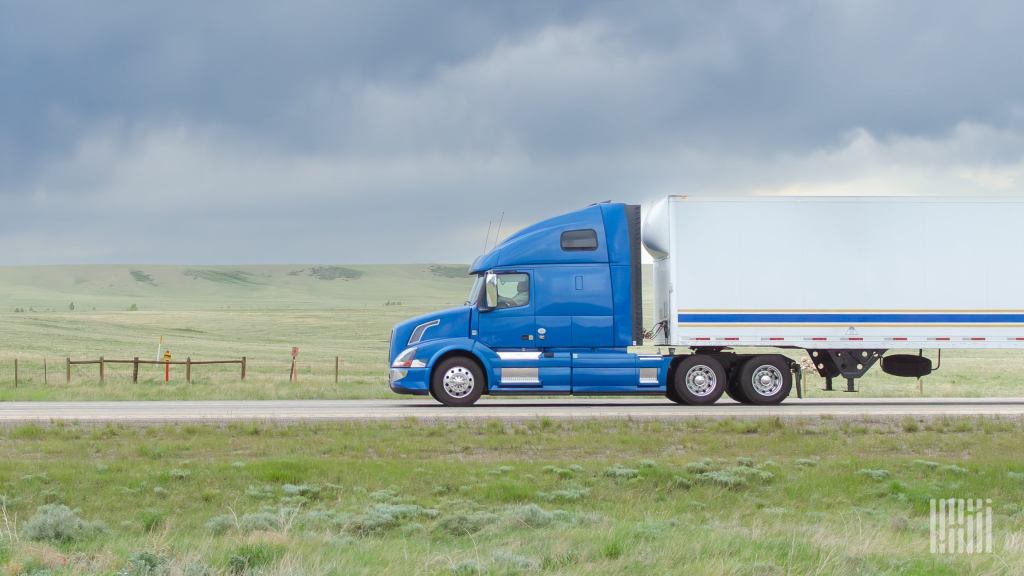
Transportation metrics slid again in December with capacity increasing at a faster pace and prices declining at a higher rate, according to a monthly survey of supply chain executives. However, there was some optimism that the cycle may turn in the new year.
The Logistics Managers’ Index (LMI) registered a 63.3 reading for transportation capacity during the month, which was 1.5 percentage points higher than in November. The LMI is a diffusion index where a reading above 50 indicates expansion while one below 50 signals contraction. The growth rate of transportation capacity was 10 points higher in the second half of the month than it was in the first half.
Transportation utilization (54.6) was 4.6 points higher in the month. The metric was up 8 points in the back half of the month, which the Tuesday report attributed to last-minute holiday-related shipments.
Transportation prices (43.1) declined again, down 1.1 points from November. The pricing index appears to have bottomed in May at 27.9, with the rates of contraction more subdued over the past five months. Lower fuel prices, which result in lower fuel surcharges, were cited as a reason for the decline.
“Fuel prices were one of the major drivers of supply-based inflation over the last two years, a decrease in costs would continue to push inflation down and help to revive the freight sector in 2024,” the report said.
Respondents were asked to predict conditions one year out. The forward-looking expectation for transportation capacity was 51 with prices coming in at 70.3.
“Both numbers would represent a major shift and clear ends to the freight recession that we have been mired in since April of 2022,” the report said.
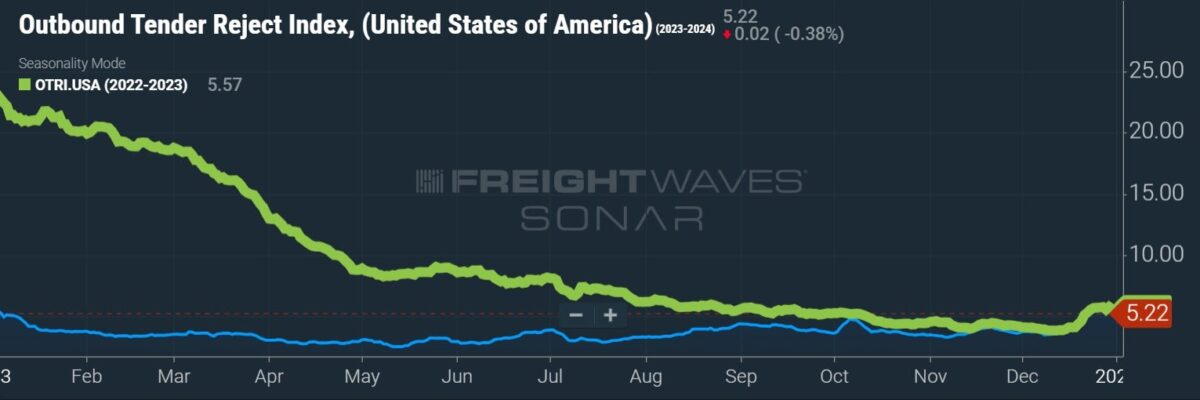
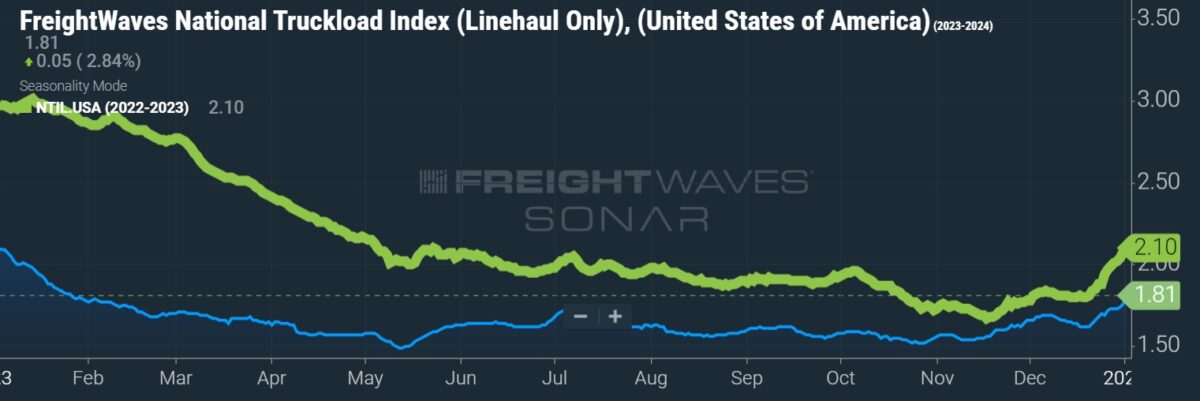
The overall LMI (50.6) moved backed into expansion territory during December. It has largely hovered around 50 over the past five months with October being the outlier at 56.5.
The move was largely the result of increases in the data set’s warehousing components. Warehousing capacity (55.1) grew at a slower pace in the month as utilization (60.2) increased 7.3 points and prices (65.5) were up 1.3 points.
Warehouse space was tight for retailers, or downstream companies, contracting at a rate of 43.9 compared to an expansion rate of 60.6 for upstream firms at the wholesale and manufacturing levels of the supply chain. Downstream respondents are predicting a surge in warehouse prices (79.7) over the next year.
Inventory levels (44.3) declined at the same pace they did in November. The index has contracted in seven of the past eight months as retailers appear to have returned to just-in-time inventory practices, which props up transportation utilization.
“It will be interesting to see if that changes in the new year or if this is the low point and manufacturers and wholesalers will begin building inventories up again,” the report said.
Downstream respondents returned a neutral response for inventory levels one year from now, but those upstream said they would be growing stockpiles over that time (56.2), which the report said was “the clearest sign yet that retailers are looking to get back to JIT and get off the inventory roller coaster they have been riding over the last few years.”
Inventory costs (55.8) were off 6.3 points during the month and grew at the lowest level ever recorded in the 7-year-old data set. This cost index has never crossed into contraction territory. Inventory costs were 15.9 points higher at the retail level of the supply chain.
Actions deployed post-pandemic to reduce inventories may result in more normal seasonal shipping patterns this year, the report said.
“Inventories have been lean for months, but as we go into 2024 with a year of inventory reduction practices under our belt, it is likely that the normal seasonality that leads to capacity utilization in warehousing — and particularly freight — will return.”
The forward-looking prediction for the overall index was 59.9 in December, 2.5 points higher sequentially and near the data set’s historical average of 62.5.
The LMI is a collaboration among Arizona State University, Colorado State University, Florida Atlantic University, Rutgers University and the University of Nevada, Reno, conducted in conjunction with the Council of Supply Chain Management Professionals.
More FreightWaves articles by Todd Maiden