FIRESIDE CHAT TOPIC: The challenge for shippers to track scope 3 emissions and select carriers that pollute less.
DETAILS: Alex Scott, associate professor of supply chain management at the Haslam College of Business, University of Tennessee, joins FreightWaves to talk about the difficulties in measuring carbon emissions in the supply chain and how to get to net-zero emissions.
KEY QUOTES FROM SCOTT:
On gaining carbon visibility: “What we are trying to do is get shippers’ and brokers’ and 3PLs’ insights into the sustainability profile of all these carriers out on the road so they can consider that in their decision-making, along with price, service and safety. … The scope 3 emissions are particularly challenging in the trucking sector because there are so many carriers out there. If you are a shipper and you use a broker that broker may have 10 or 20,000 carriers that they use. So how can that shipper then quantify their emissions of the carriers they are using?”
On regulatory compliance: “You have this coming from a variety of angles. So the EU regulations don’t look exactly as the California regulations. We don’t know what the SEC regulations will look like. You have different standards boards. … So I think there needs to be some standardization. Trucking is a perfect area for standardization. Tons of shippers, tons of carriers. Why should they all do different things? They should do the same thing so we can compare apples to apples.”
On corporate implementation: “Newer trucks are cleaner. So to marginally improve in the short term your emissions as a shipper, you can avoid those really dirty carriers. … You can now look at individual carriers and say, ‘OK, I see the trucks they are operating. They are 20% higher emissions than these other carriers. So, if you can avoid those carriers or incentivize them in some way to update their equipment, then that can reduce your emissions in the 5%, 10%, 15% level.”
Cybercriminals are only getting smarter: NMFTA’s Banks
This fireside chat recap is from FreightWaves’ Domestic Supply Chain Summit on Wednesday.
FIRESIDE CHAT TOPIC: Navigating cybersecurity challenges in the supply chain industry.
DETAILS: Antwan Banks, director of enterprise security at the National Motor Freight Traffic Association, an LTL trade group, sat down with FreightWaves’ Grace Sharkey to discuss the rising challenge from cybersecurity bad guys attacking enterprises and individuals.
KEY QUOTES FROM BANKS:
On more sophisticated attacks: “It’s starting to change now with artificial intelligence. Cybercriminals are always one step ahead, so they’re starting to incorporate artificial intelligence into their attacks. They’re using ir to make better phishing emails to make them harder to identify. They can now make phone calls and trick people to believe they’re talking to a superior or to a leader and to transfer money to places.”
On investing in cybersecurity: “Cybersecurity doesn’t make money. It’s not a profit center. It actually costs money. But what it does do is save you money in the end. If you don’t have cybersecurity and you are buying time-sensitive data and that data is exposed, it could put your business out of business.”
On those who get it: “If I’m talking to executives, they understand risks. They don’t understand the geek speak in the technical ones and zeros but they understand risk and they understand dollars and cents. And so you have to walk them through to make them understand their risk appetite.”
On simple prevention: “Phishing is the No. 1 way hackers get in. Ninety to 95% of successful attacks take place through phishing. So I always tell people to take care of the low-hanging fruit. First train your employees, because they are the weakest link. A company can spend tens of millions of dollars on the latest and greatest tools. But an employee can leave the door open or click on an email and all that investment is for nothing.”
This fireside chat recap is from FreightWaves’ Domestic Supply Chain Summit on Wednesday.
FIRESIDE CHAT TOPIC: Generative AI and its impact on the supply chain.
DETAILS: Mike Branch, vice president of data and analytics at Ontario-based Geotab, joins FreightWaves’ Thomas Wasson to talk about generative AI and its possible impacts on the domestic supply chain. Geotab provides telematics — vehicle and asset tracking — solutions to more than 50,000 customers in 160 countries.
KEY QUOTES FROM MIKE BRANCH:
“Nobody really asked us, ‘Hey, Geotab, take generative AI and mash it into your platform and make it work for me.’ But what people do ask is, ‘How can I get better insights more quickly?’ And we hypothesize that generative AI is a great way to do that. It’s a great way for you to have a conversation with your fleet. So we started that journey on generative AI this year.”
“[Generative AI] puts the power in the hands of those who have the capability to make change, whether you’re the chief sustainability officer or if you’re the fleet manager or if you’re somebody who doesn’t understand how to write a query to extract the data — you shouldn’t need to — but you have a question of the data and you simply want it answered. And this democratizes it quite a bit.”
“This year has been the year of hype for generative AI. I think next year will be the year of trust. … We think this will help move the industry forward.”
Funding tighter but still ‘a lot of innovation’ in FreightTech
This fireside chat recap is from FreightWaves’ Domestic Supply Chain Summit on Wednesday.
FIRESIDE CHAT TOPIC: Today’s investor priorities in FreightTech.
DETAILS: The landscape for investment in transportation and logistics technologies has changed. Todd Fowler, director of strategic partnerships at VC Autotech Ventures, highlights what is attracting investor interest in today’s market.
KEY QUOTES FROM FOWLER:
“We see a lot of innovation in the FreightTech space. Everyone’s attracted to anything that’s AI, but we’re seeing a lot of specific innovation in the cash payment processing cycle. It’s not super exciting, but it’s something that helps the efficiency in the back office. We’re also seeing a lot of interesting technologies within the warehouse — a lot of things related to robotics and technology. The last big area where we’re seeing interest: We know the transition to fully autonomous [trucking] isn’t going to happen overnight, so we’re seeing a lot of bridging applications, from where the environment is now to where it’s going to be 10, 15 years down the road.”
On how Autotech Ventures vets startups: “A significant amount of the capital we’re investing comes from our limited partners … [that are] transportation and logistics providers and companies that do manufacturing and things across the supply chain. That creates a good flywheel for us and gives us a great network to go out and do due diligence and ask questions about what we’re getting pitched. We see things from 25,000 feet and we can ask: How does that work at ground level? We can talk to people who are using some of this technology day to day.”
On what VCs are looking for in founders: “Like a lot of VCs, we’re always happy with the founders that have the right pedigree or have some successful exits. No doubt that’s important to us and something we consider, but definitely, in the FreightTech space, the thing we really care about is people who know the space very well. One of the lessons of the last four or five years is that this is a unique space. Having [founders] that have spent time in the transportation space in different capacities — who know the industry and know the market — is very important to us. It’s also a more challenging market right now, and things have changed with the availability of funding, so we want founders who are going to be able to grind, and work hard. When the cycle was in everybody’s favor and there was a lot of freight, that created a lot of opportunity, but this is certainly a different market from a cyclical standpoint, and it takes a different kind of founder to navigate these markets.”
Haulin’ for the Holidays; carriers say Convoy owes them cash; golf logistics – WTT
On today’s episode of WHAT THE TRUCK?!? Dooner is coming to you live from FreightWaves’ Domestic Supply Chain Summit.
He’s joined by Trucker Tools CEO Kary Jablonski to talk about this year in trucking and the importance of great user interfaces and relationships for carriers and truckers.
Jessie Merritt, EVP of sales at Reliance Partners, and Sarah Heffington of M&W Logistics are Haulin’ for the Holidays. They’ll talk about the importance of giving back to the community and will tell us how they teamed up with the Tennessee Trucking Association’s Young Professional Council to deliver this holiday season.
Bad Birdie’s Jordan Dickerson takes us into the logistics driving some of the hottest apparel in golf. Plus, we’ll hear a track from his band Bitter Pills.
FreightWaves’ Justin Martin talks about getting stuck on switchback; Convoy owing carriers cash; Matheson’s shutdown; and Tesla’s Cybertruck and Semi performance.
Plus, Yellow terminals sale approved, overbearing HOAs, Krampus visits Austria and more
Ramp-up in tech investment critical for 3PL success in 2024
This fireside chat recap is from FreightWaves’ Domestic Supply Chain Summit on Wednesday.
FIRESIDE CHAT TOPIC: What does 2024 actually look like for 3PLs?
DETAILS: Third-party logistics providers need to remain agile and vigilant to keep themselves and their customers out of harm’s way in 2024, according to Brian Rafferty, director of Capacity and Service Solutions.
KEY QUOTES FROM BRIAN RAFFERTY:
“You have to be invested in technology because customers are demanding it.”
“I do think AI is going to play a huge role, we just don’t know how it will play out.”
“We are constantly talking to our customers to be prepared for disruption.”
How supply chain technology has become an essential tool
This fireside chat recap is from FreightWaves’ Domestic Supply Chain Summit on Wednesday.
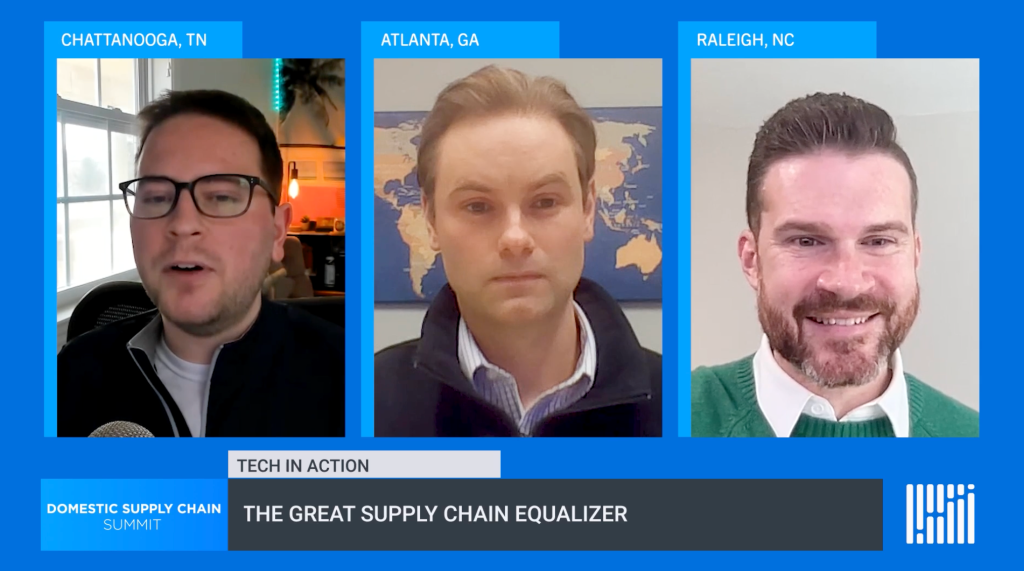
FIRESIDE CHAT TOPIC: Technology as the great supply chain equalizer.
DETAILS: Kyle Wegman, vice president of product at Turvo, and Robert Martin, director of sales and operations at Reibus Logistics, look at how technology helped the domestic supply chain with inventory, logistics and profits while amplifying customer experience.
KEY QUOTES FROM WEGMAN:
On working with Reibus Logistics:“The big thing that made us say, ‘We have to work with these guys,’ was, I actually have the notes from our original sales demo. It said these guys are obsessed with the end-user experience. That was really what drove us to want to work with them. They’re small, we’ll help them figure it out and we will get them out onto the platform. That combination of their drive and their vision of knowing what they wanted to do, as well on our side just making it as simple and as cheap as possible to get into the world of TMS tech, was a match made in heaven and it’s worked out really well so far.”
On how TMS has changed:“[A decade ago,] it was a lot of what I call brutalist software design in the space. Over time, we’ve become a lot less tolerant to these kind of half-baked and inefficient systems — especially in TMS. The big change over the last 10-15 years was that, before, you were expecting your TMS provider to do everything. When it came to integrations partnerships, there weren’t that many other companies out there in the tech world. So now, we have so many different types of companies competing with different software solutions every step of the line.”
Looking ahead to 2024:“I think that especially in [2020 and 2021], there was a lot more of an adventurous attitude of ‘I’ll throw cash at this newer company, see what they can do and what works with them.’ I think in 2023 and 2024, companies are buying less new technology. They’re more focused on working with the providers that they’ve got to really perfect things and say, ‘Do you belong in my stack or not?’”
KEY QUOTES FROM MARTIN:
Why Reibus has benefited with a TMS: “You go out to these larger shipper partners, and we started upstream in the supply chain with very, very large mills. You need to be able to integrate with their tech. We didn’t have that ourselves. Obviously, we went the route with Turvo instead of building our own, which is extremely complicated, extremely expensive, extremely time consuming. What Turvo has enabled us to do is integrate not only with their TMSes but [also] tracking aggregators, giving us the data we need in real time to partner with these carriers.”
“In the last decade or so, everyone’s made it a requirement. If you can’t integrate with XYZ, you can’t be a carrier.”
AI will level the playing field for SMB warehouses
This fireside chat recap is from FreightWaves’ Domestic Supply Chain Summit on Wednesday.
FIRESIDE CHAT TOPIC: The future of warehousing.
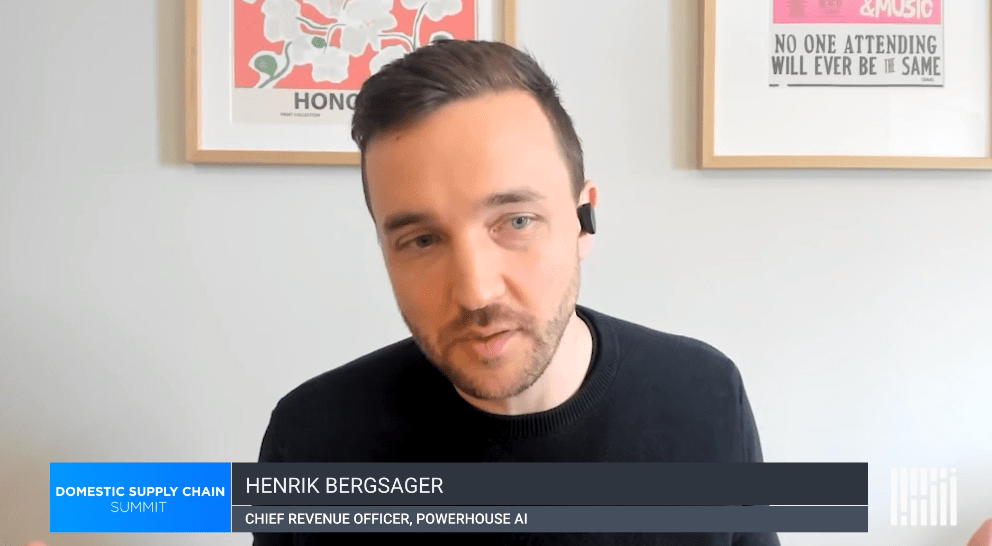
DETAILS: FreightWaves’Anthony Smith and Henrik Bergsager, Powerhouse AI’s director of strategic partnerships, operations and revenue growth, dive into the future of warehousing and how AI will level the playing field for small and midsize players.
KEY QUOTES FROM BERGSAGER:
“Where we see a main change [in warehousing automation] happening next year and the next couple of years is that more mobile solutions are accessible through your phone or an app. You can bring automation and AI tools to warehouse companies that might not necessarily have the funding, time and resources to do a fully automated warehouse but still want to elevate their processes by providing warehouse automation functionality in their system to become more competitive.”
“I think everyone is coming to terms like knowing there are more factors than just these final-mile delivery companies [to improve supply chains]. … Let’s drive efficiency. Let’s capture data better. And that way we end up in a good place when it comes to incorporating technology in your production operations.”
“I think more small, regional players will have access to technology that will make them competitive with the biggest players, leveling the playing field. I think the biggest change we will see is lowering that barrier to entry so you can run a very efficient and cost-efficient operation without having to have those huge operations.”
The Resilient Link: Strengthening U.S.-Mexico Supply Chains Through Diversification
The year 2020 marked a significant turning point for many businesses in the U.S. and throughout North America. First, the passage of the United States-Mexico-Canada Agreement went into effect, setting the stage for a more favorable trade environment. Then, businesses and consumers alike were abruptly confronted with the profound impact of supply chain disruptions caused by China’s Zero COVID Policy. These disruptions highlighted the fragility of global supply chains and underscored the need for more resilient trade strategies.
While the practice of nearshoring and reshoring manufacturing away from China has ebbed and flowed for many years, the incentive for companies to bring back more links in their supply chain to North America quickly is more apparent than ever.
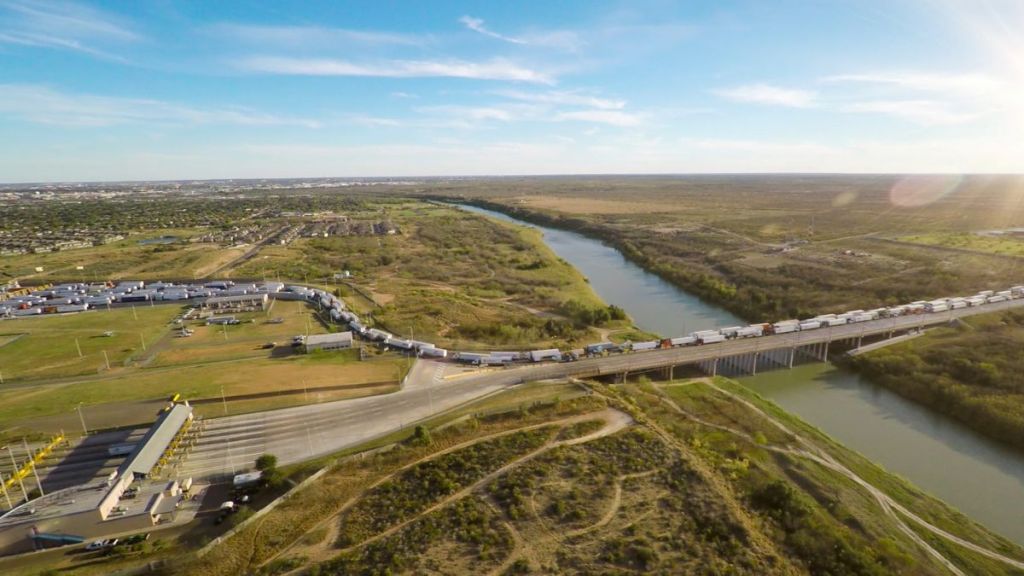
However, the inherent value seen by many organizations in building out or expanding supply chains within North America has also led to challenges along the U.S.-Mexico border. Northbound over-the-road capacity has become a thorny issue for many U.S. and Canadian businesses that now incorporate (or are planning to) Mexican manufacturing and suppliers into their overall strategy.
“The capacity issue at the border has been going on for years,” said Ed Habe, Averitt vice president of Mexico sales. “Unfortunately, there is no indication that we will see a sudden turnaround anytime soon because many of these issues revolve around complex challenges, including transportation infrastructure, the driver and equipment shortage on both sides of the border, and also delays with inspections at crossing points.”
As nearshoring continues to gain momentum, shippers will increasingly face challenges with traditional over-the-road capacity from Mexico, leading to longer transit times and higher costs with securing limited space. According to Habe, organizations need to begin examining their transportation strategies sooner than later.
“Being the last to adapt in supply chain operations is a position no business wants to find itself in,” said Habe. “It’s crucial for companies, especially those dealing with high volumes or industries heavily reliant on speed-to-market, to proactively seek and implement effective methods for diversifying their transportation strategies out of Mexico.”
In terms of diversifying Mexico cross-border shipping operations, Habe suggests rail and even ocean moves via the Gulf could be potential opportunities under the right circumstances.
“Businesses should lock arms with their transportation partners and investigate whether or not there could be benefits in exploring non-traditional northbound moves,” said Habe. “Shipping across the Gulf rather than the border may sound a bit out of the box at first, but depending on the ultimate destination of the freight, some companies may achieve better efficiencies.”
Simultaneously, cross-border diversification extends beyond merely utilizing multiple modes of transportation. A key driver of capacity challenges is the preference of many shippers to use a limited supply of U.S. trailers for the entire journey from the origin in Mexico to the destination in the U.S. Consequently, this often leads to prolonged wait times for securing a U.S. trailer in Mexico, in addition to the delays experienced at the border.
One strategy shippers can employ to address this issue is transloading from a Mexican trailer to a U.S. trailer in a border town, such as Laredo or El Paso. This approach allows for quicker access to readily available Mexican trailers south of the border and ensures more reliable U.S. trailer resources on the stateside.
According to Habe, the best approaches to overcoming challenges with cross-border transportation today and into the future will always be strengthened by relationships.
“Shippers need to build partnerships with their transportation providers that go beyond just transactional needs,” said Habe. “The opportunities with nearshoring are exponential, but the risks for failing to strategize and diversify are just as great.”
Averitt has provided logistics solutions to, from, and within Mexico for over 25 years. Backed by a dedicated team of cross-border experts, customs brokers, and a strong infrastructure of distribution centers at the border, Averitt delivers door-to-door solutions that help simplify the complex nature of cross-border transportation.
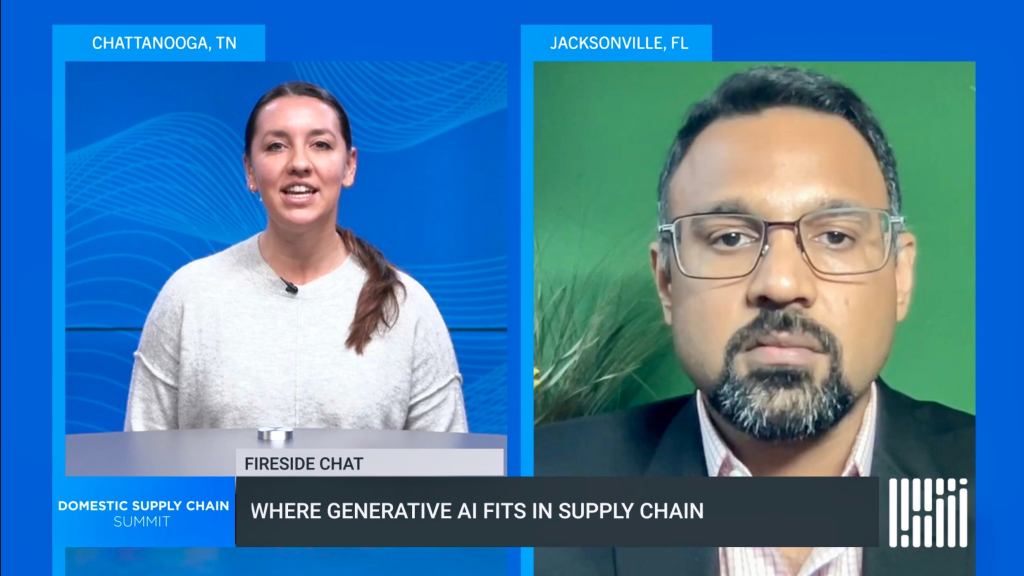
FIRESIDE CHAT TOPIC: Where generative AI fits in the supply chain.
DETAILS: Generative AI can revolutionize the supply chain industry through fraud protection, route optimization and efficiency enhancements, according to Crowley Maritime’s Anoop Mohandas.
“Generative AI is this new technology that’s based on largely large language models that can be trained on the data. … It’s different from your traditional AI, which is pretty good. The difference with generative AI, it can create these patterns, it can create new data, it can create new contents, which is quite powerful. When you train your generative AI models on the data, it helps to understand, analyze the questions, whatever the user is asking. If I were to ask a question like, ‘What is my profit for a customer for the month of December?’ It’s going to give me that research. If you ask, ‘What are my lanes that are bleeding lanes, that have this loss of profit?’ It can go hit those data points and get you that information.”
“There are certainly a lot of places where generative AI can have a big impact. … One would be like a digital companion, so that will be the forefront of your customer service going forward. Any questions that customers have, or the people in operations have, or from any stakeholders within the supply chain have, your digital companion would be the new friend that will be able to answer all these questions.”
“Sustainability is a big thing. Companies can leverage generative AI to really optimize the routes, cut down the empty miles, optimize their inventory and run the ships full.”