White Paper: How Shippers Should Be Thinking About Freight in 2024
It’s well understood that over-the-road trucking is the bedrock of freight logistics in the U.S. More than 87% of shipper respondents to a recent survey said they moved goods that way. But the modal landscape is far from static.
In partnership, Talon Logistics and FreightWaves conducted a survey focusing on North American supply chains across diverse industries. This survey revealed an intricate web of preferences, satisfaction levels and emerging concerns that should guide both shippers and logistics providers in strategic decision-making through 2024.
Insights include:
The current landscape of shipping choices
Key decision factors
Satisfaction and shortcomings in existing logistics partnerships
Emerging trends and concerns
Helpful strategies
Download the complimentary report today to access the full insights.
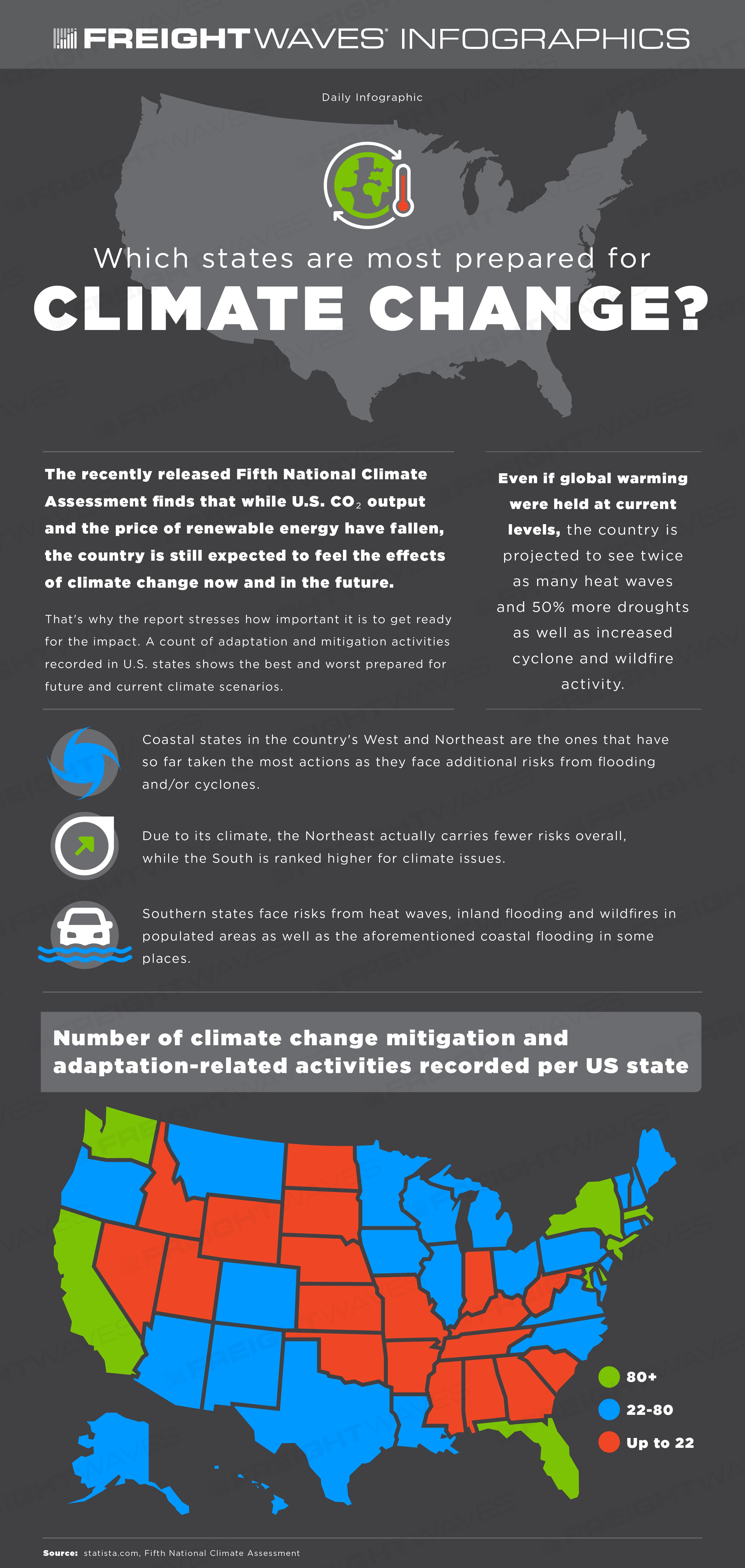
Daily Infographic: Which states are most prepared for climate change?
To view more FreightWaves infographics, click here
Thinking inside the box
The video is worth a thousand words: A tube of mascara arrives in a box that’s multiple times its size and swaddled in layers of packing material to protect what is hardly a fragile product.
James Malley, co-founder and CEO of Paccurate.io, a New York-based company founded in 2020 to help businesses optimize their packaging to reduce waste and shipping costs, has seen this movie too many times. Malley manages an internal Slack channel he calls the “Hall Of Sadness,” which includes photos and videos of parcel packaging gone awry.
Wasteful packaging plagues many industries, but cosmetics retailers seem to be notorious offenders, according to Malley. (The packaging in the video, which was reviewed by Malley’s team, was “one of the worst ones we’ve seen,” he said.)
The packaging follies has been a long-running show in the parcel-delivery industry. And it is a long way from closing. Despite advancements in knowledge, processes and technology, far too many parcels, especially those shipped in e-commerce, are still delivered with massive amounts of what is known in the packaging trade as “void fill,” or a box’s space and material that is separate from the product.
Depending on the source of the estimates, void fill accounts for 40% to up to 58% of a typical box’s size. What’s more, many household name brands haven’t changed their box sizes in 10 years, said Malley.
The problems exist in both the business-to-business and business-to-consumer categories. However, the contents of B2B shipments tend to be composed of several heavier items, and B2B shippers typically do a more effective job of filling the box. In fact, B2B shipments can be so densely packed that they run the risk of what is known as overfill. Because of this, shippers will pay higher shipping costs based on weight. It can also lead to product damage.
B2C or direct-to-consumer (D2C) packaging can be another world, especially with mom-and-pop merchants that aren’t packaging experts and generally can’t afford the high-tech equipment and the consultants that could help improve their processes. But the problems also beset larger retailers — such as the one whose product was in the video — and their third-party logistics providers that have to optimize their own packaging consumption while ensuring that their customers have enough of the rightsized packages.
In e-commerce, the speed of fulfillment center throughput is the priority, and so-called cartonization, the step in the packaging process in which associates select the appropriate box for the orders being packed, often takes a back seat. In the case of the shipment shown in the video, the package may have simply been the minimum dimensions chosen by an automated system, according to Will Brown, a consultant.
The fact is that it can be complex and expensive to keep large quantities of different packaging around to fit the unique needs of multiple SKUs. Fulfillment center operations often choose the most uniform packaging that supports faster throughput and accept the inappropriate package sizes as a cost of doing business.
“There is a lot of low-hanging fruit in package rightsizing, but many companies will never get to it,” said John Moore, founder of IQpack Global, a packaging managed services and software company in Jeffersonville, Indiana. The problem, according to Moore, is most companies lack accurate product item master data, specifically in shipment sizes and weights. ”The associates packaging the orders in warehouses are instructed to choose a particular box based on an algorithm. The algorithm is using flawed item master data (sizes), so it is classic ‘garbage in garbage out.’ The cost of bad data is enormous, especially with the dimensionalization of freight.”
The good news is that some headway has been made. In what seems like a logical approach to reducing excess packaging, Amazon.com Inc. (NASDAQ: AMZN) in August launched a program in which it ships packages without any of its boxes, meaning that only the product’s box is delivered. This saves on material and labor, although some brands may be concerned that any damage to their boxes might reflect poorly on their image.
About 11% of items that Amazon delivers arrive without extra packaging, according to published reports. It’s what the company calls “ship in its own container.” Customers are able to choose at checkout if they want extra packaging or prefer their orders without it. Malley, whose company doesn’t work with Amazon, has called it a “big step forward” in reducing packaging costs.
In addition to providing a cartonization API, Paccurate has an analytical tool called PacSimulate, which runs millions of data-driven simulations to align the proper set of boxes for a fulfillment center operation. According to the company, the tool can help customers determine the appropriate quantity of material needed to better manage their packaging for maximum shipping value.
Paccurate, which touts its software as the only one of its kind that balances shipping contract and materials costs, said it can save customers between 6% and 15% in shipping costs, reduce corrugated use by 14% and cut CO2 emissions.
“With the increasingly complex structures of [parcel] rate cards today, having an actual simulation tool to calculate transportation cost using actual order, rate and shipping information can lead to much smarter decision-making and cost avoidance,” the company said in a blog post last week.
Moore of IQPack said the company’s approach is to “scrub, harmonize, and manage the data end-to-end for operations use.” Good data “enables accurate warehouse planning,” he said. “It also allows the packaging algorithm to choose the correct box or bag.”
Poor packaging doesn’t pay
Inefficient packaging has two big drawbacks: First, it is costly. Shippers overpay by using more aircraft and trailer space because parcels can’t be optimally cubed out. Better packaging means using less air cargo capacity, fewer trailers and less corrugated material. The less-favorable status quo means that carriers lose on fuel costs and elevated emissions.
Packaging consultant Kevin J. Mireles previously was a senior product manager for e-commerce at FedEx Corp. (NYSE: FDX) and worked on a major project to improve the company’s packaging processes. He said at the time he left FedEx in early 2022, he reviewed an analysis showing that in the Southern California market alone, a 5% reduction in customer package size would save the carrier 1 million gallons of fuel and cut 22 million pounds of CO2 emissions.
The latter number points to the second issue: sustainability. Delivery trucks and aircraft are primary sources of CO2 and shippers don’t do the environment any favors by utilizing oversized packages for items a fraction of their size, thus inhibiting proper cubing by carriers and ultimately requiring more physical assets to handle the same amount of freight.
A possible turning point in the rightsizing battle may occur on social media, as environmentally conscious consumers try to shame brands, and hopefully get their attention, by posting unflattering photos and videos of their packages, experts said.
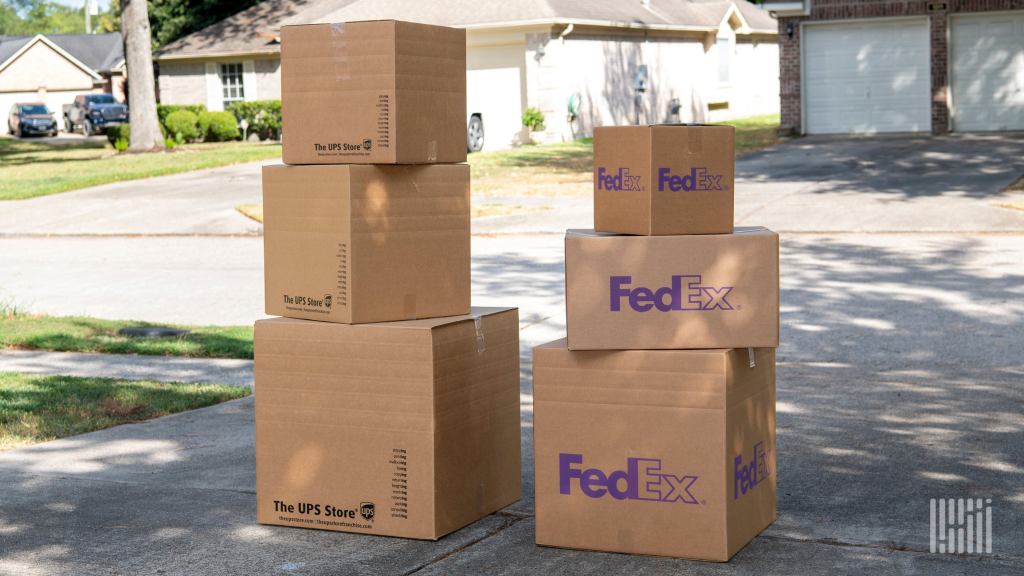
Parcel carriers have tried to administer tough love to shippers. FedEx and rival UPS Inc. (NYSE: UPS) price their services based on a package’s dimensional weight or its actual weight, whichever is higher. A package’s dimensions are calculated by multiplying its length, width and height in cubic inches and dividing the total by what’s known as a dimensional “divisor,” which today for the carriers is at 139.
For example, a parcel measuring 3 cubic feet — or 5,184 cubic inches — and divided by 139 would yield a dimensional weight equal to a 37-pound shipment, even though its actual weight would likely be much less. Because of the higher cost of shipping excess air, shippers in theory would be incentivized — with help from their carriers — to package more efficiently.
In reality, big shippers demand, and often receive, waivers on dimensional weight (DIM) charges, according to experts. Mireles said for many shippers the divisor is well into the 200s, meaning fewer shipments are hit with DIM prices and as a result there is less incentive for shippers to improve their packaging. Moore of IQpack said for some shippers the divisor is set in the 300 range.
Jack Ampuja, president of consultancy Supply Chain Optimizers and E-Commerce Optimizers, said the smaller shippers are the ones that take the financial hits from the carriers for inefficient packaging. “The small guy gets whacked. The big guy gets waived.”
Ampuja said hardware technology is readily available to help shippers, but in many cases it’s too costly, takes up a lot of space and won’t be able to process very small items.
No matter how difficult the process, the payoff is worth it, said Moore Of IQpack. “Reducing the average size of a package has an enormous impact on freight cost,” he said. “Even incremental improvements in package sizes can significantly reduce (the cost) of outbound freight.”
Biden administration announces massive logistics plan
The Biden administration has announced a huge plan to tackle issues plaguing the U.S. supply chain that covers several cross-government partnerships.
In announcing the plan Monday, White House officials said the strategy of using both domestic tools and international partnerships can help diversify and strengthen the U.S. supply chain. Citing supply chain disruptions from COVID, a White House official said, “We know hyper concentration of supply can be a problem.”
On the drug front, the Department of Health and Human Services (HHS) and the Department of Commerce are partnering to assess data to address foreign dependency and points of serious failure for critical drugs. The HHS will appoint a supply chain resilience and shortage coordinator, which will be announced at a later date.
President Biden will also issue a presidential determination to broaden HHS authorities under Title III of the Defense Production Act (DPA) to enable investment in the domestic manufacturing of medicines the president deems as essential to national defense. White House officials say that DPA will be released this week. HHS has identified $35 million for investments starting with the domestic production of materials for sterile injectable medicines. The Department of Defense will soon be releasing a new report on supply chain resilience in an effort to reduce high-risk foreign suppliers.
The Biden administration has also announced strides in the expansion of the Department of Transportation’s (DOT) digital information sharing system, Freight Logistics Optimization Works (FLOW) program.
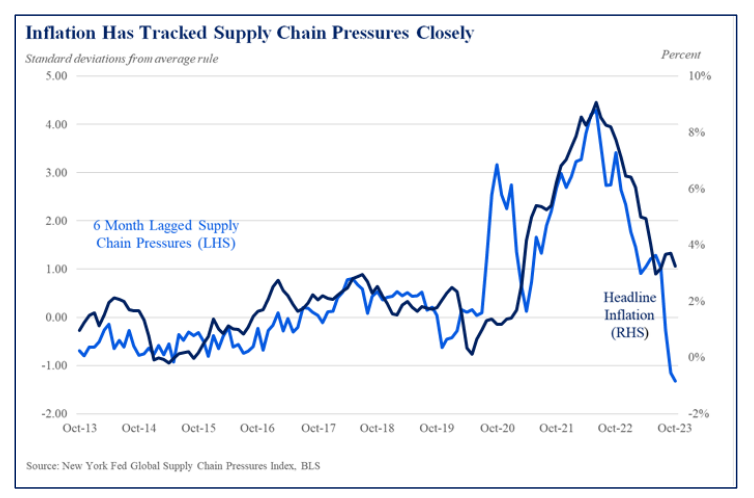
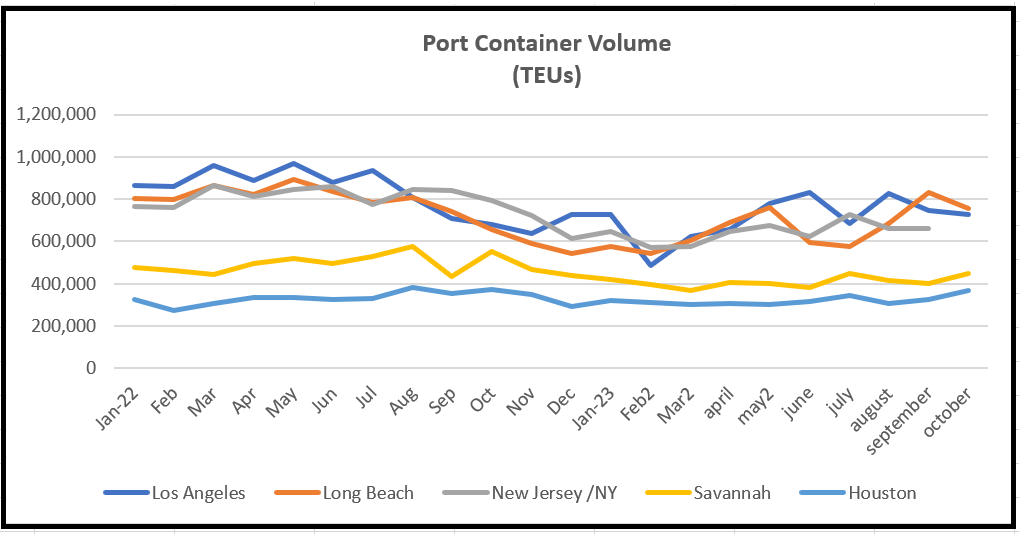
FLOW began in March 2022 with 18 participants at a time when the ports of Los Angeles and Long Beach were crippled with congestion. The container backup created a massive imbalance of supply chain issues, which exacerbated supply and demand and pushed product prices higher. These costs accelerated inflation in early 2021 and the issue intensified into 2022. The program’s goal is to reduce inflation by connecting all facets of the supply chain so logistics managers will be able to identify potential bottlenecks and track their goods from the dock to the doorstep. In order to have access to the data companies, must participate in the data sharing partnership.
Time is money, so reducing delivery times and avoiding detention costs will help kick down the price of goods. The Federal Reserve has said several times that the inflationary costs of congestion is something over which it has no control.
In a briefing with reporters, Lael Brainard, director of the National Economic Council, referred to inflationary pressures and the decrease in inflation as the prices of logistics have drastically dropped.
“Inflation has declined by 65% from its peak,” Brainard said. “We are pleased with the progress on supply chains that we are seeing lower prices for everything from turkeys to gas.”
While administration officials have pointed to Biden’s initiatives as strengthening the supply chain, one cannot forget the precipitous drop in container prices and the pullback in consumption. The combination of the two would drastically lower inflationary pressures.
DOT officials say the digital sharing platform has expanded to five of the nation’s largest container ports, seven of the largest ocean carriers and four of the five largest retailers. Retailers Albertsons, Becton Dickinson, Best Buy, Costco, Dollar General, GE Appliances, Home Depot, Land O’Lakes, Lowe’s, Nike, Ralph Lauren, Samsung, Target, The Gap, Tractor Supply Co., TrueValue, Ulta Beauty and Walmart are FLOW participants.
The biggest hurdle in the initiative has been convincing logistics companies and port stakeholders to share their data. So far, all of the terminals at the Port of Los Angeles, the nation’s largest port, are participating in FLOW, as well as three of the four terminals at the Port of Long Beach. The East Coast’s largest port, the Container Terminal located at the Port of New York and New Jersey, and the fastest-growing port, Savannah, are also participating, as well as the Gulf’s largest port, Port Houston.
Many freight logistics companies have their own freight tracking systems and, as a result, create a silo of information. U.S. shippers use multiple platforms to gain a complete picture of their supply chain. Through FLOW, the DOT is serving as an independent steward of secured and shared supply chain data across the major points of trade: ports, terminal operators, truckers, railroads, warehouses and beneficial cargo owners (shippers). All of the stakeholder data is sourced, and through the analysis, a fuller picture of the supply chain is created.
Tracking freight is key for business success. A deeper line of sight into a company’s supply chain enables logistics managers to plan more efficiently. Any aides to the planning of the movement of freight could in theory help reduce costs which are passed onto the consumer.
“Since President Biden took office, we have made enormous strides to not just fix our supply chains from the disruptions of the pandemic but to make them stronger and more resilient to keep inflation down,” said U.S. Secretary of Transportation Pete Buttigieg. “Our new Multimodal Freight Office will lead coordination of our efforts to strengthen supply chains — including our unprecedented FLOW data initiative that is now helping companies and ports make better data-driven decisions that will ultimately move goods more efficiently and keep costs down for Americans.”
Monday also marks the inaugural meeting of the White House Council on Supply Chain Resilience and the launch of the congressionally funded Office of Multimodal Freight Infrastructure and Policy (Multimodal Freight Office). The Multimodal Freight Office will be tasked with overseeing the sharing of data for the FLOW system as well as maintenance and improvement of the country’s freight network and supply chains.
The Department of Homeland Security’s Supply Chain Resilience Center (SCRC), will be the first U.S. government entity designed to collaborate directly with private businesses to mitigate risk. The center will create an annual report on the vulnerabilities at U.S. seaports and conduct scenario planning to help mitigate threats to the supply chain. The SCRC will also work with businesses to help ease disruptions in their supply chains and ensure reliable and efficient deliveries of goods and services. The center will ensure CHIPS and Science Act recipients funding are prioritized in deliveries of semiconductor manufacturing equipment. The Department of Energy is also collaborating with the SCRC to conduct deep-dive analyses on clean energy supply.
“Our job is to cut points of friction, streamline lawful trade, address security vulnerabilities head on, and help ensure American consumers and business can access the products they need,” said Under Secretary for Policy Robert Silvers. “The Supply Chain Resilience Center will bring government and industry around the table so we can become more prepared and coordinated for addressing these challenges.
The White House Council on Supply Chain Resilience, will be co-chaired by the national security adviser and national economic adviser and include the secretaries of Agriculture, Commerce, Defense, Energy, Health and Human Services, Homeland Security, Housing and Urban Development, the Interior, Labor, State, Transportation, the Treasury and Veterans Affairs; the attorney general; the administrators of the Environmental Protection Agency and the Small Business Administration; the directors of National Intelligence, the Office of Management and Budget, and the Office of Science and Technology Policy; the chair of the Council of Economic Advisers; the U.S. Trade representative; and other senior officials from the executive office of the president and other agencies.
The first quadrennial supply chain review by the council will be completed Dec. 31, 2024.
Borderlands: Eternity Group Mexico unveils tool for shippers to monitor carbon footprint
Borderlands is a weekly rundown of developments in the world of United States-Mexico cross-border trucking and trade. This week: Eternity Group Mexico unveils a tool for shippers to monitor their carbon footprints; Finkargo closes a $20 million Series A funding round; cargo-partner launches a cross-border shipping solution; and SKU Distribution receives foreign trade zone status for its Arizona warehouse.
Eternity Group Mexico launches tool for shippers to monitor carbon footprint
Eternity Group Mexico recently introduced Elis Carbon Neutral, a digital tool focused on creating more environmentally sustainable global logistics operations.
Early adoptees of carbon neutral technologies could not only gain a competitive advantage but will also be leading the way to a greener and more sustainable future, company officials said.
“We’ve developed Elis to offer carbon-neutral solutions over the customer’s supply chain,” Nicolas Portenza, president of Eternity Group Mexico, told FreightWaves. “Due to the technology developed, I’m pretty sure we are the only player in Latin America with such a solution.”
The Mexico City-based logistics and transportation solutions provider is part of Hong Kong-based Eternity Group, a global freight forwarder founded in 1989. The Eternity Group operates 15 offices in China and Panama, shipping freight throughout Asia and to/from the Caribbean, as well as Central and South America.
Eternity Group Mexico launched Elis in 2019. The service is a cloud-based platform to track international freight shipments in real time between major markets from Asia to Latin America.
The addition of a tracking system came about as a way for Elis to help global shipping operations reduce their carbon emissions.
Elis Carbon Neutral uses blockchain technology, which allows for a measurement of energy output during transport. Elis also documents any carbon footprint reduction process employed by customers, which helps them obtain the necessary external certifications for carbon neutrality or carbon credits.
“Knowing the carbon footprint we generate through our activities allows us to become aware of our contribution to global warming and therefore be able to take action,” Portenza said. “We have decided to implement [Elis Carbon Neutral] so as to mitigate and offset the emissions from all our customers’ maritime operations.”
In 2022, the global maritime shipping industry contributed about 858 million tons of CO2 emissions, compared with 739 million tons of CO2 emissions from air transport, said the Organisation for Economic Co-operation and Development (OECD).
“The results from the OECD’s estimation model show that around half of total emissions are from container ships and bulk carriers and another one-fifth are from the transport of fossil fuels (oil and liquefied natural gas tankers),” the OECD said in a report from June.
In July, the International Maritime Organization announced new global emission-reduction targets aimed at reducing CO2 emissions from the ocean container shipping industry. The IMO said its aim is for the shipping industry “to reach net-zero GHG emissions by or around 2050, taking into account different national circumstances.”
Finkargo closes $20M Series A funding round
Finkargo recently announced the closing of a $20 million Series A financing round led by QED Investors, with participation from Nazca, Quona, Flybridge, Maya and ONEVC.
The Mexico City-based company is an international trade platform for small and medium-sized businesses offering global sourcing, trade services and financing solutions.
The Series A financing will help expand Finkargo’s offerings into an integrated suite of trade services, such as supplier sourcing, product verifications, cargo insurance, foreign exchange and international trade data intelligence.
“While the global trade finance market sits at $5.2 trillion, there’s still a $1.7 trillion financing gap,” QED Investors Principal Camila Key Saruhashi said in a news release. “SMBs in Colombia and Mexico import over $30 billion in volume from Asia annually, but struggle to access capital to manage the 60- to 120-day gap it takes from payments to shipment arrival.”
Finkargo is an international trade platform founded in 2021 by Santiago Molina, Andres Ferrer and Tomas Shuk. The company has facilitated international trade solutions for over 250 customers and financed more than 2,000 import operations totaling over $200 million.
Logistics provider cargo-partner has launched a cross-border road transport solution linking shipments between the U.S., Canada and Mexico.
The company’s cross-border shipping services include transportation, storage and customs clearance, as well as custom-tailored solutions for cross-border truckload, less-than-truckload and specialized cargo across North America.
“We continue to grow our operations on all sides of the borders, so we have dedicated teams providing a variety of end-to-end solutions,” said Ralf Schneider, president of cargo-partner USA.
The company’s trucking services utilize warehouse facilities in Clarksville, Tennessee, and Chicago, offering 301,389 square feet of logistics space. In 2021, cargo-partner opened offices in Mexico City and Puebla, Mexico.
Austria-based cargo-partner has 4,000 employees at 160 locations in 40 countries.
SKU Distribution’s Arizona facility designated as FTZ
SKU Distribution announced its facility in Chandler, Arizona, has been designated as a foreign trade zone (FTZ) 3PL distribution warehouse and fulfillment center.
Chandler is located about 23 miles southeast of Phoenix.
FTZs provide special customs procedures that help companies conducting international business-related operations. When a business operates under FTZ procedures, U.S. import duties don’t have to be paid on imported components entering their factories.
“The FTZ designation is a cash flow game-changer for businesses,” James Peacock, CEO of SKU Distribution, said in a news release. “This allows companies to import their products and defer their customs duties and taxes until their product leaves the zone (our warehouse) for domestic consumption.”
Chandler-based SKU Distribution, founded in 2016, is an international and domestic third-party warehousing, distribution and fulfillment provider. The company has about 50 employees.
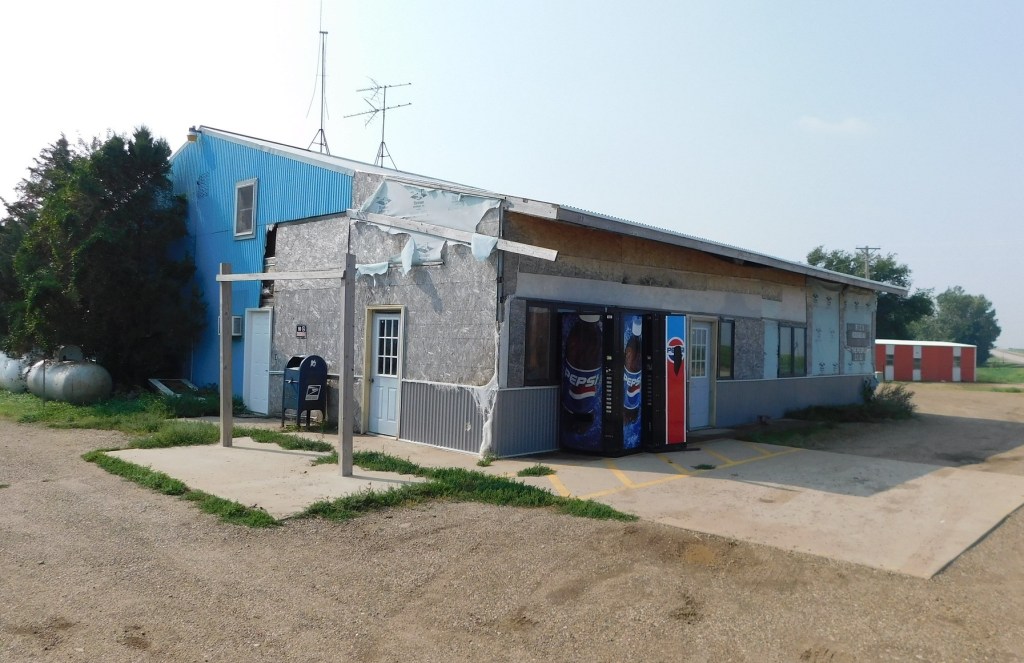
The Ridgeview, South Dakota Post Office serves ZIP Code 57652. Photo by Jimmy Emerson, some rights reserved. Photo shared under the Creative Commons License.
Ridgeview Post Office
1 US-212
Ridgeview, South Dakota 57652
‘Dire’ scenario for shipping lines more likely as spot rates fall back
There’s a lot at stake for container lines’ 2024 bottom lines in the last few weeks of 2023. If lines can’t push up spot rates very soon, next year’s annual contract rates will reset much lower versus this year’s.
That scenario — which would have a very negative financial effect on liners — looks increasingly likely. Time is running out for a fourth-quarter rebound, and indexes show spot rates falling, not rising.
Shipping lines’ attempts to use general rate increases (GRI) this month to improve their negotiating hand for annual contract resets have failed. They have one last chance in December, but their track record of getting GRIs to stick has been poor.
Maersk CEO Vincent Clerc bluntly laid out the worst-case scenario during a conference call on Nov. 3: “If nothing has happened to the spot market during the [fourth] quarter, it would not be the trough, because that will mean there is a reset of [2024] contract levels down to those levels.”
He noted that there is a significant gap between contract rates signed earlier this year — which are about to reset — and current spot rates.
What happens in the current quarter with spot rates will have “a profound impact on what 2024 is going to look like,” Clerc continued. “If Q4 is not delivering some type of improvement, I think we’re looking at a pretty dire situation in 2024.”
Spot rates fall back again
The global composite of Drewry’s World Container Index (WCI) fell 6% in the week ending Thursday versus the prior week, to $1,384 per forty-foot equivalent unit. The global composite has given back all of its gains since the beginning of Q4 and is now down 1% versus Oct. 1.
Spot rate in USD per FEU. Blue line: global composite. Green: Shanghai-New York. Purple: Shanghai-Genoa. Orange: Shanghai-Rotterdam. Yellow: Shanghai-Los Angeles. Pink: Rotterdam-New York. (Chart: FreightWaves SONAR)
All but one of the main east-west trade lanes is down from the beginning of the quarter, the Shanghai-Rotterdam lane being the exception.
Even in that lane, rates are declining. The WCI’s Shanghai-Rotterdam assessment was at $1,148 per FEU on Thursday, still up 9% from the beginning of the quarter but down 10% from the recent high on Nov. 9.
Shanghai-Los Angeles spot rates showed signs of life earlier this month but gave back the last of their quarter-to-date gains in the most recent week.
The WCI assessment of Shanghai-Los Angeles spot rates was $2,000 per FEU in the week ending Thursday, down 13% from the recent high in the week ending Nov. 9 and down 1% from the beginning of the fourth quarter.
Recovery not expected until 2025
If Asia-Europe annual contracts reset in the vicinity of Q4 spot rates starting in January, and if Asia-U.S. contract rates don’t improve — or fall further — when they reset in May, container lines would face steep losses in 2024, particularly given that costs are up 25-30% versus pre-COVID levels.
Container lines are still flush with cash from the COVID-era boom, so they should be able to weather the cash burn next year. But what if steep losses continue through 2025 or even 2026?
Clarksons Securities analyst Frode Mørkedal ran the numbers of Zim (NYSE: ZIM) in a client note on Wednesday. “Our analysis indicates that Zim’s quarterly cash burn rate is approximately $300 million, suggesting that its existing cash reserves could sustain operations for about nine quarters, or roughly 2.3 years.
“This duration should be sufficient to weather market challenges at least through 2025,” wrote Mørkedal.
“The key factor that could signal a market turnaround is a policy shift among liner companies, particularly in terms of profitability focus and ship capacity reduction.
“The main issue, in our opinion, is ship overcapacity rather than future demand,” Mørkedal continued. “We anticipate that a pivotal response to the current overcapacity issue will be implemented in 2024, with the goal of raising freight rates, potentially marking a significant turning point in the industry.
“The critical juncture at which fleet growth aligns with trade growth could occur around October 2025, implying a two-year contraction phase,” said Mørkedal.
However, that timeline assumes liners make the necessary capacity adjustments next year, whether through slow steaming, ship idling, scrapping and/or service cancellations.
Many pundits and industry executives expected shipping lines to make the necessary capacity adjustments this year. They haven’t. Scrapping and ship idling have been much lower than predicted.
Not only have liner companies not withdrawn older ships, they’re still ordering new ships. According to shipbroker reports, Ocean Network Express (ONE) just sealed an order for 12 newbuildings for deliveries in 2025 and 2026. The 13,000-twenty-foot-equivalent-unit vessels will be capable of using methanol as fuel, and the new series will have an aggregate price tag of just under $2 billion, according to Alphaliner.
FRA wants railroads to bolster winter operation procedures
U.S. railroads should beef up the procedures they use for responding to adverse weather conditions, including seeing how weather-related technologies can be integrated into positive train control and whether the railroads can collaborate on developing best practices, according to a safety advisory from the Federal Railroad Administration.
The agency hopes that by issuing the safety advisory, railroads can reduce the incident level of weather-related accidents. In this latest advisory, FRA pointed out that since the start of 2021, there have been 123 rail incidents in which severe weather conditions or weather-related events may have contributed in part or in whole to those accidents. Of these incidents, more than half of them were main-track derailments, but the advisory doesn’t detail the severity level of the various incidents.
FRA gave six recommendations for the railroads to consider:
Evaluate existing communication and training programs, rules, policies and procedures to make sure that railroads can adequately respond to weather-related incidents and that the information is up to date.
Determine whether weather forecasting policies and procedures can be integrated with dispatching operations and even incorporated with positive train control systems.
Evaluate areas where railroads’ operating infrastructure is susceptible to severe weather events. Railroads can also use technology to monitor critical infrastructure in real time, and the industry and federal, state and local agencies can establish standardized interfaces for weather-related action plans.
Look at whether existing weather-related action plans adequately address risks and whether railroads should develop an auditing program to ensure weather alert systems are working.
Establish standard operating thresholds that can help railroads operate through severe weather events.
Work with other railroads to develop best practices for utilizing weather forecasting technologies, predictive weather models and weather-related action plans. This could include determining how much deviation exists between railroads’ operating procedures during severe weather events.
FRA’s John Karl Alexy, associate administrator for railroad safety and chief safety officer, signed the safety advisory.
This most recent advisory is the sixth one that FRA has issued in 2023. FRA released four other safety advisories following the Feb. 3 derailment of a Norfolk Southern train in East Palestine, Ohio. While the incident resulted in no injuries, the planned release of vinyl chloride days after the derailment rattled the local community.
The last time FRA issued six safety advisories in a calendar year was 2013. In 2016, the agency issued four advisories, and in 2015 issued three. FRA issued two safety advisories in 2014 and 2020, and in the years 2018, 2021 and 2022, just one safety advisory was issued. In 2017 and 2019, no safety advisories were issued.
Transport Canada has been requiring Canadian Pacific Kansas City and CN since 2022 to submit plans about how they expect to conduct rail operations in winter. That mandate aligned with a recommendation from the Transportation Safety Board of Canada to compel the railways to submit such winter plans following a February 2019 derailment in Field, British Columbia, in which a Canadian Pacific grain unit train derailed, killing three employees.
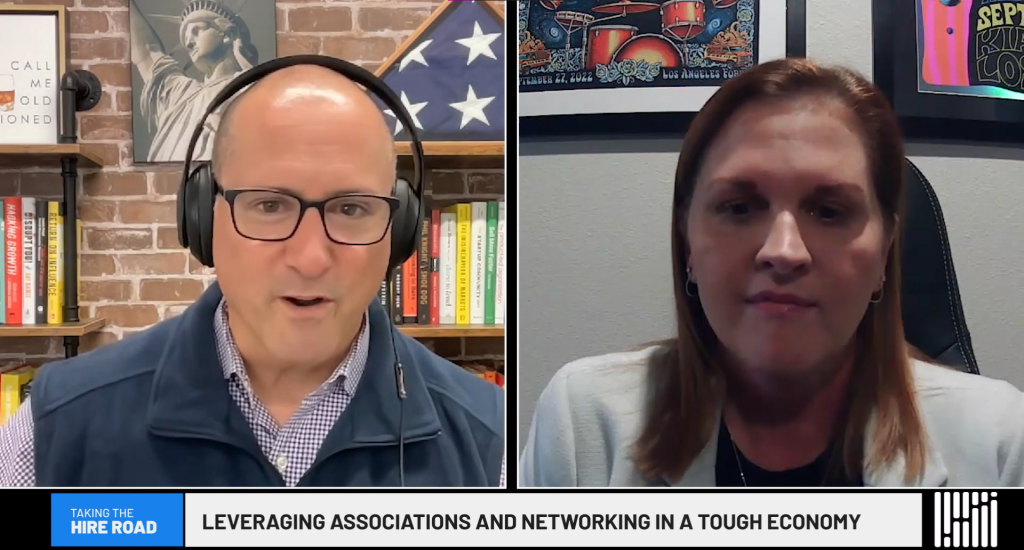
Leveraging associations and networking in tough economy – Taking the Hire Road
On this week’s episode of Taking the Hire Road, Jeremy Reymer, founder of DriverReach, is joined by Amber Edmondson, president and CEO of Trailiner Corp.
Edmondson is an industry veteran of nearly 25 years, having been with Trailiner since 1999.
But Edmondson’s connection to trucking runs deeper than just her years of employment: Her father became an owner-operator when she was 8, and Trailiner itself was started by Edmondson’s grandfather in 1976.
Trailiner, a long-haul refrigerated carrier from Springfield, Missouri, is hardly a stranger to the ups and downs of market cycles.
Given the company’s exposure to produce, particularly from the western U.S., something as simple as a rainstorm can influence financials for an entire year.
“This year there was too much rain in California, which really impacted the growing season in the Central Valley, so the market has been very similar to us as it was back in ’07 and ’08,” Edmondson stated, alluding to challenges faced during the Great Recession.
Yet reefers are not alone in experiencing hardship, as the whole of the trucking industry is struggling against a downturn. In such difficult times, carriers need to ensure that they have the fundamentals correct.
For Trailiner, “safety is the most important thing. Our drivers are out on the road, day in and day out, and getting them home safely while protecting the motoring public is our No. 1 priority.”
“Obviously,” Edmondson added, “it makes good financial sense as well.”
When margins are tight, controlling operational costs can be the difference between a carrier’s long-term success or failure. A clean safety record goes a long way in combating rising insurance rates.
Carriers do not, however, have to go it alone when facing adverse market conditions. Connections and relationships matter deeply.
Edmondson’s history of leadership and advocacy within the industry demonstrates that she understands this point all too well.
In her time as a LEAD ATA candidate, Edmondson found that “networking and those ongoing relationships were the most important thing” that she retained.
As the chair of TCA’s 2024 Refrigerated Meeting, Edmondson sees her main task as providing attendees with relevant information that can help them navigate a tumultuous industry — in other words, giving members “what they need to hear, when they need to hear it.”
Networking at such events is important because others within the industry can often be a carrier’s greatest support.
“Being able just to talk with another person about looking at new ELDs, having some issue with hiring — or whatever issue you might have — and getting some feedback from them” is indispensable, she said.
At the end of the day, Edmondson stresses that leadership in this industry is about “being a good steward of all that you have as a business owner, protecting your employees as best as you can and coming out on the other side.”
Railroads take on EPA’s pollution-reporting proposal
WASHINGTON — A Biden administration proposal to change how rail carriers report air emissions data is getting pushback not just from rail companies but from state government agencies as well.
The Environmental Protection Agency’s proposed rule, issued in August, is considering making rail yard locomotive activity reporting mandatory as opposed to the current voluntary reporting structure. The reporting of locomotive activity is aimed at improving air quality in local communities.
EPA notes in its proposal that the current approach to informing its National Emissions Inventory, a triennial estimate of air pollution sources, relies on voluntary reporting from private rail companies.
“While this approach has mutual benefit to both the EPA and those companies, it is nevertheless a voluntary measure,” according to the agency, which is therefore considering a “rail companies” option “that would additionally regulate the rail companies directly to provide activity data to EPA.”
“For the rail companies option, the EPA proposes that owners/operators of rail companies would be required to report activity data from [rail yards] to EPA. The rail companies option would have a disadvantage of imposing more requirements than continuing the ongoing voluntary approach with rail companies.”
In comments filed with EPA opposing the change, the Association of American Railroads explained that it collects information on the national locomotive fleet from its member railroads and provides that data to the Eastern Research Technical Advisory Committee (ERTAC), which uses the information to generate an estimate of emissions from rail operations by state and county.
“This approach ensures a standard methodology for identifying the active locomotive fleet and provides a single point of contact (AAR) for ERTAC and EPA when working through their triennial inventory calculation,” AAR stated. “It also avoids the complications and burdens that would be created by individual state reporting requirements that may differ significantly from one state to another.
“AAR and its members thus oppose the ‘rail companies’ approach described in the preamble to the proposed rule. This approach would simply add more complexity and complications with no demonstrable additional benefit.”
AAR also warned EPA against using national-level locomotive fleet data to estimate emissions on a local level.
“Using data on the size of the national locomotive fleet to calculate accurate and meaningful, county-specific railyard emissions inventories is not possible,” the group stated.
“Most locomotives generally move freely around and across the country and may be operated by different railroads in different locations. Use of a locomotive varies from time to time and place to place, based on need. While ERTAC’s calculations may serve a practical purpose, their limitations must be understood and recognized … and should not be used as a basis for regulation or policy setting.”
State environmental regulators push back on EPA as well
Because state and local environmental agencies would also be responsible for compiling extra data associated with the proposed rule, several states took issue with EPA’s proposed timelines and a lack of federal resources to offset the proposed requirements.
“Before requiring states to undertake the expense and effort required to change software and databases, update regulations, identify the required new reporters, and increase entity-specific reporting, EPA should have first engaged the states to more thoroughly consider the feasibility of states incorporating the voluminous changes all at once in the extremely short deadline,” commented the Arkansas Department of Energy and Environment, noting EPA’s change from triennial reporting to annual reporting.
“The proposed action will strain state resources, necessitate mandated unfunded capital expenditures, and potentially weaken data quality.”
The Ohio Environmental Protection Agency agreed with that assessment, pointing out that adding more reporting requirements on increasingly short timelines without additional funding “shows a lack of understanding of current state processes, informed by long term experience with CAP reporting, and the resources that are available to states.”
The West Virginia Department of Environmental Protection stated, “frankly, the proposed rule cannot realistically be implemented as proposed regardless of whether the states accept delegation of the [air pollution] reporting or leave implementation to the EPA.”