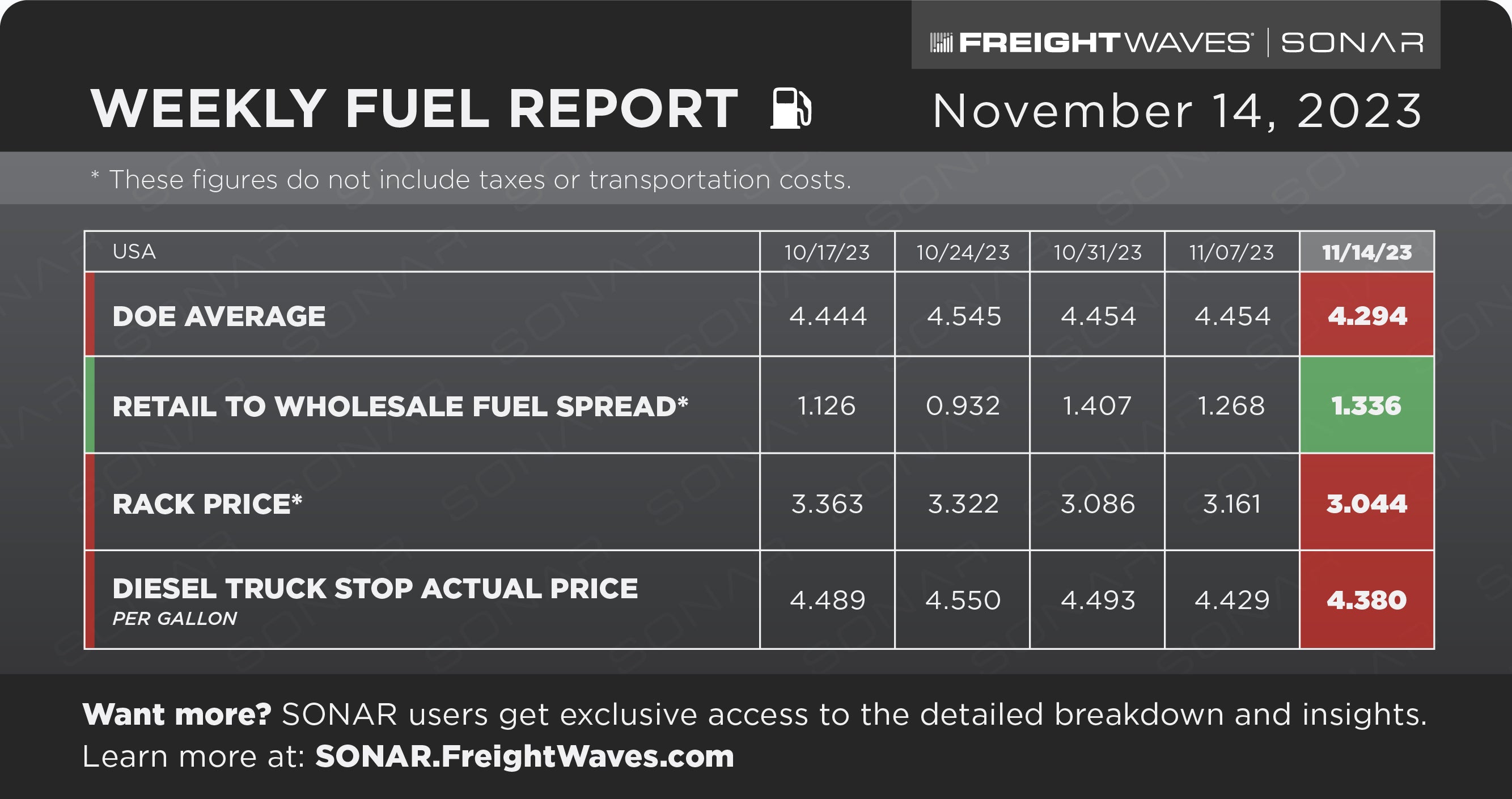
Weekly Fuel Report: November 14, 2023



Global supply chains have faced a decade of disruptions. In 2023, supply chains were impacted by a variety of natural disasters, financial failures, and operational difficulties. Supply chain activity has normalized in operational terms since the pandemic ended, but as we look at the industry outlook for 2024, there are significant risks across the industrial policy, labor action, and environmental policy implementation.
To download the full white paper and access the outlook for supply chains in 2024, complete the form below.
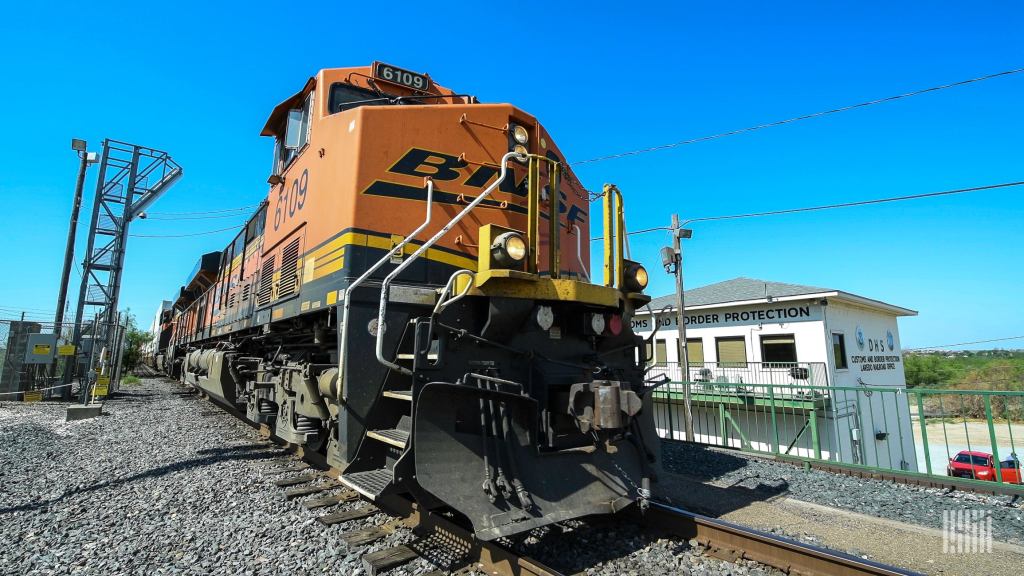
BNSF, J.B. Hunt Transport Services and Grupo Mexico’s Ferromex (GMXT) are launching an intermodal service that they say will slash a day off transit time between Monterrey in Mexico and Chicago and offer opportunities for customers to grow into expanding markets in Mexico.
The service will begin Jan. 1, 2024. Service will be offered between the Monterrey, Silao-Bajio and Pantaco-Mexico City regions and Chicago and the U.S. Midwest via the border gateway at Eagle Pass, Texas. The Dallas-Fort Worth area in Texas is also a potential interchange point with BNSF’s broader U.S. network, according to the map below.
Utilizing Eagle Pass will also serve as an alternative option to the gateway at El Paso, Texas. The El Paso gateway is also serviced by BNSF, as well as Union Pacific.
Here is how the three describe the service: Trains carrying intermodal containers from the U.S. will interchange at Eagle Pass with trains operated by GMXT. At the border, GMXT’s trains will take those containers to Monterrey, Silao-Bajio and Pantaco-Mexico City six days a week.
The new service comes just after BNSF (NYSE: BRK-B) and J.B. Hunt (NASDAQ: JBHT) announced last week at FreightWaves’ F3 event that they have launched Quantum, a premium intermodal offering designed to ensure improved delivery times with consistent service. Quantum will be run by employees from both companies at a new intermodal center at BNSF’s headquarters in Fort Worth, Texas. The customized offering will cut delivery times by one day from normal intermodal service. The shipments will be given priority drayage and rail positions to meet the time thresholds. The companies are informing customers to expect 95% on-time delivery.
Meanwhile, GMXT also has a partnership with BNSF rival Union Pacific and Canadian railway CN that seeks to bolster intermodal service between Mexico, the U.S. and Canada. And Canadian Pacific Kansas City said earlier this year that it is offering daily intermodal service between Chicago and San Luis Potosi and Monterrey in Mexico.
“Our organizations are committed to growth in Mexico and this joint service offering is a direct reflection of that commitment,” BNSF President and CEO Katie Farmer said in a Tuesday release. “By utilizing the capacity and expertise of the largest intermodal railroad in the U.S., the largest railroad in Mexico, and the largest domestic intermodal carrier, this product will seamlessly connect the North American intermodal network.”

“This new service offering will provide resilient, cross-border solutions that give our customers optionality to support their growing supply chain needs in Mexico,” J.B. Hunt CEO John Roberts said.
“GMXT is ready to support the freight demand growth that nearshoring presents with North America by providing flexible and top-notch rail services to our customers. Eagle Pass is a strategic gateway, and we are committed to connecting México and the U.S. through smart and secure borders while helping our countries facilitate the trade,” said the railway’s president, Fernando López.
Subscribe to FreightWaves’ e-newsletters and get the latest insights on freight right in your inbox.
Click here for more FreightWaves articles by Joanna Marsh.
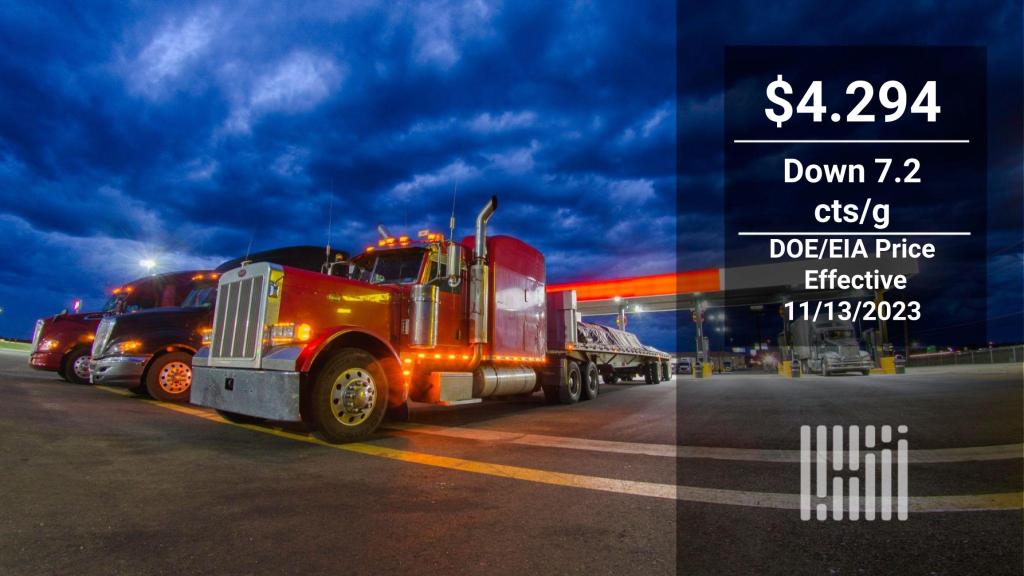
Retail diesel prices as measured by the Department of Energy/Energy Information Administration are now down almost 34 cents a gallon in the past eight weeks.
The DOE/EIA price for Monday came in at $4.294 a gallon, a decline of 7.2 cents. With that drop, the price is at its lowest since it fell to $4.239 a gallon on Aug. 7. The most recent high price was $4.633 on Sept. 18.
The price, used as the basis for most fuel surcharges, has declined in seven of the past eight weeks.
Diesel prices on the CME commodity exchange, as well as crude and gasoline, have been moving sharply lower in recent weeks, though they have turned up the past few days. Ultra low sulfur diesel on CME posted a recent high settlement of $3.2117 a gallon on Oct. 13. By last Thursday, the settlement came in at $2.7191 a gallon, a drop of 49.26 cents.
But on Monday, ULSD on CME settled up 3.51% on the day to $2.8393 a gallon. Combined with an increase on Friday, it brought ULSD futures up just over 12 cents a gallon in two days.
During the decline that for now has stopped the past few days, wholesale prices as measured by the ULSDR.USA data series in SONAR declined roughly 70 cents a gallon, significantly more than the almost 50-cent drop in the price on the CME. Those two prices — wholesale and futures — generally track movements with a relatively high degree of correlation.
Prices at the rack, the industry term for the wholesale distribution point, are affected not only by the movement in the ULSD price on CME but also by shifts in those physical markets.
These markets are traded for physical barrels either on a pipeline or on a barge. Their price is traded as a differential to the CME ULSD price.
As of a week or two ago, the trend in several of those physical market differentials had been weaker. The real-world impact of that can be seen in that steeper decline in wholesale prices compared to futures prices.
But in just the past few days, there has been a decided upward shift. Those increases will be expected to provide another bullish lift to wholesale prices in certain geographic markets on top of the increase in futures prices the past few days, reversing the recent trend.
Barrels traded on the Buckeye Pipeline system that runs from the Midwest to the East Coast were traded Monday at a 17.5-cent differential to CME, according to DTN Energy. As recently as Nov. 2, that spread was negative 19 cents.
A similar shift occurred in Chicago, where a differential Monday of 17.5 cents contrasts also with negative 19 cents a gallon on Nov. 2.
In the heavily traded Gulf Coast market, those signs of tightness have been more limited. The differential Monday was negative 13.5 cents a gallon; it was plus 12.5 cents Oct. 23. But on the West Coast, the differential since last week has been between 23.5 and 30.5 cents a gallon, according to DTN. It closed out October at “flat,” with no differential between the two prices.
At the root of the volatility in the past month has been a sentiment about both supply and demand from market bears.
The trend pointing downward on the supply side sees increasing crude flows out of several countries from the OPEC+ group, a rise in barrels that is not supposed to occur given the group’s agreement from April to limit production. It also is based on more oil from several other non-OPEC nations, such as the U.S. — which is up roughly 1 million barrels a day from the end of July — as well as Guyana and Brazil.
On the other side of that bearish coin have been projections of weakening demand worldwide.
But that assumption took a hit Monday when OPEC came out with its monthly forecast of oil demand and supply.
While OPEC’s estimate of its own supply in October differed little from those of third-party sources such as S&P Global Commodity Insights, it was the demand numbers that caught the attention of the market, propelling crude and diesel prices higher.
The OPEC report that was seen as driving the market Tuesday increased its projected global demand growth for petroleum to come in at 2.46 million barrels a day this year. That was a tiny increase of just 20,000 barrels from a month earlier, but the projected increase came in the middle of a market where slowing demand had been becoming almost a consensus view, magnifying its impact.
OPEC also projected that its forecast growth in 2024 would be unchanged at 2.25 million barrels a day and produced estimates on non-OPEC supply growth that remained tepid, even as the market has been reacting to increasing production out of various countries as 2023 winds down.
In reaction, the price of global crude benchmark Brent settled Monday at $82.52 a barrel. That was up 1.34% on the day, leaving Brent just shy of $3 a barrel more than the settlement of last Wednesday.
More articles by John Kingston
Uber Freight records tiny levels of improvement in Q3
Truck transportation jobs drop again
CRST, back in the acquisition game, buys Larkin’s BCB Transport

WASHINGTON — Advocates for getting more women into trucking weakened their stance on an overtime pay exemption as they hammered out a report to be submitted to the Federal Motor Carrier Safety Administration.
The change was made on Monday during the final meeting of the Women of Trucking Advisory Board (WOTAB), which was chartered last year by the secretary of transportation and charged with “reviewing and reporting on policies that provide education, training, mentorship, or outreach to women in the trucking industry and recruit, retain, or advance women in the trucking industry.”
Listed among “Essential statements” in its FMCSA report, a WOTAB report drafting subcommittee sought to remove the industry exemption from the Fair Labor Standards Act (FLSA), which currently allows carriers to avoid paying overtime wages to drivers.
“[The FLSA] is a barrier for women to become drivers making it hard to support their families and earn a fair wage with basic protections,” according to the subcommittee’s statement.
However, American Trucking Associations legislative affairs director Alexandra Rosen, a WOTAB member, pushed back on the draft statement, contending that “there would be a high chance that this would impact wages negatively, because many owner-operators are paid by the load and by the mile.
Rosen, who lobbies Congress on labor issues, said that removing the FLSA exemption would “upend 90-plus years of labor law, and I don’t think that impact would necessarily reflect” what the board is intending to do by changing the law.
In defending the statement to remove the FLSA exemption, WOTAB member and professional truck driver Kellylynn McLaughlin responded that one of the major complaints in this industry has been that drivers are not compensated for their time, “which is normally between 60-70 hours per week,” she said.
“The labor protections that are afforded every other industry and employer does not apply to us. And it’s time to take a good look at our protections and that we receive the same protections as others in the workforce.” She also pointed out that the exemption would not affect owner-operators, but would only apply to company drivers.
But Rosen countered that truck drivers who are considered employees under FLSA “are unlikely to receive that increased pay, because employers are going to be incentivized to adjust those compensation rates-per-mile or per load to account for that change, as well as the separate costs associated with overtime hours.”
After the discussion, WOTAB altered the statement. It was changed to read: “Review and research the potential for an industry exemption from the FLSA to determine the degree to which the lack of FLSA applicability to trucking is a barrier for women to become drivers, making it hard to support their families and earn a fair wage with basic protections.”
Debate over the issue of driver compensation resurfaced last week after legislation to remove the FLSA exemption was reintroduced in the House and Senate.
Endorsed by safety advocates and the Owner-Operator Independent Drivers Association, some members of which are company drivers, the legislation was strongly opposed by ATA, which called it “a thinly-veiled attempt to boost trial attorneys’ fees” that would “reduce drivers’ paychecks and decimate trucking jobs.”
In addition to policies that can potentially affect all drivers and carriers, WOTAB’s report focused on other ways to improve the lives of female truckers and boost the ranks of women in the industry.
The report recommended removing drivers who are proved to have committed sexual harassment and assault by setting up complaint-reporting mechanisms outside the company structure.
The board also sought to develop a rating system for carriers “that would demonstrate commitment to industry standards, allow drivers to understand potential safety concerns with carriers, and highlight carriers that actively demonstrate their commitment to upholding anti-harassment standards.”
To address harassment vulnerabilities exposed during CDL training periods, WOTAB’s report advised that, during over-the-road training, “trainers and trainees should never share the same sleeping quarters,” including hotel rooms and sleeping berths.
It also pushed for expanding government grants for training and education for women pursuing a CDL, including offsetting child care, transportation and living expenses.
After receiving and finalizing WOTAB’s report, the FMCSA administrator will submit a report to Congress, as required by law.

Final-mile service provider Riverstone Logistics (RLX) announced Monday it has acquired Ralph’s Transfer Co. Inc.
Based in Tampa, Florida, Ralph’s Transfer provides final-mile delivery of appliances and other goods throughout Florida. The company is listed with nine power units, according to Federal Motor Carrier Safety Administration data.
Financial terms of the transaction were not disclosed.
Charlotte, North Carolina-based RLX is a freight forwarder specializing in final-mile delivery of heavy goods through a network of contracted carriers. It has grown its employee count from 50 to 640 over the past two years.
“Our collective industry expertise and mutual commitment to a client-centric model, along with our emphasis on a people-first culture, will make for a seamless transition,” said RLX CEO Charlie Workmon.
The deal was the latest initiative RLX has undertaken in the past year to grow its final- and middle-mile offerings.
“Selling Ralph’s Transfer, a company that my late father, Ralph Benfield, started in 1965, was never going to be easy,” said Robert Benfield, Ralph Transfer’s president and CEO. “After getting to know Riverstone and understanding their Company Beliefs and dedication to their customers and employees, I am confident that it was the right decision to make and a decision that my father would have approved.”
More FreightWaves articles by Todd Maiden
There have been a number of “big picture” questions about shipping stocks through the years: Should companies be “pure plays” or diversify across multiple segments? Which is the best segment to own? Do master limited partnerships (MLPs) have a future as shipping equities? Are related-party deals with sponsors fair to individual investors?
All of these questions came together in a single multi-billion-dollar shipping transaction announced Monday morning.
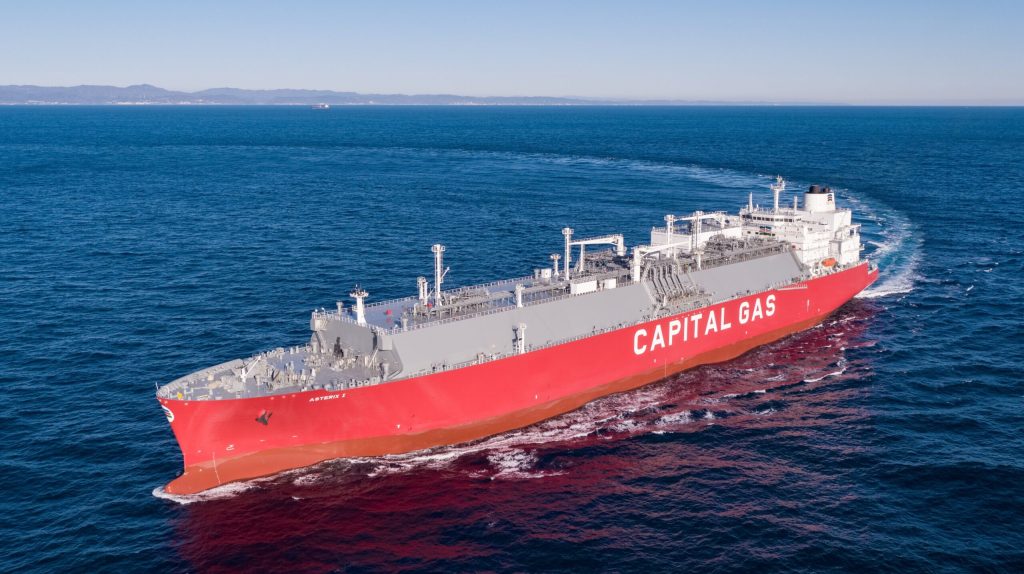
Capital Product Partners (NASDAQ: CPLP), an owner of seven liquified natural gas carriers and 15 container ships, will pay $3.13 billion to buy 11 LNG carrier newbuildings from its private sponsor, Capital Maritime, controlled by Greek shipping magnate, politician and football-team owner Evangelos Marinakis.
CPLP will convert from an MLP to a corporation, change its name to Capital New Energy Carriers effective Dec. 31 (new ticker: CNEC), sell off its fleet of 15 container ships and become an LNG shipping pure play.
It’s a “complete makeover,” said Stifel analyst Ben Nolan. CPLP’s common units closed up 7% Monday in more than triple average trading volume on the news.
The transformed entity will be a leading player in the U.S.-listed LNG shipping space, which has undergone a major reshuffle in recent years as the Ukraine-Russia war lifted LNG shipping rates to record highs.
In the minus column for LNG shipping investors, Teekay LNG, GasLog LNG and GasLog LNG Partners were taken private, as was floating regasification provider Hoegh LNG Partners, while the fleet of Golar LNG was sold. In the plus column, Flex LNG (NYSE: FLNG) listed in 2019 and CoolCo (NYSE: CLCO) — which purchased the Golar fleet — listed this March.
CPLP could see significant fleet growth beyond acquisitions announced Monday. It has the right of first refusal on any future LNG vessel sales by Capital Maritime, as well as on two ammonia carrier newbuildings and two CO2 carrier newbuildings ordered by Capital Maritime.
Following the “milestone transaction,” the company will grow into “one of the largest if not the largest LNG and energy transition gas company in the U.S. public markets,” said CEO Jerry Kalogiratos on a call with analysts.
Capital Product Partners went public back in 2007 as an owner of product tankers, thus its name. But through its history, it used a diversified fleet model, also owning crude tankers, dry bulk carriers, container ships and LNG carriers, including many bought in related-party “drop down” transactions from Marinakis. It has been building up its LNG fleet since 2021.
The debate continues on whether it’s best to diversify or not.
The pro-diversification argument is that it allows a company to manage through shipping cycles, as opposed to being a commoditized captive of a single sector’s cycle. The counterargument is that diversified shipping stocks are not attractive to investors.
The more recent moves to diversify have been driven by the desire to offset exposure to the container shipping cycle and its exceptionally weak supply-demand fundamentals.
CPLP’s move into LNG two years ago coincided with a major diversification into dry bulk shipping by fellow container-ship lessor Costamare (NYSE: CMRE). This year, container-ship lessor Danaos (NYSE: DAC) followed Costamare’s lead with its own expansion into dry bulk.
The dry bulk strategy has yet to pay off for either Danaos or Costamare, because the dry bulk market has slumped at the same time as container shipping.
Diversification hasn’t worked for CPLP either — which is why it’s now changing course.
According to Kalogiratos, the company’s common units “have been trading at a large discount to NAV [net asset value]. Despite value-creating transactions … this picture has not changed materially,” so the company is “moving away from the diversified model.”
CPLP unloaded its tanker fleet via a merger with Diamond S in 2019; the fleet of Diamond S was then sold to International Seaways (NYSE: INSW) in 2021. CPLP sold its last dry bulk carrier this year, delivering it to the buyer last month.
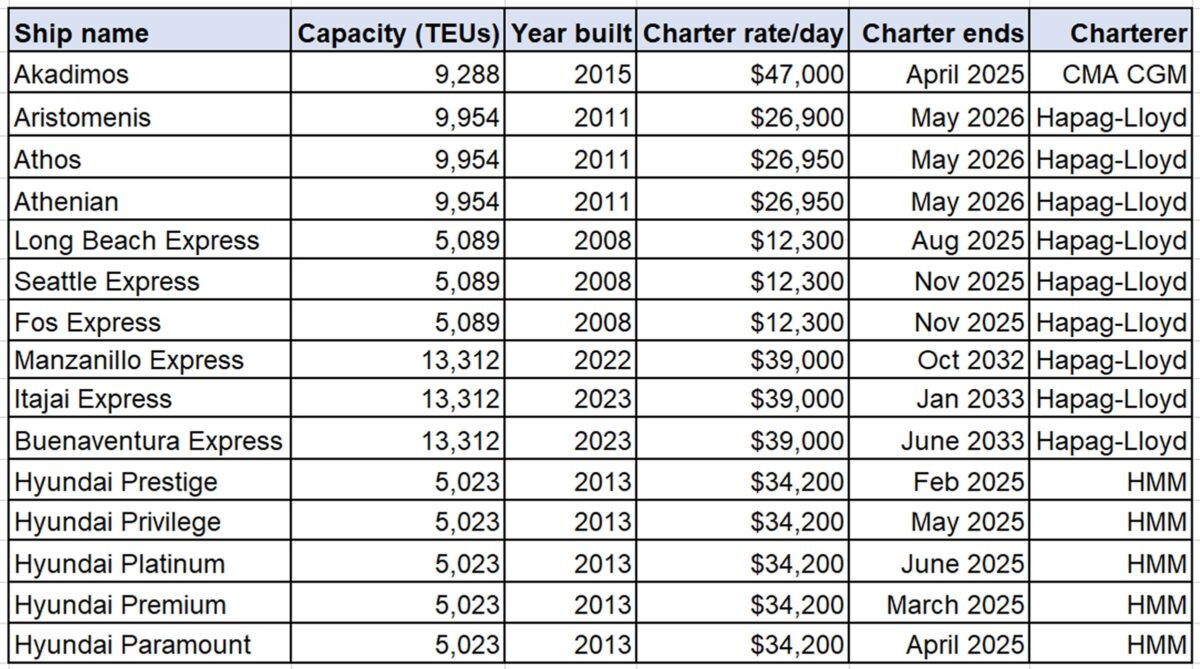
Its container shipping fleet consists of eight vessels with capacity of 5,000-5,100 twenty-foot equivalent units, four 9,000- to 10,000-TEU ships, and three 13,312-TEU ships.
Nine are on charter to Germany’s Hapag-Lloyd, five to Korea’s HMM and one to France’s CMA CGM. Nine of those charters expire in 2025, three in 2026, one in 2032 and two in 2033.
“One does not want to rush this,” said Kalogiratos, referring to the sale of the container shipping fleet. “There is no hurry. Hurried exits in shipping typically do not go well.”
He said the company is open to selling container ships off one by one or through a larger M&A deal that could involve a combination of cash and shares. “We are absolutely open as to how we do it and when we do it.”
That said, there is a sales timing factor that Kalogiratos neglected to mention on the call: An unprecedented wave of newbuildings will be delivered through 2025. The more newly delivered ships that liners put in service, the lower their interest in older, less fuel-efficient ships, a headwind to future lease rates and thus asset values and CPLP’s future fleet sale proceeds.
There’s no telling how bad the sale-and-purchase market for secondhand container ships could be a few years from now, when most of CPLP’s existing leases expire.
Another question for CPLP, given its weak share pricing and low trading volumes versus its peers despite the high profile of its Greek founder: Is CPLP’s diversified fleet the whole problem?
Could the company’s long history of related-party transactions with sponsor Marinakis have weighed down investor sentiment? And given that these related-party transactions will continue, could the NAV discount persist?
Critics of related-party deals done by Greek owners like CPLP have long argued that such transactions can benefit the sponsor too much, whether through inflated prices paid for assets or simply because common shareholders are at an informational disadvantage.
Commenting on Monday’s transaction, Nolan of Stifel said, “We view everything as a positive with the exception of the purchase price of the LNG carriers, which we estimate to be more than 10% above fair value.”

Nolan noted on the call that the purchase price “seems a little elevated relative to the market levels we’ve seen for newbuildings.”
Kalogiratos countered that “the valuation is quite fair” and was done through the board’s conflicts committee assuming charter revenues for the ships upon delivery, including rates on five of the newbuildings that have already secured charters, plus estimates for the remaining six given current long-term charter rates of around $100,000 per day.
Click for more articles by Greg Miller
The co-founder and CEO of Zenith IOS, Ben Atkins, has an ambitious and a somewhat unorthodox goal for his company. “We want to be,” he said, “the Prologis of dirt.”
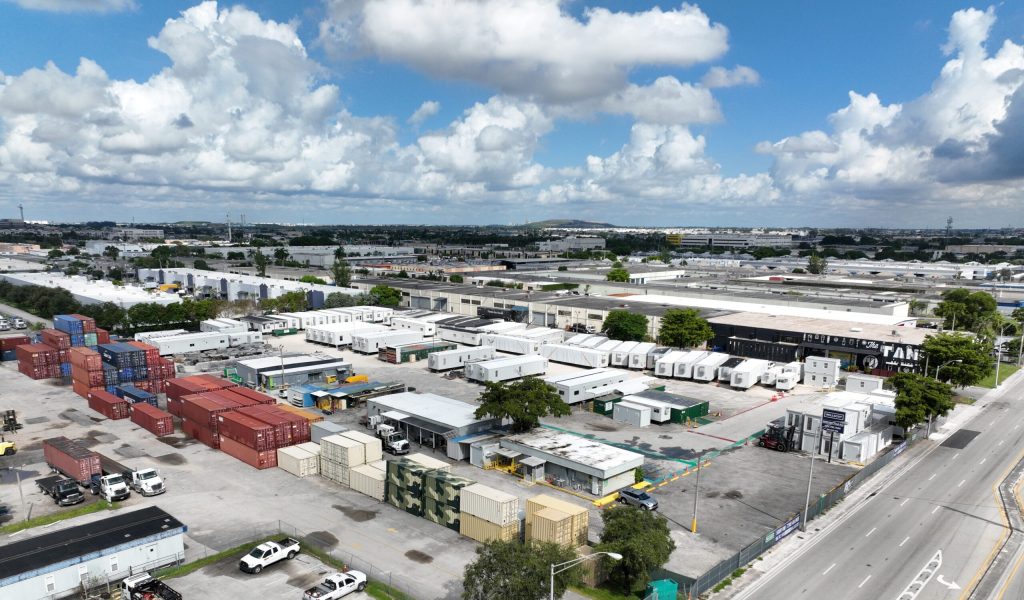
Given its massive size — more than 1 billion square feet of logistics warehousing across the globe — being known as the Prologis of anything is aspirational for most real estate developers. That’s especially true for Zenith, less than 3 years old and looking to redefine the industrial outdoor storage (IOS) industry, a legacy business built around open-air dirt facilities that have multiple uses off traditional warehouses’ beaten paths.
Atkins said that IOS has emerged foursquare on logistics warehousing’s radar screens in the wake of COVID. In a recent interview, Atkins said that he sees IOS as a $300 billion addressable market in the U.S. alone. There are a handful of IOS development providers in the country.
Zenith, which has developed and manages 50 sites in 20 markets, has entered into $400 million worth of IOS deals within the past two years, according to Atkins. In February 2022, Zenith entered into a $700 million joint venture with J.P. Morgan Asset Management to establish IOS facilities in big cities with growing populations.
“IOS has emerged in the past two to three years as a distinct subclass within industrial warehousing,” said Atkins, whose company is based in the borough of Brooklyn in New York City. He said that traditional logistics warehousing firms like Prologis (NYSE: PLD) will become more active in the space as they embrace its untapped potential. Logistics accounts for the bulk of industrial warehousing development, with a smaller amount allocated to manufacturing.
IOS facilities are built for such diverse purposes as used car lots, self-storage, construction and equipment rental sites, and locations near traditional warehouses to place delivery vehicles. The average IOS property size is 12 to 13 acres. Individual users generally utilize about half that size range, Atkins said, noting that a tenant operating an automobile lot may require up to 10 acres.
IOS is not a new market segment. For years, open-air parcels have been used by port and intermodal providers to store rail cars, containers and other outsized assets. IOS was repurposed into e-commerce utilization in the early 2010s as final-mile delivery demand increased. It garnered more attention with the dramatic changes in pandemic-driven supply chains. Demand, and pricing, ratcheted up during the past two to three years in part because ocean containers were not being returned to China and needed to be stored in the U.S., according to Dean Brody, an executive managing director at the capital markets division of real estate services giant JLL Inc. (NYSE: JLL), which has been involved in multiple IOS deals.
Experts said that IOS developers face some of the same capacity challenges as traditional warehouse developers, namely a scarcity of open, urban land known as infill, zoning restrictions and neighborhood resistance to industrial development, and the potential for alternate land uses such as residential, office or retail.
There may be instances in which IOS and traditional warehouse developers compete for the same tracts. However, there isn’t a lot of current overlap because the land itself may not be suitable, either in terms of soil condition or actual space, for logistics real estate developers, Brody said.
It remains to be seen how much e-commerce growth moves the IOS needle. Brody said he doesn’t expect e-commerce to be an IOS market mover in the coming years, adding that current IOS supply-demand scales are in equilibrium. One of his associates, Marc Duval, a managing director at the JLL division, has a different view on overall demand for IOS, including e-commerce. IOS demand will be fueled by changing supply chain requirements, the growing need to serve end customers and additional infrastructure investments such as for electric vehicle charging, he said. Atkins of Zenith said that the outsized industrial rent growth spawned by e-commerce will draw more institutional investors to IOS projects.
Increased activity combined with relatively limited supply will create a “long-term growth trajectory for rents and values” in the IOS space, Duval said.
According to JLL data, in Newark, New Jersey, a key node for IOS facilities, prices peaked in the 2021-2022 period at $38,000 per acre, based on triple-lease rates in which tenants pay all taxes, insurance and repairs and maintenance during the lease term. Prices have since receded, on average, by 20%, it said.
The slowdown could be attributed to a mean reversion following the pandemic spike, as well as Amazon.com Inc.’s (NASDAQ: AMZN) decision to pull back on its total warehousing footprint. Amazon was an early catalyst of the present-day IOS market because of the tremendous growth in fulfillment demand and the need for open space to store thousands of delivery vehicles near its fulfillment and distribution centers.
Duval said that the subsector has yet to see peak prices and that it likely won’t until it becomes a “fully mature” class for institutional investors and rents get marked to market, in part because Amazon cut back on its overall warehousing needs.
Duval said that not everyone in the logistics warehousing institutional investor pool has shown interest in IOS. But that may change. “For the market to be as mature as the industrial warehouse market we would have to see an emergence of all core investors, as well as more transparency in the data and market indicators within IOS,” he said. “When we get the institutional and accepted investor in the asset class, [then] pricing will converge with traditional warehouses.”
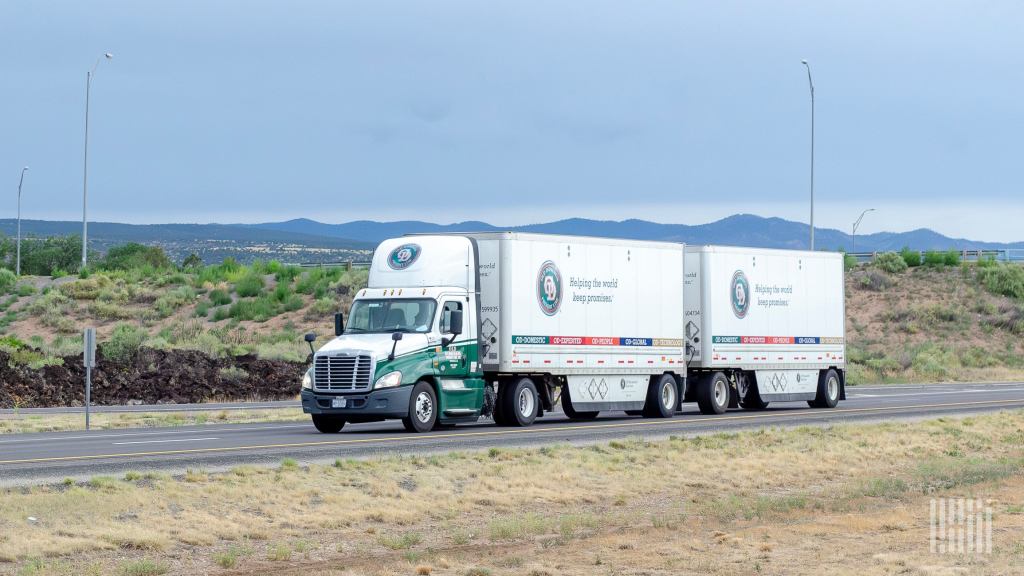
Less-than-truckload carrier Old Dominion Freight Line announced Monday it will implement a 4.9% general rate increase effective Dec. 4 on various tariff codes. The percentage increase is in line with a GRI taken earlier this year, but the effective date comes one month ahead of schedule.
Most carriers issue annual GRIs on general tariffs near the end or at the beginning of a year. General rate increases are used to adjust base rates to counter cost inflation and fund capital investments. While the percentage of the increase will vary by lane, distance and weight class, Old Dominion (NASDAQ: ODFL) expects this year’s hike to average 4.9%.
“In line with our economic forecast and expectations for the anticipated operating environment, OD is implementing a general rate increase to ensure the continued enhancement of our high-quality service network and systems,” said Todd Polen, Old Dominion’s vice president of pricing services. “This GRI, applicable to our class tariffs, aims to partially offset rising costs associated with new real estate and expansion projects, new equipment, technology investments, and competitive employee wage and benefit packages.”
The announcement follows other increases by carriers in recent weeks. The latest round of GRIs has come a little earlier for some compared to those issued a year ago as most carriers have seen a positive inflection in demand following Yellow’s exit.
Saia (NASDAQ: SAIA) recently announced a 7.5% GRI, which will also be effective on Dec. 4. The carrier’s increase was nearly two months earlier and 1 percentage point higher than the year-ago iteration. ArcBest (NASDAQ: ARCB) implemented a 5.9% GRI on Oct. 2. The GRI was in line with the year-ago increase but started one month earlier this year.
Some carriers have announced smaller increases this year.
FedEx Freight (NYSE: FDX) announced 2024 GRIs in late August. It said its Jan. 1 GRI will average between 5.9% and 6.9%, 1 percentage point lower on both ends of the range when compared to the 2023 rate bump. TForce Freight, a TFI International (NYSE: TFII) company, imposed a 4.9% increase on Oct. 2, which was 1 point lower than last year but implemented six weeks earlier this year.
XPO (NYSE: XPO) plans to issue a GRI during the first quarter of 2024, which is on schedule with its last GRI, and Forward Air (NASDAQ: FWRD) said it plans an increase of 5.9% to 7.9% as it does every year on the first Monday of February.
More FreightWaves articles by Todd Maiden