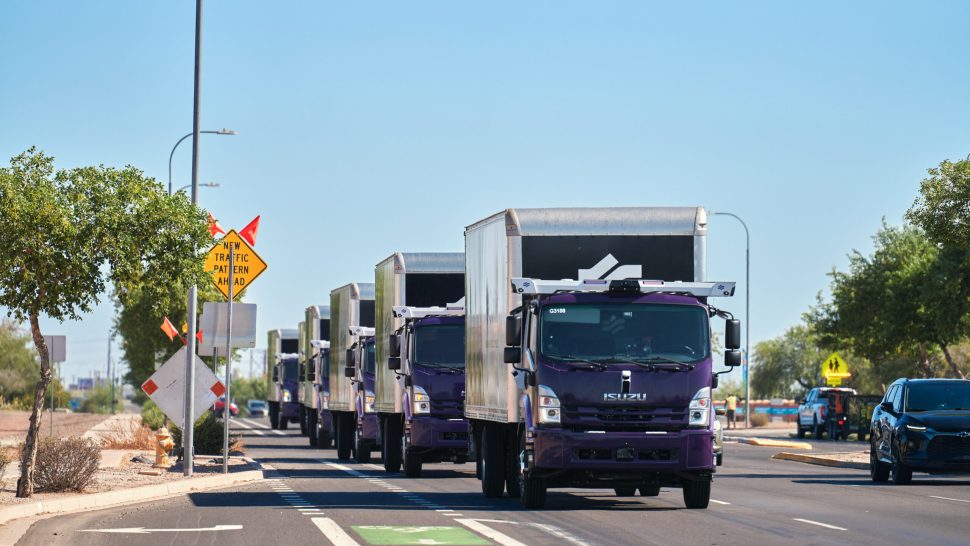
PepsiCo and Gatik on Monday announced a multi-year strategic partnership that stands as the largest commercial autonomous freight deployment to date. The deal brings fully driverless trucks into one of the world’s most demanding consumer goods supply chains. Operations are already live across Texas, Arizona and Arkansas.
“Serving our vast network of customers requires a supply chain that is safe, reliable and built for the future,” said Jim Farrell, senior vice president of supply chain at PepsiCo. “Gatik is already operating inside our networks and brings the autonomous freight technology, commercial experience and scale we need to strengthen service, add capacity and move products more consistently for our customers.”
The driverless footprint: Three states and 250 retail stops
Gatik’s autonomous trucks currently serve around 250 retail locations for PepsiCo, including Walmart and Dollar General stores. The deliveries move across both highways and surface streets — a technical distinction that matters in the autonomous vehicle space, where many competitors remain limited to interstate corridors.
“Driverless trucks deployed in commercial capacity, driving across highways and surface streets — that’s what we’re doing with PepsiCo,” said Gautam Narang, CEO and co-founder of Gatik, in an interview with FreightWaves. “The fact that they’re adopting this in very complex supply chains is one of the proof points that autonomous trucking is mainstream.”
The partnership began in 2022. Gatik went driver-out with operations in June 2025. The company maintains a99% on time track record.
No driver, no observer, one remote supervisor
Gatik’s operation stands out with fully driver-out trucks with no safety drivers or observers in the cab.
“To my understanding, in the trucking space we are the only company that can make that claim today — without a driver and without an observer,” Narang said.
The company uses Gatik Remote Supervisors, or GRS, to provide human oversight. These supervisors handle high-level go/no-go decisions but never perform remote driving or teleoperation on public roads. One person oversees multiple trucks at a time.
In the medium-duty space, the Isuzu box trucks offer another operational advantage: they can back directly into a dock. Unlike tractor-trailers, these straight trucks do not require hooking or unhooking a trailer.
The regulatory environment also supports the model. Gatik can operate in 29 states with favorable AV frameworks.
“Regulations are not, I would say, a bottleneck for us at all,” Narang said. “We do expect a national AV framework to be rolled out that will allow for safe and scalable rollout of driverless trucks.”
Because these are medium-duty operations focused on regional distribution center-to-store routes, market penetration can target a higher percentage of outbound volume compared with the more variable point-to-point nature of long-haul over-the-road trucking.
Scaling to tens of thousands of trucks
The manufacturing roadmap points to rapid expansion. Gatik, Isuzu Motors Ltd. and Nvidia are developing a production facility in South Carolina that will begin mass-producing Level 4 autonomous trucks in the second half of 2027.
“The volumes that we’re looking at for this year are in the hundreds of trucks,” Narang said. “Once the Isuzu facility is up and running and we have our vehicles coming off the production line, the volumes that we’re looking at are tens of thousands of trucks.”
The technology platform uses Gatik’s dynamic route orchestration, allowing PepsiCo to add or remove stops and adapt to shifting demand without overhauling existing operations.
“Autonomous trucking has reached commercial scale when it operates inside one of the most demanding supply chains on the planet,” Narang said. “That is what Gatik is doing with PepsiCo.”
Workforce impact: Adding capacity, not replacing people
PepsiCo frames the deployment as capacity expansion rather than workforce reduction. The focus is on high-demand regional networks that are difficult to staff — a persistent challenge facing carriers nationwide as driver wages rise and demand for safe, qualified drivers grows.
The approach aims to give frontline teams greater consistency and reliability while reducing variability across transportation networks. For an operation of PepsiCo’s scale, even marginal improvements in delivery consistency can translate to meaningful gains in customer service and shelf availability.
The partnership signals a shift for enterprise shippers evaluating autonomous freight — moving from cautious experimentation to scaling and operational integration.
Brokerage Compliance Symposium
The day before F3. Every compliance issue you face - fraud exposure, carrier liability, FMCSA rules, cargo theft, insurance gaps - navigated by attorneys and operators defining best practices in a changing industry.
F3 Awards Dinner
The night before F3. FreightTech100 companies honored. FreightTech 25 and Shipper of Choice winners revealed live. Cocktail reception into dinner and live music - 300 industry leaders in one purpose-built room.
F3: Future of Freight Festival
Industry-defining keynotes, rapid-fire technology demos, and industry leaders networking in experiences across Chattanooga - plus the inaugural F3 Awards Dinner featuring the FreightTech and Shipper of Choice reveals.
The day before F3. Every compliance issue you face - fraud exposure, carrier liability, FMCSA rules, cargo theft, insurance gaps - navigated by attorneys and operators defining best practices in a changing industry.
The Signal at Chattanooga Choo Choo • Chattanooga, TN Register NowThe night before F3. FreightTech100 companies honored. FreightTech 25 and Shipper of Choice winners revealed live. Cocktail reception into dinner and live music - 300 industry leaders in one purpose-built room.
The Signal at Chattanooga Choo Choo • Chattanooga, TN Register NowIndustry-defining keynotes, rapid-fire technology demos, and industry leaders networking in experiences across Chattanooga - plus the inaugural F3 Awards Dinner featuring the FreightTech and Shipper of Choice reveals.
The Signal at Chattanooga Choo Choo • Chattanooga, TN Register Now