
For years, commercial trucking insurers have encouraged fleets to participate in telematics programs by offering premium discounts in exchange for access to electronic driving data. Programs that once focused primarily on rewarding safe driving have gradually become an increasingly important part of commercial underwriting. Progressive Commercial’s Smart Haul program has been one of those initiatives, allowing eligible motor carriers to share telematics data with the insurer in exchange for potential premium savings. However, documentation reviewed by us and confirmed by Progressive indicates that, for some trucking applicants, participation in Smart Haul is no longer simply an opportunity to earn a discount. Instead, it has become part of the underwriting process itself.
The issue first came to light after we reviewed screenshots from Progressive’s commercial quoting platform. The screenshots showed an insurance applicant progressing through the quoting process before being prompted to identify the fleet’s current electronic logging device (ELD) provider. In the example reviewed by us, The applicant selected Samsara as the company’s existing telematics provider. Rather than continuing with the application, the system displayed a message stating that the customer would be required to purchase and install Motive telematics devices and agree to share telematics data in order to proceed.
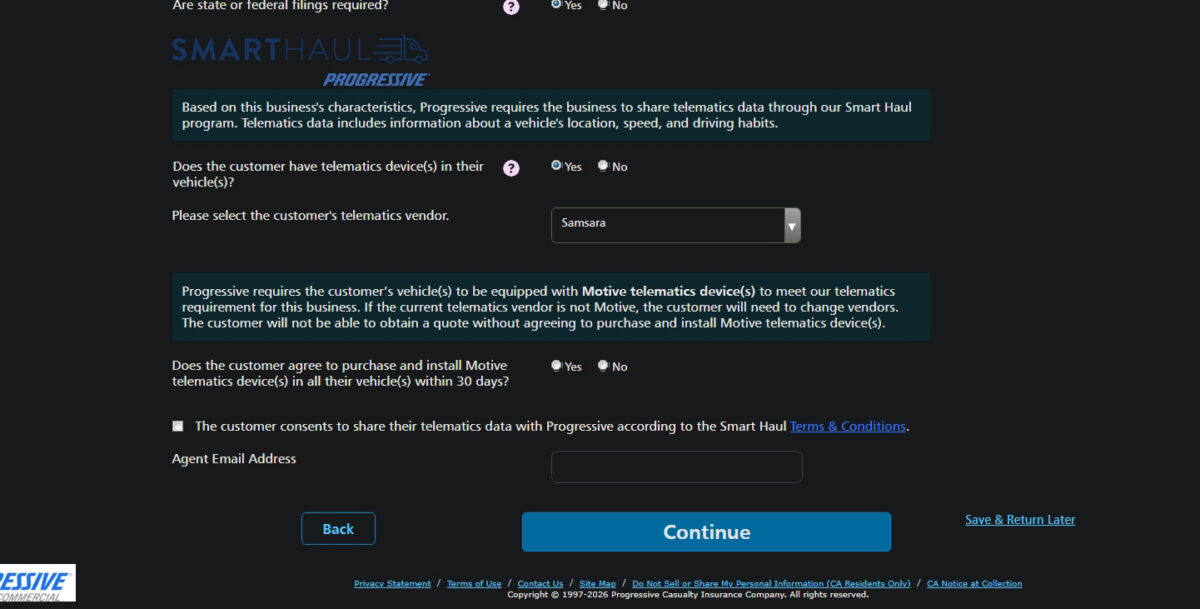
According to the website, the system advised that the applicant would not be able to receive a quote without agreeing to install Motive devices within 30 days. For many trucking companies, particularly those that have already invested heavily in an existing fleet management platform, that language represents more than a simple underwriting question. It suggests that, under certain circumstances, the choice of telematics provider may become a condition of obtaining commercial insurance coverage.
To verify whether the screenshots reflected current underwriting procedures, we contacted Progressive. The company responded by providing documentation explaining that a “small subset of trucking risks are required to participate in the Smart Haul program as part of the underwriting process”. The documentation further states that, in certain situations, customers are specifically required to install Motive telematics devices, while other applicants may qualify using different approved telematics providers depending on their underwriting profile.
Progressive’s response confirmed an important distinction between voluntary and mandatory participation. While many customers continue to have the option of enrolling in Smart Haul in exchange for a premium discount, applicants who are required to participate as part of underwriting do not receive the standard Smart Haul participation discount during their initial policy term. Instead, enrollment is treated as an underwriting requirement rather than a voluntary pricing incentive.
The documentation also explains that applicants subject to mandatory participation are expected to install qualifying telematics devices within 30 days. If the requirement applies to a policyholder and the devices are not installed within that time frame, the documentation indicates that coverage may be subject to cancellation. That requirement underscores how telematics has evolved from a safety initiative into a tool that may influence eligibility for insurance coverage itself.
The implications extend beyond simply replacing a small electronic device mounted inside a truck. Modern ELD systems have become the operational backbone of many trucking companies. Beyond recording hours-of-service information required by federal regulations, today’s telematics platforms integrate dispatch software, maintenance scheduling, GPS tracking, fuel management, payroll, routing, driver scorecards, safety reporting, and compliance documentation into a single ecosystem. For many carriers, years of operational data are stored within those systems.
Changing from one telematics provider to another often requires purchasing replacement hardware, scheduling installation across an entire fleet, retraining drivers and office personnel, reconnecting software integrations, and migrating operational information accumulated over several years. For small carriers and owner-operators, those costs may represent a significant business expense beyond the insurance premium itself. For larger fleets, replacing hundreds or thousands of devices can require months of planning and implementation.
The trucking industry has experienced rapid growth in telematics adoption over the past decade. Initially driven by the federal electronic logging device mandate, carriers quickly recognized additional benefits that extended well beyond regulatory compliance. Fleet managers now routinely use telematics to monitor equipment utilization, reduce fuel consumption, improve driver coaching, schedule preventive maintenance, and optimize routing decisions. The technology has become deeply embedded within daily fleet operations.
Insurance companies have also increasingly recognized the value of telematics data. Traditional underwriting has historically relied on information such as years in business, loss history, operating radius, cargo type, driver experience, and annual mileage estimates. Telematics adds another layer of information by providing insurers with data regarding actual driving behavior. Depending on the program, insurers may receive information related to speeding events, harsh braking, rapid acceleration, cornering, mileage, vehicle utilization, hours of operation, and other measurable driving characteristics.
Supporters argue that access to this information allows insurers to evaluate risk with greater precision than traditional underwriting methods alone. Rather than relying solely on historical loss experience, insurers can incorporate real-time operational information into pricing and underwriting decisions. Advocates also contend that telematics encourages safer driving habits by providing fleets with objective performance data that can be used for coaching and risk management.
However, mandatory participation raises broader questions for fleet owners. One issue involves customer choice. Many carriers selected their existing telematics provider after carefully evaluating available features, integration capabilities, subscription costs, customer support, and compatibility with their existing software. If insurance eligibility becomes tied to the use of a specific telematics platform, fleet owners may find themselves balancing operational preferences against underwriting requirements.
Data governance represents another area of interest. As insurers increasingly rely on operational information collected directly from commercial vehicles, questions naturally arise regarding how that information is stored, how long it is retained, who has access to it, and how it may influence future underwriting or claims decisions. Fleet operators may also wonder whether driving behavior recorded during one policy period could affect future renewals or pricing decisions.
Competition within the telematics industry could also become part of the conversation. The commercial trucking market includes numerous established providers offering different capabilities and integration options. If underwriting requirements increasingly favor particular platforms for certain applicants, telematics vendors may face additional pressure to establish technical relationships with insurance carriers or expand compatibility with underwriting systems.
Progressive’s documentation indicates that mandatory Smart Haul participation applies only to a relatively small subset of trucking risks. The company did not publicly identify the specific underwriting criteria used to determine which applicants are required to participate. We requested additional clarification regarding what underwriting factors trigger mandatory enrollment, how frequently those situations occur, whether existing policyholders could encounter similar requirements during renewal, and why Motive is specified in certain cases rather than allowing all approved telematics providers. Additional requests for comment were made to Progressive representatives; however, no further response was received prior to publication.
Although the documentation reviewed by us confirms that the mandatory program applies only to certain applicants, the development reflects a broader trend occurring throughout the commercial insurance industry. Insurers continue investing heavily in predictive analytics, artificial intelligence, machine learning, and telematics as they seek more accurate methods of evaluating risk in an environment marked by rising repair costs, increasing medical expenses, litigation, and large liability verdicts. Operational data collected directly from commercial vehicles has become an increasingly valuable underwriting resource.
For trucking companies, the evolution of insurance underwriting may require additional planning when evaluating both technology investments and insurance options. A decision regarding which ELD platform best fits a fleet’s operational needs could also become intertwined with insurance eligibility or underwriting preferences. That possibility reinforces the importance of discussing telematics requirements with insurance agents and brokers early in the quoting process so that fleets understand whether participation is optional or mandatory before making coverage decisions.
As commercial trucking insurance continues to evolve toward data-driven underwriting, telematics is becoming more than a voluntary safety tool. Progressive’s confirmation that certain applicants are required to participate in Smart Haul—and, in some cases, install Motive devices as a condition of obtaining coverage—illustrates how underwriting practices continue to change alongside advances in fleet technology. Whether similar requirements remain limited to a relatively small group of applicants or become more common throughout the trucking insurance market remains to be seen. What is clear is that the relationship between insurance underwriting and fleet technology is becoming increasingly interconnected, making telematics an important consideration not only for compliance and safety but also for obtaining commercial insurance coverage.
Brokerage Compliance Symposium
The day before F3. Every compliance issue you face - fraud exposure, carrier liability, FMCSA rules, cargo theft, insurance gaps - navigated by attorneys and operators defining best practices in a changing industry.
F3 Awards Dinner
The night before F3. FreightTech100 companies honored. FreightTech 25 and Shipper of Choice winners revealed live. Cocktail reception into dinner and live music - 300 industry leaders in one purpose-built room.
F3: Future of Freight Festival
Industry-defining keynotes, rapid-fire technology demos, and industry leaders networking in experiences across Chattanooga - plus the inaugural F3 Awards Dinner featuring the FreightTech and Shipper of Choice reveals.
The day before F3. Every compliance issue you face - fraud exposure, carrier liability, FMCSA rules, cargo theft, insurance gaps - navigated by attorneys and operators defining best practices in a changing industry.
The Signal at Chattanooga Choo Choo • Chattanooga, TN Register NowThe night before F3. FreightTech100 companies honored. FreightTech 25 and Shipper of Choice winners revealed live. Cocktail reception into dinner and live music - 300 industry leaders in one purpose-built room.
The Signal at Chattanooga Choo Choo • Chattanooga, TN Register NowIndustry-defining keynotes, rapid-fire technology demos, and industry leaders networking in experiences across Chattanooga - plus the inaugural F3 Awards Dinner featuring the FreightTech and Shipper of Choice reveals.
The Signal at Chattanooga Choo Choo • Chattanooga, TN Register Now