In a strategic restructuring that reflects the fundamental differences between how shippers and logistics service providers buy technology, project44 announced today that it is separating into two focused businesses.
project44 will continue serving enterprise shippers as a decision intelligence platform, offering TMS, visibility, yard management and last-mile solutions. Meanwhile, LSP44 launches as a dedicated, profitable, AI-native infrastructure business built for logistics service providers.
“Shippers and LSPs don’t buy the same thing, so we stopped pretending one business could serve both,” said Jett McCandless, founder and CEO of both project44 and LSP44, in a news release sent to FreightWaves. “But here’s what most people forget: project44 didn’t start with shippers. We started in 2014 serving the brokers, forwarders, and 3PLs who took the first bet on us. They built this network with us.”
“LSP44 is us coming home –handing the LSP industry more than a decade of network, data and trust, now in the form of AI agents that act, not just observe.”
The split creates two distinct go-to-market engines, two product roadmaps and two dedicated organizations. But they all run on the shared spine of the largest AI-native agent network, carrier API infrastructure and logistics data graph on Earth.
The journey to two
McCandless told FreightWaves in an interview that the decision to form two distinct businesses traces back to project44’s founding story.
–And the realization that the company had strayed from its original customer base.
When project44 launched in 2014, the logistics industry still ran on phone calls, faxes and electronic data interchange (EDI). The company’s first product was real-time API connectivity across the entire logistics workflow: rate quote, dispatch, visibility and documentation for the less-than-truckload market.
Its first customers weren’t shippers, they were logistics service providers. Brokers, forwarders and 3PLs like Worldwide Express, BlueGrace and DSV were the companies that took the initial bet, plugged in the first integrations.
That’s what helped build the infrastructure on which everything else now runs.
McCandless said that nine of the ten largest logistics service providers in the world now run on what will become LSP44 infrastructure.
But as a venture-backed company seeking growth, project44 eventually expanded into the enterprise shipper market, building visibility applications and becoming the dominant player in that space. The 2020 pandemic assisted this momentum, as COVID-19 created massive tailwinds for supply chain visibility.
There was a problem, though: shippers and LSPs speak entirely different languages.
“Where a shipper says, ‘I want to improve my OTIF, I want to improve my working capital, I want to reduce my inventory’ –LSPs don’t talk like that,” McCandless explained. “They say, ‘I want to do more dispatches with fewer people. I want to find trucks at lower prices on transactional pricing.’”
The context-switching proved increasingly difficult for sales and customer success teams. As McCandless observed his teams in joint meetings, it became clear they weren’t well-equipped to serve both buyer personas simultaneously.
“Rather than dilute the messaging to both, I said, why don’t we actually spin this out?” McCandless said.
Thus, LSP44 was born out of a desire to better serve both customer bases more efficiently.
Tech deep dive: ‘Context’ vs. ‘guessing faster’
At the heart of LSP44’s value proposition is a pointed critique of the current AI landscape in logistics: agents without context aren’t worthwhile.
“AI agents without context are just guessing faster,” McCandless told FreightWaves Today on Monday. “Shippers have found that there’s a lot of work to try to create context so that those agents can actually be effective.”
While a new generation of venture-funded startups has rushed into logistics AI and raised capital, what they don’t all have is context or distribution. McCandless identified that the real value of agents comes from when they already know the carrier, the lane, the shipment, the exception and the customer before taking a single action.
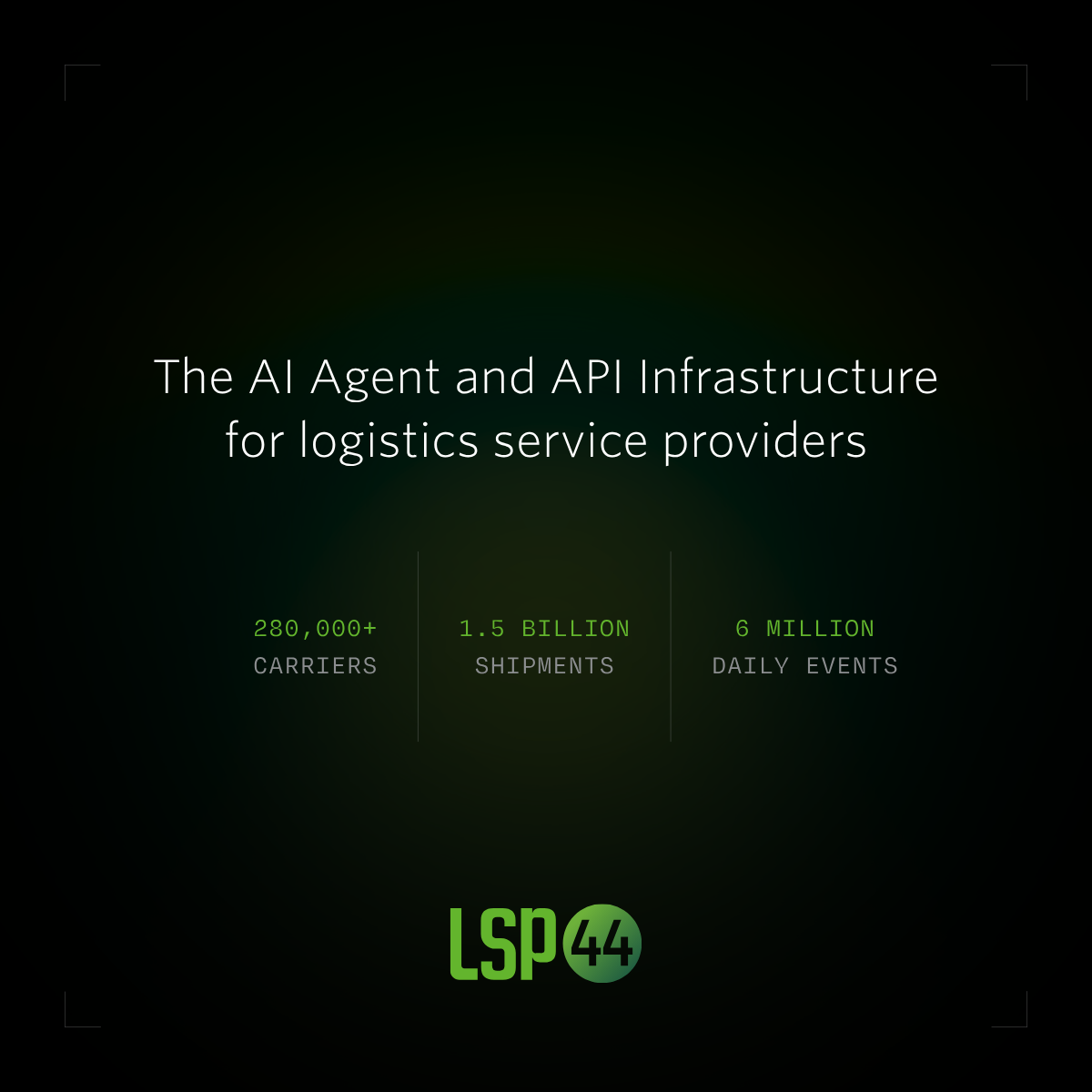
LSP44’s agents arrive pre-loaded with operational context from the largest logistics data graph in the world: over 280,000 carriers, 1.5 billion shipments and 706 million carrier events processed every day across North America, Europe, APAC and Latin America.
That context is the product –the result of over a decade and approximately $1 billion invested in infrastructure.
But scale alone isn’t the differentiator. It’s the synchronous nature of the data.
“We have the world’s largest logistics data graph,” McCandless said. “More importantly than just being the largest logistics data graph, it’s actually the largest synchronous data graph also. Somebody out there would say, ‘Well, we have a really big data graph too.’ Yeah, it’s all in EDI, phone calls and email. By the time you get the signal or triggers, you don’t even know if they’re accurate.”
When one dispatches via API, however, they can see errors within a second.
This synchronous advantage powers what LSP44 calls its “agent factory” –the capability to turn operational context into production-grade AI agents at unprecedented speed.
“We built this thing behind the scenes called an agent factory, which allows us to add about an agent a day,” McCandless said. “We can go into these LSPs with our forward-deployed engineers and say, ‘What agent do you want?’ And because we have this context and this data, a day later, we can say, ‘Okay, that agent’s live now.’”
The platform also operates on “clicks, not code” with no prompt engineering required. Users can configure workflows visually, selecting from a growing library of pre-built agents covering everything from confirming ETAs and collecting reason codes to onboarding new carriers and collecting missing delivery milestones.
“I’m not a prompt engineer [and] I’m not an engineer,” McCandless said. “We’ve already done all that prompting and we have a team. Now the [client] just has to figure out what they want and it’s as easy as clicking a button.”
The agent portfolio spans the entire logistics workflow, including: carrier procurement (with 18% cost reduction outcomes), visibility (with 60%+ reduction in “where is my shipment” calls) and exception and disruption recovery (80%+ auto-resolution).
Restructuring and looking forward
The new businesses come as project44 has dramatically streamlined its operations through aggressive internal AI adoption.
At its high watermark, the company employed 1,200 people. Today, that number stands at 582 –and McCandless has drawn a hard line.
“I forbid the company to ever go over 600 people ever again,” he said. “We release more code faster. The NPS is the highest it’s ever been. We’re a high-growth company at the largest scale of any gen-two company in the world, and I’ve got slack internally.”
That internal efficiency has created the bandwidth to spin up the dedicated LSP organization without significant new hiring. LSP44 will operate with its own sales organization, engineering team and leadership. Jett McCandless will remain as CEO of both businesses.
Critically, LSP44 launches with day-one profitability. This is in stark contrast to the wave of venture-backed logistics AI startups who burn through capital in pursuit of product-market fit.
For LSPs deciding whose infrastructure to embed at the core of their operations, that distinction matters.
“An entire field of venture-backed startups has raised billions of dollars between them to chase this opportunity,” project44 stated in its announcement Tuesday. “Not one of them is profitable. LSP44 launches with day-one profitability.”
Looking ahead, McCandless sees the combined entities as uniquely positioned for public markets.
“We are the largest gen-two logistics tech company in the world,” he said. “If a public investor wants access to invest in modern logistics tech, they really can’t get access. … As the IPO markets open up, we’re in a ready position. We make really great decisions every day to consider if it’s the right path for us.”
F3: Future of Freight Festival
Industry-defining keynotes, rapid-fire technology demos, and industry leaders networking in experiences across Chattanooga - plus the inaugural F3 Awards Dinner featuring the FreightTech and Shipper of Choice reveals.
Industry-defining keynotes, rapid-fire technology demos, and industry leaders networking in experiences across Chattanooga - plus the inaugural F3 Awards Dinner featuring the FreightTech and Shipper of Choice reveals.
The Signal at Chattanooga Choo Choo • Chattanooga, TN Register Now