




Rail union workers are at odds with other members of the freight rail industry over how cross-border rail operations are run at Laredo, Texas.
The Brotherhood of Locomotive Engineers and Trainmen (BLET) wants any post-North American Free Trade Agreement (NAFTA) to include a provision stating that only U.S. citizens should operate freight trains originating from Mexico.
That request is in response to a current NAFTA provision in which only Mexican nationals can operate U.S.-originated trains that have crossed the border into Mexico.
BLET President Dennis R. Pierce said the union has approached the White House and U.S. Trade Representative Robert E. Lighthizer to include such a provision in the next free trade agreement between the U.S., Canada and Mexico, but that the union hasn’t received a response.
Pierce urged Congressional lawmakers at a June 20 U.S. House hearing to take action on this issue.
“This Congress can do what the Administration hasn’t – protect the jobs and safety of American workers,” Pierce said. “We seek legislation that mirrors the protection Mexican workers enjoy in their country… a law that says, ‘Trains originating in Mexico may only be operated in the United States by crews comprised entirely of citizens or nationals of the United States.’”
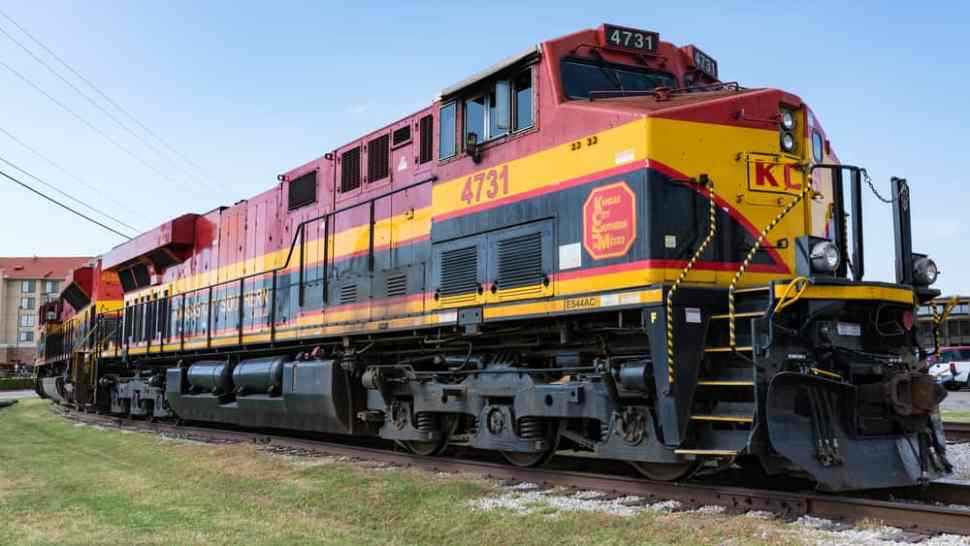
Pierce’s remarks were directed specifically to freight rail operations occurring at the International Bridge in Laredo, Texas. At the bridge, Kansas City Southern (NYSE: KSU) and its rail subsidiaries undergo federal safety inspections before moving to the Laredo Yard, which is less than 10 miles away, according to Pierce.
Over a year ago, the union was told that Mexican train crews would be running the rail operations between the bridge and the rail yard, Pierce said. The union fought the operational change unsuccessfully in the courts, and it approached U.S. President Donald Trump on the issue but hasn’t received a response, he said.
At the June 20 hearing, Federal Railroad Administration (FRA) Administrator Ron Batory said he didn’t have issues with Mexican nationals running the trains for that 10-mile stretch.
“As long as that human being is doing what’s he’s doing for the train, he’s doing his job,” Batory said.
Ian Jefferies of the Association of American Railroads said at the June 20 hearing that the Mexican crew members are vetted by the U.S. Department of Homeland Security and that the local community has been supportive of the change because it has increased train velocity.
Pierce countered in written testimony that the reasons there have previously been delays at the bridge was not because of the change of crews but because the U.S. border control needs to inspect the train for contraband and human trafficking.
“For purposes of American railroad safety law – and specifically under FRA regulations governing certification of locomotive engineers and conductors – the only foreign nationals authorized to serve as a crewmember where certification is required are Canadians,” Pierce said. “Nevertheless, it is an absolute certainty that, at some point during this hearing, there will be a Mexican crew running a train somewhere between Laredo Yard and the International Bridge.”
KCS told FreightWaves last week that it worked extensively with the U.S. Customs and Border Protection (CBP) to ensure that the Mexican crews have met CBP’s travel and work documentation requirements, including a Mexican passport, a current U.S. visa and an account with the CBP’s trusted travel program.
The CBP and KCS also deploy technology such as radio-frequency identification and video cameras to monitor rail operations and check train crews’ identification, KCS said.
The company has said previously that international crews have made the processing of trains more efficient, with savings of up to 20 minutes per train at an average of six to eight trains per day.
“Long-term initiatives including the Sanchez Yard expansion, international crews and customs process improvements are providing the extended benefit of adding additional capacity at the Laredo Gateway,” KCS chief operating officer Jeff Songer said during his company’s first quarter earnings call on April 17. He said cross-border volume was up 13 percent between the first quarters of 2018 and 2019 and 25 percent higher from the first quarter of 2017.
Meanwhile, the Port of Laredo recently and briefly beat the Port of Los Angeles at having the highest cargo volume and container volume among all U.S. airports, seaports and border crossings. The Port of Laredo garnered that top spot in March, according to data from the U.S. Census.
Brokerage Compliance Symposium
The day before F3. Every compliance issue you face - fraud exposure, carrier liability, FMCSA rules, cargo theft, insurance gaps - navigated by attorneys and operators defining best practices in a changing industry.
F3 Awards Dinner
The night before F3. FreightTech100 companies honored. FreightTech 25 and Shipper of Choice winners revealed live. Cocktail reception into dinner and live music - 300 industry leaders in one purpose-built room.
F3: Future of Freight Festival
Industry-defining keynotes, rapid-fire technology demos, and industry leaders networking in experiences across Chattanooga - plus the inaugural F3 Awards Dinner featuring the FreightTech and Shipper of Choice reveals.
The day before F3. Every compliance issue you face - fraud exposure, carrier liability, FMCSA rules, cargo theft, insurance gaps - navigated by attorneys and operators defining best practices in a changing industry.
The Signal at Chattanooga Choo Choo • Chattanooga, TN Register NowThe night before F3. FreightTech100 companies honored. FreightTech 25 and Shipper of Choice winners revealed live. Cocktail reception into dinner and live music - 300 industry leaders in one purpose-built room.
The Signal at Chattanooga Choo Choo • Chattanooga, TN Register NowIndustry-defining keynotes, rapid-fire technology demos, and industry leaders networking in experiences across Chattanooga - plus the inaugural F3 Awards Dinner featuring the FreightTech and Shipper of Choice reveals.
The Signal at Chattanooga Choo Choo • Chattanooga, TN Register Now