(Editor’s note: This is an updated article on diesel markets, including content from an article published Tuesday).
The benchmark diesel price used for most fuel surcharges fell for the third straight week, but the broader market numbers are suggesting it is going to be tough for that price to go down for a fourth consecutive time.
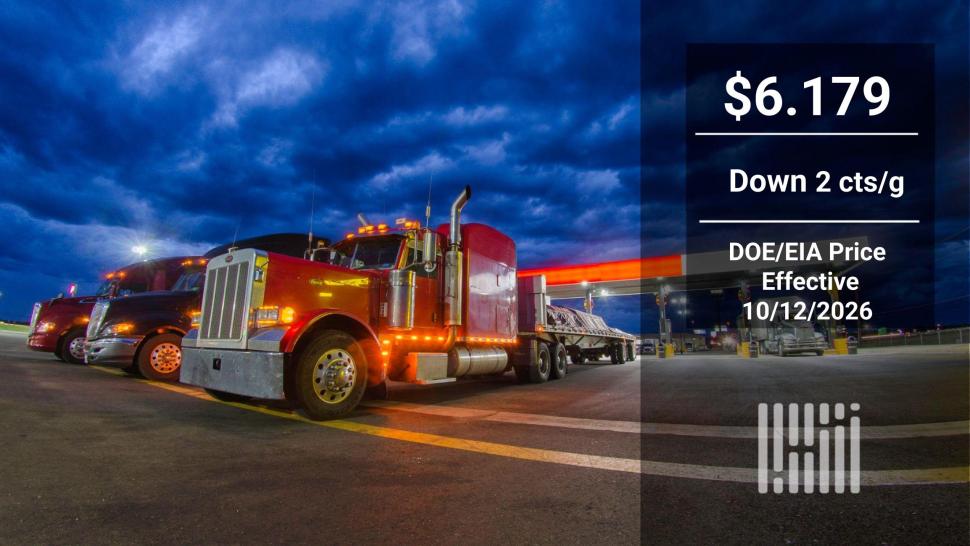
The Department of Energy/Energy Information Administration average retail diesel price was set at $6.179/gallon, effective Monday but published Wednesday, a day later than normal due to the Columbus Day holiday. That is a decline of 2 cts/g from the prior week.
But the price decline comes as the futures market for ultra low sulfur diesel (ULSD) has risen sharply since October began. Given the normal lag between changes in the futures market and the wholesale market and what consumers see at the pump, it has taken time for those increases to make their way to the retail level. But they are occurring now.
One thing that is not occurring: any negative reaction to the Trump administration deal for more supplies of diesel from Russia.
ULSD on CME settled at $4.642/g on October 1. The settlement Tuesday was $4.9344/g, a sign that both the Russia diesel deal and the move to allow on-road use of cheaper red dye diesel is having little to no impact on the broader diesel market.
At approximately 10:45 a.m. EDT Wednesday, ULSD was down about 1.2%, a decline of 6.05 cts/g, to $4.8739/g.
The futures market for ULSD has been marked by crazy volatilty in the last seven or eight trading days.
When the DOE/EIA price was published October 6, ULSD settled at $4.5694/gallon. Within two days it was more than $4.88/g. It then sunk to a settlement Monday of $4.7232/g, but it wasn’t clear that the Trump diesel deal had any impact; for all of the boasting President Trump did about the transaction, it was only down 1.52 cts/g on the day. (Permitting red dye diesel to be used over the road also has hit a regulatory maze and its impact is largely being dismissed as well).
But the sharp rise Tuesday appeared to signal that the market had largely rejected the idea that any further Russian supplies having an impact on the price.
Will Russia deal bring relief?
The Russian diesel deal is a transaction that has largely been dismissed as irrelevant to supply/demand trends. The deal with Russia also has been criticized by some members of Congress and others as illegal.
While the DOE/EIA number used as the basis for most fuel surcharges is only a weekly number, and can be delayed during a holiday week, there are other price indicators about what’s happening at the pump.
The AAA daily diesel price recently completed a 17-day run where the national average fell every day. At the start of that slide on September 22, the price was $6.5276/g. When it ended Friday, AAA said the average daily diesel price was $6.2785/g. It moved up and down slightly the next four days and Tuesday was largely unchanged from Friday.
However, it has risen the last two days, adding 3.3 cts/g from Monday’s price. The latest AAA price for Wednesday was $6.2997/g.
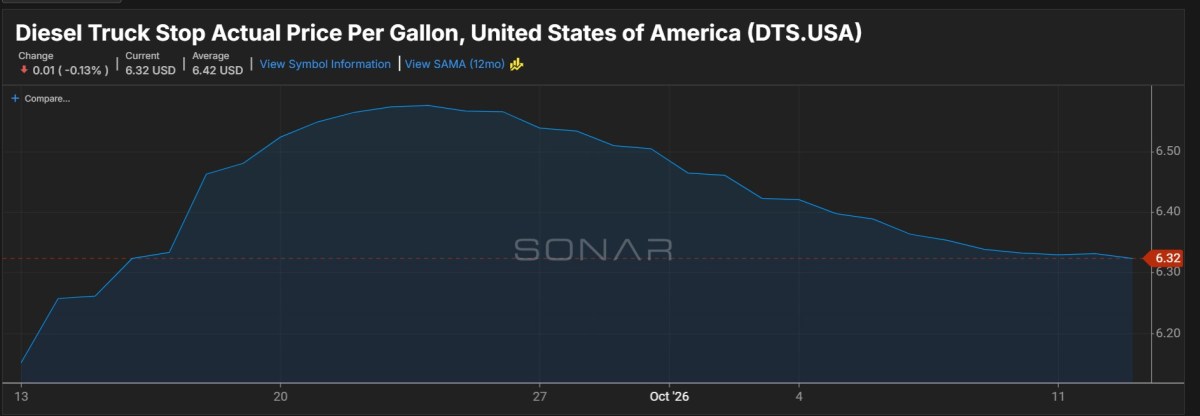
The DTS.USA average retail diesel price in SONAR Tuesday and Wednesday was $6.32/g.
Part of the volatility in the market the past few weeks has been the swing in reports about how much oil is getting through the Strait of Hormuz. Without the one definitive number for the market to agree on, that sort of uncertainty will lead to volatility.
Shipments need help
But even if the number is high, as long-time analyst Paul Sankey told CNBC in an interview, what’s getting out is not transiting through the free flow of tankers that was the state of play before the war started.
“It’s supplied at enormous military cost,” Sankey said. “That’s how you’re getting the ships through, also with the shuttle tinkering. That’s another level of cost.”
He estimated those costs are probably worth about $35/b.
Under the terms of the diesel deal announced by President Trump, Russia is to immediately supply more than 300,000 metric tons of diesel to the world market. At a conversion rate of 7.45 barrels of oil per metric tonne, the formula used by S&P Global Energy in its calculations, that works out to 2.235 million barrels.
The rest of the deal would be another 500,000 tonnes in November and 1 million tonnes soon after. At the conversion rate of 7.45 barrels per metric ton, that is 3.725 million b/d for the November quantity and double that for the supply to come after that.
U.S. daily consumption of all non-jet fuel distillates, according to the most recent report from the EIA, is about 3.65 million b/d. For the members of the OECD, which consists of most Western economies, daily diesel consumption is estimated at about 13 million b/d.
A report from S&P Global Energy quoted Masha Kotkin, a fellow at the Center for Strategic and International Studies, as saying “the amount of diesel Russia can provide would be a drop in the bucket compared to global demand. If you are asking about US diesel prices, I don’t think it’s going to make a difference. It is not very much in the scheme of things.”
It’s the products, not the crude
The move by the Trump administration to secure additional diesel supplies ultimately goes back to the reality that even if flows out of the Strait of Hormuz are increasing, irrespective of whether they only got there through U.S. military support, consumers buy refined products, not crude.
In a separate CNBC interview, Ellen Wald of Transversal Consulting said markets have been able to avoid even higher spikes in price through a wide variety of steps, including drawdowns from strategic stocks. But that has limits.
“We have seen some incredible resilience in the market,” Wald said. “We’ve seen an ability to work around and for the market to find workarounds. But at a certain point, things are going to start to give, and we’re seeing that as prices are creeping higher and higher. Any attempts to bring them down that aren’t actual new sources of supply don’t really last.”
(Editor’s note: the picture is AI-generated.)
Beyond the latest Russian diesel deal, and before that the agreement by G7 nations earlier this month to release additional strategic stocks, reportedly after a U.S. threat to implement a diesel export ban if they did not, there are the broader stock releases that were agreed upon by the members of the International Energy Agency in March.
IEA executive director Fatih Birol on Saturday tried to give a push to the ongoing releases and have them go faster.
“Members that have not yet fully delivered the volumes pledged under the March Collective Action look to see if they are able to accelerate the remaining releases to fulfil this prior commitment, prioritising diesel,” he said in his statement. He also noted that “some members have already released greater volumes than they initially pledged in March.”
More articles by John Kingston
FMCSA’s Elison: ‘weeks’ away from fixing Motus user experience
Wall Street analysts positive on C.H. Robinson deal; S&P more cautious
FMCSA split sleeper berth pilot program moves closer to launch