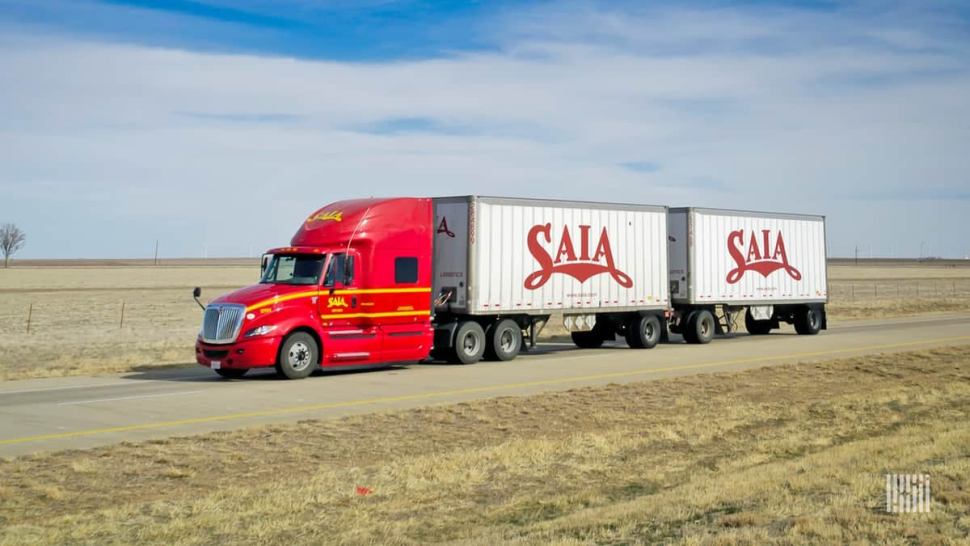
Less-than-truckload (LTL) carrier Saia, Inc. (Nasdaq:SAIA) reported today a modest miss on third quarter diluted earnings per share (EPS) as the expense of terminal openings and lower shipment weights impacted results.
Diluted EPS came in at $1.25 per share, compared to $1.07 per share in the 2018 quarter. EPS was projected at $1.29 a share by analysts polled by Barchart. Revenue rose 10.2% to $468.9 million, making Saia an outlier among almost other LTL carriers reporting flat to down revenues in a long-running weak market for industrial traffic, LTL’s bread-and-butter.
Operating income rose 17% to $45.4 million, while operating ratio – the ratio of revenues to expenses – improved slightly to 90.3% from 90.9%, Saia said. Revenue per each 100 pounds shipped, a key metric of profitability, rose 5.3%.
Shipment count rose 7.3% while tonnage rose a bit more than 3%, indicating a more than 4% reduction in weight per shipment. Declining shipment weights are an outgrowth of the year-long weakness in industrial demand. Typically, industrial freight weighs more than retail traffic. Executives acknowledged that the downward move in weight per-shipment has lated longer than they expected.
The mix of negative trends will make it harder for Saia to break below the 90% OR mark in 2020, executives said. The company refrained from 2020 guidance, though executives said they expect Saia’s volumes to be better than average market levels.
Saia has withstood the macro downtrends better than its rivals. Yet it is now experiencing the same pressures as the competition. Company executives do not see a demand rebound on the horizon. Soft demand is manifesting itself in a slowing in the pace of contract rate renewals; renewals increased, on average, by 5.5% in the third quarter, a respectable number but below the 6.7% increase in the second quarter and 9.8% in the first quarter.
The company opened three terminals and relocated a fourth in the third quarter. In October, it opened two terminals in the Northeast and one in Long Beach, California, its fourteenth in the state. It now has 168 terminals nationwide. It doesn’t expect to open any more by year’s end though it may relocate two existing locations.
Much of the terminal expansion in the past two years has been focused in the Northeast, where the company entered in 2017 and, by all accounts, has been successful. It expects to add one or two more terminals in the region next year
Brokerage Compliance Symposium
The day before F3. Every compliance issue you face - fraud exposure, carrier liability, FMCSA rules, cargo theft, insurance gaps - navigated by attorneys and operators defining best practices in a changing industry.
F3 Awards Dinner
The night before F3. FreightTech100 companies honored. FreightTech 25 and Shipper of Choice winners revealed live. Cocktail reception into dinner and live music - 300 industry leaders in one purpose-built room.
F3: Future of Freight Festival
Industry-defining keynotes, rapid-fire technology demos, and industry leaders networking in experiences across Chattanooga - plus the inaugural F3 Awards Dinner featuring the FreightTech and Shipper of Choice reveals.
The day before F3. Every compliance issue you face - fraud exposure, carrier liability, FMCSA rules, cargo theft, insurance gaps - navigated by attorneys and operators defining best practices in a changing industry.
The Signal at Chattanooga Choo Choo • Chattanooga, TN Register NowThe night before F3. FreightTech100 companies honored. FreightTech 25 and Shipper of Choice winners revealed live. Cocktail reception into dinner and live music - 300 industry leaders in one purpose-built room.
The Signal at Chattanooga Choo Choo • Chattanooga, TN Register NowIndustry-defining keynotes, rapid-fire technology demos, and industry leaders networking in experiences across Chattanooga - plus the inaugural F3 Awards Dinner featuring the FreightTech and Shipper of Choice reveals.
The Signal at Chattanooga Choo Choo • Chattanooga, TN Register Now