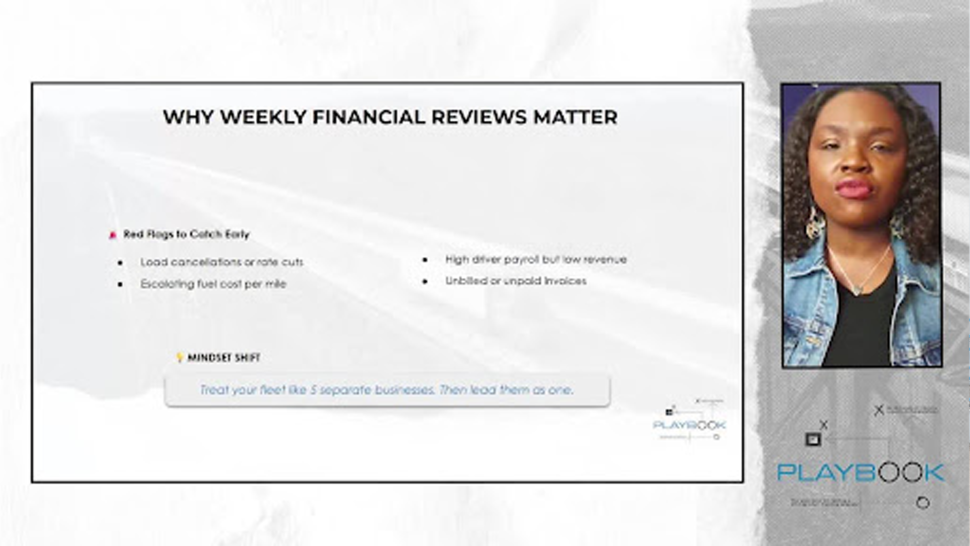
Scaling With Sanity: Financial Management for Multi-Truck Fleets wasn’t about spreadsheets and theory. It was about what actually happens when your business outgrows your personal bank account. And if you’re pushing past three to five trucks without a real financial structure in place, you’re not scaling — you’re gambling.
“More Trucks Should Mean More Profit — Not More Problems”
We kicked things off with a gut check: if your fleet is growing but your bank balance isn’t, something’s broken. And it’s not the market — it’s your math.
As your fleet expands, your cost per mistake gets bigger. You’re no longer dealing with $300 fuel days or one driver calling out. You’re managing payroll, insurance, repairs, tires, and taxes for multiple units — and if you don’t have visibility and discipline, those trucks will eat you alive from the inside out.
This class broke down exactly how to fix that — before it’s too late.
Here’s What We Covered in Class
The Truth About Revenue vs. Profit
We put to rest one of the biggest lies in trucking: that revenue equals success.
It doesn’t.
A carrier doing $80,000/month in top-line revenue but walking away with $3,000 net isn’t winning. They’re surviving.
We drilled into the gross vs. net vs. operational cash flow triangle and showed students how to separate vanity numbers from real margins. Because trucks don’t run on revenue — they run on profit. And too many carriers don’t know what that profit actually is.
Truck-by-Truck Financial Visibility
If you’ve got four trucks and can’t tell me what each one nets per week, you’ve already lost the game.
We walked through how to break down each truck as its own profit center:
- Revenue per truck
- Fuel and maintenance per truck
- Driver pay structure
- Load volume
- Downtime tracking
Why? Because averages lie. One truck might be carrying the other three — and if you don’t know which one, you can’t fix it.
Fixed Costs vs. Variable Costs — And Why You Need Both
Every carrier should know the difference:
- Fixed costs: insurance, truck payments, office rent
- Variable costs: fuel, maintenance, load-based pay
We gave students a breakdown tool to calculate their fixed cost per truck per week — and explained why cash flow dies when fixed costs outrun utilization. If you’ve got four trucks but only two consistently running, your fixed costs don’t drop — your margins do.
The Weekly Rhythm of Financial Control
One of the most valuable takeaways? The Weekly Financial Cadence.
This is the system that turns financial chaos into control:
- Monday: review last week’s profit/loss per truck
- Tuesday: flag any upcoming big expenses (tires, service, insurance)
- Wednesday: check receivables (what’s owed to you)
- Thursday: confirm payroll, match to revenue
- Friday: cash forecast next 14 days
We’re not talking about doing taxes here. We’re talking about staying alive and keeping your wheels turning.
Scaling Without Leaking
Scaling a fleet is like filling up a jug with holes. If you don’t plug the leaks before adding trucks, you’re just moving faster toward failure.
We taught carriers how to identify common financial leaks:
- Late invoices
- Overpaying drivers
- Unnecessary detention and layover losses
- Maintenance neglect turning into big repairs
And we showed them how to use real KPIs to flag issues before they bleed out profit.
Vanessa Gant Dropped a Bomb
Special guest Vanessa Gant from Provision Accounting joined us to walk through how to read your P&L like a fleet owner — not just a hustler.
She broke down:
- What to look for on a Profit & Loss report
- Why your chart of accounts matters
- The #1 mistake most carriers make when categorizing expenses
Her message was clear: if you don’t understand your numbers, your tax preparer is running your business — not you.
Financial Systems You Must Have by Truck #4
Finally, we closed out with a list of non-negotiable systems every carrier scaling to 4+ trucks must implement:
- Bookkeeping system (QuickBooks, accounting support)
- Fleet-level P&L (not just lumped income/expenses)
- Invoice tracking & factoring control
- Weekly financial review rhythm
- Driver pay reports tied to load performance
Without these systems, you’re just guessing. And guessing is expensive.
Who This Class Was For
This wasn’t a beginner course. This was for:
- Carriers with 2–10 trucks who feel like money comes in but disappears
- Owner-ops trying to scale but unsure how to budget
- Dispatchers or operations leads stepping into management roles
- Anyone preparing to hire more drivers or buy more trucks in the next 6 months
If you fall into one of those buckets and missed the class — you missed a blueprint.
But good news — we’re just getting started.
Your Next Step
Want the Templates, Frameworks, and Access to the Next Class?
Join the Playbook Masterclass Series.
We host a brand-new class every two weeks with real tools, real walkthroughs, and real strategies built specifically for small fleet owners.
This is your training ground.
If you missed this session, you can still catch the replay—and we’ll see you in two weeks for the next one.
Brokerage Compliance Symposium
The day before F3. Every compliance issue you face - fraud exposure, carrier liability, FMCSA rules, cargo theft, insurance gaps - navigated by attorneys and operators defining best practices in a changing industry.
F3 Awards Dinner
The night before F3. FreightTech100 companies honored. FreightTech 25 and Shipper of Choice winners revealed live. Cocktail reception into dinner and live music - 300 industry leaders in one purpose-built room.
F3: Future of Freight Festival
Industry-defining keynotes, rapid-fire technology demos, and industry leaders networking in experiences across Chattanooga - plus the inaugural F3 Awards Dinner featuring the FreightTech and Shipper of Choice reveals.
The day before F3. Every compliance issue you face - fraud exposure, carrier liability, FMCSA rules, cargo theft, insurance gaps - navigated by attorneys and operators defining best practices in a changing industry.
The Signal at Chattanooga Choo Choo • Chattanooga, TN Register NowThe night before F3. FreightTech100 companies honored. FreightTech 25 and Shipper of Choice winners revealed live. Cocktail reception into dinner and live music - 300 industry leaders in one purpose-built room.
The Signal at Chattanooga Choo Choo • Chattanooga, TN Register NowIndustry-defining keynotes, rapid-fire technology demos, and industry leaders networking in experiences across Chattanooga - plus the inaugural F3 Awards Dinner featuring the FreightTech and Shipper of Choice reveals.
The Signal at Chattanooga Choo Choo • Chattanooga, TN Register Now