The 2025 tariff environment wasn’t a policy adjustment — it was a structural break.
That’s the core finding from Infios‘ new report, The Rise of the Tariff-Optimized Supply Chain, which draws on millions of U.S. customs entries to map how companies responded to a tariff environment. The report lands at a moment when importers across categories are still grappling with duty rates that, for some product lines, have stacked into the 20%-to-80% range – multiple duties (a universal baseline, country-specific adjustments, Section 301, and IEEPA tariffs) layered on the same product.
Don Mabry, SVP of Global Trade Solutions at Infios, joined FreightWaves to walk through the findings and what they mean for companies still trying to get their arms around this environment.
The research frames tariff exposure as a live variable that now sits alongside freight cost, lead time, and service level as a core planning input. That’s a departure from how most supply chains operated before 2018, when duties were a background cost that companies simply absorbed.
“Mode selection, entry structuring, even where you warehouse — all those were operational and financial decisions, and tariffs sat quietly in the background as a P&L line item,” Mabry said.
That’s no longer the case. The Infios data shows the 35-to-50% duty bracket grew more than tenfold, while the 50%-plus bracket went from effectively zero to tens of thousands of entries. In that environment, Mabry said, importers stopped treating duties as something to accept and started treating them as something to design around.
“They don’t accept the duty bill. They design around it,” he said, citing the report’s central finding.
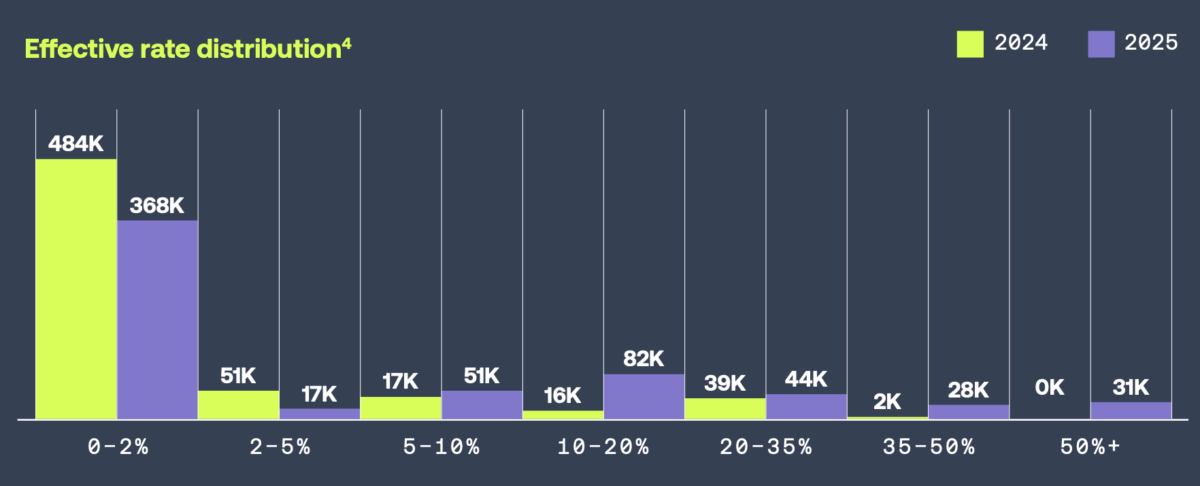
The shift showed up across three dimensions. Mode selection, once driven purely by cost and service tradeoffs, now reflects tariff risk at the entry level. Landed cost planning, which used to start near zero for duties, now bakes in a 10-to-20% baseline assumption from the outset. Compliance, once a back-end checkpoint, has become a strategic lever that actively shapes routes, modes, and entry structures.
“Traditional supply chains were linear systems built for stability,” Mabry said. “But the tariff-optimized supply chain is adaptive. It’s built for change.”
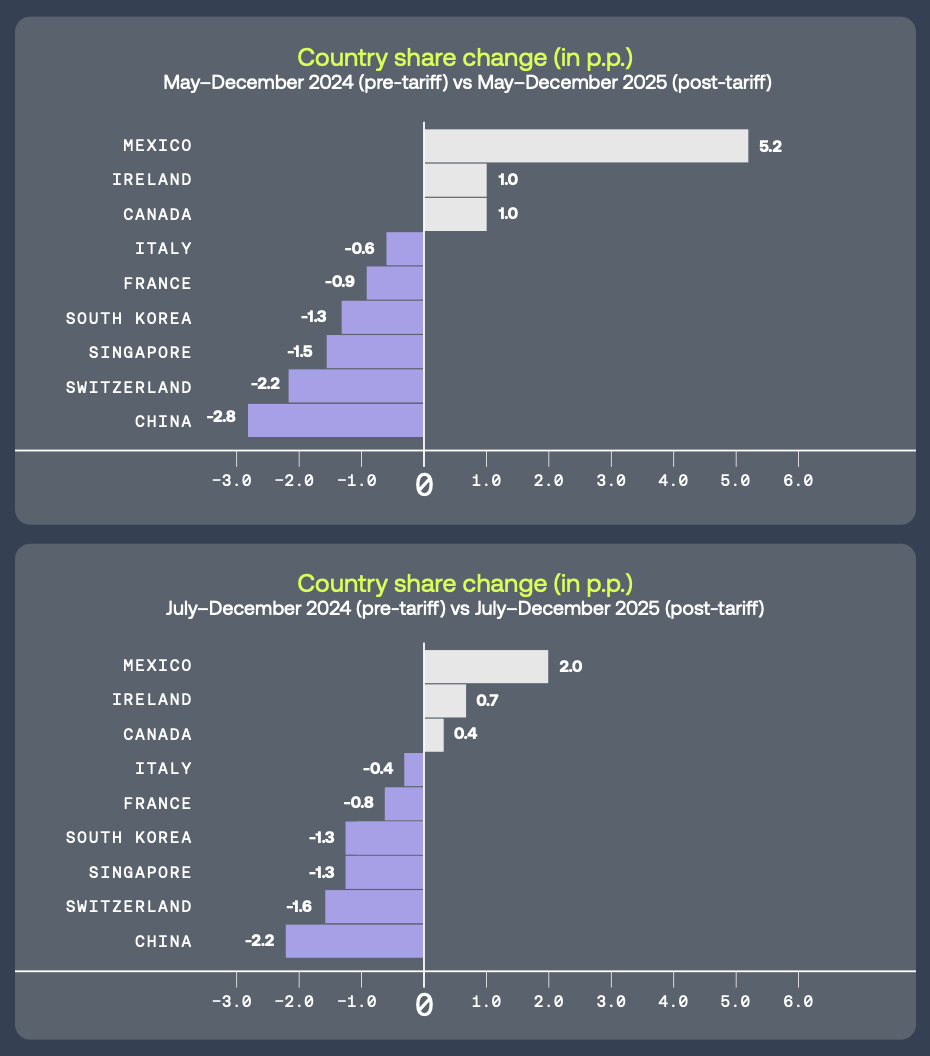
The report identifies two distinct phases of importer response. Wave one was reactive, with a surge of route testing, mode switching, and pull-forward activity driven by urgency more than strategy. Mexico’s origin share jumped 5.2 percentage points, Canada rose 1.0 percentage point, and experimental trade corridors involving countries like Vietnam, Ethiopia, Ireland, and Switzerland appeared suddenly.
But most of those gains were short-lived. By the second half of the year, Mexico’s surge had halved to roughly 2.0 percentage points and Canada’s to 0.4. That pattern is less reshoring and more panic-driven route testing. Air and truck share spiked as urgency overrode cost discipline, and the numbers told a story of an import community iterating as fast as it could just to keep pace with a shifting policy environment..
“When de minimis (the value threshold below which low-value shipments cleared without a formal customs filing) was removed, Canadian informal entries jumped by 79% — literally overnight,” Mabry said. “They went from 34,000 to 61,000, and that’s the signature of a cost environment that is changing faster than any planning cycle could absorb.”
Wave two was where the durable shifts emerged. China’s loss of origin share held (down 2.8 percentage points in the full May-to-December window, 2.2 in the more stable July-to-December period). The shift was not uniform. Elastic categories, including consumer goods, low-complexity electronics, and light manufacturing, saw genuine diversification away from China. Inelastic categories, such as specialty chemicals, rare earth products, and certain industrial components remained China-dependent, revealing that the decline in origin share reflects a segmentation of the supply base according to what can and cannot be substituted.
Air freight’s gain of approximately 12 percentage points and truck’s gain of eight didn’t reverse. Ocean freight declined 10 to 12 percentage points and did not rebound. Bonded warehouse usage climbed from around 10% of entries to 16–18% and kept rising into the second half. Harmonized Trade System classification complexity nearly doubled, moving from about six sequences per entry to 11.6, and stayed there. Total entered value rose roughly 78% while entry counts fell 7%. Importers were consolidating into fewer, higher-value shipments rather than simply shipping less.
Mabry distinguished between adaptation and optimization.
“We’re not claiming companies optimized their tariff position back in 2025,” he said. “What the data captures is the early stages of active management. True optimization still lies ahead.”
The durable changes, he argued, were not sourcing decisions. “Smarter classification, deliberate mode selection, phased duty exposure, more adaptive routing. And critically, those capabilities aren’t dependent on any single policy outcome,” Mabry said. “They’re mechanisms for operating under uncertainty, and that’s why they’ve persisted into 2026.”
Among the most telling shifts in the data is the rise of bonded warehousing from a niche tool to a mainstream strategy.
“Consider something like a single 40-foot container of midrange electronics,” Mabry said. “They could carry duties in hundreds of thousands of dollars. At that level, duty stopped being really a P&L line item. Instead, they really start being a treasury question.”
Three mechanisms are driving the shift: deferred duty payment that aligns tariff costs to actual sales velocity; protection against midcourse policy changes for goods sitting in bond; and selective withdrawal, where importers pull forward lower-duty items while deferring higher-duty ones.
“Leading companies are no longer treating duties as this fixed, static cost,” Mabry said. “They’re actively managing their exposure to those duties within the bounds of applicable laws and regulations.”
That shift is the conversation finance-oriented buyers want to be having, and it’s just beginning to scale.
Beyond mode and entry-level shifts, the report’s trade route analysis reveals where companies are actively experimenting with new supply chain configurations. The data distinguishes between routes that gained value, routes that lost it, and corridors that are entirely new, which makes it a map of real-time supply chain reconfiguration at scale.
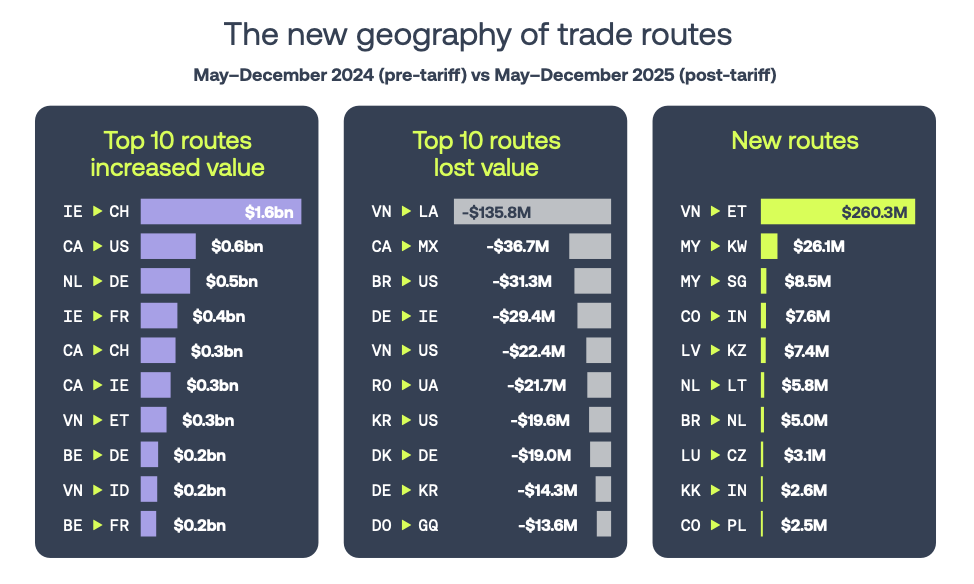
“Route intelligence is only actionable if rules of origin discipline is maintained,” Mabry said. The experimental corridors appearing in the data like the new $260M Vietnam to Ethiopia lane only hold if the compliance infrastructure behind them is sound.
The report is direct about the shortcomings of existing infrastructure. “Traditional systems were not designed for this environment,” Mabry said.
TMS platforms lack a concept of tariff exposure. ERP planning cycles are too slow for weekly policy changes. Brokerage workflows can’t handle the filing volumes. And procurement tools evaluate suppliers by location without modeling the execution pathways that determine landed cost.
Six capabilities emerged as essential: dynamic tariff modeling, intelligent classification and origin management, multimodal execution decisioning, warehouse entry and withdrawal optimization, route and corridor intelligence, and automated compliance orchestration.
On compliance, Mabry pushed back against the idea that it’s simply a constraint. “Compliance isn’t a standalone theme. It’s structurally what makes everything else possible,” he said. “Mode shifts only hold if origin documentation supports the entry. Duty deferral only works if your classification is accurate.”
The report frames the endgame around optionality as the new efficiency. Tariff-era supply chains have to maintain multiple modes, qualified origins, entry strategies, and routing options simultaneously in order to move fast when policy shifts.
That’s where AI enters the picture. Generative AI handles the language and document side, extracting and normalizing content from commercial invoices, supplier certifications, and policy updates that used to be manual bottlenecks. Agentic AI takes the next step, continuously monitoring tariff layers, rerunning landed cost scenarios, flagging classification risk, and recommending mode changes when the duty math on a lane shifts.“Generative AI gives you the comprehension. Agentic AI gives you the execution,” Mabry said. “Together, they turn the tariff-optimized supply chain from a thesis into something companies can actually operate against at scale.”
Click here to learn more about Infios.
Click here to get your free copy of the report.
Brokerage Compliance Symposium
The day before F3. Every compliance issue you face - fraud exposure, carrier liability, FMCSA rules, cargo theft, insurance gaps - navigated by attorneys and operators defining best practices in a changing industry.
F3 Awards Dinner
The night before F3. FreightTech100 companies honored. FreightTech 25 and Shipper of Choice winners revealed live. Cocktail reception into dinner and live music - 300 industry leaders in one purpose-built room.
F3: Future of Freight Festival
Industry-defining keynotes, rapid-fire technology demos, and industry leaders networking in experiences across Chattanooga - plus the inaugural F3 Awards Dinner featuring the FreightTech and Shipper of Choice reveals.
The day before F3. Every compliance issue you face - fraud exposure, carrier liability, FMCSA rules, cargo theft, insurance gaps - navigated by attorneys and operators defining best practices in a changing industry.
The Signal at Chattanooga Choo Choo • Chattanooga, TN Register NowThe night before F3. FreightTech100 companies honored. FreightTech 25 and Shipper of Choice winners revealed live. Cocktail reception into dinner and live music - 300 industry leaders in one purpose-built room.
The Signal at Chattanooga Choo Choo • Chattanooga, TN Register NowIndustry-defining keynotes, rapid-fire technology demos, and industry leaders networking in experiences across Chattanooga - plus the inaugural F3 Awards Dinner featuring the FreightTech and Shipper of Choice reveals.
The Signal at Chattanooga Choo Choo • Chattanooga, TN Register Now