




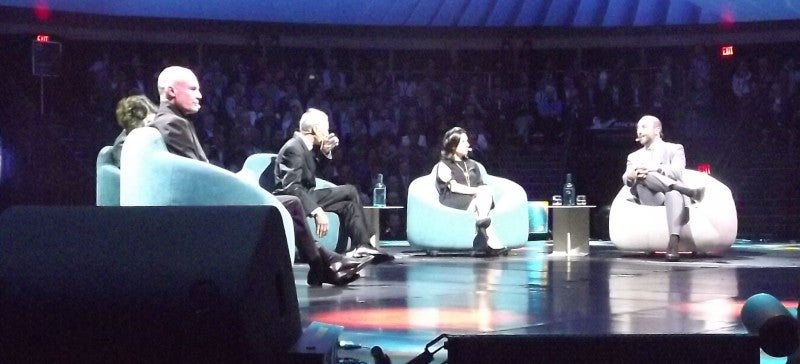
The future of mobility is going to require government regulation, according to panelists at the opening session of the Movin’ On by Michelin conference in Montreal. Bertand Piccard, president of Solar Impulse Foundation, Valeria Plante, mayor of Montreal, Jean-Dominique Senard, president & CEO of Michelin, and Kate White, deputy secretary for Environmental Policy and Housing Coordination – California State Transportation Agency, opened the annual conference on sustainable mobility with a discussion on how government and private enterprise can work together to develop sustainable solutions for the future.
Many may be surprised to hear that all agreed that to develop innovative solutions requires government regulation. Society needs “clear regulation that will pull innovation forward,” explained Piccard, who noted that the real problem is selling government on innovation.
“We have to [position it] logically as well as ecologically,” he said. “If we go to politicians with ecological [solutions], they tell us it’s too expensive. We have to prove them wrong; we have to prove ecological is profitable.”
Like many cities, Plante is presiding over a metropolis that is struggling to meet modern demands of both people and freight movement. She ran on a platform of mobility and said she found that “during the campaign the appetite for mobility was there. What there was, was the desire to have options – yes, I want to have a car, but only on the weekend. During the week I want a bike.”
Montreal is now expanding its mobility options, including adding 300 hybrid buses to its fleet and working to develop bike lanes. Developing the solutions, though, is not designed to promote one transit mode over another, she said. “We share the same grids, so for me it was not to put them in opposition (trucks vs. cars vs. bikes vs. pedestrians), it was about [finding solutions],” she said.
Michelin’s Senard said that the solutions to sustainable mobility rely on being as environmentally friendly as possible and protecting road safety. “We, together, can plan an incredible action,” he said.
Senard and White also talked about the importance of the Paris Climate Agreement and the importance of building solutions that meet those goals, regardless of whether the U.S. is part of the agreement or not. “We have the roadmap, the problem is to execute it,” Senard said.
In her role, White touts the importance of getting Americans to adopt more sustainable solutions such as environmentally friendly vehicles, ride-sharing options, and bikes.
“I helped start car-sharing in California in the early 2000s…with the belief we need to start weeding Americans off their car,” she said. It’s really like an addiction, the car is another member of their family.
“We want to make sure our sustainability initiatives work to meet the [parameters] of the Paris agreements,” she added.
To do that, though, requires government involvement, Piccard said. “There are a lot of people who don’t care about the environment, they want business as usual,” he said.
Piccard noted how citizens used to throw trash into the rivers, but then regulation outlawed it. The result, he said, was better for the environment, but it also created jobs and improved health, which is a key to getting governments involved. Poor air quality kills 7 million people a year globally, he said, adding that some dollars spent on health costs could be directed to sustainable mobility solutions that would provide health benefits at a more effective cost.
While many private businesses are buying into sustainable initiatives, Piccard said to get more solutions, they need to be shown to be profitable endeavors for businesses.
“These collaborations are the key to the future,” Senard noted. “I can’t think of one country where the collaboration between government and companies [will not be important].”
Regulation, Senard said, will drive innovation from private enterprise by providing the framework to develop solutions.
“We’re trying to advance some of those [regulations] and I think it’s working,” White said, pointing to a cap-and-trade program between California and Quebec that has poured billions of dollars into the California budget to advance sustainable solutions. She also pointed to the new fuels tax that went into effect last year and is expected to bring in $5.5B in new revenue “that we are investing in sustainable transportation.”
“We need the government, the legislatures to take the lead and tell the public where we want to go and how we will get there,” Piccard added.
The panelists repeatedly went back to the idea of effecting change. “I think it’s very important to keep in mind what our climate goals are, what our health goals are,” White said, “and make sure that every mobility option is moving us toward a sustainable [future].”
Stay up-to-date with the latest commentary and insights on FreightTech and the impact to the markets by subscribing.
Brokerage Compliance Symposium
The day before F3. Every compliance issue you face - fraud exposure, carrier liability, FMCSA rules, cargo theft, insurance gaps - navigated by attorneys and operators defining best practices in a changing industry.
F3 Awards Dinner
The night before F3. FreightTech100 companies honored. FreightTech 25 and Shipper of Choice winners revealed live. Cocktail reception into dinner and live music - 300 industry leaders in one purpose-built room.
F3: Future of Freight Festival
Industry-defining keynotes, rapid-fire technology demos, and industry leaders networking in experiences across Chattanooga - plus the inaugural F3 Awards Dinner featuring the FreightTech and Shipper of Choice reveals.
The day before F3. Every compliance issue you face - fraud exposure, carrier liability, FMCSA rules, cargo theft, insurance gaps - navigated by attorneys and operators defining best practices in a changing industry.
The Signal at Chattanooga Choo Choo • Chattanooga, TN Register NowThe night before F3. FreightTech100 companies honored. FreightTech 25 and Shipper of Choice winners revealed live. Cocktail reception into dinner and live music - 300 industry leaders in one purpose-built room.
The Signal at Chattanooga Choo Choo • Chattanooga, TN Register NowIndustry-defining keynotes, rapid-fire technology demos, and industry leaders networking in experiences across Chattanooga - plus the inaugural F3 Awards Dinner featuring the FreightTech and Shipper of Choice reveals.
The Signal at Chattanooga Choo Choo • Chattanooga, TN Register Now