I’ve held a CDL-A with all endorsements for 25 years. I’m still licensed today, renewed my TWIC and hazmat last month. I’ve taught CDL driving for years under a Virginia DMV license. I also teach teen behind-the-wheel training in Virginia under the Department of Education and DMV.
I’m telling you this because what I’m about to describe is what I see every week when teenagers get in my car.
A 17-year-old gets in. Can’t adjust the seat. Can’t adjust the mirrors. Can’t put the car in gear. Looks at me and says, “I’m only doing this because my mom made me. I have to get a job. I don’t even want a license.” I was a legally emancipated adult in VA at 15, which blows my mind because most people at 15 today need help putting their socks on. It’s a different world.
This happens constantly. This mentality is now far more prevalent among our male teens than among our female teens. It didn’t used to be this way.
Males used to be the ones ready to get their license the day they were eligible. They couldn’t wait. They’d been thinking about it for years. Now? The females are getting in my car at 15 and 16, begging for a license, already working jobs, ready to take the world by the horns. The males are the ones being dragged in by their parents, disinterested, unmotivated, checking out.
We’ve had a serious shift in male and female roles regarding teen licensing, work, and ambition, and most people don’t even recognize that it’s happened.
The Data
According to the Federal Highway Administration, only 25.6% of 16-year-olds had a driver’s license in 2022, down from 43.1% in 2000. For 17-year-olds, it’s dropped from 62.6% to 45.5%. Even 18-year-olds are getting licensed less: 60.3% in 2022 versus 80.4% in 2000. By the senior year of high school in 2023, only 63% had licenses, compared to 82% in 2005 and nearly 90% among boomers and Gen X.
But the gender split is where it really gets wild.
According to the Hamilton Project, men born in the late 1990s had labor force participation rates 9 percentage points lower at age 25 than men born 45 years earlier. Women born in the same period? Their participation rates were higher than those of any previous generation at that age. The San Francisco Federal Reserve found that 14% of millennial males at age 25 are not in the labor force, double the rate for baby boomer males at the same age.
Pew Research reports that 47% of women ages 25 to 34 now have a bachelor’s degree compared to just 37% of men. Women account for 50.7% of the college-educated labor force; they surpassed men in the fourth quarter of 2019, and the gap keeps widening. From 2019 to 2020, male first-time college enrollment dropped by 5.1%, while female enrollment dropped by less than 1%.
For men ages 25 to 34, workforce participation was 92.4% in 2004. By August 2024, it had fallen to 88.8%, meaning over 700,000 fewer young men were working. Women in the same age group went the opposite direction: from 72.8% to 78.5%.
When Pew asked Americans without bachelor’s degrees why they didn’t get one, men were more likely than women to say they “just didn’t want to.”
We’re watching a fundamental restructuring of ambition and motivation between young men and young women, and our highways are going to feel the consequences.
What The Military Builds
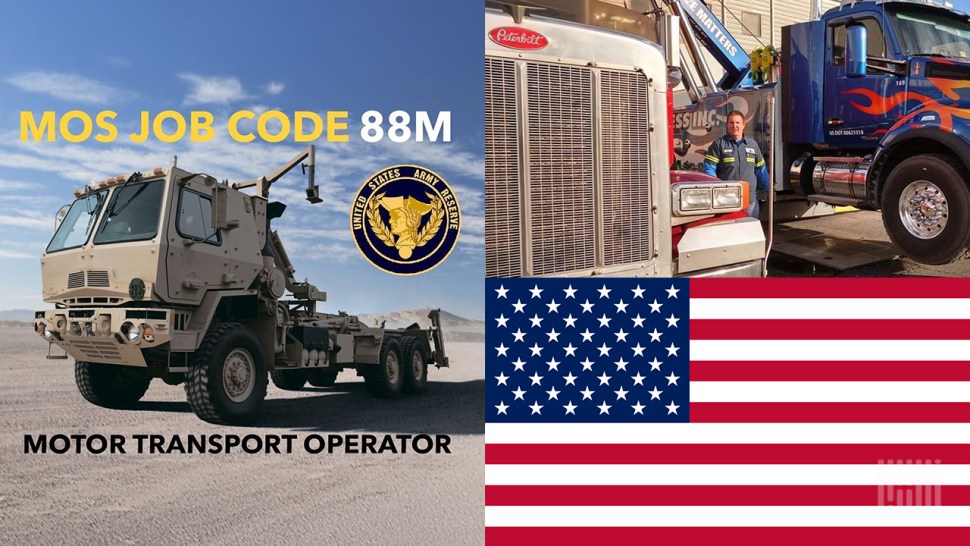
The Army’s 88M Motor Transport Operator course requires 221 hours of training,32 hours in the classroom, and 189 hours of practical behind-the-wheel instruction over a six-week curriculum. The student manual is 229 pages. There are four levels of training. Instructors must meet rigorous qualification standards. Soldiers receive ongoing sustainment training and annual check rides. There’s a Master Driver Trainer certification.
What matters more than the hours is what the military brings to the table; the military doesn’t just teach someone to operate equipment. It fundamentally transforms who they are as a person.
Military service instills discipline. It demands personal responsibility. It teaches respect for authority, situational awareness, teamwork, and decision-making under pressure. It creates an understanding that your actions have consequences,not just for you, but for everyone around you. It builds an allegiance to something larger than yourself. It makes young people less naive to external motivations and more aware of their moral and ethical responsibilities as citizens.
The data proves this works. Veterans have 42% fewer accidents than non-veteran drivers. They achieve 98% more miles driven. They have 59% fewer voluntary terminations and 68% fewer involuntary terminations.
Why? Because the military produces different people. People who show up. People who follow procedures. People who understand that the decisions they make behind the wheel affect every family driving next to them on the highway.
That’s not an 18-year-old. That’s what an 18-year-old becomes after the military gets done with them.
What We Have Instead
The civilian Entry-Level Driver Training rule requires training providers to cover a curriculum of 30 topics. It mandates registration with a Training Provider Registry. It requires demonstration of “proficiency” as determined by the training provider.
What it does not require is a single hour of behind-the-wheel training. Zero. The ATA itself acknowledged this: “There are no minimum training hours required.”
It gets worse.
Six states, Alaska, Arkansas, Iowa, Kansas, North Dakota, and South Dakota, allow learner’s permits at age 14. South Dakota issues unrestricted licenses at 16. Mississippi has permanently waived road tests for teenagers. Nebraska has waived both the written and road tests for new drivers. Several states don’t require driver’s education at all; Tennessee, West Virginia, Wyoming, and the District of Columbia let teens skip formal training entirely.
Think about what this means.
A 14-year-old in South Dakota can get behind the wheel with a permit. They practice, unsupervised in many cases, with minimal instruction, for two to three years. They develop habits. They learn shortcuts. They internalize behaviors that nobody corrects because nobody qualified is watching. By 16 or 17, they’re driving on their own. By 18, under the ATA’s proposal, they could be driving an 80,000-pound tractor-trailer across state lines.
These aren’t trained drivers. These are people who practiced self-taught bad habits for years and now want to operate commercial motor vehicles in interstate commerce.
I see this in CDL testing, too. Young people are showing up to test in automatic trucks because that’s all they know. The “E restriction” for automatic-only operation is now the most common restriction placed on CDLs. We have a population of drivers who’ve never learned to actually handle equipment; they’ve only learned which buttons to push.
We have a very different population today than we had 10 or 20 years ago. The industry is pretending otherwise.
The Conversation We Need To Have
Over 60 countries maintain mandatory military service. Not failed states, democracies. Israel. South Korea. Switzerland. Finland. Austria. Norway. Sweden. Denmark. Greece. Singapore. Taiwan.
In Israel, men serve two years and eight months, and women serve two years. In South Korea, 18 to 21 months, depending on the branch. In Switzerland, all able-bodied male citizens must serve. These aren’t optional programs. They’re requirements of citizenship.
The reasoning across these nations is consistent: mandatory service instills discipline, personal responsibility, civic engagement, and allegiance to the country. It creates a shared experience that builds national unity. It forces young people to operate within a structured environment where actions have consequences. It teaches them that they’re part of something larger than themselves.
The United States has no such requirement.
We rely entirely on voluntary enlistment. Fewer than 1% of Americans actively serve in the military. That means 99% of our population has never experienced the institutional transformation that military service provides.
If parents don’t instill discipline, responsibility, and a work ethic, society inherits whatever those parents produced or failed to produce. We have no institutional mechanism to fill that gap. The military is it. And 99% of Americans never experience it.
Maybe that’s why my training car is full of 17-year-old males who don’t want to be there, can’t operate basic equipment, and have no concept of why any of this matters. Their female counterparts show up motivated, prepared, and ready to work. Something has shifted fundamentally, and we’re not even willing to talk about it.
The Irony
The military generally doesn’t accept felons. There are exceptions; moral waivers exist for certain offenses, but by and large, if you have a serious criminal record, you can’t enlist.
The institutional transformation that the military provides, the discipline, the structure, the personal responsibility, the accountability, the understanding that your decisions affect others, is exactly what many offenders lack. It’s arguably what they needed before they became offenders. The military develops precisely the qualities that might have prevented criminal behavior in the first place.
Yet the people who need it most are the ones excluded from it.
Maybe what we need as a society is something that builds up our youth into country-focused, considerate, productive members of society before they make the mistakes that close doors forever. Maybe that’s military service. Maybe it’s something else. But whatever it is, we don’t have it, and our highways are one of the places where that absence is measured in bodies.
The real solution nobody wants to discuss
If the military model works, and the data proves it does, then the answer isn’t lowering the age for untrained civilians.
The answer requires military-level standards.
Imagine if every CDL applicant had to complete 221 hours of training with 189 hours behind the wheel. Imagine if training providers had to meet the same qualification standards as Army instructors. Imagine if ELDT actually meant something,if it certified that a driver had received rigorous, federally standardized instruction rather than checking boxes on a curriculum with zero time requirements.
Better yet: let the military train civilian commercial drivers.
The infrastructure exists. Programs like Troops Into Transportation and SkillBridge already connect the military with civilian trucking careers. The curriculum is proven. The instructors are qualified. The training produces measurably safer drivers. Why not expand this into a civilian pipeline that actually produces competent professionals?
Or, and this is the conversation nobody wants to have, maybe it’s time to ask whether America should require some form of national service. Not necessarily military combat. But a structured service that develops discipline, personal responsibility, respect for authority, and an understanding that citizenship comes with obligations, not just rights. Something that transforms entitled, unmotivated teenagers into functional adults before we hand them the keys to anything.
Sixty countries do this. They understand something we’ve forgotten: if you want citizens who contribute to society rather than take from it, you have to build them. Character doesn’t develop by accident.
Now We Know
Do I believe someone who has served in the military should be able to drive a truck at 18? Yes. They’ve earned it. They’ve been transformed by an institution designed to develop competence, discipline, and responsibility.
Do I believe an untrained civilian teenager, someone who got a permit at 14 in South Dakota, practiced self-taught bad habits for 3 years, may have never taken a road test, and has no minimum behind-the-wheel training for their CDL, should operate an 80,000-pound tractor-trailer in interstate commerce?
Absolutely not.
The military argument works precisely because military service produces different people. It’s not the age. It’s what happens to that person before they get behind the wheel.
Those invoking the military to support the ATA’s exemption request should be advocating for military standards. They should push for 221 hours of training. They should demand qualified instructors, structured curricula, and institutional accountability. They should support expanding military training programs to civilian drivers.
Until then, the comparison is intellectually dishonest, a talking point designed to exploit our respect for those who serve while putting unqualified drivers on the highway.
I was raised by people born in the 1910s and 1930s. They were no-nonsense. They taught me that freedom comes with responsibility, that showing up matters, and that the world doesn’t owe you anything. Somewhere along the way, we stopped teaching that, and now I’m watching a generation of young men who can’t adjust a car seat and don’t care to learn.
That’s who the ATA wants driving your family’s minivan off the road at 70 miles per hour.
Public comment on ATA’s exemption request remains open. Docket FMCSA-2025-1117 at regulations.gov.
Your voice matters. Use it.
Brokerage Compliance Symposium
The day before F3. Every compliance issue you face - fraud exposure, carrier liability, FMCSA rules, cargo theft, insurance gaps - navigated by attorneys and operators defining best practices in a changing industry.
F3 Awards Dinner
The night before F3. FreightTech100 companies honored. FreightTech 25 and Shipper of Choice winners revealed live. Cocktail reception into dinner and live music - 300 industry leaders in one purpose-built room.
F3: Future of Freight Festival
Industry-defining keynotes, rapid-fire technology demos, and industry leaders networking in experiences across Chattanooga - plus the inaugural F3 Awards Dinner featuring the FreightTech and Shipper of Choice reveals.
The day before F3. Every compliance issue you face - fraud exposure, carrier liability, FMCSA rules, cargo theft, insurance gaps - navigated by attorneys and operators defining best practices in a changing industry.
The Signal at Chattanooga Choo Choo • Chattanooga, TN Register NowThe night before F3. FreightTech100 companies honored. FreightTech 25 and Shipper of Choice winners revealed live. Cocktail reception into dinner and live music - 300 industry leaders in one purpose-built room.
The Signal at Chattanooga Choo Choo • Chattanooga, TN Register NowIndustry-defining keynotes, rapid-fire technology demos, and industry leaders networking in experiences across Chattanooga - plus the inaugural F3 Awards Dinner featuring the FreightTech and Shipper of Choice reveals.
The Signal at Chattanooga Choo Choo • Chattanooga, TN Register Now