

Carrier vetting has always been a matter of operational necessity for freight brokers and third-party logistics providers. Before you get freight moved, you have to verify authority, check insurance, and confirm safety records. How that review was documented, who signed off, and what was known at the time has rarely received the same attention.
The U.S. Supreme Court’s ruling in Montgomery v. Caribe Transport II, LLC has changed the need for documentation. The decision exposes freight intermediaries to a new level of scrutiny around negligent hiring claims, putting the burden on brokers and 3PLs to demonstrate that they exercised reasonable care when selecting a carrier. For many organizations, that demonstration would require pulling together emails, spreadsheets, and internal notes. Fragmented paper trails like that are not necessarily designed to hold up in litigation.
Descartes recognized the reshaping of expectations around carrier selection, documentation, and demonstrating reasonable care. The result is AuditLog, a new capability built directly into Descartes MyCarrierPortal™ that automatically transforms carrier review management into defensible documentation without adding steps to existing workflows.
“As the U.S. transportation industry evaluates the implications of the recent U.S. Supreme Court ruling in Montgomery v. Caribe Transport II, LLC, documenting carrier vetting activities, establishing consistent review practices and demonstrating reasonable care in carrier selection is coming under greater scrutiny,” said Dan Cicerchi, EVP, Corporate & Operations Development at Descartes. “While carrier vetting and safety reviews have long been a critical component of transportation risk management, our new AuditLog capabilities help organizations establish more consistent governance around carrier selection while maintaining operational efficiency.”
Ask most freight brokers how they currently document a carrier approval decision, and the answer tends to involve a combination of systems, which is hardly sustainable. Risk assessment might run in one platform while a compliance issue gets flagged in an email thread. Managers often still give verbal approval for various vital tasks, and dispatchers are still typing notes into TMS fields that weren’t built for legal recordkeeping.
None of this is adequate when a plaintiff’s attorney starts asking what the broker knew about a carrier.
AuditLog addresses that gap by embedding documentation directly into the carrier vetting workflow inside Descartes MyCarrierPortal. When a carrier is reviewed, the assessment results, reviewer actions, management decisions, and onboarding outcomes are automatically captured as an auditable record without requiring users to take any additional documentation steps.
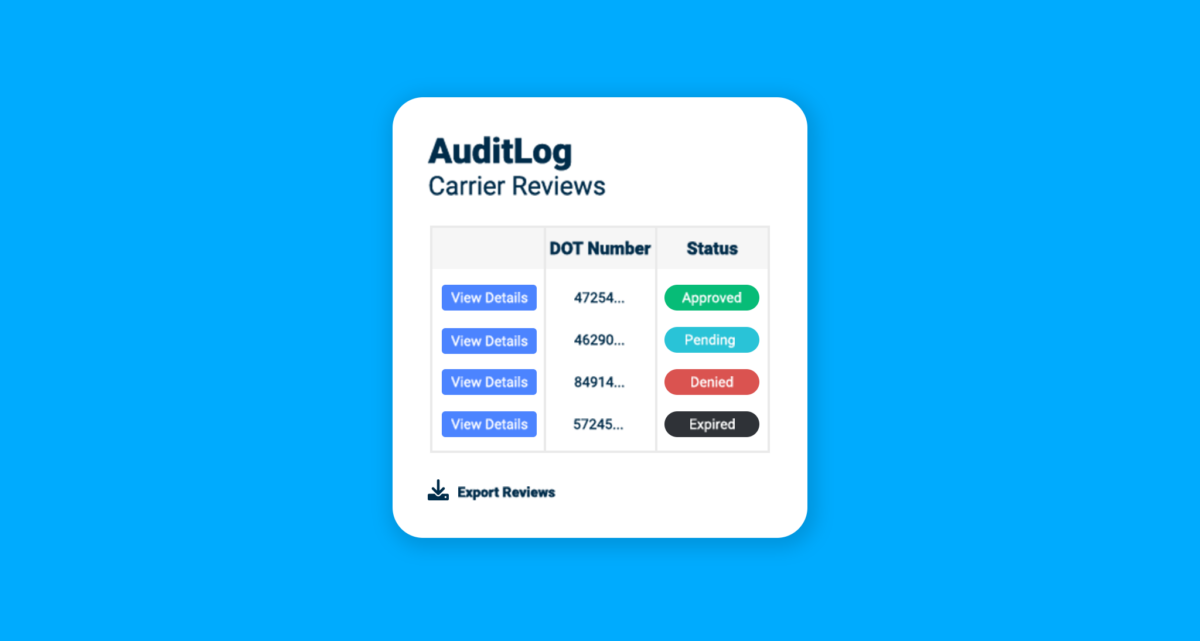
One of AuditLog’s most consequential design choices is what Descartes calls snapshot-based documentation. When a carrier risk assessment is completed and an approval decision is made, AuditLog captures the carrier’s profile, safety record, authority status, and risk factors exactly as they existed at that moment.
This matters because carrier profiles change. A carrier that’s approved today might receive a safety violation six months from now. Without a time-stamped record of what was known at the point of approval, organizations have no way to demonstrate that their decision was reasonable given the information available.
If a carrier’s profile changes after approval, AuditLog retains the original review record while also triggering a re-review notification, which ensures that ongoing monitoring remains part of the documented governance process.
AuditLog also introduces a structured management escalation path for carriers that require additional scrutiny. Rather than leaving the decision to approve a flagged carrier to whoever is running the load, AuditLog allows organizations to require management review for specific risk scenarios and documents that review as part of the permanent record.
“Companies need more repeatable, defensible review practices to document the information reviewed, decisions made and oversight applied throughout the carrier onboarding process,” said Ken Wood, EVP Product Management at Descartes. “AuditLog provides the structured workflows, documented management escalation paths and consistent review records required to help teams better mitigate liability by efficiently following established carrier selection procedures.”
Once a management review is completed, approved carriers can move forward through existing TMS onboarding workflows without additional manual intervention, preserving speed while staying compliant with the new legal exposures.

Beyond litigation defense, AuditLog is designed to support the broader compliance and governance initiatives that shippers and enterprise 3PLs increasingly require from their logistics partners. As carrier networks grow more complex and shipper expectations around carrier vetting accountability rise, having a centralized, standardized audit record becomes a competitive differentiator as much as a legal safeguard.
“As a long-standing Descartes customer, we’re pleased to see the ongoing commitment to expand the carrier vetting capabilities available within the platform,” said Holly Phillips, Director of Accounts Receivable at Bridgeway. “In the wake of the Montgomery decision, the ability to leverage customizable carrier risk assessments and conduct deeper carrier reviews directly within the carrier profile will be increasingly valuable as organizations look to strengthen and document their carrier selection processes.”
AuditLog’s centralized review workflow also addresses the consistency problem that tends to emerge at scale. Different reviewers apply different standards to similar risk scenarios in organizations that manage large carrier networks across multiple users and teams. AuditLog creates a single, documented process that applies across the organization, all of which reduces the variability that can undermine both operational quality and legal defensibility.
AuditLog is available for all Descartes MyCarrierPortal customers. The capability integrates into existing carrier onboarding workflows without requiring platform reconfiguration, and supports both broker and shipper use cases across a range of carrier network sizes.
Freight intermediaries across the country are still figuring out how they’re going to navigate the post-Montgomery landscape. The window to get documentation practices in order is not indefinite. Claims take time to surface. By the time a broker is asked to produce records of a carrier vetting decision, that decision may be 12 or 24 months in the rearview mirror. That means the time to start building those records is now.
To learn more about AuditLog or schedule a demo, visit https://www.mycarrierportal.com/features/auditlog/.
Brokerage Compliance Symposium
The day before F3. Every compliance issue you face - fraud exposure, carrier liability, FMCSA rules, cargo theft, insurance gaps - navigated by attorneys and operators defining best practices in a changing industry.
F3 Awards Dinner
The night before F3. FreightTech100 companies honored. FreightTech 25 and Shipper of Choice winners revealed live. Cocktail reception into dinner and live music - 300 industry leaders in one purpose-built room.
F3: Future of Freight Festival
Industry-defining keynotes, rapid-fire technology demos, and industry leaders networking in experiences across Chattanooga - plus the inaugural F3 Awards Dinner featuring the FreightTech and Shipper of Choice reveals.
The day before F3. Every compliance issue you face - fraud exposure, carrier liability, FMCSA rules, cargo theft, insurance gaps - navigated by attorneys and operators defining best practices in a changing industry.
The Signal at Chattanooga Choo Choo • Chattanooga, TN Register NowThe night before F3. FreightTech100 companies honored. FreightTech 25 and Shipper of Choice winners revealed live. Cocktail reception into dinner and live music - 300 industry leaders in one purpose-built room.
The Signal at Chattanooga Choo Choo • Chattanooga, TN Register NowIndustry-defining keynotes, rapid-fire technology demos, and industry leaders networking in experiences across Chattanooga - plus the inaugural F3 Awards Dinner featuring the FreightTech and Shipper of Choice reveals.
The Signal at Chattanooga Choo Choo • Chattanooga, TN Register Now