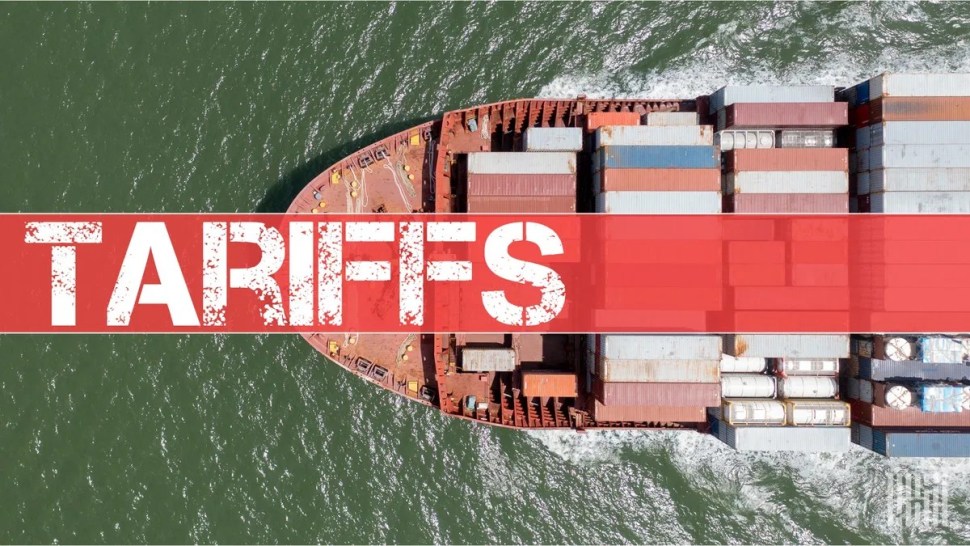
President Donald Trump announced Friday that the U.S. could impose tariffs of up to 100% on imports from China by Nov. 1, marking an escalation in the U.S.–China trade conflict and raising uncertainty across global supply chains.
In a Truth Social post Friday, Trump said the tariffs were retaliation for China’s new export controls announced a day earlier on rare earth minerals and related technologies.
Many U.S. companies that rely on Chinese manufacturing could face soaring costs and shipment delays as they scramble to reroute orders or find alternative suppliers in Mexico, India, or Southeast Asia. Containerized imports from China—roughly 40% of all U.S. inbound freight—could plummet, triggering blank sailings, idle vessel capacity, and rate volatility.
Freight forwarders said shippers need to be proactive when dealing with tariffs.
“Whether it’s this announcement or the additions under Section 232 a couple of weeks ago, it’s clear tariffs are here to stay,” Ben Bidwell, senior director of customs and compliance at C.H. Robinson.
“The current environment may feel unpredictable to some, but businesses can be proactive versus reactive by building resilient supply chains: consider establishing a sourcing hierarchy, leveraging dual sourcing, exploring bonded warehouses or free trade zones, and other strategies. These are conversations we’ve had with customers for years but the current trade landscape has accelerated the occurrences, and many of our customers’ timelines.”
China remains a major U.S. trade partner and is the largest supplier of goods to the U.S., but it ranks behind Mexico and Canada in total trade volume.
The U.S. has exchanged roughly $420 billion to $440 billion in goods with China year-to-date, down from more than $465 billion during the same period in 2024, according to Census Bureau data.
The leading U.S. imports include electronics, machinery, furniture, and consumer goods, while top exports to China are agricultural products, aircraft, and semiconductors.
Brokerage Compliance Symposium
The day before F3. Every compliance issue you face - fraud exposure, carrier liability, FMCSA rules, cargo theft, insurance gaps - navigated by attorneys and operators defining best practices in a changing industry.
F3 Awards Dinner
The night before F3. FreightTech100 companies honored. FreightTech 25 and Shipper of Choice winners revealed live. Cocktail reception into dinner and live music - 300 industry leaders in one purpose-built room.
F3: Future of Freight Festival
Industry-defining keynotes, rapid-fire technology demos, and industry leaders networking in experiences across Chattanooga - plus the inaugural F3 Awards Dinner featuring the FreightTech and Shipper of Choice reveals.
The day before F3. Every compliance issue you face - fraud exposure, carrier liability, FMCSA rules, cargo theft, insurance gaps - navigated by attorneys and operators defining best practices in a changing industry.
The Signal at Chattanooga Choo Choo • Chattanooga, TN Register NowThe night before F3. FreightTech100 companies honored. FreightTech 25 and Shipper of Choice winners revealed live. Cocktail reception into dinner and live music - 300 industry leaders in one purpose-built room.
The Signal at Chattanooga Choo Choo • Chattanooga, TN Register NowIndustry-defining keynotes, rapid-fire technology demos, and industry leaders networking in experiences across Chattanooga - plus the inaugural F3 Awards Dinner featuring the FreightTech and Shipper of Choice reveals.
The Signal at Chattanooga Choo Choo • Chattanooga, TN Register Now