




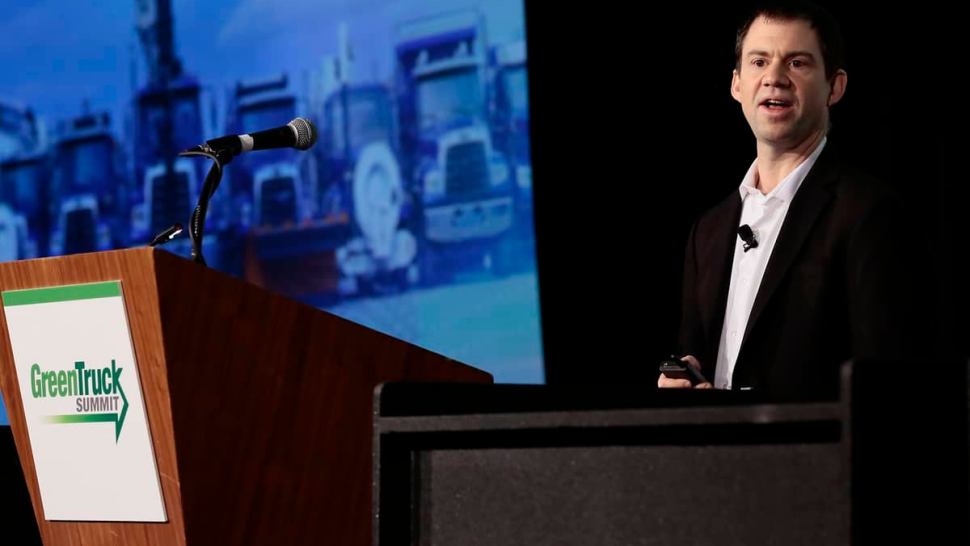
Stating that people buy trucks to make money, Daimler Trucks North America’s (DTNA) Sean Waters, vice president of product compliance and regulatory affairs, outlined on Tuesday why diesel remains an important fuel choice for fleets. In the keynote address at the Green Truck Summit, ahead of the NTEA’s Work Truck Show in Indianapolis, Waters also explained DTNA’s approach to electrification, and what needs to happen for widespread adoption of electric vehicles.
“People don’t buy our trucks because they want to, people buy our trucks because they have to,” Waters said. “These are not toys. They buy the trucks to make money.”
Pointing to the 24/7 nature of trucking and the value it provides for the economy, Waters addressed the challenges facing the industry as it seeks to adopt electrification. He highlighted the many electric products Daimler produces across its global brands, including the Class 8 eCascadia and medium-duty eM2 106 vehicles that fleets are now testing. Other Daimler electric products include Thomas Built Buses all-electric Saf-T-Liner eC2 Jouley school bus in North America, the FUSO eCanter in North America, and the Mercedes-Benz eActros, eEconic and eCitaro in Europe. The FUSO eCanter is also on the road in Europe and Japan. Freightliner Custom Chassis Corp. is introducing the purpose-built MT50e chassis for walk-in vans this week at the Work Truck Show.
“We are committed to the decarbonization of transportation,” Waters said. “We are starting with our own house.”
Daimler has set an internal goal to have all production vehicles be carbon-neutral by 2039, but that doesn’t mean only electric options. Diesel is not going away before then, Waters said.
“As we transition to new technologies, we can’t lose sight of the importance of diesel because those [diesel] trucks we sell in 2039 are going to be on the road for a long time,” he said, pointing out that technological advancements have already cut emissions from diesel engines by 90% from baseline numbers.
DTNA, which already has 30 eCasadias and eM2 vehicles in test fleets that have amassed over 100,000 miles to date, announced the new Freightliner Customer Experience (CX) fleet, which will add six more eCascadias and two eM2s to test fleets. The CX fleet is part of Daimler’s “co-creation” approach to electrification that works with fleets to develop products they want and find ways to make those products work in real-world applications.
The product is only one leg of the stool needed to make electric work, Waters said. The e-mobility ecosystem and policies and regulations also will play important roles.
“Where are we at for commercial vehicle infrastructure [for instance],” Waters asked. “The answer is, we aren’t there yet.”
Buyers are interested in total cost of ownership, route assessment, financing, maintenance and end-of-life considerations, Waters said, but “I think the infrastructure is the biggest one.”
Right now, Daimler is focused on drayage, regional haul, food and beverage, pickup and delivery, and last-mile operations.
“We are trying to have a vehicle for each of these applications because we believe these will be the initial applications,” Waters said.
Electric vehicle adoption will depend on how quickly the industry is able to develop standardized procedures, such as those for charging infrastructure.
The final piece of the puzzle relates to policies and regulations, and it is here that Waters is asking for help.
“We’re not going to accelerate the adoption of electric vehicles without the government’s help,” he said. A best practice may be to consider the impact on electric vehicles for each new rule or regulation, Waters suggested.
Building the charging infrastructure will also require assistance.
“[Public utilities] are not going to build charging infrastructure for no money,” he said. “The only way they are going to build infrastructure is if they can pass along [the cost] in rates to customers.”
Public utilities must go before rate commissions to ask for rate increases, which may or may not be approved.
It is important for countries to work together to assist manufacturers, Waters said, urging governments to ditch the patchwork of regulations and create global standards.
“We need to get better economies of scale, and we can get better economies of scale if we can bring technology across the ocean,” he said.
One approach the U.S. government can take to boost electric adoption is the elimination of the federal excise tax (FET) on electric trucks. FET is a 12% tax on new vehicles. The trucking industry has been campaigning for several years to eliminate the tax entirely, but Waters noted that vehicles using advanced technologies or alternative power such as electric, inherently cost more, and the FET is higher as a result.
“As a matter of public policy, we should have a conversation as to whether it is the right tax to have on a truck,” he said. “This excise tax actually creates a disincentive to invest in new technology.”
Waters said Daimler, like others, will continue to meet customer demand, and that includes continuing funding diesel advancements, but the world is changing, and customers are changing.
“Our customers demand we take action. Society demands we take action. And frankly, we demand it,” he said.
Brokerage Compliance Symposium
The day before F3. Every compliance issue you face - fraud exposure, carrier liability, FMCSA rules, cargo theft, insurance gaps - navigated by attorneys and operators defining best practices in a changing industry.
F3 Awards Dinner
The night before F3. FreightTech100 companies honored. FreightTech 25 and Shipper of Choice winners revealed live. Cocktail reception into dinner and live music - 300 industry leaders in one purpose-built room.
F3: Future of Freight Festival
Industry-defining keynotes, rapid-fire technology demos, and industry leaders networking in experiences across Chattanooga - plus the inaugural F3 Awards Dinner featuring the FreightTech and Shipper of Choice reveals.
The day before F3. Every compliance issue you face - fraud exposure, carrier liability, FMCSA rules, cargo theft, insurance gaps - navigated by attorneys and operators defining best practices in a changing industry.
The Signal at Chattanooga Choo Choo • Chattanooga, TN Register NowThe night before F3. FreightTech100 companies honored. FreightTech 25 and Shipper of Choice winners revealed live. Cocktail reception into dinner and live music - 300 industry leaders in one purpose-built room.
The Signal at Chattanooga Choo Choo • Chattanooga, TN Register NowIndustry-defining keynotes, rapid-fire technology demos, and industry leaders networking in experiences across Chattanooga - plus the inaugural F3 Awards Dinner featuring the FreightTech and Shipper of Choice reveals.
The Signal at Chattanooga Choo Choo • Chattanooga, TN Register Now