If you’re a fleet owner, owner operator, or small carrier trying to build a team that lasts, listen up: what happens in the first 30 days with a new driver doesn’t just impact their performance—it determines whether they’ll still be with you 6 months from now.
And that’s exactly why our most recent Playbook Masterclass focused on the systems, structure, and steps you need to get those first 30 days right.
We host a brand-new masterclass every two weeks inside the Playbook, but this one was too important not to spotlight. Because too many fleets are bleeding talent, wasting time, and leaving money on the table simply because they haven’t built a real onboarding system.
This class changed that.
The Problem Many Small Fleets Don’t Realize They Have
Many small fleets think hiring a driver is the hard part. It’s not.
The real challenge is keeping that driver long enough for the hire to pay off—and it all starts in week one.
The common trap?
- Driver shows up
- Gets handed keys
- Gets a pep talk about being “part of the team”
- Then gets left to figure it out alone
We called it out directly in the session: if your onboarding process is just “hope they figure it out,” you’re already halfway to losing them.
Instead, we broke down a structured 30-day system—one that gets results, protects your business, and builds driver loyalty from day one.
What the First 30 Days Are Really About
This isn’t orientation. It’s calibration.
In this masterclass, we flipped the script on what onboarding should be. It’s not about paperwork and policies—it’s about shaping performance, trust, and communication habits that will define the relationship.
Here’s what those 30 days really do:
- Establish trust and rhythm between driver and dispatcher
- Teach your workflows the right way—not the “figure it out” way
- Spot bad habits and red flags before they become real liabilities
- Set clear expectations around safety, pay, communication, and accountability
If you’re not checking those boxes in the first month, you’re leaving your success to chance.
The 30-Day Onboarding Blueprint
We gave attendees a week-by-week breakdown with exact agendas, templates, and KPIs. Here’s a quick preview:
Week 1 – Orientation & Culture
- Mission and values
- Expectations and SOPs
- TMS & ELD setup
- Test route + end-of-week check-in
Week 2 – Workflow Mastery
- Dispatch flow and route rhythm
- TMS reporting for MPG, HOS, delays
- Performance coaching starts here
Week 3 – Communication & Coaching
- Check call protocols and escalation process
- Coaching session on professionalism and team fit
- Ownership of next week’s planning (with oversight)
Week 4 – Independence & Evaluation
- Driver autonomy check
- Final performance review
- Decision point: Keep, Retrain, or Let Go
Every step is tracked, coached, and documented. Because onboarding without data is just guesswork.
What We Track (and Why)
You can’t coach what you don’t measure.
We showed attendees how to set up a real driver scorecard system using:
- TMS reports: on-time %, MPG, idle time, ELD alerts
- ELD data: HOS violations, trip planning patterns, unassigned time
- Manual checklists: dispatcher notes, self-assessments, red flag logs
- Soft skills: communication, professionalism, and coachability
One of the key takeaways: your TMS is your eyes—but your coaching is your voice. You need both to grow a fleet that doesn’t rely on luck.
Most Common Mistakes That Kill a New Hire
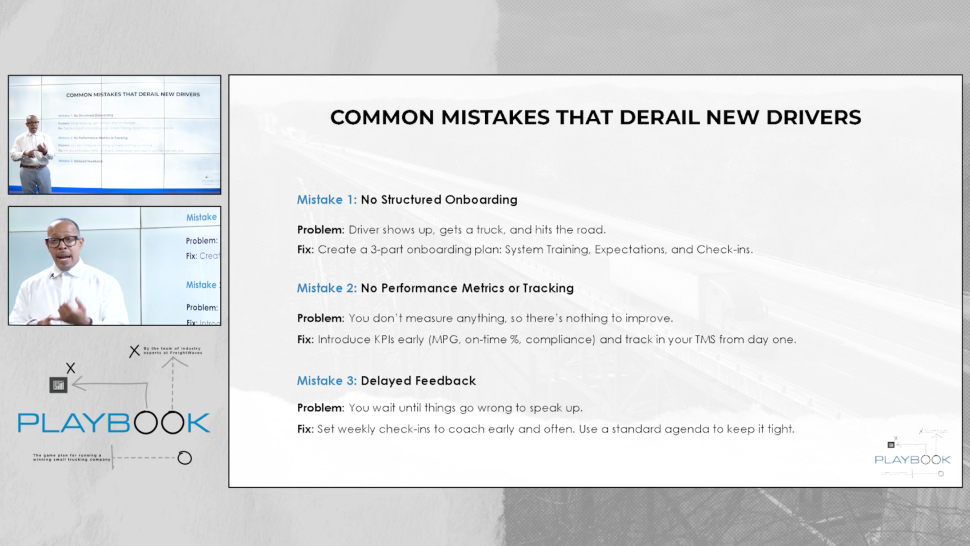
We didn’t sugarcoat it. Too many carriers make the same mistakes:
- No structured onboarding: driver’s on the road with no training
- No performance tracking: you’re flying blind
- Delayed feedback: you only correct when something explodes
- Information overload: you dump too much too fast
- No culture check: you never ask, “Do they actually fit here?”
One sentence stuck with attendees:
“You don’t lose drivers in month six. You lose them in week one—and just don’t realize it yet.”
The Weekly Coaching Call Format
This was a value add for the viewers. We handed out a template for weekly coaching calls that take 10 minutes but drive 10x retention.
Each call covers:
- Wins and challenges of the week
- Dispatch flow or TMS data issues
- Driver scorecard feedback
- Reminders on SOPs, pay plans, safety
- Personal check-in: “How are you feeling out there?”
Most driver issues aren’t driver issues—they’re feedback issues that went unspoken too long.
The Evaluation That Saves You
At 30 days, you make the call:
- Keep
- Retrain
- Let Go
We shared our full evaluation form that covers:
- Revenue, on-time %, fuel use
- Safety, inspections, compliance
- Soft skills and communication
- Coachability and SOP alignment
Because the cost of keeping a bad fit is higher than the cost of letting one go.
Why Retention Starts on Day One
Retention is not a mystery. It’s a system.
If you want fewer surprises, fewer ghosted dispatchers, and fewer safety incidents, you need to stop onboarding drivers off the top of your head.
This class helped our members build a repeatable onboarding system that lives in their TMS, lives in their HR folder, and gives drivers the support they need to succeed—not just survive.
A Glimpse Into the Future
We also previewed the “Driver Bench” concept—the future of how small fleets scale without panic hiring. Attendees walked away with:
- Bench-building worksheet
- Candidate tracking template
- Coaching call structure
- SOP and orientation video outlines
- Google Drive folder layout
You can’t scale your fleet if you’re rebuilding your driver team every 90 days.
Final Thought:
“You can’t afford to ‘wing it’ with your people. That’s how fleets die—one uncoached driver at a time. But when you set the tone early, lead with structure, and coach with care? You don’t just build a team—you build a future.”
Want the Templates, Frameworks, and Access to the Next Class?
Join the Playbook Masterclass Series.
We host a brand-new class every two weeks with real tools, real walkthroughs, and real strategies built specifically for small fleet owners.
This is your training ground.
If you missed this session on onboarding, you can still catch the replay—and we’ll see you in two weeks for the next one.
Brokerage Compliance Symposium
The day before F3. Every compliance issue you face - fraud exposure, carrier liability, FMCSA rules, cargo theft, insurance gaps - navigated by attorneys and operators defining best practices in a changing industry.
F3 Awards Dinner
The night before F3. FreightTech100 companies honored. FreightTech 25 and Shipper of Choice winners revealed live. Cocktail reception into dinner and live music - 300 industry leaders in one purpose-built room.
F3: Future of Freight Festival
Industry-defining keynotes, rapid-fire technology demos, and industry leaders networking in experiences across Chattanooga - plus the inaugural F3 Awards Dinner featuring the FreightTech and Shipper of Choice reveals.
The day before F3. Every compliance issue you face - fraud exposure, carrier liability, FMCSA rules, cargo theft, insurance gaps - navigated by attorneys and operators defining best practices in a changing industry.
The Signal at Chattanooga Choo Choo • Chattanooga, TN Register NowThe night before F3. FreightTech100 companies honored. FreightTech 25 and Shipper of Choice winners revealed live. Cocktail reception into dinner and live music - 300 industry leaders in one purpose-built room.
The Signal at Chattanooga Choo Choo • Chattanooga, TN Register NowIndustry-defining keynotes, rapid-fire technology demos, and industry leaders networking in experiences across Chattanooga - plus the inaugural F3 Awards Dinner featuring the FreightTech and Shipper of Choice reveals.
The Signal at Chattanooga Choo Choo • Chattanooga, TN Register Now