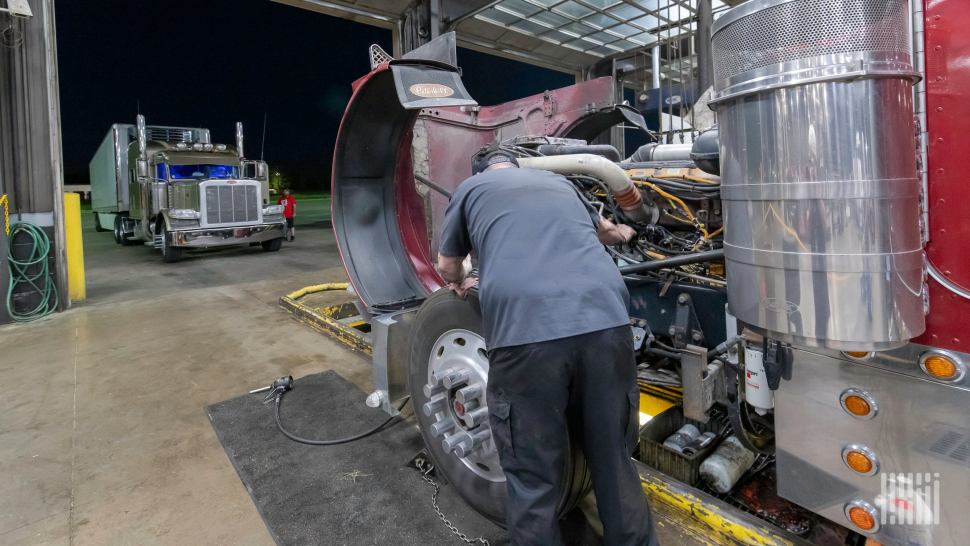
The maintenance cost story in trucking has been quietly telling the truth about the freight recession in a way that spot rates and load volumes never fully captured. When freight slows down, trucks run fewer miles, which means fewer service events per truck per month. The Q4 2025 Decisiv/TMC Parts and Labor Service Benchmark Report showed a 1.3% dip in combined parts and labor costs — and some corners of the industry treated that as a positive signal. It is not. Decisiv CEO Tim Hardin was direct about what the data actually shows: “The moderation in costs seen in the current report illustrates how this is being addressed at shops using effective management practices.” In plain language — costs dipped because trucks ran less, not because maintaining a truck got cheaper.
The five-year trend is the number that matters. Since early 2020, combined parts and labor costs for heavy-duty trucks have risen 27.4%. Parts specifically are up 23.8%. Labor is up 33.5%. To translate that into operational terms: if your shop costs were running $1,000 per month per truck in 2020, the same maintenance workload now runs approximately $1,274. And that is before the tariff environment adds its next layer.
What the Tariffs Are Actually Doing to Equipment Costs
The Section 232 tariff on imported medium and heavy-duty trucks — 25% on Class 3 through 8 vehicles and many truck parts, effective November 1, 2025 — is the most significant structural cost change in the equipment market in years. The American Trucking Associations estimated the tariff adds up to $35,000 to the delivered price of an imported Class 8, bringing total new truck acquisition cost to approximately $238,000 including federal excise tax.
That headline number matters for the purchase decision. What matters more for day-to-day operations is what the tariff does to parts prices. Hardin acknowledged that raw material costs — steel and aluminum specifically — began increasing around the time tariffs were introduced, and that these increases are showing up in component prices even before direct tariff impact can be isolated in the data. The Richmond Fed’s CFO Survey found that firms attribute close to 40% of total unit cost growth in 2025 and 2026 to tariffs and tariff-related uncertainty.
The mechanism matters: supply chain anxiety pricing. When distributors and parts manufacturers believe tariff-driven supply disruptions are coming, they adjust pricing preemptively — before any physical shortage materializes. Hardin was specific about this: “Typically what I’ve seen is it gets priced into the supply chain regardless of whether there’s a physical impact or not.” For an owner-operator buying a water pump, a set of injectors, or a turbocharger, the distinction between actual tariff impact and preemptive pricing adjustment is irrelevant. The invoice is higher either way.
Parts costs rose in 19 of the 25 VMRS vehicle systems tracked in the Decisiv benchmark, and year over year showed increases in 16 of those systems. The shift from labor-driven to parts-driven maintenance inflation is not a technicality — it changes where cost management attention should be focused. In the previous cycle, negotiating better labor rates with your shop or optimizing your PM intervals to reduce labor time was the lever. In the current environment, parts sourcing strategy — who you buy from, what quality tier, and at what price point — is increasingly where the real money is.
The Age of Your Fleet Is Now a Bigger Variable Than It Used to Be
The most consequential equipment decision a small carrier makes right now is not whether to buy a new truck. It is how aggressively to maintain the trucks already on the road.
Fleetio’s analysis of 1.2 million commercial vehicles released in February 2026 found that older assets drive outsized service spend — a finding that is intuitive but whose magnitude matters for planning purposes. A truck with 600,000 miles in the current parts cost environment is a materially different maintenance liability than the same truck was two years ago. The components that wear at high mileage — injectors, turbochargers, EGR systems, DPF systems, transmissions — are now 20% to 30% more expensive to replace than they were when you bought that truck. The economic calculus on keeping an aging asset running versus replacing it has shifted, and not in the direction that favors running it longer.
The counter-argument is that new truck acquisition costs have also shifted significantly upward — up to $35,000 per unit in tariff impact on imported Class 8 trucks, with used truck prices still elevated and financing rates not having returned to pre-2022 levels. So the choice is not between cheap maintenance and cheap acquisition. It is between expensive maintenance and expensive acquisition, and the right answer depends on specific mileage, condition, and freight type for each unit in your fleet.
What this environment does argue for clearly is a condition-based assessment of every truck in your fleet before the freight market recovery drives utilization back up. When trucks are running harder — more miles, more hours, more heat cycles through the engine — deferred maintenance items that were manageable at lower utilization become breakdowns. A breakdown at current parts prices, with current shop wait times, is more expensive than it was in 2022 and takes longer to resolve. Scheduling a comprehensive condition review now — before Q2 and Q3 freight demand pushes utilization higher — is the most cost-effective maintenance investment most small fleets can make in April 2026.
The Technology Layer That Has Become Mandatory
Telematics and in-cab technology are no longer optional for small carriers operating in 2026 — not because of regulatory mandate, but because the cost consequences of operating without them have exceeded the cost of adoption.
On the insurance side, the dynamic is now explicit: multiple insurers are refusing to quote carriers who do not have telematics and camera systems installed. That market reality means the technology is no longer a choice between having it and not having it — it is a choice between having it and being uninsurable in preferred markets. At current insurance cost levels, the premium differential between preferred and non-preferred market access exceeds the cost of camera and telematics installation on most fleets within 12 months.
On the maintenance side, the value of predictive data has shifted as parts costs have risen. A fault code that generates a service alert before it becomes a breakdown was worth addressing at $400 in parts and labor when that was the repair cost. At $500 to $600 in the current parts environment, the same repair is more expensive — but the alternative, a roadside breakdown with a tow and an emergency shop visit, now runs $2,000 to $4,000 or more. The math on proactive fault code response has improved dramatically as breakdown costs have escalated.
The new PC-12 heavy-duty engine oil category that is approaching finalization — with rollout expected ahead of 2027 — is a relevant maintenance planning item for fleets managing engine longevity on aging equipment. The category is designed to provide improved protection for modern emissions-equipped engines and extended drain intervals. Fleets that plan their PM schedules around the transition will be better positioned than those who are still on PC-11 oil when PC-12 becomes widely available. Ask your dealer or fleet service provider where the transition timeline falls for your equipment profile.
What to Do Before Freight Volumes Increase
The window between now and the freight market recovery that most analysts are projecting for Q2 and Q3 is the operational window to address equipment condition proactively. Once utilization goes back up and trucks are running hard, deferred maintenance becomes emergency maintenance — at current prices and with current shop availability.
Four specific actions matter before that window closes.
Pull your Fleetio or TMS data on unscheduled repair frequency by unit. The trucks generating the most unscheduled events are not just costing you more in parts and labor — they are costing you in utilization loss when they are in the shop instead of on the road. A truck that generates $8,000 per year in maintenance spend with four days of downtime is a different cost profile than a truck that generates $6,000 per year with twelve days of downtime. The frequency and duration of downtime matter as much as the repair invoice.
Schedule a DPF inspection and cleaning on any diesel truck with more than 300,000 miles and no documented DPF service in the past 18 months (assume it hasn’t been done if you purchase used). DPF-related failures are one of the highest-cost unscheduled repair categories in the Decisiv data, and preventive cleaning at $400 to $600 is the most cost-effective way to avoid a DPF replacement at $3,000 to $5,000. In the current tariff environment, DPF component costs have been among the categories showing year-over-year increases.
Review your parts sourcing relationships and price agreements. If you are buying parts at the counter of a dealer or distributor without a fleet account or volume pricing, you are paying retail for components that your maintenance spend volume likely qualifies you for a discount on. A fleet running five trucks and $30,000 per year in parts spend has enough volume to negotiate a fleet account discount at most regional suppliers. That conversation has not happened for most small carriers, and the parts inflation environment makes it more valuable now than it has been at any prior point.
Document everything your trucks generate — fault codes, inspection results, service events, driver vehicle inspection reports. In the nuclear verdict environment, maintenance records are not just an operational tool. They are a legal defense. A documented maintenance history that demonstrates proactive care for the vehicle reduces the narrative space available to a plaintiff attorney arguing systemic safety neglect.
Brokerage Compliance Symposium
The day before F3. Every compliance issue you face - fraud exposure, carrier liability, FMCSA rules, cargo theft, insurance gaps - navigated by attorneys and operators defining best practices in a changing industry.
F3 Awards Dinner
The night before F3. FreightTech100 companies honored. FreightTech 25 and Shipper of Choice winners revealed live. Cocktail reception into dinner and live music - 300 industry leaders in one purpose-built room.
F3: Future of Freight Festival
Industry-defining keynotes, rapid-fire technology demos, and industry leaders networking in experiences across Chattanooga - plus the inaugural F3 Awards Dinner featuring the FreightTech and Shipper of Choice reveals.
The day before F3. Every compliance issue you face - fraud exposure, carrier liability, FMCSA rules, cargo theft, insurance gaps - navigated by attorneys and operators defining best practices in a changing industry.
The Signal at Chattanooga Choo Choo • Chattanooga, TN Register NowThe night before F3. FreightTech100 companies honored. FreightTech 25 and Shipper of Choice winners revealed live. Cocktail reception into dinner and live music - 300 industry leaders in one purpose-built room.
The Signal at Chattanooga Choo Choo • Chattanooga, TN Register NowIndustry-defining keynotes, rapid-fire technology demos, and industry leaders networking in experiences across Chattanooga - plus the inaugural F3 Awards Dinner featuring the FreightTech and Shipper of Choice reveals.
The Signal at Chattanooga Choo Choo • Chattanooga, TN Register Now