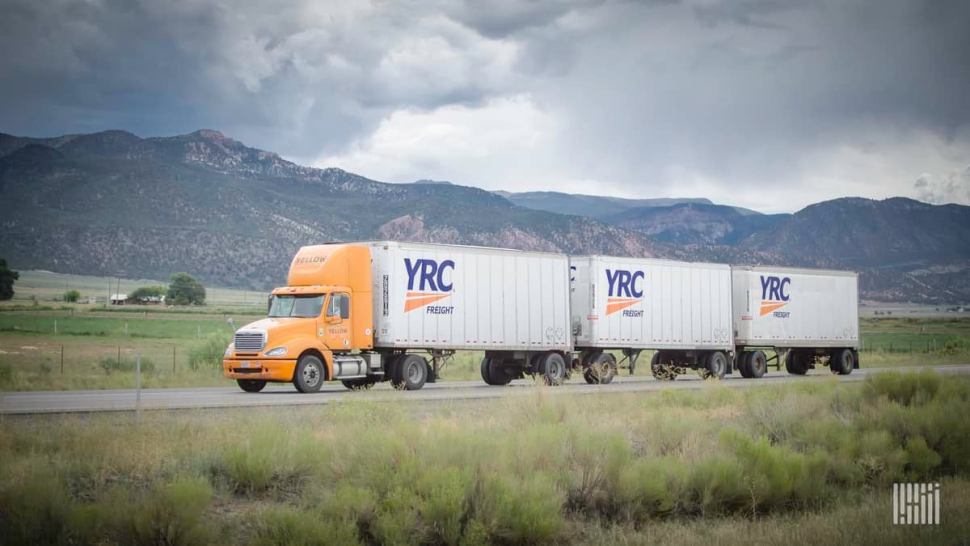
Heavily debt-burdened YRC Worldwide has had its debt rating reviewed by Moody’s Investors Service, but the review wasn’t empowered to do anything about it in any event.
Still, given the less-than-truckload (LTL) carrier’s major debt load, and the fact that it received $700 million in federal government support since the last review by Moody’s, any action, or lack thereof, by a ratings agency is significant.
YRC now carries a Caa1 rating from Moody’s, which is just a few steps above the lowest rating in the Moody’s scale before the bottom-rung rating given to entities that default.
What Moody’s announced Tuesday is that it had completed a “periodic review” of YRC. The “portfolio review … reassessed the appropriateness of the ratings in the context of [Moody’s] methodologies, recent developments and a comparison of the financial and operating profile to similarly rated peers.”
What it did not involve was a ratings committee, which is the only way for a borrower to have its rating increased or decreased.
A spokeswoman for Moody’s directed FreightWaves to a statement issued by the company last year when it first began to announce the completion of periodic reviews. “[A] portfolio review is not the outcome of a rating committee,” the statement said. “An issuer’s credit ratings and outlook status cannot be changed in a portfolio review, and hence outlooks and ratings are not impacted by an announcement that a periodic review has been completed.”
That isn’t to say that the release accompanying the end of the YRC portfolio review had nothing to say. The statement noted Moody’s “thin operating margins and substantial debt balance, when including Moody’s adjustments related to underfunded pension obligations.”
Moody’s Caa1 rating was already affirmed soon after the company received the $700 million loan from the Treasury Department. (Moody’s rival S&P Global Ratings gave it an upward boost). While the amount seemed enormous, it was not enough to move the needle on YRC’s debt rating. The affirmation of Caa1 “balances the additional liquidity … and related amendments to the company’s existing revolving credit facility and term loan, and the need to increase its earnings and cash flows sufficiently to service the increase in the company’s debt.”
In explaining the rationale behind the periodic reviews, one thing Moody’s does not comment on is whether the review can lead to some conclusions that then might trigger a broader review of the company’s debt rating.
When the debt ratings were affirmed in July, after the Treasury loan, the outlook on the company stayed at stable, which generally means that a downgrade or upgrade was not likely in the foreseeable future unless there was a significant change in the company’s outlook.
At the time of the affirmation, the company’s speculative grade liquidity rating was upgraded one notch to SGL-3 from SGL-4. The rating is a measure of the liquidity of companies that hold less than an investment grade rating.
YRC’s stock price around the time of the Treasury announcement was about $3.25. It rose as high as $5.65 on Aug. 21, but at 3:10 p.m. Tuesday was at $3.93, a drop of 30.4% from that 52-week high. In that same time, Old Dominion Freight Lines, a leading LTL carrier, is down just 8.4%.
More articles by John Kingston
S&P says YRCW situation is good enough for an increase in company’s debt rating
Panel of shippers looks at the question of YRCW’s fate
YRCW won’t face loan maturity payments for 4 years under new deal
Brokerage Compliance Symposium
The day before F3. Every compliance issue you face - fraud exposure, carrier liability, FMCSA rules, cargo theft, insurance gaps - navigated by attorneys and operators defining best practices in a changing industry.
F3 Awards Dinner
The night before F3. FreightTech100 companies honored. FreightTech 25 and Shipper of Choice winners revealed live. Cocktail reception into dinner and live music - 300 industry leaders in one purpose-built room.
F3: Future of Freight Festival
Industry-defining keynotes, rapid-fire technology demos, and industry leaders networking in experiences across Chattanooga - plus the inaugural F3 Awards Dinner featuring the FreightTech and Shipper of Choice reveals.
The day before F3. Every compliance issue you face - fraud exposure, carrier liability, FMCSA rules, cargo theft, insurance gaps - navigated by attorneys and operators defining best practices in a changing industry.
The Signal at Chattanooga Choo Choo • Chattanooga, TN Register NowThe night before F3. FreightTech100 companies honored. FreightTech 25 and Shipper of Choice winners revealed live. Cocktail reception into dinner and live music - 300 industry leaders in one purpose-built room.
The Signal at Chattanooga Choo Choo • Chattanooga, TN Register NowIndustry-defining keynotes, rapid-fire technology demos, and industry leaders networking in experiences across Chattanooga - plus the inaugural F3 Awards Dinner featuring the FreightTech and Shipper of Choice reveals.
The Signal at Chattanooga Choo Choo • Chattanooga, TN Register Now