




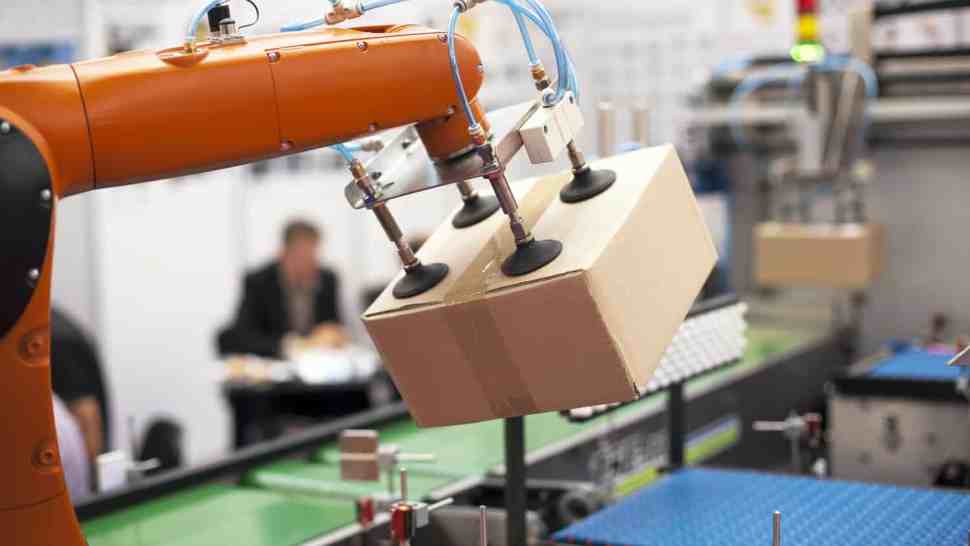
Robotics as a vertical has been a mainstay in the industrial floor for decades now, with robotic arms making automation easier and more efficient than human workers. But yesteryear robots came with a lot of baggage – they are clunky, heavy, and inherently non-intelligent. Unlike human workers, they cannot learn on the job nor can they be trained to work on tasks that have not been programmed into their process.
Innovation in micro-technology and grip & sensing capabilities has made robots lighter, agile, and with the ability to lift weights. The idea of computer vision on robots has been peddled over the years and is closer to reality now, with automated robots perceiving products based on image processing. With the help of these cutting-edge technologies, robots today can move around warehouses, scan for products and physically lift them across the floor.
New generation robots can significantly cut down the need for skilled labor, with the role of personnel gravitating towards supervising a fleet of intelligent robots. Robots can be made to work in tandem with employees, helping with heavy lifting and redundant jobs, and freeing time for people to work on planning and logistics operations.
Large e-commerce companies with the need for massive warehousing understand the importance of recruiting robots for cutting down their operational bills. Amazon’s acquisition of Kiva robots in 2012 for a whopping $775 million is a glimpse into how big the scope is for robotics in the supply chain. Boston Dynamics, the erstwhile subsidiary of Google, has designed ‘Handle’, a robot that can jump over obstacles, scamper around warehousing floors and lift 100 lbs. with ease.
Machines with near-human intelligence use historical and real-time data arising from the supply chain to conceptually understand problems and can provide logistics solutions. All this can be potentially done without human involvement, courtesy of artificial intelligence and machine learning programs that power them.
The future though, lies in the creation of a general-purpose robot, as against a single-purpose robot that exists today. These robots must be able to learn from observing people and go about replicating the tasks without manual interference. For example, robots involved in moving freight in the warehouse must be able to understand the process of flipping burgers in a restaurant and repeat them, all on its own.
Apart from the warehousing part of the supply chain, automation and robotics have found use cases in delivery processes as well. The freight industry is facing a crisis with nearly one-third of all its drivers approaching retirement, and young millennials being disillusioned with taking up the job. But with fascinating technology like drones, it is possible to envision a future where the skies could be used to deliver parcels directly to the doorstep of customers.
Drone delivery might not be a plausible solution to the long hauling heavy-load supply chain, but it is an attractive option for delivering lightweight products in the B2C marketspace. Drones also serve as a marketing gimmick as much as it cuts down on time for delivery. Amazon is investing millions in this technology, with it doing a pilot run in the UK a year back, with its Amazon Prime Air feature. Though the technology is still in incipient stages, experts believe that it has a great future in bolstering supply chain logistics.
But all this might come at a cost. Though the advent of robots into the supply chain is good for companies looking to reduce operational expenses, the impact it could have on the company’s reputation needs to be assessed. When the news of robots replacing humans hit the media, the chances are that it forms an ugly blotch on the company’s name, since recruiting robots equal job cuts. Research, though, indicates that robots do not generally replace workers.
“Our opinion is it won’t take jobs away,” Sami Atiya, president of the Robotics and Motion division of ABB Group, told an audience at the TechCrunch Sessions: Robotics forum earlier this year. “If you just look at pure data and statistics, in the countries that have the highest rate of robots per employee, which is Japan and Germany – and they have about 300 robots per 10,000 employees – they have the [lowest] unemployment [in the manufacturing sector]. And if you look over the last five years, [there have been] produced more than 100,000 robots in the manufacturing area and in that same manufacturing area, we’ve added 270,000 jobs, so basically that’s two jobs per one robot.
To avoid such hiccups, contemporary workers need to be given skill training parallely in-house. This would help them transcend their redundant jobs and work on managing robotic fleets and in reducing delivery time – thus improving logistics efficiency.
Stay up-to-date with the latest commentary and insights on FreightTech and the impact to the markets by subscribing.
Brokerage Compliance Symposium
The day before F3. Every compliance issue you face - fraud exposure, carrier liability, FMCSA rules, cargo theft, insurance gaps - navigated by attorneys and operators defining best practices in a changing industry.
F3 Awards Dinner
The night before F3. FreightTech100 companies honored. FreightTech 25 and Shipper of Choice winners revealed live. Cocktail reception into dinner and live music - 300 industry leaders in one purpose-built room.
F3: Future of Freight Festival
Industry-defining keynotes, rapid-fire technology demos, and industry leaders networking in experiences across Chattanooga - plus the inaugural F3 Awards Dinner featuring the FreightTech and Shipper of Choice reveals.
The day before F3. Every compliance issue you face - fraud exposure, carrier liability, FMCSA rules, cargo theft, insurance gaps - navigated by attorneys and operators defining best practices in a changing industry.
The Signal at Chattanooga Choo Choo • Chattanooga, TN Register NowThe night before F3. FreightTech100 companies honored. FreightTech 25 and Shipper of Choice winners revealed live. Cocktail reception into dinner and live music - 300 industry leaders in one purpose-built room.
The Signal at Chattanooga Choo Choo • Chattanooga, TN Register NowIndustry-defining keynotes, rapid-fire technology demos, and industry leaders networking in experiences across Chattanooga - plus the inaugural F3 Awards Dinner featuring the FreightTech and Shipper of Choice reveals.
The Signal at Chattanooga Choo Choo • Chattanooga, TN Register Now