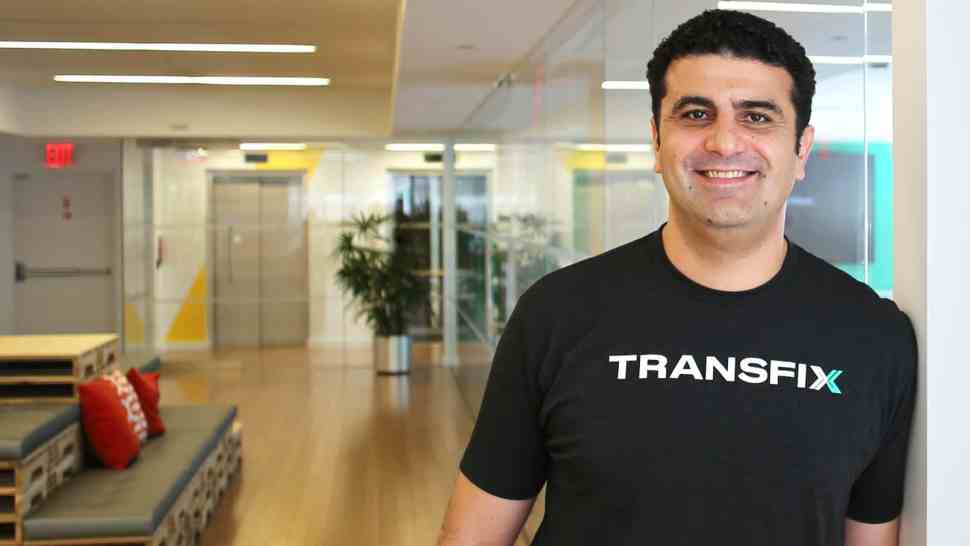
Transfix, the venture capital-backed digital freight marketplace based in New York City, announced that Ahmad El-Dardiry joined the company as its new chief revenue officer.
El-Dardiry comes to Transfix from a 19-year stint at Intel Corporation, where most recently he managed cloud computing, memory and storage enterprise sales in the Americas, Asia and global industry verticals including financial services, telecommunications and energy.
Transfix was founded in 2013 by Drew McElroy, who grew up in freight brokerage, and Jonathan Salama, a software engineer, with the goal of removing waste and improving the economics of the freight industry. Like other tech-enabled freight brokerages, Transfix has built technology to automate load-matching and decouple revenue growth from headcount growth.
But McElroy and his team are betting that Transfix’s technology can create new economic incentives for carriers and change their behavior. If Transfix can improve asset utilization and grow revenue per tractor per week on lower rates per mile, both the carrier and the shipper win.
In an interview with FreightWaves, El-Dardiry articulated an ambitious vision of the future of digital freight brokerage, a business model that extended far beyond the traditional exploitation of gross margins on loads covered. Transfix is building data and analytics tools that reach further upstream into its customers’ supply chains, and part of El-Dardiry’s job as chief revenue officer will be to figure out how to negotiate strategic partnerships, and price and monetize these new tech services.
El-Dardiry’s previous roles at Intel gave him experience in turning what could be a transactional, arbitrage-based business into strategic collaborations. Cloud computing and storage, like truckload capacity, are volatile commodities whose prices are driven by unpredictable supply and demand.
“Banks and telecoms are building infrastructure and you have to fulfill commitments, but they don’t want to overpay,” El-Dardiry explained. “People want suppliers to stick around, and they want to scale and be successful – reasonable business people look at both sides of the market, whether it’s up or down, for the long-term.”
At Intel, El-Dardiry helped his customers grow their businesses through both constrained environments and looser cycles, gaining trust and helping Intel’s partners buy into long-term, stable pricing models.
“When there’s a surge in demand, how do you build the right collaboration with your customers to support their upside demand?” El-Dardiry said. “You have historical data, you put projections on it, but sometimes the market grows faster.”
Digital freight matching is really only the initial phase of the technological disruption of the third-party logistics industry. Transfix is building tools for many segments of the value chain, on both the shipper and carrier sides, examining the unique needs of carriers, dispatchers, drivers, procurers and inventory managers.
“We’re looking to do more than just moving folks’ freight, but truly be a deep integration into their logistics needs and be a strategic asset for them in how they work,” El-Dardiry explained. “We’re accountable for moving their freight, but that’s table stakes for us.”
Transfix will consult with shippers on their vendors to help them anticipate new product launches, study inbound and outbound efficiencies, and do root cause analysis on network bottlenecks. While visibility solutions are now fairly ubiquitous for the transportation and logistics industry, the data does not always translate into actions.
“You might know a truck is going to be late but the receiver doesn’t dynamically manage the schedule – nothing happens differently,” El-Dardiry said. “We need to rethink how we stack the schedules.”
Ultimately, Transfix wants to pull data from all parts of the value chain to optimize every carrier and every shipper on every lane. What does that look like? If Transfix’s platform can ingest enough data from a regional collection of shippers and carriers, it can aggregate both demand and capacity and put assets into continuous, reliably scheduled loops.
The payoff is a virtual fleet and a virtual dedicated customer. Multiple carriers adhering to dynamic schedules would service multiple shippers on predictable circuits, creating a ‘dedicated’ experience on both sides. That means that the carrier would not have to hunt for freight, play spot rates or deadhead to headhaul markets where freight is relatively abundant. Instead, the driver feels like he works for a dedicated carrier: high asset utilization, regular home time, steady revenue per work and deep customer relationships.
On the other side of the market, shippers get access to on-demand capacity that, while it may come from a set of fleets instead of a single carrier, is always available. Part of Transfix’s value proposition is that because of high levels of automation and high asset utilization, it should be able to charge shippers lower rates per mile, while typical ‘dedicated’ agreements offer guaranteed capacity to shippers at a premium.
What’s the payoff of creating a virtual dedicated experience on both sides of the marketplace?
El-Dardiry’s vision is to create a new kind of freight arrangement, a true contract – not the paper rates that asset-based carriers call ‘contract’ – based on a new standard of tech-enabled service and cost. Transfix wants to leverage its technology to offer better service at a lower cost, and ultimately build a new dedicated contract structure that locks in capacity for shippers and revenue for carriers.
“When I talk to shippers, that’s actually what they want,” El-Dardiry said. “It’s not just tools and tech; it’s actually driving a loyal carrier base that has predictable volume.”
Brokerage Compliance Symposium
The day before F3. Every compliance issue you face - fraud exposure, carrier liability, FMCSA rules, cargo theft, insurance gaps - navigated by attorneys and operators defining best practices in a changing industry.
F3 Awards Dinner
The night before F3. FreightTech100 companies honored. FreightTech 25 and Shipper of Choice winners revealed live. Cocktail reception into dinner and live music - 300 industry leaders in one purpose-built room.
F3: Future of Freight Festival
Industry-defining keynotes, rapid-fire technology demos, and industry leaders networking in experiences across Chattanooga - plus the inaugural F3 Awards Dinner featuring the FreightTech and Shipper of Choice reveals.
The day before F3. Every compliance issue you face - fraud exposure, carrier liability, FMCSA rules, cargo theft, insurance gaps - navigated by attorneys and operators defining best practices in a changing industry.
The Signal at Chattanooga Choo Choo • Chattanooga, TN Register NowThe night before F3. FreightTech100 companies honored. FreightTech 25 and Shipper of Choice winners revealed live. Cocktail reception into dinner and live music - 300 industry leaders in one purpose-built room.
The Signal at Chattanooga Choo Choo • Chattanooga, TN Register NowIndustry-defining keynotes, rapid-fire technology demos, and industry leaders networking in experiences across Chattanooga - plus the inaugural F3 Awards Dinner featuring the FreightTech and Shipper of Choice reveals.
The Signal at Chattanooga Choo Choo • Chattanooga, TN Register Now