




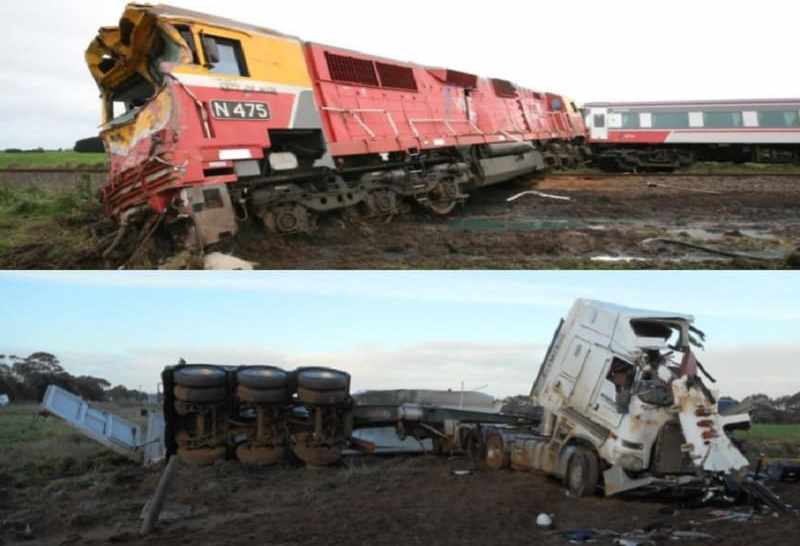
Trucking safety at level railroad crossings proved to be a major issue this week with the release of two separate reports by the nation’s transport safety detective. In both cases there were very serious train derailments. Meanwhile, the National Transport Commission was asking whether Australia’s trucks are safe enough.
Passenger train smashed into semi-trailer because of restricted vision
A lack of clear lines of sight was the fundamental reason why a passenger train smashed into a semi-trailer at 59 miles per hour on July 13, 2016, injuring 21 people. The train driver and the truck driver were both hurt. Thankfully, there were no deaths.
A recently released report by the Australian Transport Safety Bureau (ATSB), which is tasked with investigating aviation, maritime and rail accidents, concluded that the truck driver entered the level crossing in the Australian state of Victoria unaware that a nearby train was approaching.
He couldn’t see the train because the view along the track to the left was restricted by an acute road-to-rail angle. Controls available to the local authorities to manage the risk were not used by either the train operator or the local council. The interaction between the two bodies in tackling the risk was also ineffective.
The ATSB also concluded that more than 100 level crossing in Victoria were non-compliant with safety standards because of acute road-to-rail angles that affected the ability of truck drivers to see approaching trains.
On the day of the accident, the truck was hauling 26.5 metric tonnes (29.2 U.S. tons) of bulk stock feed in a prime mover/semi-trailer configuration. The train carried 99 passengers. Both vehicles were fitted with data-logging devices.
The train began sounding its horn about 1,700 feet away on its approach to the level crossing; the train driver later reported he had seen the truck through a row of trees. The truck stopped a short distance before the crossing. It waited for three seconds. The truck started up. It moved onto the crossing. The train was less than 722 feet away. The train driver hit the emergency brakes. The truck’s prime mover cleared the crossing. The trailer had not.
The train smashed into the trailer at 59 miles an hour.
The locomotive derailed but stayed upright. The trailer/truck jackknifed and was flung into a nearby field. The trailer rolled over and was completely smashed. The front left-side of the prime mover’s cab was utterly destroyed.
The findings of the report were made known to the operator of the railway, V/Line, in advance of publication. Because more than 100 level crossings present restricted line of sight dangers, V/Line has since carried out numerous safety actions such as beginning a survey, introduction or more risk controls and upgrading some of the crossings.
Heavy freight truck likely caused second train derailment
Meanwhile, a freight train derailment in the Australian state of Queensland was likely caused by the under frame of a low-clearance heavy truck damaging both rails, the Australian Transport Safety Bureau has concluded in a recently released report.
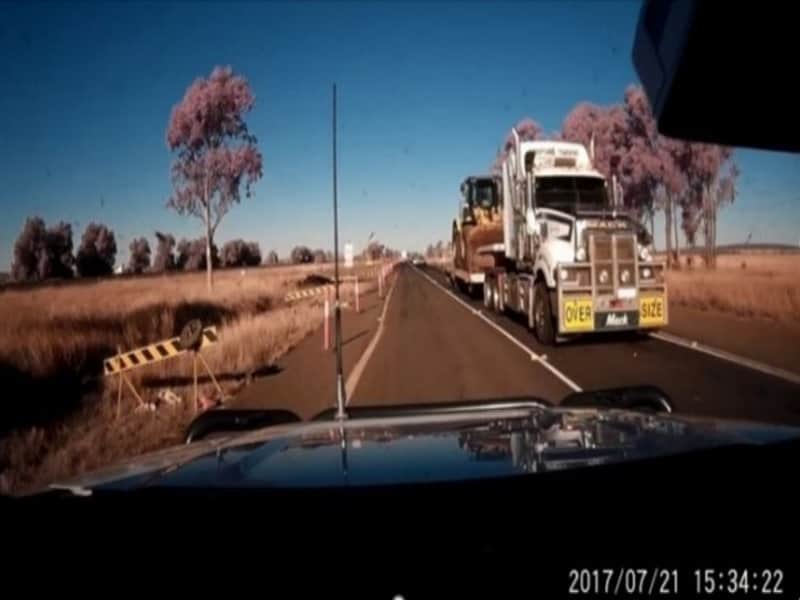
On July 21, 2017, a train hauling 18 wagons of coal derailed and destroyed about 300 meters (984 feet) of rail.
An investigation of the site by the ATSB revealed identical impact marks to the rails at the level crossing and that the rails were misaligned because of the impact. Analysis showed that the marks were consistent with being hit by a low-clearance road vehicle.
A passer-by told the ATSB that a heavy road vehicle come to a sudden stop on the crossing, the driver got out of the cab, inspected the low-loader trailer, which was carrying construction equipment, and then carried on the journey. He did not report the accident to the appropriate authorities despite instructions to that effect on-site signage, which also provided a toll-free contact number.
The train driver saw a “kink” in the rails and tried to stop but the lead locomotive passed over the crossing and the train derailed.
The ATSB also found that the monitoring and inspection process for the level crossing failed to ensure that the level crossing was in a safe condition. The surface had eroded to such a point that the under frame of the low-loader trailer could hit the rails.
“If rail infrastructure is damaged due to a road accident, it is vitally important that the driver responsible report the matter to the local police or the asset owner as soon as possible,” said ATSB Director of Transport Safety Dr. Stuart Godley.
“Rail infrastructure managers, who are responsible for the management of the rail corridor, need to ensure that approach roads and the crossing surface at level crossings are subject to regular and effective inspection and monitoring processes,” Dr. Godley said.
“This is particularly relevant for level crossings with gravel-based road surfaces and inclined approach roads.”
The owner of the level crossing, Queensland Rail, has since repaired the track and the crossing.
Truck driver safety and practices under review
Australia’s National Transport Commission (NTC) is reviewing the Heavy Vehicle National Law and, as part of that review, it is looking at safety.
The Heavy Vehicle National Law was passed by the various states and territories of Australia in 2012 and took effect in 2014. It has 800 sections and five sets of supporting regulations. The new law replaced 13 model laws and six sets of state and territory transport-related laws. It creates a single national system of laws (including regulations) and established a single regulator.
However, the Heavy Vehicle National Law has been subject to considerable criticism.
The NTC’s Issues Paper, “Safe people and practices” says that the law and regulations “can be inconsistent in approach, difficult to read and interpret, and onerous for industry to follow. They’re also difficult for the [Regulator] to administer. Many parts of the HVNL are complex and prescriptive. They reflect an era when access to digital technology and innovation wasn’t a consideration. The HVNL doesn’t adequately recognise a ‘one size fits all’ approach to regulation is not appropriate for many locations or in different industries.”
In the Issues Paper, the NTC notes that many truck operators use safety management systems to identify hazards and to manage risk. However, there is a philosophical difference in approach: some prefer to develop their own systems and others want the clarity of prescriptive rules. In either case, safety management systems have no formal status under the Heavy Vehicle National Law, unlike rail and aviation where they are required.
The paper also points out several anomalies in Australian law and practice. It notes that the Heavy Vehicle National Law has a limited application in relation to safety; that’s addressed by other laws such as the Chain of Responsibility laws. But, while the Chain imposes a shared responsibility for safety on all parties it “generally doesn’t include the driver,” the paper says.
Meanwhile, the Heavy Vehicle National Law has no explicit rules that drivers should be competent and there are no behind-the-wheel prerequisites for heavy vehicles.
Nor are there any health and fitness obligations.
“Work conditions predispose heavy vehicle drivers to health conditions, which, in turn, affect their fitness for duty. Yet road transport is the only transport mode in Australia that doesn’t have a fitness for duty standard,” the paper says.
There’s no national system for heavy vehicle licensing which is, instead, managed through state and territory laws.
While it may appear from the above that the Heavy Vehicle National Law doesn’t regulate much, nothing could be further from the truth. It governs a wide spectrum of trucking-life such as standards, maximum mass and dimensions, securing and restraining loads on heavy vehicles, fatigue and more.
And many of the gaps in the Heavy Vehicle National Law are addressed in other legislation, as in, for instance, the Workplace Health & Safety laws.
Brokerage Compliance Symposium
The day before F3. Every compliance issue you face - fraud exposure, carrier liability, FMCSA rules, cargo theft, insurance gaps - navigated by attorneys and operators defining best practices in a changing industry.
F3 Awards Dinner
The night before F3. FreightTech100 companies honored. FreightTech 25 and Shipper of Choice winners revealed live. Cocktail reception into dinner and live music - 300 industry leaders in one purpose-built room.
F3: Future of Freight Festival
Industry-defining keynotes, rapid-fire technology demos, and industry leaders networking in experiences across Chattanooga - plus the inaugural F3 Awards Dinner featuring the FreightTech and Shipper of Choice reveals.
The day before F3. Every compliance issue you face - fraud exposure, carrier liability, FMCSA rules, cargo theft, insurance gaps - navigated by attorneys and operators defining best practices in a changing industry.
The Signal at Chattanooga Choo Choo • Chattanooga, TN Register NowThe night before F3. FreightTech100 companies honored. FreightTech 25 and Shipper of Choice winners revealed live. Cocktail reception into dinner and live music - 300 industry leaders in one purpose-built room.
The Signal at Chattanooga Choo Choo • Chattanooga, TN Register NowIndustry-defining keynotes, rapid-fire technology demos, and industry leaders networking in experiences across Chattanooga - plus the inaugural F3 Awards Dinner featuring the FreightTech and Shipper of Choice reveals.
The Signal at Chattanooga Choo Choo • Chattanooga, TN Register Now