




By Chris Dupin
Ports and shipping companies operating in the Caribbean and Central America may benefit from the Panama Canal expansion, new U.S. trade agreements with Panama and Colombia, increased production of some commodities and crops, and continued growth in tourism.
With the opening of a third set of larger locks at the canal, scheduled for 2014, 'there definitely is going to be a change in the whole region,' said Carlos Urriola, senior vice president at Carrix, which operates Manzanillo International Terminal (MIT) at the Caribbean entrance to the Panama Canal.
Ports ready with equipment and deepwater to handle large ships 'are going to have a big opportunity especially in the Caribbean,' to transfer cargo from big ships able to utilize the canal to smaller ships serving U.S. and other regional ports that don't have deep channels, he said.
Transshipment has been responsible for rapid growth by many container terminals in the region during the past decade. Urriola, who is also president of the Caribbean Shipping Association, said only about 100,000 TEUs moved through Panama in 1994, where today 5 million TEUs move through its terminals at both ends of the canal. While some of that is organic growth, most is transshipment-related, he said.
The larger locks will increase the size of containerships able to transit the canal from about 5,000 TEUs to more than 12,500 TEUs, perhaps as much 14,500 TEUs. Most analysts believe 8,000- to 9,000-TEU ships will, at least initially, be much more common.
'These ships are not going to call every port. It's a basic reality of these big ships that they really want to go between hub and hub, where you load a lot of cargo at the originating hub and go to the other hub and then reload to go back,' said Bob West, a principal strategist in the infrastructure and environment practice at WorleyParsons.
While many U.S. East Coast ports would like to handle larger ships, it may be many years before they are able to do so because of the slow pace of dredging projects, he noted.
West believes that in addition to the economies of scale big ships bring, transshipping cargo through Caribbean ports would enable carriers to serve multiple markets with a single vessel.
Cargo in Shanghai, for example, could be loaded for multiple destinations, then transferred to smaller ships serving ports not only on the U.S. East and Gulf coasts, but also in Colombia, Venezuela, Central America, Mexico and the Caribbean. Likewise, he argues, those ships would get higher utilization on their backhauls to the Far East if they can gather cargo from many locations in the western hemisphere.
Prior to the rise of transshipment ports, a greater portion of the cargo might have moved through the United States, but U.S. ports remain the home base for large regional carriers in the Caribbean such as Tropical Shipping, Seaboard Marine and SeaFreight, said Fritz Pinnock, executive director of the Caribbean Maritime Institute.
Most cargo moving to Puerto Rico, for example, continues to move through U.S. distribution centers on the U.S. mainland, said John Douglas, senior vice president and general manager of Puerto Rico and Caribbean services for Crowley.
His colleague, John Hourihan, Crowley's senior vice president and general manager of Latin America Services, agreed. 'I don't see yet clearly what will be a significant change' in how cargo is routed into the U.S. as a result of the canal expansion.
There is a wide range of estimates as to how much savings there will be from using bigger ships ' from $90 to as much as $400 per TEU, West said.
Savings For Who? 'It's anyone's guess who will share in all of those savings,' West said. Shippers, carriers, the Panama Canal Authority, ports that are deepening their harbors, and transshipment hubs all would like a piece.
West believes ports positioned to increase their transshipment business include terminals in Panama; Kingston, Jamaica; Cartagena, Colombia; Freeport, Bahamas; and Caucedo, Dominican Republic.
He's more skeptical about the ability of Port of Spain in Trinidad to become a major transshipment hub, saying it is too far east to be useful for ships calling the United States. But he adds it might become a transshipment point for ships serving Brazil.
He also doubts Puerto Cabello, Venezuela, will have success as a hub because of the Chavez administration. Many analysts say Cuba is an ideal place for a transshipment hub, both because of its location and large population, but think it unlikely to become one without a change in government. An ideal location for such a hub, said West, is the South Coast near Guantanamo Bay, where there is deep water.
West and others also are skeptical about transshipment potential for San Juan or the new Port of the Americas near Ponce in Puerto Rico because the Jones Act would require the use of U.S.-built and crewed ships to call the United States.
Rick Eyerdam, executive director of the Miami River Marine Group, questions whether many proposed hubs have the land to become larger hubs, while Pinnock noted operating a transshipment hub is a high risk business ' customers are highly mobile, and prices are very low.
Intra-America Trade. While most of the discussion about the Panama Canal's ability to handle bigger ships has centered on the economies of scale available to all-water services from China and Asia, one consultant thinks one of the most important changes the canal will bring will be increased trade between the United States and Latin America.
'I think we are going to see some serious changes taking place in the three to five years after the canal opens,' said Joseph Cervenak, managing principal with the York, Pa.-based consulting firm KemperJoseph.
Pending free trade agreements with Panama and Colombia, if approved, would increase imports and exports. The U.S. International Trade Commission estimated in 2006 that the Colombia free trade agreement could increase exports by $1.1 billion and imports from the country by $487 million.
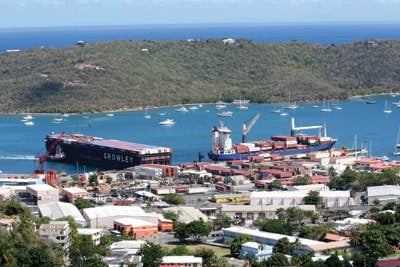
| Shippers rely on the day-of-the-week sailings to ports like St. Thomas. |
Central America and the Caribbean have long been an important source for apparel. And Crowley's Hourihan said in recent discussions, apparel companies have indicated to him they believe Central America will be a growing source of product over the next five years.
'Central America seems to have found its sweet spot with more of the basic apparel, mostly cotton T-shirts, underwear, socks are where there are healthy volumes,' he said. Producers in locations like Central America and the Dominican Republic have an edge over producers in the Far East because of shorter lead times. If a particular color shirt is a hot seller, shelves can be restocked more quickly than if the product must come from Asia. Similarly, if T-shirts are screen printed with an image that ties into a summer movie, extra shirts can be ordered if it's a blockbuster.
Produce exports from Central America to Europe and the United States continue to grow as more crops are approved for import into the United States, Hourihan said.
In 2009, Costa Rica and the United States signed a protocol to allow U.S. imports of fresh peppers and tomatoes. Growth in pineapple imports was one reason that APM Terminals wants to build a large new terminal in Moin, Costa Rica.
Haitian mangoes are imported to the United States in large quantities, but Pinnock said Caribbean economies have become far less export-centered. The end of trade preferences by the European Union for Caribbean bananas has meant a sharp drop in exports from the islands.
The rapid growth in both land-based vacationers and cruise ships have 'changed the structure of the economy in that tourism is more import-centered,' he said.
Pinnock estimates the cost of transportation in the Caribbean is about 30 percent higher than it is in other parts of the world. This is partly because of the 9-to-1 imbalance in imports and exports to the Caribbean trade, and what he calls 'social ports' where the emphasis is more on job creation than the bottom line. Many ports, he added, have a monopoly and don't face competition.
Urriola believes many of the carriers specializing in the Caribbean trade will be able to retain their dominance in the region.
'They go to very niche markets where there is not enough volume to justify larger vessel size,' he said. Bigger lines are 'getting into alliances with niche carriers and using them to move cargo instead of trying to replace them with their own vessels. It's to both their benefit.'
Frank Wellnitz is director of Caribbean Feeder Services, which operates a dozen vessels ranging from 250 TEUs to 580 TEUs, seven of which are gearless and five of which have cranes. The line does business with some of the world's largest container carriers including Zim, Hapag-Lloyd, Hamburg S'd, COSCO, Evergreen and CSAV. He also works with CMA CGM and Maersk, though he notes those companies have their own operations in the region.
He believes the canal expansion and increased trade will probably result in bigger ships operating in the region.
But cargo operations in many of the region's ports are limited by shallow drafts, infrastructure, and preferential berthing rights for cruise ships.
As ships get bigger there may be more ports where the ships used by linehaul carriers will no longer be able to call directly, 'and the feedering will increase. I think we all go one notch up,' Wellnitz said.
Interest by global carriers in serving the Caribbean and Central America ebbs and flows depending on the health of major trades.
'If ships are full going into the United States, then there is not that much interest going into the Caribbean and Central America. But if the ships are not full into the United States then Caribbean cargo is very welcome,' he said.
Rate levels into the Caribbean, he noted, tend to be healthier than in the U.S. trades 'because you have very fragmented markets ' you have six containers here, seven containers there,' Wellnitz said.
Fuel, however, has become 40 percent to 45 percent of Caribbean Feeder Services' operating costs, he said.
'The biggest challenge for any of the operators in the Caribbean is the spiraling cost of bunker, or in our case, diesel,' said Douglass of Crowley. 'It's difficult despite fuel surcharges to keep up with the rapid rise in prices.'
Fuel-saving options such as slow steaming are not possible, as distances aren't long enough in the Central American and Caribbean trades, Hourihan said.
And, because most islands do hardly any manufacturing and rely on carriers for almost everything they consume, 'they depend on your day-of-the-week sailing,' Douglass said. 'They know when you sail and St. Thomas in the Virgin Islands, we have to be there on Sunday morning, in St. Croix have to be there by likewise, and the same is true of Nassau or Puerto Rico.'
Brokerage Compliance Symposium
The day before F3. Every compliance issue you face - fraud exposure, carrier liability, FMCSA rules, cargo theft, insurance gaps - navigated by attorneys and operators defining best practices in a changing industry.
F3 Awards Dinner
The night before F3. FreightTech100 companies honored. FreightTech 25 and Shipper of Choice winners revealed live. Cocktail reception into dinner and live music - 300 industry leaders in one purpose-built room.
F3: Future of Freight Festival
Industry-defining keynotes, rapid-fire technology demos, and industry leaders networking in experiences across Chattanooga - plus the inaugural F3 Awards Dinner featuring the FreightTech and Shipper of Choice reveals.
The day before F3. Every compliance issue you face - fraud exposure, carrier liability, FMCSA rules, cargo theft, insurance gaps - navigated by attorneys and operators defining best practices in a changing industry.
The Signal at Chattanooga Choo Choo • Chattanooga, TN Register NowThe night before F3. FreightTech100 companies honored. FreightTech 25 and Shipper of Choice winners revealed live. Cocktail reception into dinner and live music - 300 industry leaders in one purpose-built room.
The Signal at Chattanooga Choo Choo • Chattanooga, TN Register NowIndustry-defining keynotes, rapid-fire technology demos, and industry leaders networking in experiences across Chattanooga - plus the inaugural F3 Awards Dinner featuring the FreightTech and Shipper of Choice reveals.
The Signal at Chattanooga Choo Choo • Chattanooga, TN Register Now