




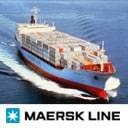
The losses were a huge reverse from the $278 million in profits in the first half of 2008, a decline Maersk executives put down to unviable freight rates that bottomed out in May and June. Maersk said it had expected the bottom of the container market to be reached in April, but that second quarter rates actually were worse than the first half as a whole for the line (34 percent down in the second quarter, compared to 30 percent for the first half).
Revenue fell 30 percent in the first half to $9.8 billion, in line with the container rate drop. The A.P. Moller-Maersk Group as a whole had revenue of $22.7 billion in the first half, a drop of 25 percent, while losses were $540 million, compared to $2.5 billion in the first half of 2008.
'Rates continued to decline through June when we thought April would be the worst month for rates,' A.P. Moller-Maersk Group Chief Executive Officer Nils Andersen said in an earnings call with analysts Friday. 'We expect rates in the second half to be in line with the first half.'
 |
| Andersen |
'We see the recent rate increases we announced are sticking,' he said. 'When we look at rates throughout year, rates bottomed out in May and June and even the so far announced increases are not enough to bring the average up to the level of the first half, so we need to see more increases. The rates that are sticking are still not anywhere near what is an acceptable return.'
He said the problem is rates bottomed out in such a pronounced manner that the increases are tacked on to yet unsustainable rate levels. For Maersk Line, rates dropped even further than the industry average, which Andersen chalked up to the lane on which Maersk is most dependent.
'The headline figure for us is worse than the market, but there are two reasons for that,' he said. 'The Asia-Europe lane has gone down further than global average, and that's our key market. And second, we've seen increased utilization west to east (from Europe to Asia) which is the backhaul so it's a lower rate market.'
One analyst questioned whether Maersk Line's move to decentralize rate decision-making contributed to the rate decline.
'Once you make decision-making procedures, there's risk that things can go wrong,' Andersen said. 'But it's not our feeling that we have priced out of the range of the competition. The whole industry has responded to this crisis in an immature manner. We followed the rate cuts to save market share. I'm not saying mistakes have not been made. It's a big company. But we're satisfied with the performance.'
While Maersk Line’s rates plummeted by 30 percent in the first half, volume fell only 7 percent in the first half, and 3 percent in the second quarter. That relatively small drop in volume in the second quarter suggests Maersk Line has been fighting for market share in the depressed rate environment.
Andersen emphasized that the group as a whole performed admirably in the first half, carving out $1 billion worth of savings over the first half of 2009 by cutting staff, moving offices to less expensive addresses, paring down travel and other structural changes that he said will serve the company well when the economy rebounds. He stressed that if not for the historically poor ocean freight and tanker rates, the company would have been in the black.
The group has container terminal operations, oil and gas, and retail divisions. Maersk announced earlier in August that it would close its Danish shipyard once current orders are filled. It also laid off 1,500 staff at Maersk Line in the first half after culling 4,500 jobs in 2008.
'If you discount the container and tanker business, the rest of our businesses are performing quite well,' he said.
Andersen said overall the liner carrier is in a pretty solid position given the circumstances. He said Maersk's liquidity situation is 'satisfactory' and that no debt refinancing would be needed before 2012, while the carrier's newbuilding program is almost fully financed.
He also said Maersk hasn't had any problems getting ship financing from the banking industry which has been reticent the past year to lend money. 'We can't complain about the banking support we're getting,' he said.
However, Andersen said Maersk would eye the issue of bonds down the road as a way to diversify its lending activities, in case the crisis engulfing the ship financing industry continues.
On the positive side for Maersk Line, Andersen said the carrier is deriving more income than the market, a change from two years ago when the carrier struggled to integrate its acquisition of former rival carrier P&O Nedlloyd.
'If we look at the relative performance of Maersk Line, we were below the market by $200 per container on EBIT (earnings before interest and tax) level,' he said. 'The last few quarters we have found ourselves ahead of the market to the tune of about $100 per container. That's a huge swing. And that gives us confidence that when the market improves and container volumes rebound, we will be in a position to make money.'
Also hurting Maersk's bottom line was the relatively low price of oil in the first half of 2009. At $52 per barrel, that was less than half of the $109 per barrel oil cost in the first half of 2008. That price drop affected revenue from Maersk's oil interests. It lowered the cost of bunker fuel for the container line, but rates dropped to levels below which that advantage could be seen.
As for the second half, Andersen said he sees a result 'in line with the first half.' He, like others in the industry, predicted that carriers will struggle to rebound as quickly as the global economy does due to excess capacity coming into the market the next few years.
But he characterized Maersk Line's order book as 'reasonable' and said the line had taken delivery of a modest number of vessels so far this year. It has also been active in laying up capacity and has scrapped 2 percent of its fleet, with another 2 percent scheduled for scrapping in the second half.
'We need to improve throughout the group,' Andersen said. 'The only problems are container rates and tanker rates. But we feel we have the situation well under control.' ' Eric Johnson
Brokerage Compliance Symposium
The day before F3. Every compliance issue you face - fraud exposure, carrier liability, FMCSA rules, cargo theft, insurance gaps - navigated by attorneys and operators defining best practices in a changing industry.
F3 Awards Dinner
The night before F3. FreightTech100 companies honored. FreightTech 25 and Shipper of Choice winners revealed live. Cocktail reception into dinner and live music - 300 industry leaders in one purpose-built room.
F3: Future of Freight Festival
Industry-defining keynotes, rapid-fire technology demos, and industry leaders networking in experiences across Chattanooga - plus the inaugural F3 Awards Dinner featuring the FreightTech and Shipper of Choice reveals.
The day before F3. Every compliance issue you face - fraud exposure, carrier liability, FMCSA rules, cargo theft, insurance gaps - navigated by attorneys and operators defining best practices in a changing industry.
The Signal at Chattanooga Choo Choo • Chattanooga, TN Register NowThe night before F3. FreightTech100 companies honored. FreightTech 25 and Shipper of Choice winners revealed live. Cocktail reception into dinner and live music - 300 industry leaders in one purpose-built room.
The Signal at Chattanooga Choo Choo • Chattanooga, TN Register NowIndustry-defining keynotes, rapid-fire technology demos, and industry leaders networking in experiences across Chattanooga - plus the inaugural F3 Awards Dinner featuring the FreightTech and Shipper of Choice reveals.
The Signal at Chattanooga Choo Choo • Chattanooga, TN Register Now