




With America’s surface infrastructure deteriorating and expected to become more congested with increases in freight, short sea shipping is a viable alternative to move oversized and overweight freight in bulk. But barriers, such as the Harbor Maintenance Tax, prevent short sea shipping from being fully utilized domestically, witnesses told a House Transportation subcommittee on Wednesday.
The Harbor Maintenance Tax is directly levied on importers and domestic shippers using coastal and inland ports as a 0.125% ad valorem tax on the value of imported cargo. The revenues are put into the Harbor Maintenance Trust Fund, from which Congress appropriates monies to the Army Corps of Engineers for harbor maintenance dredging. The House Transportation and Infrastructure Committee last month favorably reported to the full House a bill that would fully utilize the Harbor Maintenance Trust Fund.
The tax, however, is double applied to any cargo transshipped from one U.S. port to another, said Subcommittee on Coast Guard and Maritime Transportation Chairman Sean Patrick Maloney, D-N.Y.
Larry Willis, president of AFL-CIO’s transportation trades department, told the panel, “The biggest hindrance to the use of short sea shipping is the double tax imposed under the harbor maintenance trust fund. Taxing shippers twice — once when their goods reach a port of entry and again when these same exact goods arrive at a secondary port — this law arbitrarily disincentivizes shippers from choosing short sea shipping as a viable method to move their cargoes.”
Rep. John Garamendi, D-Calif., said the double taxation harms the West Coast’s shipping industry. He said it is a “very strong incentive to use the Port of Vancouver rather than the Port in Seattle” and suggested that when trains carrying the cargo to the U.S. Midwest from Vancouver, “maybe that tax ought to apply when it crosses the border.”
James Weakley, president of the Lake Carriers’ Association, said the tax has had a similar effect in the Great Lakes. He said ships are unloaded in Canada and moved across the border on rail into Detroit and Chicago.
The Port of Cleveland subsidized “direct containerships on a more liner basis to Europe,” he said, which “still survives” despite the port ending the subsidy.
“However, the exact problem we’re talking about prevents Cleveland from being a feeder, a hub and spoke, to Europe because of that second domestic move,” Weakley said.
Truck freight volume is expected to grow by 43% by 2045, which will further clog the nation’s roads and highways with major infrastructure investments, Maloney said in his opening remarks.
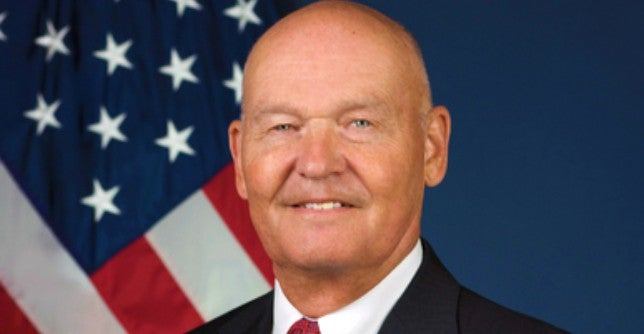
Rear Adm. Mark Buzby (pictured above), the head of the Maritime Administration (MARAD), said, “Our waterways are our one artery where we still have capacity to grow into. If we double our cargo … in the next 30 years, we don’t have any choice. We will have to go into the waterways.”
Jon Nass, CEO of the Maine Port Authority, likened America’s surface infrastructure to “a vessel taking on water fast.”
“By not making an alternative freight transportation system a national priority, especially short sea shipping alternatives, I believe that we are misusing our surface transportation network,” he said. “We are missing a win-win opportunity to both stop the leaks in the highway infrastructure while fostering a revitalized waterway economy nationally. … That’s exactly what the Maritime Administration’s Marine Highway is designed to do, and it should be a top priority for fixing the entire system.”
The marine highway system currently includes 25 all-water routes that serve as extensions of the surface transportation system. The routes are designated by the transportation secretary “because they can offer relief to landside corridors that suffer from traffic congestion, excessive air emissions or other environmental concerns and challenges or provide new transportation option,” according to MARAD’s website.
The Transportation Department has awarded $24 million in competitive marine highway grants supporting at least six new and two existing marine highway services, Buzby said in his opening remarks. The first round of grants totaling $7 million was awarded in 2010. The program received an additional $5 million per year in 2016 and 2017 and the Consolidated Budget Act of 2018 provided a further $7 million.
“Federal grants designed to facilitate marine highway services should be significantly increased,” Willis said. “The initial cost of acquiring equipment and infrastructure improvements necessary for short sea shipping can be significant, and federal dollars we think are necessary to reduce this market barrier to entry.”
In April, MARAD announced $6.79 million in grants awarded to three marine highway projects. The Marine Highway Open Season “Call for Projects” was published in March and is currently open. The Office of Marine Highways will review applications on a rolling basis every six months until May 31, 2022, according to MARAD’s website.
Marine highway projects grant-funded services moved 35,215 TEUs by water in fiscal year 2016, saving about $1.5 million in road maintenance and congestion costs, Buzby said. The savings increased to an estimated $3.6 million in fiscal year 2017 and to more than $4.9 million in fiscal year 2018, he continued.
“While the numbers may be small to the initial grant, the equipment will operate for decades in most cases and the deductions in infrastructure damage, emissions and fatalities will be felt for years,” Buzby said.
Weakley said ships can move a ton of cargo 607 miles with one gallon of fuel, compared to 202 miles for rail and 59 miles for trucks.
“Vessels also emit fewer tons of carbon dioxide per ton mile,” Weakley said. “Economies of scale help lower energy consumption.”
The panelists also said a revitalization of domestic short sea shipping would create jobs for American maritime workers because the vessels would have to operate under the Jones Act. The act, also known as the Merchant Marine Act of 1920, requires goods shipped between U.S. ports be transported on vessels that are built, owned and operated by U.S. citizens or permanent residents.
“Administrator Buzby and other government officials have repeatedly stated that we have 1,800 fewer mariners than what is needed to address America’s sealift needs,” Maloney said in his opening statement. “That gap would quickly begin to close if we fully utilized America’s marine highways and began shipping cargo on coastwise ships.”
Brokerage Compliance Symposium
The day before F3. Every compliance issue you face - fraud exposure, carrier liability, FMCSA rules, cargo theft, insurance gaps - navigated by attorneys and operators defining best practices in a changing industry.
F3 Awards Dinner
The night before F3. FreightTech100 companies honored. FreightTech 25 and Shipper of Choice winners revealed live. Cocktail reception into dinner and live music - 300 industry leaders in one purpose-built room.
F3: Future of Freight Festival
Industry-defining keynotes, rapid-fire technology demos, and industry leaders networking in experiences across Chattanooga - plus the inaugural F3 Awards Dinner featuring the FreightTech and Shipper of Choice reveals.
The day before F3. Every compliance issue you face - fraud exposure, carrier liability, FMCSA rules, cargo theft, insurance gaps - navigated by attorneys and operators defining best practices in a changing industry.
The Signal at Chattanooga Choo Choo • Chattanooga, TN Register NowThe night before F3. FreightTech100 companies honored. FreightTech 25 and Shipper of Choice winners revealed live. Cocktail reception into dinner and live music - 300 industry leaders in one purpose-built room.
The Signal at Chattanooga Choo Choo • Chattanooga, TN Register NowIndustry-defining keynotes, rapid-fire technology demos, and industry leaders networking in experiences across Chattanooga - plus the inaugural F3 Awards Dinner featuring the FreightTech and Shipper of Choice reveals.
The Signal at Chattanooga Choo Choo • Chattanooga, TN Register Now