As OPEC prepares to meet this week, here’s a Harper’s Index of some key numbers that will help you through the news coming out of Vienna. The group faces projections of a supply/demand imbalance in 2020. Some of these numbers will make that clear; other numbers provide a historical context of what the oil market has done over the past 12 months since OPEC agreed to cut production last year in conjunction with a group of non-OPEC producers.
————————————————–
Date the meeting starts: Tuesday, Dec. 3, but that has changed multiple times.
Number of days it is expected to last: Four in total, with meetings and submeetings on Dec. 3, 5 and 6.
Amount of oil cuts agreed to in December 2018: 800,000 barrels/day for OPEC, 400,000 b/d for its non-OPEC allies.
OPEC production in November 2018, last full month before the agreement (all OPEC numbers per S&P Global Platts): 33.08 million barrels/day.
OPEC production in October 2019: 28.45 million b/d.
OPEC production in August 2019, the last full month before the attacks on Saudi facilities impacted output: 29.93 million b/d.
Size of OPEC reduction between November 2018, just before the OPEC deal to cut 800,000 b/d, and August, the last full month before the attacks on Saudi facilities: 3.15 million b/d.
Saudi crude production, November 2018: 11.02 million b/d.
Saudi crude production, October 2019: 8:45 million b/d.
Non-OPEC supply in October, according to the International Energy Agency (IEA): 65.6 million b/d.
Projected growth in non-OPEC supply worldwide in 2020 per IEA: 2.3 million b/d.
Projected growth in world oil demand in 2020 per IEA: 1.2 million b/d.
Based on those numbers, the amount of room for OPEC output to grow in 2020 and keep supply and demand balanced: 0 b/d.
Projected 2020 crude oil production from Guyana: 120,000 b/d, on its way to 750,000 b/d by 2025.
Actual 2019 crude oil production from Guyana: zero. (It’s just one part of the surge in non-OPEC supply that OPEC must deal with: a brand-new producer.)
U.S. oil production, latest weekly report from Nov. 27: 12.9 million b/d, the highest weekly number ever.
U.S. oil production in December 2018, when the expiring OPEC deal was reached: 12.03 million b/d.
Energy Information Administration projection for U.S. production at the end of 2020: 13.4 million b/d.
Reaction of Scott Sheffield, CEO of Pioneer Resources and an industry legend, to the EIA prediction: “Way too optimistic.”
Price of WTI on the CME, Dec. 7, 2018, when OPEC set its last agreement: $52.91/barrel.
High price of WTI in the almost one year that has followed: $66.30 on April 23.
Low price of WTI in the almost one year that has followed: $42.68 on Dec. 24 (Christmas Eve, a day that all financial markets around the world turned in a big lump of coal).
WTI settlement price on Nov. 27: $58.11/b
Average WTI price Dec. 7, 2018, through Nov. 27, 2019: $56.01/b.
Price of ultra-low-sulfur diesel (ULSD) on the CME, Dec. 7, 2018, when OPEC set its last agreement: $1.8862/gallon.
High price of ULSD in the almost one year that has followed: $2.1232/g on May 16.
Low price of ULSD in the almost one year that has followed: $1.6622/g on Christmas Eve (again).
ULSD settlement price on Nov. 27: $1.9465/g
Strongest spread between ULSD and Brent on CME in 2019: $22.54/b on Oct. 21. (Brent is a more relevant comparison than WTI for determining how strong or weak ULSD is to crude because both are more global markets than WTI, though WTI is catching up as U.S. crude exports climb beyond 3 million b/d. A strengthening ULSD-Brent spread would be expected to be indicative of a diesel market beginning to climb because of activity related to IMO 2020).
Weakest spread, same comparison: $12.86 on May 31.
Spread on Nov. 27: $17.69/b
DOE/EIA weekly retail diesel average price at time of last year’s OPEC meeting: $3.282/gallon.
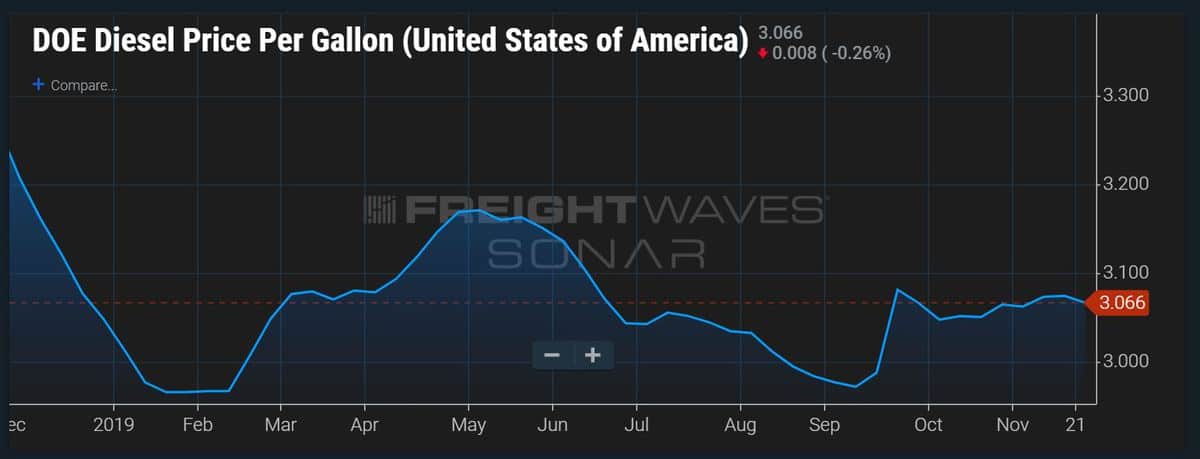
Most recent price: $3.066/g.
North American Baker Hughes rig count on Nov. 22: 940.
North American Baker Hughes rig count one year earlier: 1,283.
Oil patch bankruptcies in the U.S. reported by the law firm of Haynes & Boone, January through September 2019: 33, with $12.9 billion in liabilities.
Oil patch bankruptcies in the U.S. reported by the law firm of Haynes & Boone, full-year 2018: 27, with $13.1 billion in liabilities.
U.S. crude exports, December 2018: 2.391 million b/d.
U.S. crude exports, most recent weekly report (which is open for revision in the final monthly report): 3:027 million b/d.
ExxonMobil closing stock price, Dec. 7, 2018: $77.64.
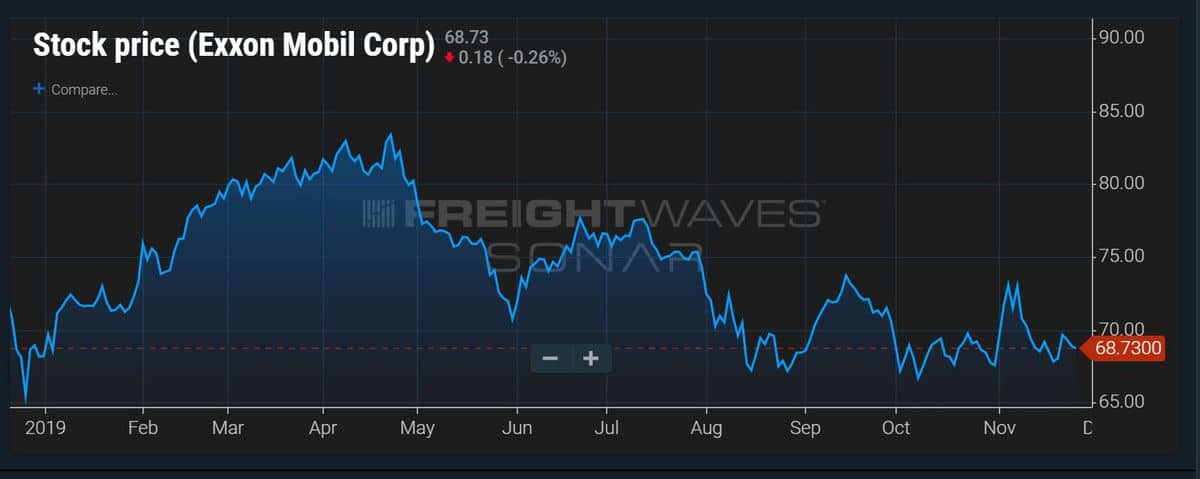
ExxonMobil closing stock price, Nov. 27, 2019: $68.70, for a decline of 11.5%.
Increase in S&P 500 during that time: Approximately 17.8%.
Final verdict: OPEC in the form of Saudi Arabia has done a remarkable job cutting output and keeping the price from collapsing. But the market is still dealing with growing supplies and demand that isn’t matching that surge, and you see it in the stock price of oil companies, ExxonMobil being one of the more obvious ones. That has cut the level of U.S. activity significantly, as evidenced in the rig count and the bankruptcy numbers. Diesel spreads relative to Brent and on an outright basis have stayed relatively steady even with the specter of IMO 2020 looming. That’s the landscape OPEC faces as it meets this week.
Brokerage Compliance Symposium
The day before F3. Every compliance issue you face - fraud exposure, carrier liability, FMCSA rules, cargo theft, insurance gaps - navigated by attorneys and operators defining best practices in a changing industry.
F3 Awards Dinner
The night before F3. FreightTech100 companies honored. FreightTech 25 and Shipper of Choice winners revealed live. Cocktail reception into dinner and live music - 300 industry leaders in one purpose-built room.
F3: Future of Freight Festival
Industry-defining keynotes, rapid-fire technology demos, and industry leaders networking in experiences across Chattanooga - plus the inaugural F3 Awards Dinner featuring the FreightTech and Shipper of Choice reveals.
The day before F3. Every compliance issue you face - fraud exposure, carrier liability, FMCSA rules, cargo theft, insurance gaps - navigated by attorneys and operators defining best practices in a changing industry.
The Signal at Chattanooga Choo Choo • Chattanooga, TN Register NowThe night before F3. FreightTech100 companies honored. FreightTech 25 and Shipper of Choice winners revealed live. Cocktail reception into dinner and live music - 300 industry leaders in one purpose-built room.
The Signal at Chattanooga Choo Choo • Chattanooga, TN Register NowIndustry-defining keynotes, rapid-fire technology demos, and industry leaders networking in experiences across Chattanooga - plus the inaugural F3 Awards Dinner featuring the FreightTech and Shipper of Choice reveals.
The Signal at Chattanooga Choo Choo • Chattanooga, TN Register Now