





Clayton Slaughter, Chief Strategy Officer at FTR, moderated the event for presenters, Todd Tranausky, Senior Analyst, Rail and Intermodal, and Avery Vise, VP of Trucking Research. The webinar looks at the capacity issues plaguing the truck and rail modes and how they are likely to resolve over the balance of 2018. They also examine what shippers can expect over the balance of 2018 and 2019 from these capacity drivers.
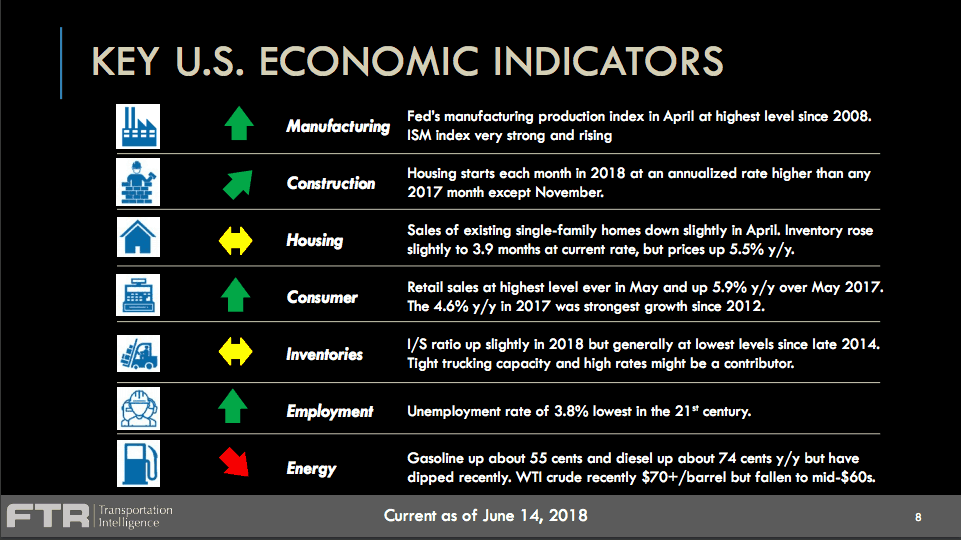
Overall, the economy remains strong. Of the slight negatives, housing is mixed because while sales have leveled off it could also be because prices are up. It’s mixed, but with a slight positive in the near term. “Even energy, while we’re putting this on the slight downturn, is still relative to regional areas,” said Vise.
Energy effects everything even if you’re not directly related to it. The regions are network businesses, and everything’s connected. There’s a growth in sand, petrochemical volumes adding volumes to already-strained southern network. Crude oil price spreads make rail economical right now. Strong demand for oilfield trucks has pulled dry van and flatbed capacity from all shippers in the numerous Texas markets, and elsewhere. You’re drawing those drivers out from other places, where you already have a hot market like Dallas and Houston.
If you look at the Market Demand Index, which examines the current year against last year and the five-year moving average, right now, we’re at the kickoff of the summer season. So the current level has peaked significantly. We might expect it to come down slightly over the next few months, but it obviously remains very high compared with previous years and doesn’t look to soften until the end of the year, if at all.
While the spot market remains hot, it isn’t anything that is out of bounds either historically or structurally. “Right now, we sound like a broken record,” said Vise. “We’re seeing full utilization, and project continuing to for the remainder of the year with only possible modest softening toward the end of the year, but not because of lower demand but because of increased infrastructural capacity.”
The spot market in fact is at a historically high level—a record high and heading higher for the rest of the year. Yes, rates are increasing.
Speaking of hiring, the aggressive recruiting sector has added jobs. We saw 6,600 from April to May. The slight downward outlier we saw was because of the ELDs, according to what they theorize, said Vise. Probably some have simply dropped out in fairly significant numbers due to the new regulations. Given the demand in the market, you might think that trucking should be adding even more jobs, but consider what the trucking industry is up against. Construction and manufacturing have added 545,000 jobs this year, which are also jobs that directly compete with trucking. “It’s like a double whammy,” said Vise.
With rail we’ve seen a growing increase in capacity, but we can still see that in terms of making speed—one of the ways you can overcome capacity constraints, but what you can see from the data, it’s not very good. We’re slower right now than we were in 2016 or 2017, and even below the 10 year moving average.
“The real challenges we’re seeing, and what we need to do to see improvements is that there are limits in growth in domestic and carloads realms. Velocity and dwell times are at historically poor levels, creating equipment tightness and causing some railcars to be removed from storage,” said Tranausky.
The intermodal rate pressure index is up and up significantly, which ties directly into rates, which isn’t unexpected. This will start to ease up later in the year, but it’s not going to back to anything like normal rates.
Rail carload rates aren’t anything like the dramatic increases of intermodal rail. It’s a lot more stable, but it’s still increasing over 2.4 percent compared to last year’s averages. It’s a lot easier to stomach in that context compared to intermodal. All the uncertainty about trade has created issues. Asian and European nations are expected to retaliate against recent tariff actions. Also, NAFTA is in doubt after the recent actions at the G-7 meeting.
In terms of employment, we are seeing unemployment at historically low levels. We haven’t seen it below 3.8 percent was December of 1969. What does this mean? The economic rules might be changing a bit. Stimulus could simply lead to inflation, not growth. When labor is this tight, the same things that have been working may not. In transportation, it’s very much an issue. It’s a concern for the overall economy and where do we go from here.

FMCSA regulatory developments in terms of personal conveyance and agricultural commodities have certainly added some necessary flexibility. We would presume that the expiring agricultural ELD waiver (June 18) will go away. The larger point is that the next phase of all this is deregulatory. It may not be quick because we are dealing with rule-making, but we may see some significant changes in HOS flexibility, perhaps also as it relates to sleep.
The Supreme Court deciding not to review J.B. Hunt’s appeal in California, and how that will go to trial is that the trial overshadows all other legislative issues. It is the issue.
The California Supreme Court adopted the so-called ABC test in the Dynamex case. This makes it more difficult to treat workers as independent contractors if they do the same work as the employers. The key issue is whether all three conditions must be met. It’s going to be very difficult for carriers to hire owner-operators depending on how the ABC rule is interpreted.
Stay up-to-date with the latest commentary and insights on FreightTech and the impact to the markets by subscribing.
Brokerage Compliance Symposium
The day before F3. Every compliance issue you face - fraud exposure, carrier liability, FMCSA rules, cargo theft, insurance gaps - navigated by attorneys and operators defining best practices in a changing industry.
F3 Awards Dinner
The night before F3. FreightTech100 companies honored. FreightTech 25 and Shipper of Choice winners revealed live. Cocktail reception into dinner and live music - 300 industry leaders in one purpose-built room.
F3: Future of Freight Festival
Industry-defining keynotes, rapid-fire technology demos, and industry leaders networking in experiences across Chattanooga - plus the inaugural F3 Awards Dinner featuring the FreightTech and Shipper of Choice reveals.
The day before F3. Every compliance issue you face - fraud exposure, carrier liability, FMCSA rules, cargo theft, insurance gaps - navigated by attorneys and operators defining best practices in a changing industry.
The Signal at Chattanooga Choo Choo • Chattanooga, TN Register NowThe night before F3. FreightTech100 companies honored. FreightTech 25 and Shipper of Choice winners revealed live. Cocktail reception into dinner and live music - 300 industry leaders in one purpose-built room.
The Signal at Chattanooga Choo Choo • Chattanooga, TN Register NowIndustry-defining keynotes, rapid-fire technology demos, and industry leaders networking in experiences across Chattanooga - plus the inaugural F3 Awards Dinner featuring the FreightTech and Shipper of Choice reveals.
The Signal at Chattanooga Choo Choo • Chattanooga, TN Register Now