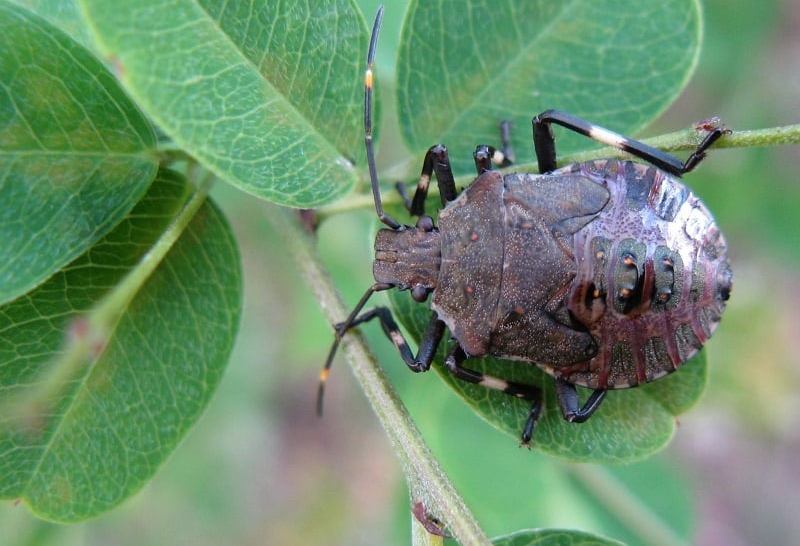
Pictured: a juvenile specimen of the Brown Marmorated Stink Bug (Halyomorpha Halys). Of Asian origin, it has become a serious agricultural pest. Photo: Kenpei, Wikimedia Commons Creative Commons v3.
Infestations of Brown Marmorated Stink Bug found on ships en-route to Australia are causing havoc with local supply chains. Bugs are breeding, ships are re-routing, trucks are idling, supply chains are collapsing, costs are escalating… and tempers are fraying.
At least three vessels have been ordered by local biosecurity authorities to leave Australian waters and seek insect eradication treatment elsewhere. The latest vessel to be ordered away from Australia was the Thalatta (IMO 9702455), a Wallenius Wilhelmsen car carrier that was ordered away from Fremantle, Western Australia, while carrying a cargo of vehicles and machinery. The other two vessels ordered to leave were also car carrier vessels; one was ordered out in December and the other was asked to leave in November.
It’s not just car carrier vessels that are at risk though. So are box ships, break bulk ships and other general cargo ships. It is difficult to overstate the maritime and on-land consequences for a vessel to be ordered away from Australia to seek insect eradication treatment elsewhere.
On the marine-side, FreightWaves understands from local contacts that at least one vessel has incurred over A$250,000 (US$180,000) in direct costs after being ordered to leave Australia. Ports/terminals, marine pilots and other such service providers will charge a “no-show” fee to a vessel that doesn’t turn up. Then there’s all the wasted expenditure if the vessel actually makes it to Australia only to be turned away – there are expenditures for fuel, provisions, fumigation or heat treatment, crew time, the opportunity costs of not being available for hire and so on. These latter costs are then re-incurred if the ship is sent somewhere else, such as Singapore, for fumigation.
If box ships (as opposed to other types of ships) are ordered away from Australia, there are a variety of other box-specific costs. There are direct costs payable to stevedores in container storage fees, possibly demurrage costs for late discharge of ships (in which a ship has docked but is delayed) and container detention fees payable to the shipping lines for late return of empty boxes.
But that’s not all. There are other cost-incurring adverse effects that ripple through the system.
I’ve got a lovely bunch of… cargo ships
No matter where the insects are detected, they’re bad news for pan-Australian logistics. Peter Anderson of the Victorian Transport Association (a trucking company representative body for the state of Victoria) told FreightWaves that infested ships are typically detected in or near either Fremantle or Brisbane. Maritime carriers typically make Singapore their last port of call to pick up trans-shipped cargo of various kinds before heading south to sail the loop around Australia. Ships typically sail in a clockwise direction around Australia from east-to-west on a Singapore-Brisbane-Sydney-Melbourne-Adelaide-Fremantle-Singapore rotation. A smaller number sail in the counter-clockwise direction. These patterns of port calls explain why either Fremantle or Brisbane is often the first port of detection.
“So a ship hits in Fremantle or Brisbane, then it wouldn’t have gotten to us [in Melbourne or Sydney] for a week, so it gives us a week to organise ourselves,” says Anderson, explaining that ship turn-arounds cause few immediate logistics problems in the two biggest Australian cities.
Those problems arrive shortly after the ship turn-around.
“It throws the schedules out. You have ship bunching – it’s not just the cargo that’s delayed. You then get something like three ships trying to get into Brisbane at once. Bunching causes problems for transport operators,” he said, adding that the turn-back of the Wallenius car-carrier in Western Australia caused bunching in Melbourne a week later.
“We had nine ships bunched in Melbourne because of what happened in Western Australia. Ship bunching causes lots of pressure and activities with no improvement on return,” Anderson said.
But the problems, of course, don’t end there.
Cascading problems
It’s entirely possible that the authorities won’t allow the goods or a ship to enter Australia at all. If the ship doesn’t turn up when expected, then, on the landside logistics front, there’s a cascading effect of disappointments and incurred costs. Importers may miss deadlines on supply contracts. Forwarders and brokers have to tell their customers that their goods are not, or not yet, on the way. There’s a loss to trucking businesses for the lost drayage jobs. If the trucks are idled then the drivers are left twiddling their thumbs.
“Drivers still have to be paid. You can’t just send them home. It’s neither fair to the driver nor the business,” comments Simon O’Hara of Road Freight NSW, a local transport body. “Everyone’s ready to pick stuff up. They’ve got their own logistics in place. Systems are in sync with the local port. It’s a major pain in the neck,” he comments.
Many of these problems can potentially cascade further along in the supply chain in part or full at inland intermodal terminals, distribution centres and customer premises. And then someone has to re-organise, and pay for, the set up of a replacement supply chain ready to move the goods when they actually do land in Australia.
It’s a (stink) bug’s life
There’s a lot of hate for Halyomorpha Halys. And It’s not just because the malodorous bug is whiffy (it smells like a particularly rancid version of cilantro/coriander, apparently).
It’s fertile.
And, worse, it’s hungry.
The stink bug is a mass breeder that feeds on hundreds of different plant species – fruit, trees, vegetables, ornamentals – and it does so by sticking its proboscis inside the plant. That weakens the plant, makes its fruit both visually unappealing and inedible while also making the plant susceptible to infection by pathogens. Crops infested by the stink bug are simply ruined.
And that’s a big deal for Australia. The gross value of Australian farm production in 2016-17 was A$60 billion, about three percent of Australia’s total gross domestic product (GDP). About 77 percent of that is exported, earning about A$44.8 billion in the 2016-17 financial year, according to the National Farmers’ Federation.
Colonial expansion
Unfortunately, the bug is swarming to, and colonising, new areas.
“Forget about high-risk countries being targeted for treatment; the indication from [the Australian] government is that, by next season, we will be talking about treatment of goods from high-risk continents,” comments the Freight & Trade Alliance, a locally-based association for the international supply chain sector.
The stink bug is a mobile little hitch-hiker. Originating in northern Asia, the bug is now widely established in Europe and North America. The bug’s range is expanding because it’s a 2km (1.24 miles) a day flyer that likes to hide en-mass in crevices, cracks and crannies. So it can easily infest cargo-carrying vehicles like trucks, planes and ships. That explains why ro-ro/car-carrying vessels appear to have particularly been affected in the current season: cars, trucks and farm equipment are just full of the little-hidey spaces that the stink bug favours.
Vessels and cargoes from high-risk countries destined for Australia must be fumigated or heat-treated offshore to meet local biosecurity rules. But there there is some concern in the local industry about pre-loading infestation treatments. It appears that Wallenius Wilhelmsen had its vessel and cargo pre-treated, and certified as such, prior to departure. But still the bugs came along anyway. It’s not the first time that insects have been found after an eradication treatment has been carried out. It is not known if the presence of insects is due to the pests simply being able to somehow survive, new bugs arriving to make a new home post-treatment, or merely a sloppy job carried out by the exterminators. It may be interesting to note that the local biosecurity authorities stopped accepting certificates for sulfuryl fluoride treatments done in Italy.
“This was in response to [Brown Marmorated Stink Bug] detections and a review of treatment providers and certificates,” reads a statement from the Australian Department of Agriculture & Water Resources.
Managing not to manage
There is a lot of local industry criticism levelled at the Australian biosecurity authorities. “We are seeing that the Government’s response to [the stink bug] is causing great uncertainty for importers and their customers… we are concerned that greater predictability will not come any time soon,” says trade and customs lawyer Russell Wiese of Hunt & Hunt lawyers.
The Freight & Trade Alliance has accumulated a litany of complaints about the bureaucratic response to the stink bug threat. These include allegations of ineffective planning; a lack of trained biosecurity officers; a lack of weekend working and overtime for those officers; information technology failures; too broad profiling in too many areas; delays in processing and inspections; limited treatment options; removal of various insect exterminators from the approved list (including the whole country of Italy); a lack of training for industry; a lack of onshore treatment options; inflexibility in dealing with one-off scenarios; and, finally, a lack of information and quantifiable intelligence.
That’s quite a list of criticisms. FreightWaves sought a response from the Australian federal Department of Agriculture and Water Resources. The Department did reply but mostly did not address the charges levelled against it by industry.
A response, edited by FreightWaves for brevity and relevance, reads: “The Department’s priority is biosecurity and ensuring we have strict measures in place to safeguard our environment, industries and animal and human health from pests and diseases. We have implemented stronger measures than ever before this season to manage risks associated with this significant pest. The Department is aware of some delays in clearance of imported cargo, and ports in Sydney and Melbourne will be those most affected. These delays have been due to several factors including seasonal trade peaks, system outages and [stink bug] requirements. Importers have been provided with advice by the Department on how they can assist to minimise delays including by having goods treated offshore and early lodgement of required documentation. The Department has deployed all available resources to manage the delays, including engaging additional staff and use of overtime.”
Desperate and expensive work-arounds work… for now
Meanwhile, freight forwarders are trying to work around the problems by resorting to “desperate and expensive measures using a combination of sea cargo movements from origin, trans-shipping cargo at intermediary ports [then] using air freight to land goods into Australia,” according to the Freight & Trade Alliance.
However, the industry anticipates that this particular loophole will be closed by the authorities and that air cargo shipments will face biosecurity controls before too long. As Wiese comments, “the impact of the stink bug… will motivate our Government to adopt a zero tolerance approach. In the delicate balance between biosecurity and trade facilitation, biosecurity will always win.”
Upcoming FreightWaves Events
Compliance
Brokerage Compliance Symposium
The day before F3. Every compliance issue you face - fraud exposure, carrier liability, FMCSA rules, cargo theft, insurance gaps - navigated by attorneys and operators defining best practices in a changing industry.
October 26, 2026
The Signal at Chattanooga Choo Choo • Chattanooga, TN
The night before F3. FreightTech100 companies honored. FreightTech 25 and Shipper of Choice winners revealed live. Cocktail reception into dinner and live music - 300 industry leaders in one purpose-built room.
October 26, 2026
The Signal at Chattanooga Choo Choo • Chattanooga, TN
Industry-defining keynotes, rapid-fire technology demos, and industry leaders networking in experiences across Chattanooga - plus the inaugural F3 Awards Dinner featuring the FreightTech and Shipper of Choice reveals.
October 27, 2026 – October 28, 2026
The Signal at Chattanooga Choo Choo • Chattanooga, TN
ComplianceBrokerage Compliance SymposiumOct 26 • The Signal at Chattanooga Choo Choo • Chattanooga, TN
The day before F3. Every compliance issue you face - fraud exposure, carrier liability, FMCSA rules, cargo theft, insurance gaps - navigated by attorneys and operators defining best practices in a changing industry.
The Signal at Chattanooga Choo Choo • Chattanooga, TNRegister Now
AwardsF3 Awards DinnerOct 26 • The Signal at Chattanooga Choo Choo • Chattanooga, TN
The night before F3. FreightTech100 companies honored. FreightTech 25 and Shipper of Choice winners revealed live. Cocktail reception into dinner and live music - 300 industry leaders in one purpose-built room.
The Signal at Chattanooga Choo Choo • Chattanooga, TNRegister Now
FreightTechF3: Future of Freight FestivalOct 27 – Oct 28 • The Signal at Chattanooga Choo Choo • Chattanooga, TN
Industry-defining keynotes, rapid-fire technology demos, and industry leaders networking in experiences across Chattanooga - plus the inaugural F3 Awards Dinner featuring the FreightTech and Shipper of Choice reveals.
The Signal at Chattanooga Choo Choo • Chattanooga, TNRegister Now