One map illustrates why NAFTA can’t be undone
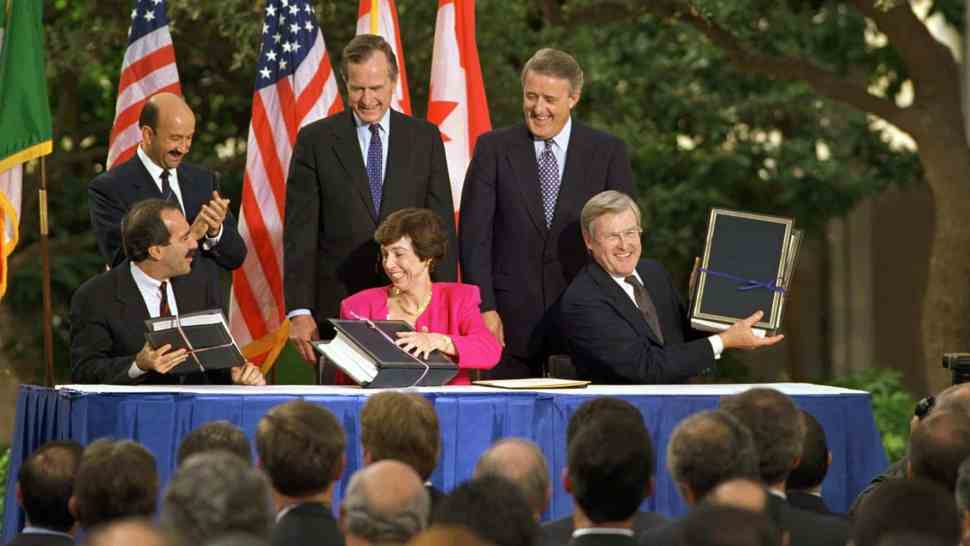
The contentious NAFTA renegotiations continue: just this morning, President Trump suggested that the deadline for certifying an updated deal should be extended beyond its current date in March through July, to alleviate political pressure on Mexican President Enrique Peña Nieto, who faces re-election this summer. As recently as yesterday, media outlets were reporting that the Canadian government was “increasingly convinced” that President Trump will soon announce his intention to withdraw the United States from the North American Free Trade Agreement (NAFTA), the epoch-making deal finalized in 1994 that created a trilateral trade bloc between Canada, the United States, and Mexico. The free trade area encompasses 481M people and has a collective GDP of $22.5T, making it comparable to the European Union, which unites 511M people with a collective GDP of $20.9T.
President Trump, of course, ran his 2016 campaign on a promise to end NAFTA, repeatedly calling the agreement “the worst trade deal in the history of the world.” Almost immediately after taking office, Trump proposed a 20% tariff on Mexican imports to pay for a border wall; just a few months ago the White House moved forward with a 20.83% tariff on Canadian softwood lumber. Trump is clearly putting pressure on the United States’ trade partners, and now diplomats from both Mexico and Canada think NAFTA’s days may be numbered.
The politics of economic anxiety, trade imbalances, and immigration roil the American electoral system, cooling down and flaring back up in cycles. Remember when former House Majority Leader Eric Cantor (R-VA) lost his 2014 primary in an upset to Dave Brat, an anti-immigration hardliner? Now President Trump himself is talking about the possibility of comprehensive immigration reform. In any case, no matter what happens to NAFTA, whether it’s rewritten to favor American interests or scrapped entirely, it won’t change the basic reality of the uneven geographical distribution of supply and demand.
Resources are abundant in some places and scarce in others: that is why trade exists. “Canada has oil and water but few people; America and Mexico have 400M people that lack water but offer huge markets,” writes global strategist Parag Khanna in his 2016 book Connectography. “Since the 2003 electricity blackout that plunged the Northeast region from Toronto to Baltimore into darkness, Canadian companies have been deploying underwater and underground power lines to deliver Quebec’s vast hydro and wind power across New England,” Khanna wrote.
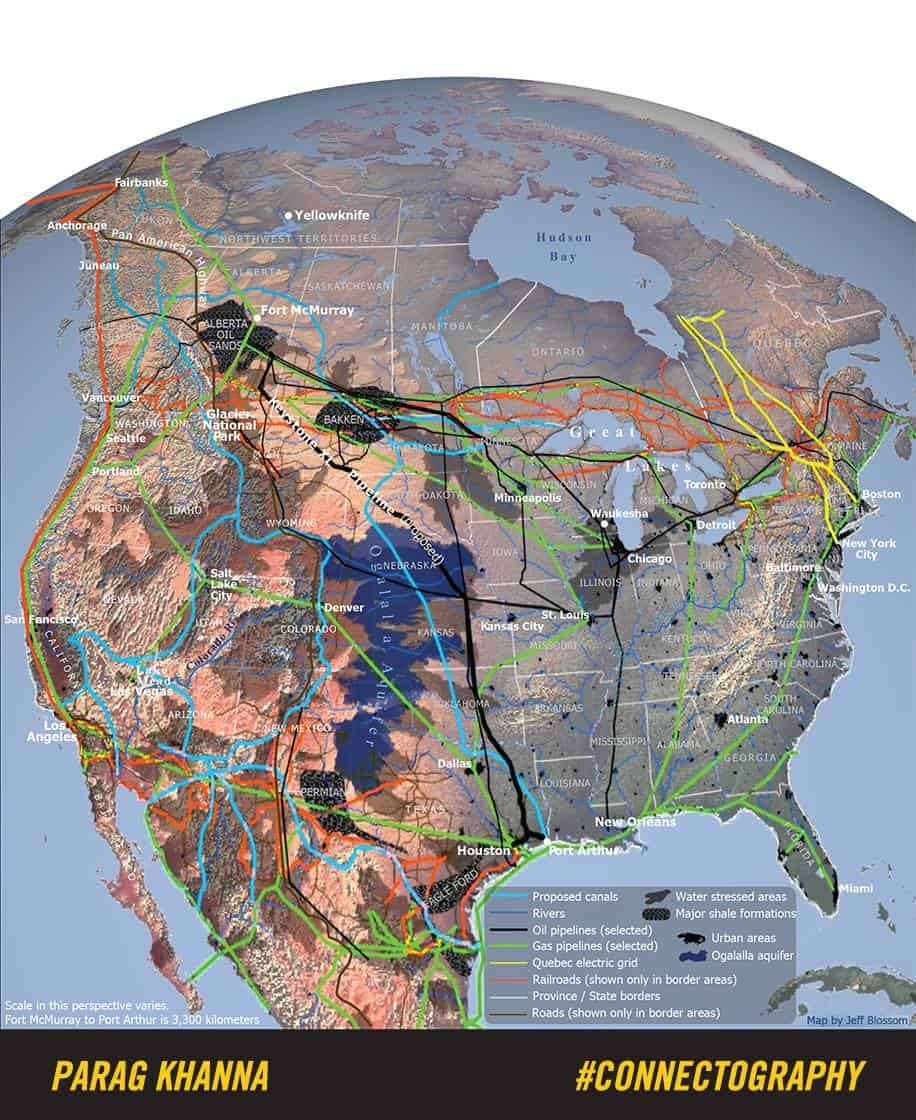
Over three dozen oil and gas pipelines already transfer energy supplies across the U.S.-Canada border, and many more have been proposed. The Keystone XL pipeline, which the Trump administration has resurrected, will move oil from Alberta through the United States to refineries in Houston, from which it can then be exported across the Atlantic. The Keystone XL pipeline is just one example of how the obvious economic benefit of connected infrastructure is ‘trumping’ the politics of nationalist tribalism and populist protectionism.
The same story is true on the southern border: the Trans-Pecos pipeline, which moves American natural gas into central Mexico to help feed the energy demand of the country’s burgeoning population, came online in 2017. San Diego and Tijuana now view the border between as a hindrance costing $2B in lost revenue every year—their motto is “Dos ciudades, pero una región [two cities, but one region].” The Mexican automotive industry is now bigger than Detroit after foreign investments from Japanese, German, and American companies, but the preferred suppliers are still American parts companies. And, of course, everyone knows that the United States is completely dependent on a flexible immigrant labor force from its southern neighbor to meet seasonal agriculture harvest demand and volatile, shifting construction activity.
Every year, there are 50M legal border crossings between Canada and the United States, and 35M legal border crossings between the United States and Mexico. The value of the goods crossing the two borders every day exceeds $2.4B. Clearly, the geography of supply chains is becoming more important than the geography of political borders.
Stay up-to-date with the latest commentary and insights on FreightTech and the impact to the markets by subscribing.
Brokerage Compliance Symposium
The day before F3. Every compliance issue you face - fraud exposure, carrier liability, FMCSA rules, cargo theft, insurance gaps - navigated by attorneys and operators defining best practices in a changing industry.
F3 Awards Dinner
The night before F3. FreightTech100 companies honored. FreightTech 25 and Shipper of Choice winners revealed live. Cocktail reception into dinner and live music - 300 industry leaders in one purpose-built room.
F3: Future of Freight Festival
Industry-defining keynotes, rapid-fire technology demos, and industry leaders networking in experiences across Chattanooga - plus the inaugural F3 Awards Dinner featuring the FreightTech and Shipper of Choice reveals.
The day before F3. Every compliance issue you face - fraud exposure, carrier liability, FMCSA rules, cargo theft, insurance gaps - navigated by attorneys and operators defining best practices in a changing industry.
The Signal at Chattanooga Choo Choo • Chattanooga, TN Register NowThe night before F3. FreightTech100 companies honored. FreightTech 25 and Shipper of Choice winners revealed live. Cocktail reception into dinner and live music - 300 industry leaders in one purpose-built room.
The Signal at Chattanooga Choo Choo • Chattanooga, TN Register NowIndustry-defining keynotes, rapid-fire technology demos, and industry leaders networking in experiences across Chattanooga - plus the inaugural F3 Awards Dinner featuring the FreightTech and Shipper of Choice reveals.
The Signal at Chattanooga Choo Choo • Chattanooga, TN Register Now