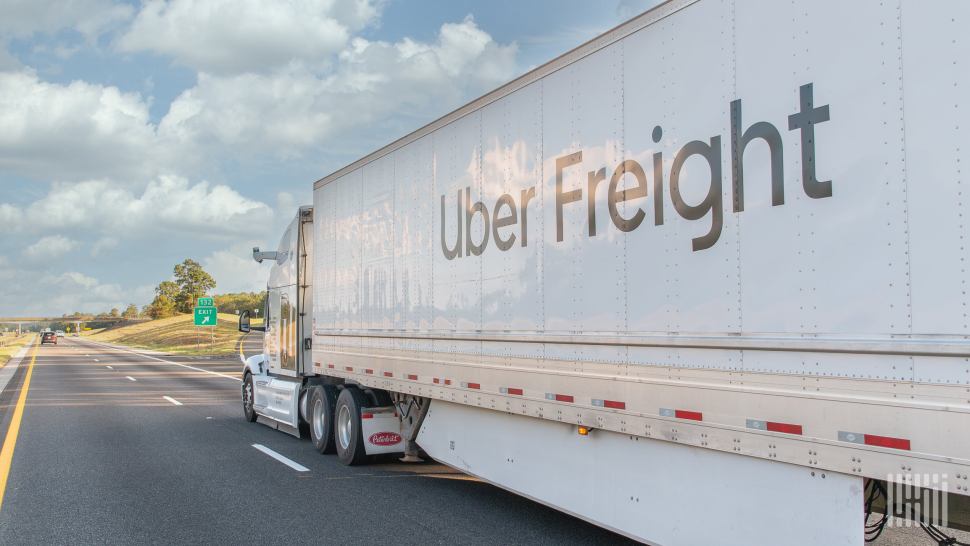
Uber Freight posted its eighth consecutive quarter of negative earnings before interest, taxes, depreciation and amortization, and its third-largest since the digital brokerage’s fourth-quarter 2021 integration with shipper-focused transportation management system Transplace.
EBITDA at Uber Freight (parent company is NYSE: UBER) was negative $19 million for the third quarter. Since the closing of the Transplace deal and its integration into one company, only twice has Uber Freight posted a larger negative EBITDA: negative $21 million in the first quarter of this year and negative $23 million in the first quarter of 2023.
EBITDA a year ago was negative $13 million. Uber Freight has only posted a positive EBITDA three times since the integration, spread out over the first three quarters of 2022: $2 million, $5 million and $1 million, respectively.
If there was one financial positive in the earnings at Uber Freight, it was that gross bookings rose year on year as well as sequentially.
The year-on-year increase was the first time that such a gain has been realized by Uber Freight since the Transplace integration. (While the the fourth quarter of 2022 had more revenue than a year earlier, the revenue figure for 2021’s fourth quarter did not recognize Transplace revenue for the entire three months and thus was only a partial figure.)
Uber Freight’s revenue in the third quarter this year was $1.308 billion. A year earlier, it was $1.284 billion. Sequentially, gross bookings were up from $1.272 billion in the second quarter.
In its prepared statement accompanying the earnings, the company said the year-on-year increase “was primarily driven by an increase in revenue per load, partially offset by continued pressure from category-wide headwinds.”
The subject of Uber Freight’s performance was not mentioned on the parent company’s earnings call, according to a transcript.
Reports on brokerage profitability this quarter have been mixed to negative.
While 3PL giant C.H. Robinson (NASDAQ: CHRW) was able to boost several measures of profitability, management did not attribute that to a stronger market, but instead the continued implementation of what it calls its “model” for overhauling the company.
The non-asset Integrated Capacity Solutions segment at J.B. Hunt (NASDAQ: JBHT) saw its revenue drop 7% year on year, to $278 million, but its operating loss narrowed to negative $3.3 million from $9.4 million.
Revenue at brokerage segment Werner Logistics (NASDAQ: WERN) rose to $206.8 million, an increase of 10.1%. But operating income plummeted to negative $345,000 from $2 million a year earlier.
Touting its technology
Uber Freight has been touting various technological improvements in its digital brokerage activities as well as the operations of legacy TMS Transplace. Some of that added technology was mentioned in the prepared commentary on Uber Freight accompanying the release of Uber Technologies’ earnings, but there was no commentary on the economic conditions at Uber Freight.
Many of those technology advancements were touted by Uber Freight President Lior Ron at the company’s Deliver conference last month in Texas.
The advancements highlighted in the earnings report were an integration between Uber Freight and Uber Direct, which helps shippers deliver parcels through Uber Freight’s Parcel Transportation Management System and various AI enhancements.
In an email to FreightWaves, an Uber Freight spokeswoman did not address the financial performance. But she did highlight other developments at the company not cited in the earnings statement, such as growth in cross-border trade with Mexico, growth in Canada in less-than-truckload and an industry award on fighting cargo theft.
Uber Freight revenue: 3.2% of corporate total
Skepticism over whether there is a future for Uber Freight within Uber Technologies arises periodically. But in the past, the skeptics were silenced on multiple occasions by actions that reflected a company commitment to Uber Freight, which in the third quarter was just 3.2% of gross bookings at the parent company.
Those transactions were the $2.25 billion acquisition of Transplace announced in July 2021, the $550 million it took in new ownership at the end of 2021 at the same time it was closing the Transplace deal, or a half-billion-dollar investment by Greenbriar Capital in 2020.
In an August interview on CNBC, Uber Technologies CEO Dara Khosrowshahi was mostly positive about the future of Uber Freight, saying the segment “continues to execute really well in a very, very difficult market.”
“We’re watching very carefully, but in the meantime, our team continues to bring technology to essentially connect shippers with truckers on a direct basis, kind of the next-gen freight company,” Khosrowshahi said. “We’re very confident of the prospects there. But right now, the environment’s a tough one.”
More articles by John Kingston
TFI’s Bedard: Buying UPS’ LTL operations was not a mistake
Trucking and marijuana testing find their way to the Supreme Court
As Helene keeps key roads closed, Trimble’s routing service makes adjustments
Brokerage Compliance Symposium
The day before F3. Every compliance issue you face - fraud exposure, carrier liability, FMCSA rules, cargo theft, insurance gaps - navigated by attorneys and operators defining best practices in a changing industry.
F3 Awards Dinner
The night before F3. FreightTech100 companies honored. FreightTech 25 and Shipper of Choice winners revealed live. Cocktail reception into dinner and live music - 300 industry leaders in one purpose-built room.
F3: Future of Freight Festival
Industry-defining keynotes, rapid-fire technology demos, and industry leaders networking in experiences across Chattanooga - plus the inaugural F3 Awards Dinner featuring the FreightTech and Shipper of Choice reveals.
The day before F3. Every compliance issue you face - fraud exposure, carrier liability, FMCSA rules, cargo theft, insurance gaps - navigated by attorneys and operators defining best practices in a changing industry.
The Signal at Chattanooga Choo Choo • Chattanooga, TN Register NowThe night before F3. FreightTech100 companies honored. FreightTech 25 and Shipper of Choice winners revealed live. Cocktail reception into dinner and live music - 300 industry leaders in one purpose-built room.
The Signal at Chattanooga Choo Choo • Chattanooga, TN Register NowIndustry-defining keynotes, rapid-fire technology demos, and industry leaders networking in experiences across Chattanooga - plus the inaugural F3 Awards Dinner featuring the FreightTech and Shipper of Choice reveals.
The Signal at Chattanooga Choo Choo • Chattanooga, TN Register Now