On November 13, 2025, the U.S. Court of Appeals for the D.C. Circuit stayed FMCSA’s interim final rule restricting non-domiciled commercial driver’s licenses.
Six days later, FMCSA filed an unopposed motion to hold the entire case in abeyance. The agency told the court it wanted time to promulgate a final rule, so no one would waste time briefing arguments that might become moot.
The court granted that request in early December. The litigation is on ice. The stay remains in effect.
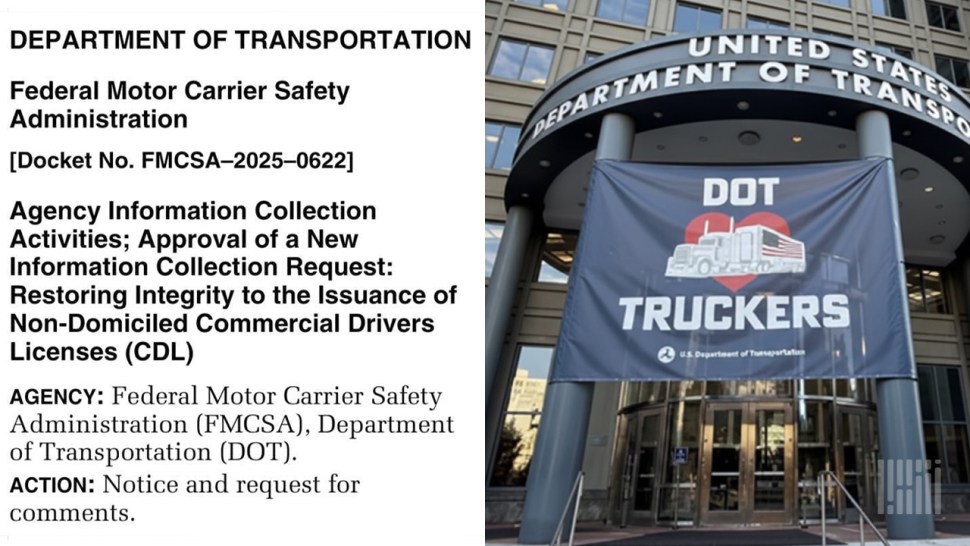
Today’s Federal Register tells a different story. FMCSA is seeking full three-year OMB approval for the information collection requirements tied to that stayed rule. The emergency approval expires February 28. The agency wants the paperwork infrastructure locked in before the final rule lands.
What the Rule Actually Does
The interim final rule dropped on September 29, 2025. FMCSA called it “Restoring Integrity to the Issuance of Non-Domiciled Commercial Drivers’ Licenses.”
Translation: Significantly limiting state driver licensing agencies’ authority to issue CLPs and CDLs to individuals domiciled in foreign countries. The rule restricted eligibility to H-2A, H-2B, and E-2 visa holders, cutting out asylum seekers, refugees, and DACA recipients.
The information collection requires states to retain copies of both identification documents used in the non-domiciled application process, plus a copy of the required SAVE query verifying immigration status. States must keep these records for at least two years from the date of issuance, transfer, renewal, or upgrade.
States must produce those documents within 48 hours of an FMCSA request.
Why FMCSA Says It Needs This
FMCSA’s justification is blunt. During Annual Program Reviews, the agency found that states couldn’t answer basic questions about their non-domiciled CDL programs.
How many non-domiciled licenses did you issue? States didn’t know.
What documentation did applicants provide? States couldn’t say.
The agency says the prior information collection requirements “were not sufficient to ensure FMCSA has the ability to review non-domiciled CLP and CDL issuance by SDLAs in a reasonable timeframe.”
In other words, we requested records from the states. The states didn’t have them.
Nineteen States Push Back
California, Massachusetts, and 17 other jurisdictions filed joint comments opposing the information collection.
Their argument: FMCSA has no statutory authority over immigration. The agency itself admits there’s no evidence linking immigration status to CDL driver safety. Requiring states to retain and produce immigration documents duplicates DHS responsibilities and is unrelated to FMCSA’s mission.
The states also raised privacy concerns. The rule requires retaining passports and I-94 arrival records containing personally identifiable information. The joint submission said FMCSA failed to comply with statutory requirements to assess privacy impacts.
They also noted that FMCSA promised a Privacy Impact Analysis would be available in the docket. It wasn’t.
The 48-hour turnaround requirement drew particular criticism. States called it unreasonable, especially given existing regulations that already mandate annual program reviews and information sharing.
FMCSA Says, We Need This
The agency isn’t budging.
FMCSA states the collection is neither duplicative nor unlimited. It requires copies of exactly two identification documents already inspected during the application process, plus the SAVE query result. The states didn’t cite any existing approved information collection containing these specific retention requirements.
The agency has extensive authority over CDL issuance under the Commercial Motor Vehicle Safety Act of 1986. States that issue non-domiciled CDLs must do so according to federal regulations. FMCSA has delegated authority to ensure it’s done correctly.
The 48-hour requirement? FMCSA says it “ensures that the Agency has adequate access to the records.”
Not Everyone Opposes It
The Small Business in Transportation Coalition filed comments supporting the information collection. They said the collection is necessary, didn’t contest the burden estimates, and offered no suggestions for minimizing burden without reducing data quality.
In other words: Do what you need to do.
The Abeyance Strategy
FMCSA is playing this smart.
The interim final rule got stayed. Rather than fight the emergency motion in court, the agency asked to put the whole case on hold while it finishes a proper final rule. The petitioners didn’t oppose it. The court granted it.
Now, the FMCSA can take whatever time it needs to address procedural concerns and the APA notice-and-comment requirements that critics said the agency bypassed. When the final rule drops, the litigation over the interim rule becomes moot.
It’s seeking OMB approval “despite the stay, in order to ensure that the collection will be able to be enforced as soon as the stay is lifted or, alternately, as soon as FMCSA is able to issue a final rule.”
That’s not defiance. That’s preparation.
The History
This fits a pattern.
Secretary Duffy threatened to pull $50 million in MCSAP funding from California, New Mexico, and Washington over English Language Proficiency enforcement. He’s gone after New York, claiming more than half of its non-domiciled CDLs were issued illegally. The administration is cracking down on CDL mills. FMCSA Administrator Derek Barrs has made non-domiciled CDL integrity a priority.
The Annual Program Reviews exposed a fundamental problem: States were issuing non-domiciled licenses without keeping adequate records. FMCSA couldn’t verify whether those licenses were properly issued because the required documentation was missing. There’s an accountability gap.
Whether you support the policy or oppose it, the underlying reality is the same: States were operating non-domiciled CDL programs without maintaining records sufficient for federal review.
The final rule is coming. The paperwork requirements are being finalized. And when it all goes live, FMCSA will be able to request documentation from states and expect it within 48 hours.
Comments on the information collection request are due by March 2, 2026.
Brokerage Compliance Symposium
The day before F3. Every compliance issue you face - fraud exposure, carrier liability, FMCSA rules, cargo theft, insurance gaps - navigated by attorneys and operators defining best practices in a changing industry.
F3 Awards Dinner
The night before F3. FreightTech100 companies honored. FreightTech 25 and Shipper of Choice winners revealed live. Cocktail reception into dinner and live music - 300 industry leaders in one purpose-built room.
F3: Future of Freight Festival
Industry-defining keynotes, rapid-fire technology demos, and industry leaders networking in experiences across Chattanooga - plus the inaugural F3 Awards Dinner featuring the FreightTech and Shipper of Choice reveals.
The day before F3. Every compliance issue you face - fraud exposure, carrier liability, FMCSA rules, cargo theft, insurance gaps - navigated by attorneys and operators defining best practices in a changing industry.
The Signal at Chattanooga Choo Choo • Chattanooga, TN Register NowThe night before F3. FreightTech100 companies honored. FreightTech 25 and Shipper of Choice winners revealed live. Cocktail reception into dinner and live music - 300 industry leaders in one purpose-built room.
The Signal at Chattanooga Choo Choo • Chattanooga, TN Register NowIndustry-defining keynotes, rapid-fire technology demos, and industry leaders networking in experiences across Chattanooga - plus the inaugural F3 Awards Dinner featuring the FreightTech and Shipper of Choice reveals.
The Signal at Chattanooga Choo Choo • Chattanooga, TN Register Now