Beyond looking out the windshield and seeing retail diesel prices that once again are rising, here are some key comparisons that a consumer dealing with those higher numbers should know.
On February 27, the last day before military action began between Iran on one side and the U.S. and Israel on the other, the price of international crude benchmark Brent settled at $72.48/barrel on the CME commodity exchange. On the same day, ultra low sulfur diesel (ULSD) settled at $2.596/gallon.
On Wednesday, Brent settled at $91.62/b. ULSD settled at $4.4523/g.
The math: since the start of the war, Brent is up 26.4%. ULSD is up 71.5%. (Thursday’s settlement was $4.4803/g.)
On CME, the contract for RBOB, an intermediate product that serves as a proxy for gasoline, had risen 56.5% since the Iran war began. It’s a lot more than Brent, but less than diesel.
But it’s that yawning gap between crude and diesel that is bringing broad attention to the price of the fuel, driven in part by fleets frustrated to hear reports of crude rising slowly or even falling while their own fuel costs most definitely are not. Diesel is even taking the spotlight from gasoline, which as a product consumed by far more people than diesel generally draws the most attention from the media, politicians and general consumers.
The shift to the world focusing on diesel prices was encapsulated in the title of a recent article on Axios: “Diesel desperation is mounting.”
There has been no stronger consistent voice on the rising diesel market and what it means for the broader energy picture than Jeffrey Currie, former head of commodities at Goldman Sachs and now involved in several different businesses. He’s done numerous television interviews, including one this week on CNBC where he noted the disconnect between crude and product prices as being historic.
“Nobody consumes crude oil but refineries,” he said. “To everybody else on the planet Earth, what matters are the product prices.”
Historically, Currie said, the spread between product prices and crude prices was “relatively stable.” But on a day when Brent was trading at about $87/b, Currie noted that diesel in European trading was about $170/b.
“Crude is nearly half the price of the products,” Currie said. “So those relationships, those econometric models, everybody that’s been making that assumption that the spread between oil and products is a relatively stable constant relationship have missed out.”
A gigantic gap
Beyond the percentage increase, there are other ways of measuring the current disconnect.
The crack spread is the measure of taking a barrel of crude and turning it into products. There are multiple ways it can be calculated.
But a simple way to emphasize the diesel strength is to take the second month price of ULSD on CME and compare it to the first month Brent price, since the latter can be refined into the former.
On February 27, the final day of trading before the Iran war started, the spread was about $36.55/b.
On the first two days of this week, it crossed $90/b for the first time since the war began, and likely for the first time in history. Crude settled at $91/b that day, driving home what Currie said in his CNBC interview: crude is about half the value of ULSD. (The spread fell slightly below that $90 mark Wednesday.)
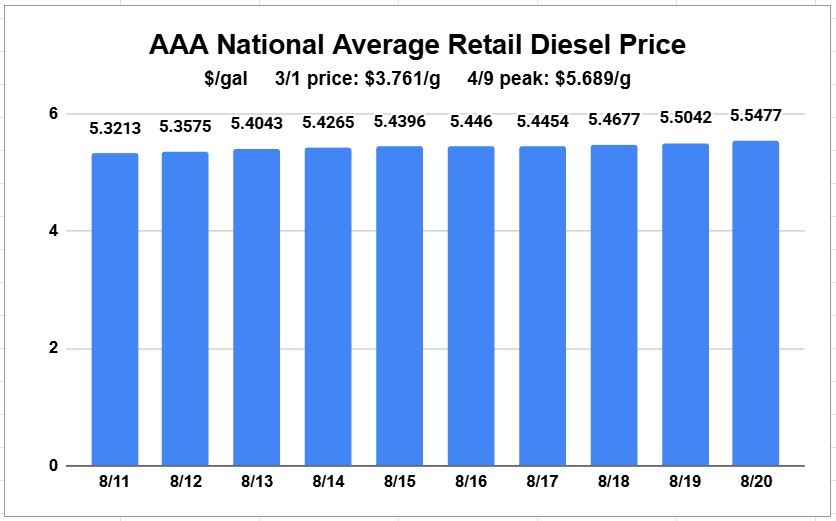
The end result at the pump is that average U.S. retail diesel prices, as measured daily by the AAA, were at $5.5477/g Thursday, within 15 cents of the post-war high of $5.5689/g set April 9 and up more than 25 cts/g since August 10, when the latest run of higher retail prices began.
The question then is why since the Iran war began has diesel reacted to the whole range of bullish market factors more than crude and more than gasoline. The list is a long one.
Cutbacks in Russia: With so much focus on the Middle East and the Strait of Hormuz, the impact on diesel from Ukrainian attacks on Russia’s refining infrastructure–which is heavily engineered to produce a strong diesel yield–had initially not received significant attention. But that has changed.
The International Energy Agency, in its monthly report for July, detailed some of the impact from the drone attacks. As that report came out a month ago, the situation has only gotten worse from the perspective of the diesel market.
“Trade data show that exports have nearly halved in recent weeks, following the intensification of attacks by Ukrainian forces on Russian refineries,” the IEA said.
In July, the IEA estimated Russian refining runs were down 1.6 million b/d year-on-year because of the attacks.
“In conjunction with the attack on Russian storage sites and infrastructure, this loss of product output has reportedly caused widespread domestic fuel shortages and led to a temporary ban on diesel exports,” the IEA said.
More recently, energy consulting and information firm RBN Energy estimated that crude runs in Russia had dropped from more than 5 million b/d last year to around 3.8 million b/d in July, which it said was a 25-year low.
How U.S. refiners are reacting: U.S. refiners are rushing to take advantage of the spread. The refinery utilization rate published weekly by the Energy Information Administration hasn’t been below 90% since the end of April and has been consistently above 95% since the first week of June. The latest weekly report has the utilization rate at 97.2%.
“They’re always going to respond to market signals, and with strong diesel cracks, they’re going to produce the maximum,” John Auers, managing director-refined fuels at Novi Labs, said in an interview with FreightWaves.
Wall Street has rewarded the independent refiners with a surge in their stock prices as a result of the market. For example, Valero (NYSE: VLO) hit yet another 52-week high Thursday at $352.33. A year ago, it was less than $138.
Auers said refineries have planned investments into making more diesel long-term, in part because of softer gasoline demand created by the adoption of electric vehicles, slowing in the U.S. but continuing strong in other parts of the world. But those will take time to come to fruition.
“New refineries globally are generally more diesel or distillate oriented,” he said.
There have been expressions of concern that running refineries that hard for that long is setting some up some plants for a major breakdown. The U.S. industry even in good times tends to run more than 90% at this time of year, but not this hard and for this long.
But there are fewer refineries: The U.S. Energy Information Administration reported earlier this year that the U.S. last year lost about 250,000 b/d of refining capacity. Two significant refineries closed in 2025, one in Houston and one in California.
But given that the oil market is global, a shutdown anywhere in the world can kick back into the U.S. market, whether it is permanent or because of the impact from the war.
In the latest IEA report, the agency said global refinery inputs were about 5 million b/d less than a year earlier at 80.9 million b/d. Global oil demand is more than 100 million b/d, but not all of that is refined products; for example, production and consumption of natural gas liquids production like propane are in that 100 million number. But while some supply comes out of refineries, there are other sources. Still, a loss of 5 million b/d of refinery operations is significant.
Middle East refineries hit: Auers said there were “three or four” refineries in the Middle East that have been damaged by Iranian attacks, cutting refining capacity from that region. A 380,000 b/d refinery in Bahrain was hit early in the war, and Auers said it is “completely out.” He also pointed out an uncertainty: what has been the war’s impact on Iranian refining capacity? That is difficult to know.
Crude quality: Middle East and Russian crudes, both which have seen supplies impacted by their respective military conflicts, are heavier and tend to produce more diesel than, for example, a crude produced out of West Africa or from the Permian Basin in the U.S.
Tight inventories: The latest weekly report from the EIA shows total U.S. non-jet distillate inventories–which includes such things as heating oil but is generally a little less than 90% diesel–are well below normal levels for this time of year.
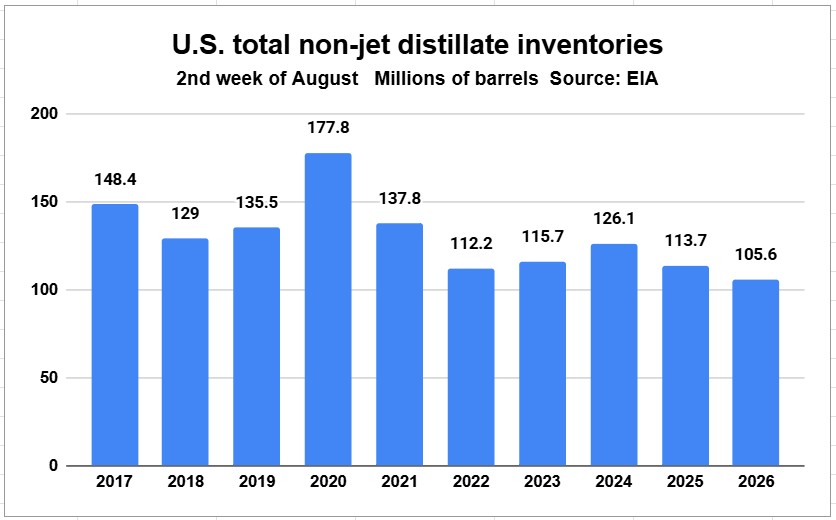
Currie, in an interview on X with Mario Nawfal, said divergence in inventories is a key reason for the blowout in crack spreads.
Products markets are dealing with what Currie called “rotating bottlenecks around the world right now.” But crude markets have been bearishly impacted by releases from strategic stockpiles, like the U.S. Strategic Petroleum Reserve (SPR). There are no strategic inventories for products.
The releases from reserves like the SPR has given the market a “reprieve” that also was boosted by the surge in crude supply that came out of the Gulf when the ceasefire first went into effect in early April. Products had no such injection of supply, Currie said, “and it’s just a matter of time before we end up with the shortages starting to move from products into crude oil, and there’s no indication this thing is ending anytime in the very near future.”
More articles by John Kingston
XPO upgraded by S&P, just one notch below investment-grade
C.H. Robinson earnings call shifts to nuclear verdict as key topic
RXO, post-Montgomery, sees benefit in its insurance, vetting
Brokerage Compliance Symposium
The day before F3. Every compliance issue you face - fraud exposure, carrier liability, FMCSA rules, cargo theft, insurance gaps - navigated by attorneys and operators defining best practices in a changing industry.
F3 Awards Dinner
The night before F3. FreightTech100 companies honored. FreightTech 25 and Shipper of Choice winners revealed live. Cocktail reception into dinner and live music - 300 industry leaders in one purpose-built room.
F3: Future of Freight Festival
Industry-defining keynotes, rapid-fire technology demos, and industry leaders networking in experiences across Chattanooga - plus the inaugural F3 Awards Dinner featuring the FreightTech and Shipper of Choice reveals.
The day before F3. Every compliance issue you face - fraud exposure, carrier liability, FMCSA rules, cargo theft, insurance gaps - navigated by attorneys and operators defining best practices in a changing industry.
The Signal at Chattanooga Choo Choo • Chattanooga, TN Register NowThe night before F3. FreightTech100 companies honored. FreightTech 25 and Shipper of Choice winners revealed live. Cocktail reception into dinner and live music - 300 industry leaders in one purpose-built room.
The Signal at Chattanooga Choo Choo • Chattanooga, TN Register NowIndustry-defining keynotes, rapid-fire technology demos, and industry leaders networking in experiences across Chattanooga - plus the inaugural F3 Awards Dinner featuring the FreightTech and Shipper of Choice reveals.
The Signal at Chattanooga Choo Choo • Chattanooga, TN Register Now