If you’re a diesel user and you don’t know whether you’re coming or going, you’ve got plenty of company.
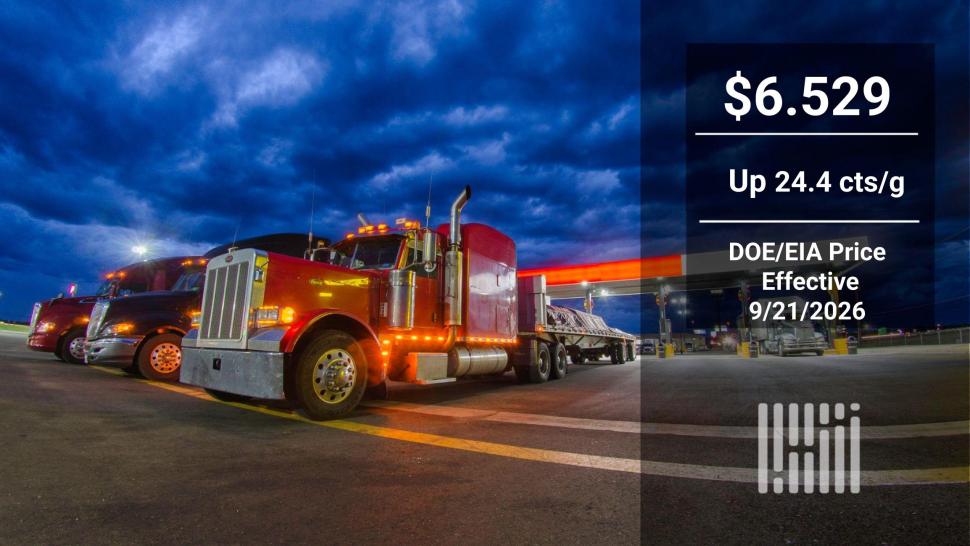
The volatility in the market was evident just in the past few days. On Tuesday, the Department of Energy/Energy Information Agency posted the ninth increase in 11 weeks in the benchmark price used for most fuel surcharges. The DOE/EIA price rose 24.4 cents/gallon to $6.529/g, effective Monday but published Tuesday. That price is yet another all-time high.
Since that run began with a posting of $4.578/g on July 6, the price is up a staggering $1.951/g.
Meanwhile, the futures market for diesel has done a sharp reversal.
Ultra low sulfur diesel (ULSD) on the CME commodity exchange, which is the starting point for the price-setting steps that ultimately leads to that number on the pump, late last week signaled a possible end–at least for now–to the relentless rise in diesel prices.
Big drops in futures
Ultra low sulfur diesel’s record high settlement occurred on Tuesday, September 15, when it settled at $5.262/gallon. Since then, it fell 37.25 cts/g to Monday’s settlement of $4.8895/g.
But even that number is still about 40 cts/g more than where it settled a month earlier. And it continued Tuesday.
At approximately 9:25 a.m. Tuesday, ULSD was down 9.56 cts/g, or 1.96%, to $4.7939. That’s almost 47 cts/g less than its September 15 record high. Prices were said to be pushing lower on news reports of Saudi Arabia making progress in reworking its east-west crude pipeline that takes oil to the Red Sea port of Yanbu for export, where it can avoid the Strait of Hormuz.
That decline in diesel futures prices, along with concurrent drops in crude and gasoline futures over the last few days, particularly on Monday, also appear to have occurred as a result of U.S. estimates of the amount of oil and LNG flowing out of the Strait of Hormuz as well as buzz that President Trump might meet his Iranian counterpart at the UN General Assembly in New York this week
“Focus has shifted to improving oil and LNG flows through Hormuz and the possibility of diplomatic progress on the sidelines of the UN General Assembly in New York,” Arne Lohmann Rasmussen, chief analyst at A/S Global Risk Management, said, according to a report by Bloomberg. “The worst pressure on crude may be easing.”
Bank says: beats me
All of this confusion and craziness led the commodity analysts at J.P. Morgan last week to make a startling confession: they don’t know what’s going on either.
“For the first time since the start of the Iran conflict, we don’t have a baseline view,” the commodities research team wrote in a report published Thursday. “We simply don’t know how to model the endgame.”
The report said it came into the Iran war thinking there were a few “economic red lines” that the Trump administration would not allow to be crossed: $100 Brent, gasoline near $5/gallon, or a “5-handle” on the 10-year Treasury yield. Depending on the definition of “near,” all those other things have occurred. (The AAA average daily retail price for gasoline Tuesday was $4.4750/g).
“With no clear signals from either the U.S. or Iran that they are prepared to de-escalate…the assumption that the disruption is temporary is becoming increasingly difficult to sustain,” JP Morgan wrote.
With that sort of uncertainty being expressed by even experts on markets, it is leading to beliefs and proposals that smack of desperation.
Export ban discussed
One suggestion that has been floating is that the U.S. should halt all exports of diesel fuel to aid U.S. consumers.
With that sort of uncertainty being expressed by even experts on markets, it is leading to beliefs and proposals that smack of desperation.
One suggestion that has been floating is that the U.S. should halt all exports of diesel fuel to aid U.S. consumers.
It was backed by Louisiana Gov. Jeff Landry in a recent CNBC interview.
The case for the export ban is simple: U.S. exports of ULSD last year averaged 1.267 million barrels/day, but since the Iran war began, they have risen to 1.566 million b/d. Keep that supply in the U.S., the theory goes, and it can put downward pressure on prices here.
Garrett Golding, an energy expert with the Dallas Fed, took to X to lay out the case against such a ban.
An export ban would put additional supplies on to the market, but that would mostly be in the Gulf Coast. It is the refining sector in that part of the country that provides the surplus barrels that are exported, Golding wrote.
That will provide downward pressure, Golding said, but only in the Gulf Coast region. The West Coast in particular would get no relief from the ban, nor would the Northeast.
“With US export volumes exiting the global market, the global diesel/distillate balance tightens,” Golding wrote. “This immediately causes those prices to rise, and will boomerang back on portions of the country that rely on imports, namely the East Coast and to a lesser extent the West Coast.”
For the refineries that do export diesel, they will be faced with a loss of markets. Golding said that will lead to a buildup of inventories and likely cuts in refinery operating rates, which have been consistently near 100% given the profitability of making diesel these days.
If that occurs, there will also be a loss of other products that came from the refining process, like gasoline, Golding said.
“The bottom line in this discussion is when you reduce run rates because you can’t export distillate/diesel, you end up reducing how much gasoline, jet fuel and other refined products you’re producing – which means higher prices,” Golding wrote.
More articles by John Kingston
Another aspect of Montgomery: it might make human brokers more valuable
Brokerage Compliance Symposium
The day before F3. Every compliance issue you face - fraud exposure, carrier liability, FMCSA rules, cargo theft, insurance gaps - navigated by attorneys and operators defining best practices in a changing industry.
F3 Awards Dinner
The night before F3. FreightTech100 companies honored. FreightTech 25 and Shipper of Choice winners revealed live. Cocktail reception into dinner and live music - 300 industry leaders in one purpose-built room.
F3: Future of Freight Festival
Industry-defining keynotes, rapid-fire technology demos, and industry leaders networking in experiences across Chattanooga - plus the inaugural F3 Awards Dinner featuring the FreightTech and Shipper of Choice reveals.
The day before F3. Every compliance issue you face - fraud exposure, carrier liability, FMCSA rules, cargo theft, insurance gaps - navigated by attorneys and operators defining best practices in a changing industry.
The Signal at Chattanooga Choo Choo • Chattanooga, TN Register NowThe night before F3. FreightTech100 companies honored. FreightTech 25 and Shipper of Choice winners revealed live. Cocktail reception into dinner and live music - 300 industry leaders in one purpose-built room.
The Signal at Chattanooga Choo Choo • Chattanooga, TN Register NowIndustry-defining keynotes, rapid-fire technology demos, and industry leaders networking in experiences across Chattanooga - plus the inaugural F3 Awards Dinner featuring the FreightTech and Shipper of Choice reveals.
The Signal at Chattanooga Choo Choo • Chattanooga, TN Register Now