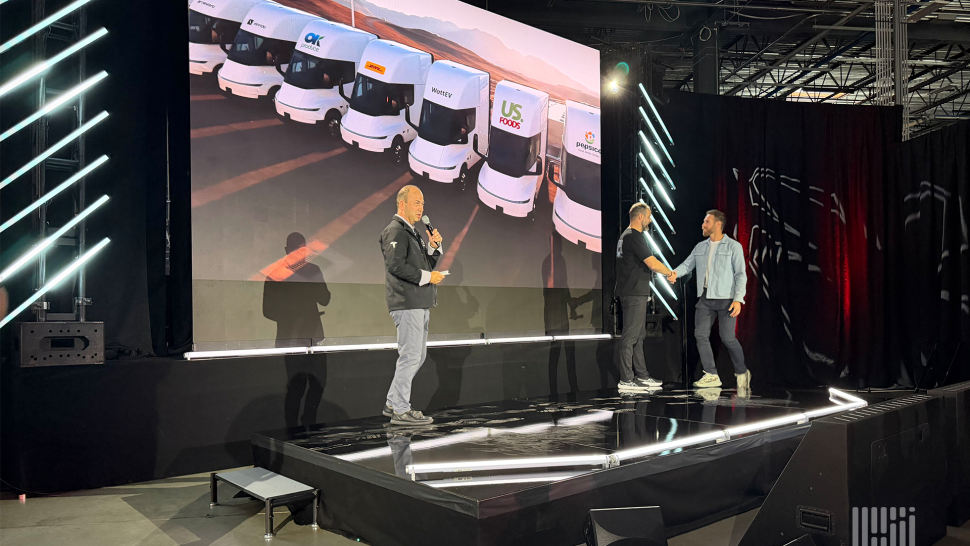
Tesla formally inaugurated its dedicated Semi factory in Sparks, Nevada on September 24, a 1.7 million square foot plant built adjacent to Gigafactory Nevada, and while the company framed the day as the start of high volume production, the first truck actually came off that line back in April, which makes this less a factory opening than a coming-out party for a program that has been promising this moment since 2017.
Deliveries went to DHL, PepsiCo and US Foods to name a few. The plant is designed for 50,000 trucks a year. Tesla has not said what it is currently producing, and that distinction matters.
I drove one. Fully loaded, tractor and trailer, and I came away impressed by three things in particular: the power, the acceleration, and the ride quality. The acceleration is the part that will get written about because it is the part that surprises people. The ride quality is the part that would matter to me if I were putting a driver in it every day.
There is also a detail from behind the wheel worth naming. You barely touch the service brake. Regenerative braking handles so much of the deceleration that the driving rhythm changes, and anyone who has run mountain grades understands immediately what that implies for brake wear and for the cost line that goes with it.
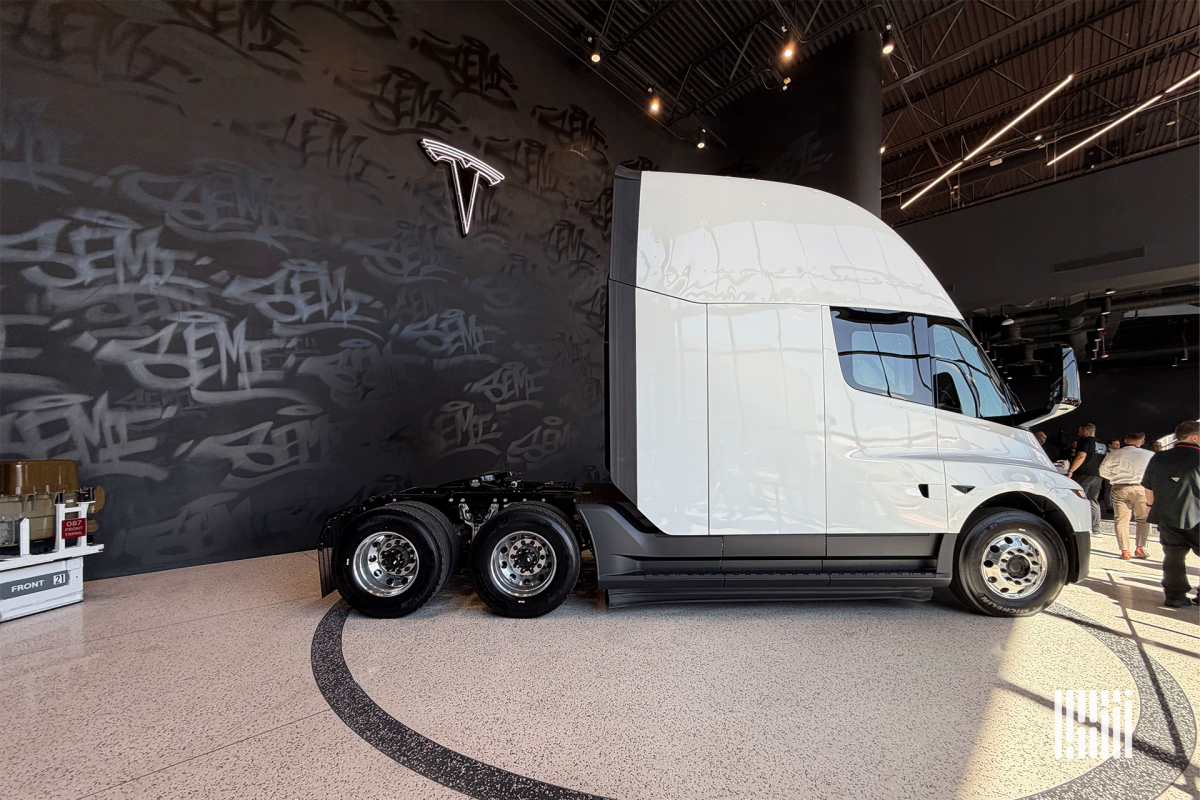
Nine Years, Told Honestly
Dan Priestley, who leads the Semi program, walked me through a timeline that started earlier than most people realize.
The idea surfaced in 2014, and the origin was a contradiction inside Tesla’s own operation. The company was building a battery and powertrain plant in Nevada and shipping parts down to Fremont, California on diesel trucks. Electric car components moving on diesel power did not sit right with the mission.
Design work went from modeling to hardware in early 2016. Two alpha trucks appeared publicly in 2017, and Priestley said those vehicles drove more miles than any alpha program Tesla has run. The design language from those trucks survived, particularly the center seating position and the dual screen cockpit.
The pilot fleet came in 2022. Just under 200 trucks, and roughly 17.5 million miles accumulated across them. Priestley described the architectural change between the alphas and that fleet as a massive leap, and then described the current production truck as the product of taking fleet data and direct customer feedback and feeding it back into the design.
What I appreciated was his framing of why. He said plainly that Tesla is not a heavy truck company yet, expressed respect for the people who run trucks every day, and said the truck has to work for the majority of fleets and drivers rather than for one customer.
The clearest evidence that the feedback loop is real is a window. The original truck had a small pop-out window. Customers pushed back hard, and Tesla put in a roll-down window. The reason turned out to be mundane and completely obvious in hindsight: badge readers, toll booths and call boxes all sit at roughly that height. Priestley and the team owned it as a design call they got wrong.
The Best Part Is No Part
The factory tour is where the engineering argument actually lives, and the phrase the team repeated is that the best part is no part.
The battery moved from purchased 2170 cells to in-house 4680s built in the complex next door. That change let Tesla cut battery mass and total kilowatt hours while holding range, because efficiency improvements elsewhere absorbed the difference.
The efficiency number is the one I would put in front of a skeptical fleet manager. The original internal target was roughly 2,000 watt-hours per mile, and the team said outside voices called it impossible. They are now running around 1.6 to 1.7, which is about 25 percent better than the target they were told they could not hit.
The drivetrain was reworked. The previous rotor used a carbon fiber sleeve borrowed from the Plaid powertrain, which performed well but was not the right technology for mass production. The new steel cage rotor is cheaper, produces more torque, and is more reliable. A bar-round stator shared with Cybertruck took roughly 80 kilograms out of the drive axle and let Tesla reuse an existing production line.
Then the subtractions, which is where a maintenance manager should pay attention.
The truck originally ran three separate oils, one for the motor, one for the gearbox, one for the hub. The hub is now fully integrated with no oil at all, which also lowers rolling resistance. The motor and gearbox share a single common oil rated to last more than a quarter million miles.
Hydraulic power steering is gone, replaced by a fully redundant electric steer-by-wire system developed for Cybertruck. Priestley made the operational case directly: a hydraulic steering leak is rarely catastrophic, but it puts the truck out of service until a technician gets to it. Removing the loop removes the failure mode and removes it from the pre-trip inspection. The side benefit is a turning radius Tesla claims is close to a Model Y, which showed up in dock maneuvering.
The thermal system is the same indirect design used on Cybercab, with the same compressor and coolant pumps used across tens of millions of Tesla vehicles. There are no refrigerant lines running forward, so there are no AC lines to damage or service.
Range, Charging and the Shift Math
Two variants are coming out of Sparks, a 325 mile standard range and a 500 mile long range. Tesla says the 500 miles is real world at 82,000 pounds fully loaded rather than a diminishing load figure. Standard range curb weight is under 20,000 pounds with a 45,000 pound payload capability.
Priestley was candid about why the range is not higher. Tesla could build a truck that crosses the country on one charge, and it would carry very little, because more battery means more mass and more cost. His argument is that range only means something paired with charging.
The shift arithmetic he described goes like this. Start at 450, run 400 miles, arrive at 10 percent, take 60 percent back in 30 minutes during the break the driver was going to take anyway, and run another 300. That is roughly 700 miles in a shift without stopping solely to charge.
On infrastructure, Tesla is using the Megawatt Charging System and says it is designed for full interoperability in both directions, meaning the Semi can charge on other providers’ equipment and other manufacturers’ MCS trucks can use Tesla’s network. By the end of the year Tesla expects more than 30 stations and over 200 megawatt-capable posts, with deployments at Pilot Flying J. The charging hardware is available for purchase.
There is no sleeper, and Priestley was straightforward that a sleeper depends on an over the road charging network that does not exist yet. The chassis is set up to accept one. The sequence is regional first, then connecting regions, then over the road.
He also declined to discuss price. Outside estimates have circulated around $290,000, which would sit below published estimates for a Freightliner eCascadia or a Volvo VNR Electric, but Tesla has not confirmed a number publicly.
Uptime Is the Argument That Will Land
The pilot fleet is running at 98 percent uptime, and Priestley did not pretend the road there was clean. He described teething problems on drivetrain components and issues with routing, airlines and hoses.
The service model borrows from the car business. A dedicated Semi service network, mobile technicians dispatched to the truck, over the air diagnostics and updates, and shared parts distribution with the automotive fleet. That last point is the underrated one. There are far more Tesla cars on the road than Class 8 trucks, and the same distribution centers and the same high voltage technician training pipeline serve both. Field failures found on the car side propagate to the truck side.
The team said they were appalled at the vehicle off road numbers they saw across the industry, and built to beat them. The line I wrote down was that planned maintenance is fine and unscheduled maintenance is a tragedy.
The Market This Enters
Now the honest context, because the factory is an enormous bet on a market that has not yet arrived.
Battery-electric vehicles account for less than one percent of new Class 6 through 8 truck sales in North America. ACT Research does not expect widespread long haul Class 8 adoption until somewhere between 2035 and 2040. Volvo Trucks executives have publicly said they expect electric truck sales to stay modest through 2026 and into 2027. Federal incentives and emissions rules that supported early deployments are receding, which pushes the decision back onto total cost of ownership.
Against that, ACT forecasts roughly 224,800 Class 8 retail sales in the United States in 2026. A plant sized for 50,000 units is sized for more than a fifth of the entire market.
The competitive picture is further along than the headlines suggest. Volvo has over 750 VNR Electrics running, more than 30 million zero-tailpipe miles, and 84 certified EV dealerships across 33 states and four Canadian provinces. Freightliner has eCascadias with more than 55 fleets and over six million miles. Tesla’s 17.5 million miles came from fewer than 200 trucks, which is a far higher per-truck utilization, but Volvo’s dealer network is a real asset Tesla is building from scratch.
Why It Matters
The strongest case for this truck is not the acceleration that everyone will write about, it is the systematic removal of failure points, the hydraulic steering loop, two of three oils, the refrigerant lines, because those are the items that put a truck out of service on a Tuesday and cost a fleet money it never planned for. Whether that engineering discipline can overcome a charging network that barely exists outside a few corridors is the question the next three years will answer, and it will be answered by fleets running real freight rather than by anyone standing in a factory.
Brokerage Compliance Symposium
The day before F3. Every compliance issue you face - fraud exposure, carrier liability, FMCSA rules, cargo theft, insurance gaps - navigated by attorneys and operators defining best practices in a changing industry.
F3 Awards Dinner
The night before F3. FreightTech100 companies honored. FreightTech 25 and Shipper of Choice winners revealed live. Cocktail reception into dinner and live music - 300 industry leaders in one purpose-built room.
F3: Future of Freight Festival
Industry-defining keynotes, rapid-fire technology demos, and industry leaders networking in experiences across Chattanooga - plus the inaugural F3 Awards Dinner featuring the FreightTech and Shipper of Choice reveals.
The day before F3. Every compliance issue you face - fraud exposure, carrier liability, FMCSA rules, cargo theft, insurance gaps - navigated by attorneys and operators defining best practices in a changing industry.
The Signal at Chattanooga Choo Choo • Chattanooga, TN Register NowThe night before F3. FreightTech100 companies honored. FreightTech 25 and Shipper of Choice winners revealed live. Cocktail reception into dinner and live music - 300 industry leaders in one purpose-built room.
The Signal at Chattanooga Choo Choo • Chattanooga, TN Register NowIndustry-defining keynotes, rapid-fire technology demos, and industry leaders networking in experiences across Chattanooga - plus the inaugural F3 Awards Dinner featuring the FreightTech and Shipper of Choice reveals.
The Signal at Chattanooga Choo Choo • Chattanooga, TN Register Now