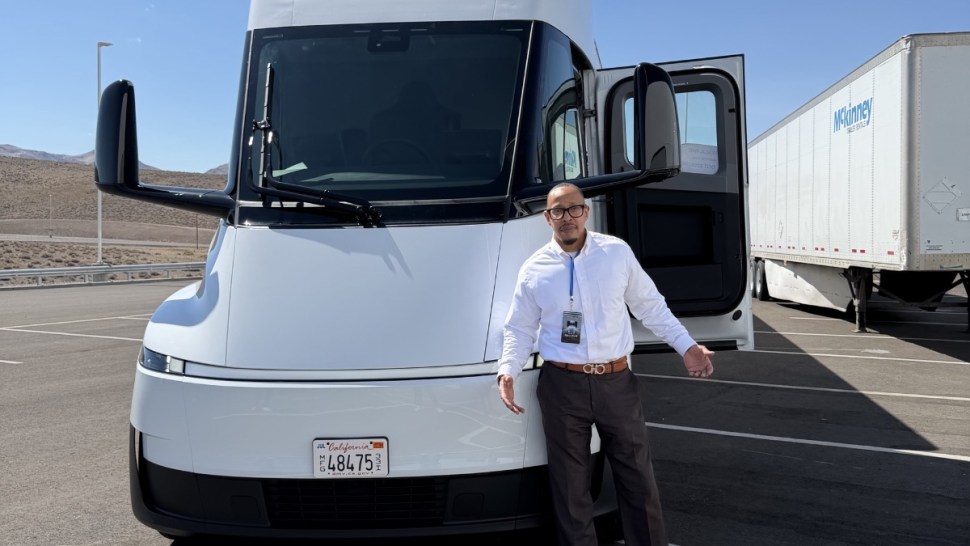
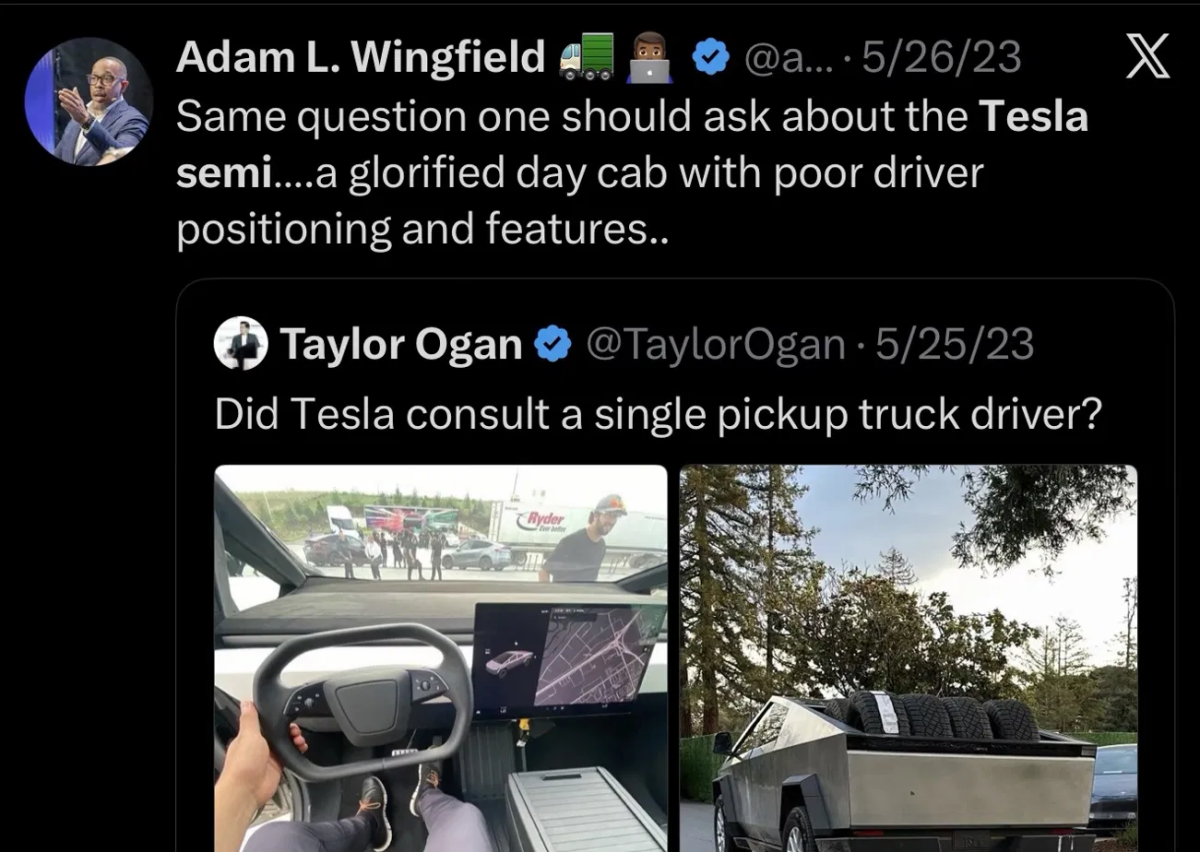
Back in May 2023 I called the Tesla Semi a glorified day cab with poor driver positioning and weak features. In July 2025 I said that outside of what it could do as an electric truck, it was never appealing from a driver’s standpoint, and that current cab configurations ran circles around it on comfort, especially as legacy OEMs moved to electric while keeping the same cab standards as their diesel models. In February of this year I said electrification might well be the cheaper option, but the Tesla Semi itself was overhyped and rough to look at. And in April, when a video went around of a Frito-Lay Semi pulling away from a gate with what somebody called a “massive trailer”, I called it rage bait and pointed out that snack haulers run lift axles because the product weighs almost nothing.
So nobody has to wonder where I stood. I’ve held a Class A CDL with a hazmat endorsement for most of my adult life and spent close to three decades around this business, and I’ve been one of this truck’s louder skeptics.
Then I drove one loaded. Here’s what held up and what didn’t.
What I was actually worried about
My doubts ran in three directions.
One, I questioned whether the range numbers would survive contact with real freight and real weight. Two, I questioned whether a company built around passenger cars understood what this job asks of a person across a fourteen-hour day. Three, I questioned the center seat, which struck me as a decision made by people who had never backed a 53-foot trailer into a tight dock.
One of those three still stands. The other two didn’t make it past the first few miles I drove.
The seat I was most ready to hate
You climb in and you’re sitting dead center, screens on both sides.
Every instinct I have says that’s wrong. I’ve spent my career with a door and a window on my left and a whole lot of truck on my right, and that geometry sits so deep in muscle memory that being centered feels like somebody rearranged a room you’ve walked through in the dark for twenty years.
Tesla’s argument is that the side-by-side layout is inherited from horse-and-buggy days and that most trucking is done by one person, so you build around that person. Intellectually, that’s hard to argue with. Teams exist however, most of this work is done solo.
In practice, the direct forward visibility is better than anything I’ve driven, because you’re looking down the centerline of the truck instead of down one edge of it. You stop guessing where your right side is. You can see it.
Side visibility runs through cameras and mirrors, and here’s the honest version. It kinda works. It’s also different, and different takes a little time getting used to. I wasn’t going to get fluent in a camera-and-mirror setup in one session, and neither will you. But the blind-spot problem I fully expected to find didn’t show up the way I expected it to.
That’s the first place my “poor driver positioning” take took a fact check hit.
The window is the tell
Small thing that says a lot. The earlier trucks had a pop-out window. The production truck has one that rolls down.
That changed because customers pushed and Tesla admitted the original call was wrong. The reason isn’t glamorous. Badge readers, toll booths, call boxes and guard shacks all sit around that height, and a pop-out window turns every one of those into a problem. You don’t get a big window to roll down like in a regular truck, but you have a decent sized one that does.
I care about that more than most of the original spec sheet. It means somebody listened to people who pull up to gates for a living, and it means they were willing to say out loud that they missed. That posture isn’t common in this industry.
The brake pedal is the part that got me
This is the one I didn’t see coming, and it’s what I’d lead with if you asked me my initial takes.
You barely touch the service brake.
Regenerative braking handles so much of the deceleration that the rhythm of driving changes. You lift, and the truck slows with authority even loaded. It isn’t the soft coast you get lifting off a diesel when using the low setting of your Jakes. It’s closer to working a Jake in the hills, except it’s happening constantly, in traffic, on ramps, coming into a dock.
Think about what that means for anybody who’s constantly running mountain grades. Brake fade, heat, snubbing your way down a hill while watching air gauges and hoping the guy ahead of you knows what he’s doing. I didn’t run a mountain descent, so I’m not telling you it erases that. What I can tell you is that on flat ground with weight behind me, the service brake became something I used at the very end of a stop instead of throughout it.
Run the maintenance math yourself. Shoes, drums, air system components, and the labor on all of it. If regen carries most of the deceleration on a regional route with a lot of stops, that’s a real maintenance line item moving the right way. I’m not putting a number on it, because I don’t have one, and anybody speculating about a number today is guessing like I was.
Steering, turning and the power everybody oversells
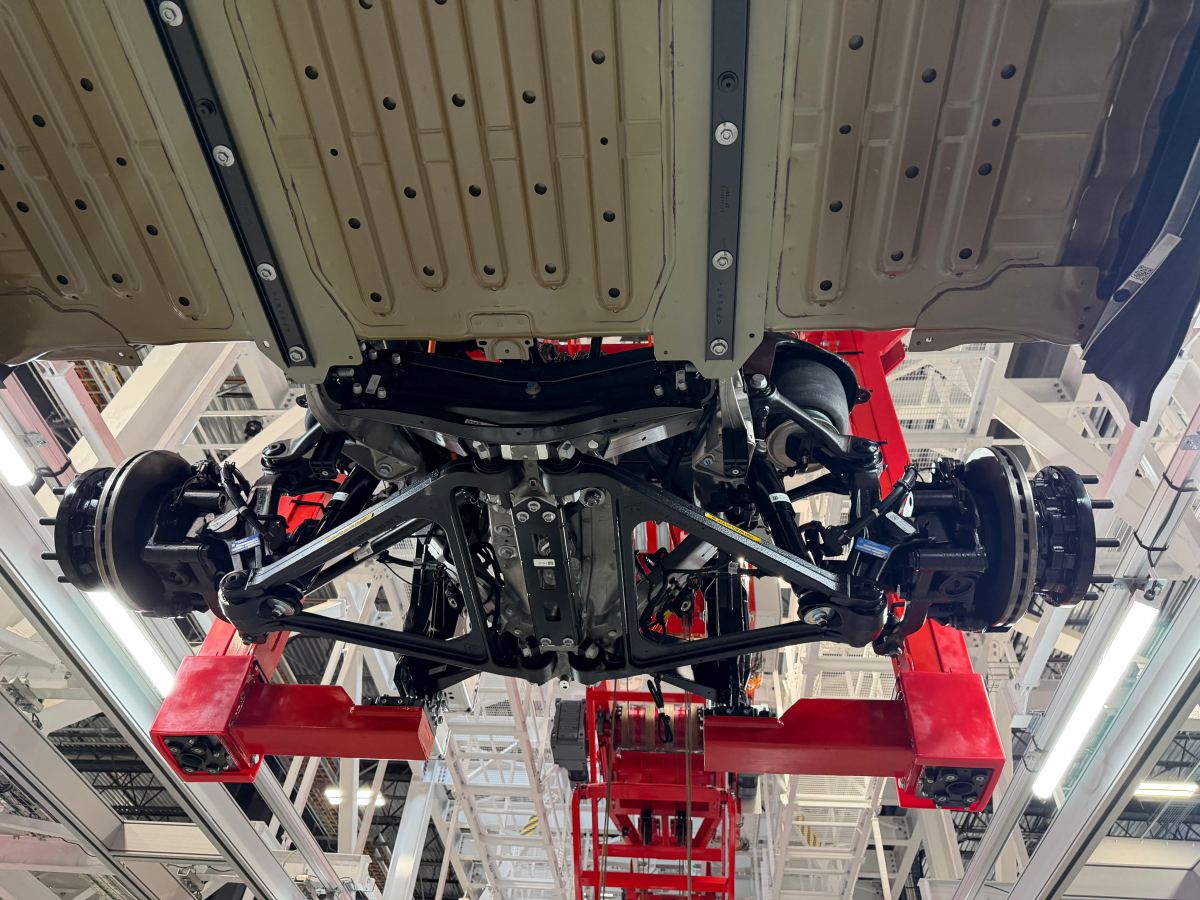
The steering is electric and fully redundant, with no hydraulic loop anywhere in the truck. You feel it right away. Response is quicker and more precise than any Class 8 I’ve driven. You put the truck where you want it instead of aiming and correcting. Pair that with a wheel cut Tesla says gives it a turning radius close to a Model Y, and tight maneuvering stops being a negotiation.
Precise steering isn’t a luxury feature for a driver. It’s the difference between coupling trailers in a tight yard first try and getting out to look three times.
The power is what everybody writes about. It is every bit as advertised. I asked the engineer that was in the truck with me, when I hooked to a loaded trailer, was it even loaded because it felt like there was nothing in it. He told me to look at the screen with the onboard scale, and there it was. Tesla lists 800 kW of drive power from three independent rear motors, and yes, it accelerates loaded in a way that’ll surprise you if diesel is your frame of reference. But acceleration is the most oversold attribute of every electric vehicle ever built, and it’s a big part of why I called this truck overhyped in the first place. Merging with weight behind you is meaningfully easier, and there’s a real safety argument in that. It’s still not why you’d buy it.
Ride quality is why I’d look harder. The cab is hard mounted rather than air mounted, which on paper should ride worse, and it doesn’t. Since there are no differentials at each drive axle, you don’t get that “cab rise” that you get when torque is transferred. Road noise is down noticeably, and there’s acoustic glass in it. Eleven hours in, quiet isn’t a comfort feature, it’s a comfort feature. That’s the second place my old take lost ground, because I’d said flat out that existing cabs ran circles around this one on comfort.
Things a driver would actually use
Your driver profile follows you. Walk up to any truck in the fleet with your phone, open the door, and the seat, mirrors and settings come with you. Anybody who’s climbed into a slip-seated truck and spent a few minutes fighting the seat, mirrors and preferences back to where their body needs it understands why that matters.
The pre-trip is different too. A lot of what you’re checking is on the screen, and some of what you used to crawl under the truck for doesn’t exist anymore. No hydraulic steering loop means no steering fluid leak to chase. Three separate oils became one, and the hub runs dry. The refrigerant lines that run forward on a conventional truck aren’t there.
Fewer things to leak is fewer things to leak. That isn’t Tesla marketing, it’s just true. There whole premise is “the best part is no part”, which is an engineering rule from Elon Musk.
The trip planner factors weather, traffic and your changing load, so the range estimate adjusts after a pickup or a drop instead of lying to you or you trying to guess.
At the dock is where I changed my mind
Backing is the test. It’s what every driver worries about the second they hear “center seat,” and it’s what I was most prepared to be annoyed by.
Sitting centered, you lose the move where you hang out the window and look straight down the driver side of the trailer. That’s a real loss and I won’t pretend otherwise. What you get back is symmetry. Both sides of the truck sit the same distance from you, all camera views are equivalent, and you’re not compensating for a driver-side bias you’ve spent years learning to correct for.
Add the steering precision and the tight wheel cut, and the net came out better than I expected, not worse. Setting up the approach took fewer corrections. The truck went exactly where I pointed it.
I’d still tell a fleet to give a veteran driver a couple of weeks before judging it, because you’re unlearning something real. But the thing I was loudest about turned out to be the thing I was most wrong about.
Where my skepticism still stands
Two places, and neither one is about how the truck drives.
First, weight and freight type. Tesla’s published specs list the Long Range at 500 miles with a curb weight around 23,000 pounds, while the Standard Range comes in at 325 miles under 20,000 pounds, both rated at a full 82,000-pound gross combination weight thanks to the 2,000-pound federal allowance for electric trucks. The version with the range you’d want for regional work is the heavier one, which means your payload ceiling drops on anything that weighs out. That’s exactly why my Frito-Lay post still holds up. Snack freight cubes out long before it weighs anything, so of course that’s where these trucks look their best. Show me one running 46,000 pounds of canned goods all day and then we’ll talk.
Second, infrastructure. There’s no sleeper, and Tesla is straight about why. Until there’s an over-the-road charging network, a sleeper doesn’t make sense, and the chassis is built to take one whenever that changes. The shift math is that you run your range down, take 60% back in about thirty minutes on 1.2 MW charging during the break you were taking anyway, and keep going. On paper that works. It works if the charger is where you need it, if it’s working when you get there, and if nobody’s sitting in it. Every driver reading this knows exactly how that goes at a truck stop on a Monday night.
So here’s where I ended up, and it surprised me. My remaining doubt isn’t really about the truck anymore. It’s about everything around the truck. The vehicle is further along than I gave it credit for, and the infrastructure isn’t, and no amount of engineering inside that cab fixes what’s missing outside of it.
I’ll also say this plainly, since I’ve been on record for years. Still not as pretty as a Kenworth W900 classic. I’d just stop leading with that now.
Why it matters
I walked in expecting a piece of technology built by people who’d never done this job, and what I found was a truck where the most meaningful changes are the things they took out rather than the things they added, which is exactly the instinct you’d want from anybody who understands that a truck sitting in a shop earns nothing. If you get a chance to drive one, take it, and judge it on the brake pedal and the steering instead of the acceleration, because those are the two places where somebody clearly thought about the person in the seat. And then judge the rest of it on your own time, because a truck that shines for some people may not fit the lanes you actually run. But don’t judge it before you try it.
Brokerage Compliance Symposium
The day before F3. Every compliance issue you face - fraud exposure, carrier liability, FMCSA rules, cargo theft, insurance gaps - navigated by attorneys and operators defining best practices in a changing industry.
F3 Awards Dinner
The night before F3. FreightTech100 companies honored. FreightTech 25 and Shipper of Choice winners revealed live. Cocktail reception into dinner and live music - 300 industry leaders in one purpose-built room.
F3: Future of Freight Festival
Industry-defining keynotes, rapid-fire technology demos, and industry leaders networking in experiences across Chattanooga - plus the inaugural F3 Awards Dinner featuring the FreightTech and Shipper of Choice reveals.
The day before F3. Every compliance issue you face - fraud exposure, carrier liability, FMCSA rules, cargo theft, insurance gaps - navigated by attorneys and operators defining best practices in a changing industry.
The Signal at Chattanooga Choo Choo • Chattanooga, TN Register NowThe night before F3. FreightTech100 companies honored. FreightTech 25 and Shipper of Choice winners revealed live. Cocktail reception into dinner and live music - 300 industry leaders in one purpose-built room.
The Signal at Chattanooga Choo Choo • Chattanooga, TN Register NowIndustry-defining keynotes, rapid-fire technology demos, and industry leaders networking in experiences across Chattanooga - plus the inaugural F3 Awards Dinner featuring the FreightTech and Shipper of Choice reveals.
The Signal at Chattanooga Choo Choo • Chattanooga, TN Register Now