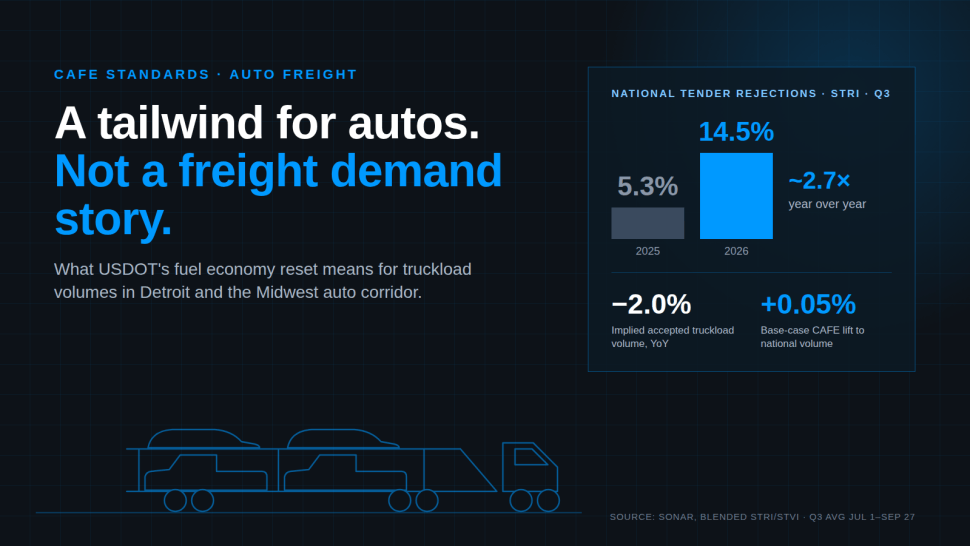
USDOT’s reset of the Corporate Average Fuel Economy (CAFE) standards is a modest tailwind for U.S. auto production, but it is unlikely to turn the truckload freight market into a demand story in the next 12 months. SONAR data shows 2026 truckload tightness is still being driven by capacity leaving the market, not by more freight.
On Sept. 28, USDOT finalized its “Freedom Means Affordable Cars” rule resetting NHTSA’s CAFE standards. The department says it will cut the average new-vehicle price by $1,300 and save Americans $138 billion over five years (USDOT). The question for freight: does cheaper, more flexible car-building translate into more loads out of Detroit, Toledo, Indianapolis and the Southeast auto corridor?
Key takeaways
- Auto manufacturing: Mild positive. Automakers get product-mix flexibility, but the biggest financial lever (CAFE fines) was already zeroed out in 2025.
- Consumer sentiment: Unlikely to move. Sentiment sits at 48.1, weighed down by record diesel, rising gas and higher rates, not fuel economy rules.
- Freight demand: Small and slow. Our best estimate is a 0.5%–2% lift in light-vehicle output by 2027–2028, worth well under 0.1% of national truckload volume, concentrated in Midwest and Southeast auto markets.
- The real story: SONAR data shows implied accepted truckload volume is roughly flat to down year over year, while tender rejections have nearly tripled. This is still a capacity story.
- Regulatory design: Footprint-based CAFE and the 25% Chicken Tax both favor big domestic trucks, and statutory mandates such as the 2007 biofuel targets have repeatedly been waived down. A rule on paper is not a volume forecast.
What the CAFE reset changes — and what it doesn’t
The rule lowers the fuel economy bar automakers must hit through model year 2031. It does not change the tariff, rate or fuel-price environment that is actually setting car prices today.
What changes under the new CAFE standards
- Lower targets. The December 2025 proposal reset standards for MY 2022–2031 with increases of roughly 0.25%–0.7% per year, landing at a 34.5 mpg fleet average by 2031 (USDOT proposal). The prior rules targeted about 50.4 mpg by 2031 (Reuters via Yahoo).
- No EV math. Standards are now set without assuming EV production or credit trading, following DOT’s June 2025 interpretive rule (Automotive News via Yahoo).
- Product planning flexibility. Automakers can plan more trucks, SUVs and ICE/hybrid volume without building EVs to offset them.
What doesn’t change for automakers
- Fines were already $0. The One Big Beautiful Bill Act set the CAFE civil penalty to zero in July 2025 (Sidley). Much of the cost relief is already priced in.
- Tariffs, rates and fuel. Import tariffs on vehicles and parts, elevated borrowing costs and record diesel remain the dominant cost drivers.
- Product cycles. Vehicle programs take 2–4 years to change. Any mix or volume shift shows up mostly in MY 2027–2029, not this quarter.
- Legal risk. Expect litigation from states and environmental groups. Congressional Democrats have already argued the targets fall below what automakers achieved in MY 2024 (35.4 mpg) (Rep. Matsui letter).
Why vehicles keep getting bigger: CAFE footprint rules and the Chicken Tax
Two older rules shape the consumer vehicle fleet far more than the commercial one, and both push it toward larger, heavier trucks, which likely means heavier loads for the freight that builds and delivers them. One rewards making vehicles larger. The other keeps small foreign-built trucks out of the U.S. market.
- Footprint standards reward size. Since model year 2011, CAFE targets have been set by vehicle footprint, so larger vehicles face lower mpg targets (Tax Policy Center). A University of Michigan modeling study found that this design expands vehicle size by 2%–32% in 20 of 21 scenarios, eroding fuel economy gains by 1–4 mpg and raising CO2 emissions by 5%–15%, with the largest effect on light trucks (Whitefoot and Skerlos, Energy Policy, 2012). Ito and Sallee document the same kind of distortion for Japan’s weight-based standards (NBER).
- Consumer vehicles bear the brunt. Light-duty CAFE covers vehicles up to 8,500 pounds gross vehicle weight rating, while heavier work trucks fall under separate medium- and heavy-duty rules (NHTSA). The footprint incentive therefore operates on light-duty pickups, SUVs, and vans, and not on tractor-trailers or vocational trucks.
- Trucks have always been graded on a softer curve. Light trucks have had their own CAFE class since the program began, with an initial 17.2 mpg standard in 1979 and 20.7 mpg for years afterward, versus 27.5 mpg for passenger cars (CRS).
- The Chicken Tax removes the low end. The 25% tariff on imported light trucks dates to 1964 and was retaliation for European duties on U.S. chicken. Trade rules required it to apply to all countries, and it has never been removed, while passenger cars pay 2.5% (FEE). In 2001, fewer than 7,000 pickups came from outside North America, or 0.23% of nearly 3 million sold (AEI). The tariff still bites: Ford paid $365 million in March 2024 to settle a Justice Department claim, without admitting liability, that it imported Transit Connect cargo vans with temporary rear seats to pay the 2.5% passenger rate instead of 25% (Wards Auto).
- The combination is the argument. The Drive contends that the two rules together ended small American pickups: the Ford Ranger, Dodge Dakota, and Ford Explorer Sport Trac were all canceled around the time footprint standards took effect, and the Ford Maverick survived by using a compact hybrid platform (The Drive). While the causality isn’t strict here, the way the incentives align suggests this conclusion.
- The counterpoint. The Tax Policy Center concludes the tariff alone probably is not the main driver, because Toyota builds U.S. trucks similar in size to Detroit’s without paying it, and cheaper gasoline and safety perceptions also push buyers toward size (Tax Policy Center). The full-size pickup now averages more than $66,000 and is the profit engine of the U.S. industry (Marketplace).
The result: In model year 2024, trucks (a category that includes SUVs and pickups) were 66% of new vehicles and cars were 34%. SUVs alone were 50% (EPA). Average new-vehicle weight reached a record 4,371 pounds in model year 2023, and the average new pickup outweighed the average new sedan by about 1,535 pounds (EPA Automotive Trends Report).
Why it matters for freight: Heavier vehicles likely mean heavier loads for the haulers and suppliers that move them. Car haulers work under an 80,000-pound federal limit, and the trucking industry has asked for 88,000 because heavier electric vehicles mean fewer units per load (The Drive). The same arithmetic should apply to heavier trucks, though we have not found data that quantifies it for gasoline models. Separately, the reset lowers the CAFE bar and the fine is already $0, so the size incentive from CAFE is likely weaker than the models above assumed, while the Chicken Tax is unchanged. Our read is that this keeps large-truck assembly in North America, the parts-heavy, Midwest-centered build described above. That supports the base case, but it protects existing volume more than it creates new volume.
Mandates vs. markets: what the Renewable Fuel Standard says about CAFE targets
The 2007 law behind CAFE’s 35 mpg target also set biofuel blend targets, and together they are a useful test of how far a legislated number carries a market. For CAFE, the statute required a combined fleet average of at least 35 mpg for model year 2020 (49 U.S.C. 32902). For biofuels, it required 36 billion gallons of renewable fuel in 2022 (CRS).
How the biofuel mandate works: The Renewable Fuel Standard (RFS) requires refiners and fuel importers to blend set volumes of renewable fuel into the fuel they sell. The statute set targets for three fuel families that behaved very differently: corn ethanol, biodiesel and renewable diesel, and cellulosic fuels (CRS).
Corn ethanol (non-cellulosic): the mandate that mostly worked
- What it is. Ethanol made from corn starch, which the RFS calls conventional biofuel. The statute implies a 15 billion gallon level starting in 2015 (CRS), and EPA’s 2026 rule again implies 15 billion gallons (Federal Register).
- Why it mostly worked. The plants and the E10 blending infrastructure already existed. The U.S. consumed about 14 billion gallons of fuel ethanol in 2022 (EIA). EPA cut the conventional volume in 2020 and 2021 when the pandemic reduced fuel demand (farmdoc daily).
Biodiesel and renewable diesel: the mandate that grew
- What they are. Both are diesel substitutes made from vegetable oils, animal fats, and recycled grease, with soybean oil the dominant U.S. feedstock (CRS). Biodiesel is an ester fuel blended into diesel at low shares such as B5 or B20. Renewable diesel is a non-ester fuel that can be used pure or blended (EIA; CRS).
- The statute set only a floor. Congress required 1.0 billion gallons of biomass-based diesel by 2012 (CRS). EPA has since set the requirement far higher, so this category never had the cellulosic problem of a target beyond reach.
- The 2026 jump. EPA’s 2026 requirement is about 67% above 2025’s, the largest one-year increase in the program’s history, and works out to roughly 5.7 billion physical gallons (farmdoc daily).
- Why it matters for freight. This is the mandate that is blended into diesel. In 2022 the U.S. consumed about 1.7 billion gallons each of biodiesel and renewable diesel (EIA). We have not quantified its effect on diesel prices here.
Cellulosic biofuel: the mandate that missed
- What “cellulosic” means. Fuel made from cellulose, hemicellulose, or lignin, the fibrous structural material in plants such as corn stalks, wood waste, and grasses, and not from the starch in corn kernels or from vegetable oil. The statute also requires a lifecycle greenhouse gas cut of at least 60% versus petroleum (42 U.S.C. 7545). Since 2014, EPA also lets biogas from landfills, wastewater plants, and farm digesters count when it is converted to vehicle fuel such as compressed natural gas (Crowell).
- Targets ran far ahead of production. The cellulosic mandate rose from 100 million gallons in 2010 to 1 billion in 2013 and 16 billion in 2022 (CRS), while production “struggled to reach even a few million gallons” (farmdoc daily). EPA reduced the requirement every year from 2010 through 2022 (Federal Register).
- The shortfall persists. In 2024, production fell about 7% short of EPA’s own, heavily reduced requirement (Federal Register). For 2025, EPA waived roughly 12% of the requirement (Federal Register).
Why infrastructure decides what a mandate can deliver
The legal obligation sits with refiners and importers (CRS), but the pumps, storage tanks, engines, and plants that determine whether the fuel gets used belong to other parties. When those do not keep pace, the obligated party cannot comply, and the usual outcome is a smaller mandate.
- Ethanol is limited by pumps and vehicles. Most gasoline is E10, and higher blends need compatible vehicles and pumps. This “blend wall” caps ethanol near a tenth of gasoline demand, and only flex-fuel vehicles can use E85, which is sold at about 4,300 stations (EIA). E15 is approved for more than 95% of vehicles on the road but is sold at only about 3,000 to 5,000 stations, depending on the source (DTN; Renewable Energy Magazine). Summer E15 sales still depend on an annual emergency waiver, and 2026 was the fifth in a row (DTN).
- Diesel is limited by engines, weather, and geography. B5 works in any diesel engine, and many manufacturers approve B20, but blends above B20 can affect engine warranties and high-level blends can gel in cold weather (DOE Alternative Fuels Data Center). Renewable diesel avoids most of those limits, but almost all of it is consumed in California, pulled by state clean fuel programs rather than the federal mandate (EIA).
- Cellulosic is limited by plants that do not exist at scale. KiOR, a wood-to-fuel company backed by prominent investors, built a commercial plant in Mississippi that had produced no fuel by March 2014 and filed for bankruptcy that November (C&EN). A mandate cannot create a working plant.
How enforcement has held up over time
- The total shrank. EPA’s final 2022 volume was about 20.6 billion gallons against the 36 billion gallon statutory figure, a reduction of roughly 43% (CRS).
- Courts policed the method, not the ambition. In 2013 the D.C. Circuit vacated the 2012 cellulosic standard because EPA’s production projection “did not take neutral aim at accuracy” (CRS).
- Rules arrive late and change after the fact. The statute calls for EPA to set volumes at least 14 months before the year they apply (CRS). The 2026 and 2027 volumes were finalized in March 2026, with the first compliance year already under way (Federal Register).
- Exemptions and delays continue. In November 2025 EPA decided 16 small refinery exemption petitions covering 2021–2024, granting 2 in full and 12 in part (EPA). On Aug. 31, 2026 it decided 34 petitions for 2025 and moved the 2025 compliance deadline from Sept. 1 to Oct. 1 (Federal Register). EPA is reallocating 70% of the exempted 2023–2025 volumes into 2026 and 2027 (Federal Register).
- CAFE followed the same arc. Congress set the civil penalty to zero in July 2025, which leaves the standard with no direct financial enforcement (Sidley).
The pattern: “Unenforced” is not quite the right word for the biofuel mandates, since the statute gives EPA the waiver authority it has used. What the record shows is three ways a “thou shalt” fails. Targets are set beyond what infrastructure, plants, or markets can deliver, as with cellulosic fuel and the ethanol blend wall. Enforcement is softened through waivers, exemptions, late rules, or a zero penalty. And firms change behavior to fit the rule instead of its intent, as with size growth under footprint standards and the Transit Connect seats. Biodiesel and renewable diesel show the opposite case: where a mandate matches a fuel the market can make and distribute, it grows.
Why it matters for freight: The 34.5 mpg path through 2031 is a target, not a forecast. Production and freight forecasts should key on what automakers can sell at a profit given tariffs, rates, and fuel prices, which is how the scenarios above are built, and not on the regulatory number.
Auto manufacturing outlook: resilient sales, soft Detroit 3 share
New-vehicle demand is not broken — affordability and domestic market share are. That limits how much a regulatory change can add.
- Sales are holding up. Cox Automotive raised its 2026 forecast to 16.1 million units from 15.8 million, with September’s SAAR expected near 16.3 million (Cox Automotive).
- Prices are near record. The average transaction price hit $50,089 in August, with incentives down to 6.5% of ATP (Kelley Blue Book). Monthly payments average $821, a September record (J.D. Power).
- Detroit 3 are losing ground. Cox forecasts the Detroit 3 will finish Q3 with their lowest U.S. share on record as Asian brands gain (Cox Automotive).
- Production is flat, not growing. S&P Global Mobility put 2026 North American output near 15 million units and cut 2027 by 339,000 units on oil-price risk tied to the Iran conflict (S&P Global Mobility).
Why it matters for freight: The Detroit 3 are the biggest winners from looser CAFE because their fleets are truck-heavy. They also run the densest domestic supplier networks in Michigan, Ohio and Indiana. If the rule helps them win back share with U.S.-built trucks and SUVs, that is where inbound parts freight would grow first.
Consumer sentiment and car prices: the rule doesn’t touch the pain points
Consumers are worried about fuel, tariffs and interest rates. A $1,300 sticker reduction phased in over several model years won’t offset those.
- Near record lows. The University of Michigan index fell to 48.1 in September from 51.7 in August and 55.1 a year ago (UMich Surveys of Consumers).
- Fuel is top of mind. 31% of consumers mentioned gasoline unprompted, and most expect prices to keep rising (University of Michigan).
- Rates are hurting vehicle buying conditions. Higher borrowing costs pushed vehicle buying conditions lower in September (University of Michigan).
- Tariff anxiety is rising. Unprompted tariff mentions rose from 24% in July to 35% in September (Spectrum News).
The tension: Looser CAFE lets automakers build more of the less-efficient trucks and SUVs they profit on. But with gas and diesel climbing, buyer demand is drifting toward hybrids and practical, efficient vehicles. The rule may push product mix in one direction while the pump pushes consumers the other way.
SONAR data: truckload tender rejections surge without more freight
SONAR‘s blended tender volume index (STVI) is up, but tender rejections (STRI) are up far more. Strip out rejected loads and the freight actually moving is roughly flat to down — nationally and in Detroit.
| Q3 average (Jul 1–Sep 27) | STVI | STRI | Implied accepted volume* |
| USA — 2025 | 10,447 | 5.3% | 9,892 |
| USA — 2026 | 11,338 (+8.5%) | 14.5% | 9,693 (−2.0%) |
| Detroit (DTW) — 2025 | 206.1 | 5.0% | 195.8 |
| Detroit (DTW) — 2026 | 233.1 (+13.1%) | 17.6% | 192.0 (−1.9%) |
*Implied accepted volume = STVI × (1 − STRI). A directional estimate: rejected loads get re-tendered, which inflates tender volume when the market tightens. Source: SONAR, blended STVI and STRI, pulled Sept. 28, 2026.
- National STRI has nearly tripled. September 2026 is averaging 14.1%, versus 5.3% in September 2025.
- Detroit is tighter than the nation. DTW tender rejections averaged 17.6% in Q3, about 3 points above the national rate, even as accepted freight slipped.
- The read: Carriers are rejecting more freight because there are fewer trucks, not because shippers are tendering meaningfully more loads. Auto country is no exception.
How much truckload freight will the CAFE rollback add?
Even in a bullish case, the rule adds about 0.1% to national truckload volume. In core auto markets the lift is larger but still under 1%, and it arrives over 2027–2029.
Methodology: how we estimated the freight lift
- Price effect: DOT’s $1,300 savings is about 2.6% of the $50,089 August ATP.
- Demand response: We assume a price elasticity of about −1.0 for new vehicles, so a full 2.6% price cut adds about 2.6% to unit sales (~419,000 units on a 16.1M base).
- Realization: Only part of the savings reaches buyers, and it phases in with model-year changeovers. Tariffs and zeroed-out fines already absorb much of the benefit.
- Freight exposure: We assume auto-linked freight (inbound parts plus finished vehicles moved by truck) is ~5% of national truckload volume and ~25% of outbound volume in core auto markets like Detroit, Toledo and Indianapolis.
| Scenario | Share of savings realized | Added annual units | Lift to national truckload volume | Lift in core auto markets |
| Bear | 20% | ~84,000 (+0.5%) | ~0.03% | ~0.1% |
| Base | 40% | ~167,000 (+1.0%) | ~0.05% | ~0.3% |
| Bull | 75% | ~314,000 (+2.0%) | ~0.10% | ~0.5% |
Scale check: National STRI moved from 5.3% to 14.5% year over year. A 0.05%–0.1% volume lift is a rounding error against a capacity shift of that size.
Where auto freight could see a bigger lift
- Parts suppliers in Michigan, Ohio, Indiana, Kentucky, Tennessee and South Carolina, if Detroit 3 truck and SUV programs get more domestic volume.
- Car haulers and rail. Finished-vehicle moves lean heavily on rail and specialized car-haul fleets, which SONAR dry van tender indices don’t fully capture.
- Flatbed and industrial freight tied to any new plant or retooling investment, a longer-dated upside.
What to watch: auto freight signals in SONAR
- STVI and STRI in DTW and other auto markets. Real demand shows up as rising volume with steady or easing rejections, not rising rejections alone.
- Detroit 3 production schedules. Announced shift adds or restarted truck and SUV lines are the earliest hard signal.
- Fuel prices. If gas keeps climbing, buyers keep shifting to efficient vehicles and the mix benefit shrinks.
- Tariff and rate moves. Either could swamp the $1,300 price effect in a single announcement.
- Litigation. A court stay would freeze product planning and delay any freight upside.
- Enforcement and tariff changes. With the CAFE fine at $0, the targets are guidance more than constraint. Watch for any restored penalty or change to the Chicken Tax, either of which would change the truck-mix math.
Bottom line
- The CAFE reset is directionally positive for domestic auto manufacturing, especially for truck-heavy Detroit 3 fleets and Midwest suppliers.
- It is unlikely to lift consumer sentiment, which is being driven by fuel, tariffs and rates.
- It is not a near-term freight demand catalyst. Our base case adds ~0.05% to national truckload volume, phased in over 2027–2029.
- The 2026 freight market remains a capacity story: accepted volume is flat to down while rejections have nearly tripled. Watch SONAR’s auto markets for the first sign that demand, not supply, starts doing the work.
- Regulation sets incentives, not outcomes. The Chicken Tax, footprint-based CAFE, and the EISA biofuel mandates show that statutory targets are often waived, exempted, or worked around. Treat the 34.5 mpg path as a ceiling on ambition, not a forecast.
Frequently asked questions about CAFE standards and freight
What do the new 2026 CAFE standards change?
USDOT finalized the reset on Sept. 28, 2026. It lowers the fuel economy path to a 34.5 mpg fleet average by model year 2031, versus about 50.4 mpg under the prior rules, and sets standards without assuming EV production or credit trading.
Will the CAFE rollback increase truckload freight volume?
Only slightly. Our base case adds about 0.05% to national truckload volume and about 0.3% in core auto markets such as Detroit, Toledo and Indianapolis, phased in over 2027–2029 as model-year programs change.
Why are truckload tender rejections so high in 2026?
Capacity is leaving the market. National STRI averaged 14.5% in Q3 2026 versus 5.3% a year earlier, while implied accepted volume fell about 2% year over year. Carriers are rejecting more freight because there are fewer trucks, not because shippers are tendering more loads.
Are CAFE standards still enforced?
Not financially. The One Big Beautiful Bill Act set the CAFE civil penalty to $0 in July 2025, so the new targets work more as guidance than as a binding constraint on automakers.
What is the Chicken Tax and how does it affect pickups?
The Chicken Tax is a 25% U.S. tariff on imported light trucks that dates to 1964. Combined with footprint-based CAFE targets, it favors large, North American-built pickups and SUVs, which keeps truck assembly and parts freight concentrated in the Midwest and Southeast.
Which freight markets are most exposed to auto production?
Parts suppliers in Michigan, Ohio, Indiana, Kentucky, Tennessee and South Carolina, plus car haulers, rail and flatbed carriers tied to plant investment. Watch STVI and STRI in auto markets such as Detroit for the first sign of real demand.
Track tender volume and rejections in auto markets with SONAR freight market intelligence.
Want to learn more about SONAR? Request a demo.
Brokerage Compliance Symposium
The day before F3. Every compliance issue you face - fraud exposure, carrier liability, FMCSA rules, cargo theft, insurance gaps - navigated by attorneys and operators defining best practices in a changing industry.
F3 Awards Dinner
The night before F3. FreightTech100 companies honored. FreightTech 25 and Shipper of Choice winners revealed live. Cocktail reception into dinner and live music - 300 industry leaders in one purpose-built room.
F3: Future of Freight Festival
Industry-defining keynotes, rapid-fire technology demos, and industry leaders networking in experiences across Chattanooga - plus the inaugural F3 Awards Dinner featuring the FreightTech and Shipper of Choice reveals.
The day before F3. Every compliance issue you face - fraud exposure, carrier liability, FMCSA rules, cargo theft, insurance gaps - navigated by attorneys and operators defining best practices in a changing industry.
The Signal at Chattanooga Choo Choo • Chattanooga, TN Register NowThe night before F3. FreightTech100 companies honored. FreightTech 25 and Shipper of Choice winners revealed live. Cocktail reception into dinner and live music - 300 industry leaders in one purpose-built room.
The Signal at Chattanooga Choo Choo • Chattanooga, TN Register NowIndustry-defining keynotes, rapid-fire technology demos, and industry leaders networking in experiences across Chattanooga - plus the inaugural F3 Awards Dinner featuring the FreightTech and Shipper of Choice reveals.
The Signal at Chattanooga Choo Choo • Chattanooga, TN Register Now