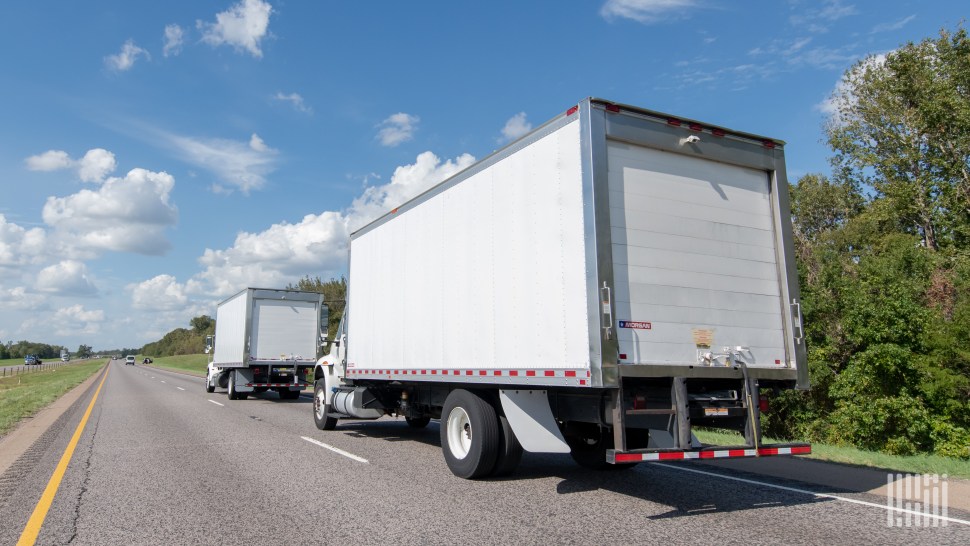
Telly Arnold founded TLA Group LLC, a Houston-based carrier that has run non-CDL box trucks for about three years. In that time the company has rented a truck, co-owned one, financed its own, hauled final-mile appliance deliveries and moved over the road. Her advice to new owners, drawn from each of those stops, comes down to two habits: know every line item behind your cost per mile, and change course quickly when a business model stops paying.
She came to trucking with a bachelor’s degree in accounting, a master’s degree in business and more than 20 years in corporate America. She is also a small business trainer at the University of Houston Small Business Development Center. She runs StraightConnect, a platform aimed at new box truck owners, and co-hosts a podcast, “The Box Truck Hustle,” with Sharif Brooks.
Arnold started TLA Group to create opportunities for her son, and she planned to run it alongside a full-time job. Her business partner, Sharif Brooks, who has more than 20 years in trucking and a CDL, would drive.
“I thought it was something easy I could do while I work full-time and that you can make a lot of money,” Arnold said in an interview with FreightWaves. “I kind of just watched what he did and I saw his work ethic and I was like, I got a driver. I got the business sense. Let’s start a trucking business.”
Three tries at a truck and the bills that followed
Getting a truck on the road took three tries, and the first was a rental. “We heard that you can rent a truck and then you don’t really have the commitment, but you do not know about how much it costs to rent a truck,” Arnold said.
A 50-50 ownership split on a truck with another party came next. “That was a disaster,” she said. The third try was a financed truck of its own, and a truck note came with it.
The biggest surprise was the expenses, and they started the day the company’s motor carrier authority went active. The first insurance deposit ran $4,000 to $5,000 against a monthly premium of about $2500. “That was alarming,” Arnold said. “Was not expecting that whatsoever.”
Then came renewal. “Also, finding out that even though you renew your insurance, that big deposit does not go away,” she said. “I didn’t realize that every time you renew your commercial policy, you’re having to pay a deposit every single time.”
The largest bill she named was a repair. The company’s first major mechanical breakdown cost about $10,000. Of everything on her list, including the deposit and the truck note, the repair bills are the ones she singles out.
“The mechanical bills — not maintenance, the mechanical bills,” she said. “When your truck breaks down, how expensive that is.”
Final-mile lessons
Finding freight came next, and the load board turned out to be the easy part. “People say when your MC becomes active, you can immediately start booking loads on the load board. That is very true. However, there’s not a lot of brokers that like to work with new authority,” Arnold said.
TLA Group sat for a month before it went looking for white-glove work, the appliance and furniture deliveries that new box truck owners are told pay $5,000 to $6,000 a week. “That’s not true,” she said. The company landed local carrier work first, then moved into appliance delivery after Hurricane Beryl made landfall in Texas in July 2024. That is where it learned what claims cost.
“People tell you about the claims, but they don’t really go into deep details about the claims and how do you survive the claims and what can you do to prevent the claims so your check is not being pinched away,” Arnold said.
Her rule for anyone doing that work is documentation at every handoff: a photo of every side of the box at the warehouse, another once it is on the truck and another at the customer’s house, because damage can be concealed inside the packaging. TLA Group learned that on its first day.
“We were new. We didn’t know. We didn’t take pictures,” she said. “And so if you don’t have the pictures to support that this refrigerator, as an example, was damaged before we even did anything, you’re going to get hit with a claim. There’s no ifs or buts about it.”
Customer surveys carried their own risk. On one install, a stove scratched the inside of a customer’s door. Because the crew worked as contractors, TLA Group was responsible for the damage, and Arnold moved fast to keep a claim off the company’s insurance.
“I called a contractor within 24 hours to go out there, repair it, exact paint. I called him, I followed up, I did all the steps, great customer service, and he did a horrible survey on us,” she said. “And because he did a horrible survey on us, I didn’t get a route the next day.”
Over the road, from a phone
TLA Group left appliance delivery for over-the-road freight in February 2025. “We learned that we have to pivot really fast because when you sit in something too long and you’re seeing that is not a good business model for you, it’s best to make those changes quick instead of just drowning,” Arnold said.
Over the road works much the same for a box truck as for a semi, she said. The carrier searches a load board and decides how far out it will run, 500 miles or 1,000. Out of Houston, TLA Group prefers freight headed to the Midwest, where the truck bounces between loads. A load booked on Friday may deliver on Monday.
“We’re booking loads off the load boards like Truckstop, DAT. We have to have a pallet jack, straps. Sometimes we got to have PPE. It just really depends what’s on the load board at that time,” she said.
Her partner drove the first truck, and he drives the only truck TLA Group runs today. In between, when the company added a second truck, it hired drivers and kept one truck local. “Hiring drivers was another obstacle that I did not see, which is hiring drivers who are qualified to drive non-CDL because the box truck you don’t need a CDL, but you need that CDL knowledge, hours of service, post-trip, pre-trip, making sure you strap down the freight so we don’t get any type of claims,” Arnold said.
The company dispatches its own loads, and Arnold is moving into AI dispatch tools to shorten the search. She uses two: Truckstop’s AVA, a voice assistant the load board launched in July, and FleetWorks, which builds AI dispatch agents.
“Like on Truckstop, they have a tool called AVA where you could talk to AVA and tell her what you’re looking for,” she said. “And then there’s another company called FleetWorks that they’ll email us and say, ‘Hey, where are you looking? Where’s your truck at?’ And then we’ll tell them how much we can hold, what region we like to go.”
“What I like now is everything I do is on my phone,” Arnold said. “Book a load, factor it, everything is on my phone. I generally rarely have to go to my computer.”
Knowing the numbers
Arnold recently sat down with someone to go through every expense TLA Group carries. She already knew her cost per mile. Now she is learning what each line item inside it pays for.
“So when you’re negotiating, you’re knowing that if your rate per mile is $2 a mile, this is covering everything that is helping your truck to stay operational,” she said.
Fuel is the line that swings. “If the fuel fluctuates, it is going to hit you, but you still need to know your numbers,” Arnold said. TLA Group splits its fueling between two cards because one drafts its account on Friday and the other on Tuesday, and both carry discounts.
“All I can say is we’ve been used to struggling already, so we just come up with a game plan,” she said.
Cost-per-mile math also decides when to add a truck. Arnold would not put a second truck on a very young authority unless overhead stopped at insurance, fuel, driver pay and a dispatcher. Before an owner scales, she wants a bookkeeper keeping clean books and reports the owner can read.
“Before you jump into that second truck, know your numbers. It’s very important for you to know your numbers,” she said.
Drivers shape the insurance bill too. Safety violations affect it, she said, and turnover can make a small carrier look risky. “When I went from one truck to two trucks, drivers in and out, in and out, in and out, you look kind of high risk,” Arnold said.
After a year of stability with her partner driving, the company’s latest renewal came in “a lot better,” though Arnold is not sure the stability was why. “Maybe we’ll see next year,” she said. “It may go up three times the amount.”
A second truck is on the plan for 2027 or 2028. “I think we’re ready to scale. Our MC is aged. We built a good reputation,” Arnold said.
The numbers are where Arnold parts ways with the advice new owners find online. “There are a lot of social media gurus who are out here selling people pipe dreams,” she said. “They concentrate on revenue but you can make six figures in revenue and you need to look at your bottom line.”
She built StraightConnect in response. The platform features verified industry voices, and her podcast brings on dispatchers, box truck carriers and factoring companies to explain what to expect. Being in the industry taught her that trucking “is more than just moving freight,” she said.
“People are really out here struggling for information and you don’t know who’s really trying to just sell you a course or if they’re really just trying to help you,” Arnold said. “This is why I created my podcast and also why I created the platform StraightConnect because I looked for it and never could find it.”
Brokerage Compliance Symposium
The day before F3. Every compliance issue you face - fraud exposure, carrier liability, FMCSA rules, cargo theft, insurance gaps - navigated by attorneys and operators defining best practices in a changing industry.
F3 Awards Dinner
The night before F3. FreightTech100 companies honored. FreightTech 25 and Shipper of Choice winners revealed live. Cocktail reception into dinner and live music - 300 industry leaders in one purpose-built room.
F3: Future of Freight Festival
Industry-defining keynotes, rapid-fire technology demos, and industry leaders networking in experiences across Chattanooga - plus the inaugural F3 Awards Dinner featuring the FreightTech and Shipper of Choice reveals.
The day before F3. Every compliance issue you face - fraud exposure, carrier liability, FMCSA rules, cargo theft, insurance gaps - navigated by attorneys and operators defining best practices in a changing industry.
The Signal at Chattanooga Choo Choo • Chattanooga, TN Register NowThe night before F3. FreightTech100 companies honored. FreightTech 25 and Shipper of Choice winners revealed live. Cocktail reception into dinner and live music - 300 industry leaders in one purpose-built room.
The Signal at Chattanooga Choo Choo • Chattanooga, TN Register NowIndustry-defining keynotes, rapid-fire technology demos, and industry leaders networking in experiences across Chattanooga - plus the inaugural F3 Awards Dinner featuring the FreightTech and Shipper of Choice reveals.
The Signal at Chattanooga Choo Choo • Chattanooga, TN Register Now