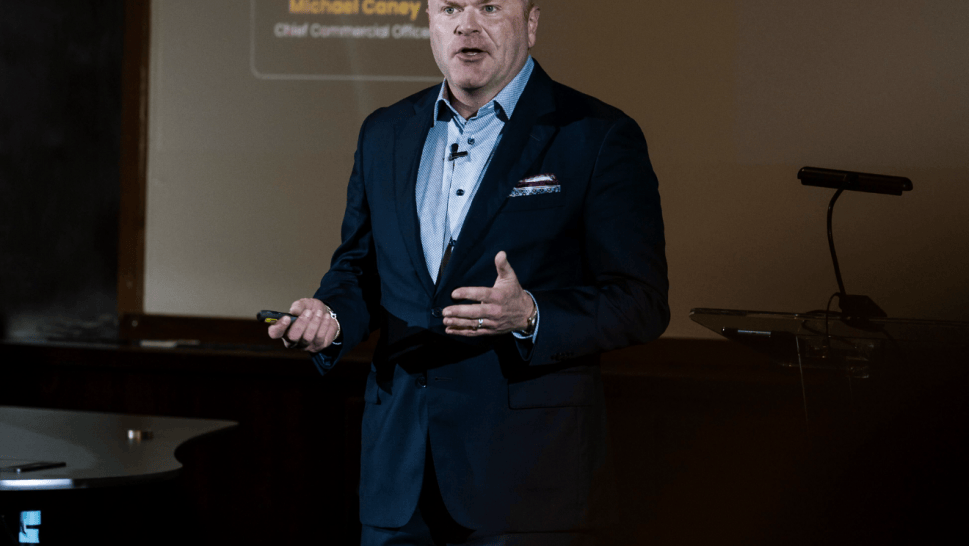
The freight industry has spent years and real money chasing fraud, piling up more tracking, more data, and more awareness than it has ever had, and the losses keep climbing anyway, which is the paradox Michael Caney, Chief Customer Officer at the carrier-identity platform Highway, set out to unpack at the FreightWaves Broker Compliance Symposium, and his answer began with a reframe most of the room had never sat with, that fraud is not really the problem at all but a signal pointing at a deeper one the industry keeps refusing to name.
Caney, who spent two decades as an operator before moving to the technology side, started from a hard truth. No industry has ever eradicated fraud. He pointed to healthcare, where the total addressable market for fraud keeps growing despite decades of fighting it, and to the fact that none of us have switched off our own credit monitoring because the threat simply does not disappear. Fraud, he argued, is a symptom that tells you where to go look, and the freight business has spent its energy swatting at the symptom instead of treating the condition underneath.
Three Ingredients, And An Industry Full Of Them
Fraud needs three things to work, Caney said, the prospect of gain, anonymity, and urgency, and freight hands criminals an abundance of the last two. A broker under pressure to cover a load before a shipper’s clock runs out is a broker tempted to relax a standard, and a bad actor who can stay anonymous long enough to exploit that urgent moment can steal freight, endanger the motoring public, and move on. The uncomfortable part is that brokers sit at the dead center of this, which Caney framed as either a curse or an opportunity depending on how the industry chooses to respond, with the roughly 600 million dollar broker verdict hanging over the symposium as a reminder of how expensive the curse version gets.
The Problem Is Not Data, It Is Enforceability
Here Caney made his sharpest point. The industry does not actually suffer from a lack of standards. Everyone in the room has standards. What it lacks is standards that are shared, arbitrated, and above all enforceable, and a system where ignoring them carries a consequence. He drove the point home by naming three groups that feed brokers enormous amounts of data while carrying, in his telling, very little accountability, the insurance agents, the telematics providers, and the factoring companies that collect premiums and receivables off the freight transaction yet were nowhere to be found at a compliance symposium. When an insurance agent submits bad data, misses a cancellation, or lets a scheduled item lapse, the broker making a hiring decision on that data is the one left exposed.
The numbers he gave on insurance data alone were striking. Of roughly 10,000 agents feeding the system, he said about 40 cover nearly half the vehicles while 200 cover only 3 percent, which means thousands of small sources push data that brokers rely on for vetting with almost no continuity, timeliness, or accuracy. Having that much data, Caney said, is not the same as being able to enforce anything with it.
Years Of Chasing The Signal
The reason freight is in this spot, he argued, is that it has conditioned itself to run at the signal rather than the source. Something goes missing, something is late, a number is off, and the response is to call a TMS provider or a vendor to fix that one thing, then move to the next one. He walked the room back to the era before load tracking was universal, when shippers began selling the little blue dot for a dollar a load with the promise that all problems would vanish, then pushed the cost onto brokers when carriers balked. Years later the industry tracks almost everything, spends heavily to do it, and still watches fraud rise.
The spending without accountability is its own tell. Caney said that when brokers audit their own technology bills, the tracking line is enormous, built on volume, on pings and searches rather than on outcomes, and yet those same brokers will balk at a 500 dollar fee tied to a guaranteed load. His blunt arithmetic was that 500 dollars is cheaper than 600 million, and that with everything a broker already pours into tracking, the load ought to be on time to begin with.
Verified Data Versus The Data You Think You Have
One of the more pointed moments was about the gap between reported and real performance. Carriers routinely hand over tracking records showing 90 percent compliance, Caney said, and when Highway runs those records through its own verification the true figure often lands closer to 75 percent, exposing chameleon carriers and operators gaming the scorecard. For a long time, meeting a customer’s scorecard on paper was enough to keep the freight flowing, with no consequence for the vendor that oversold the tracking or the carrier that faked it. What has changed, in his framing, is that the industry finally has a stick. Highway will de-certify a telematics provider whose network is riddled with carriers that steal, drop a carrier, or refuse to accept insurance certificates from an agent whose data cannot be trusted.
Risk Has Moved From Rules To Process
Caney’s forward-looking argument was that the industry’s risk has shifted from its rules to its processes. For years brokers believed the answer was better rules, and they accumulated them, one oddly specific exception at a time, until configuring a new rule went from a six-month statement of work to a thirty-minute task. The result, he said, is that brokers now hold more rules than ever and override a huge share of them, so many that the rules are no longer really their own. The future is not more data for its own sake or more rules layered on top, but simpler decisions baked into the workflow, powered by network effects rather than tribal knowledge living in one person’s head.
That is why he kept returning to automation and context. A load, in his view, is becoming less like a truck going from A to B and more like a fully digital financial transaction with many parties contributing to whether it conforms or not. Good vetting should not just confirm a carrier is satisfactory or passes a rule set, it should confirm the carrier actually carries the insurance to haul this specific load, catching the buried policy exceptions, the commodity that is not covered, the liability limit that falls short. None of that, he argued, belongs on a sticky note in a cubicle, and tracking should initiate automatically rather than depending on someone asking a driver to accept an app, because the carriers doing the right thing show up, connect, and are easy to verify, while the ones that resist are the exception worth examining.
A Buttonwood Moment For Freight
Where this goes next, Caney said, is toward guarantees at the transaction level, borrowing the language of lending, where conforming and non-conforming loans became prime and subprime. Highway, he noted, has guaranteed well over a billion dollars in freight and rarely paid out, the exceptions tracing back to someone gaming a certification. But the real close was a call to collective action. He observed that of his 1,500 customers, only 243 had enrolled in the stricter Performance Team standard that costs nothing but requires following the rules, and that those 243 had moved a million loads with what he called total peace of mind, leaving the obvious question of where the other 1,300 were.
To make the stakes plain he reached for history, citing Dee Hock, the founder of Visa, and the warning that an industry that will not govern itself from within will be governed from without. He invoked the Buttonwood Agreement of May 1792, when a couple dozen brokers standing under a tree on Wall Street agreed on the standards and the conduct that would define their trade and, in doing so, seeded what became the New York Stock Exchange. The lesson he drew was that standards never emerge from a vendor’s successful funding round or a great pitch, they emerge when the participants themselves get together and decide what is acceptable and what is not, and attach consequences to the difference. The companies that come out of the current fraud crisis strongest, he predicted, will be the ones that stop waiting and start setting those requirements for every party in the transaction, from insurance agents to telematics providers to factoring companies.
Why It Matters
Freight does not have a data problem, it has an enforcement problem, and no amount of additional tracking or rule-writing will fix a system where the parties feeding the data face no consequence for feeding it badly. Caney’s challenge to brokers is that the tools to verify carriers, automate vetting, and guarantee loads already exist, so the real variable now is whether the industry will govern itself by agreeing on shared, enforceable standards, or keep chasing the next fraud signal until it is governed from the outside by rules it had no hand in writing.
This article is based on a keynote by Michael Caney, Chief Customer Officer of Highway, at the FreightWaves Broker Compliance Symposium. Figures and claims about carriers, data sources, and the platform are as presented by the speaker. The Dee Hock and 1792 Buttonwood Agreement references are his, used to frame a call for industry self-governance.
F3: Future of Freight Festival
Industry-defining keynotes, rapid-fire technology demos, and industry leaders networking in experiences across Chattanooga - plus the inaugural F3 Awards Dinner featuring the FreightTech and Shipper of Choice reveals.
Industry-defining keynotes, rapid-fire technology demos, and industry leaders networking in experiences across Chattanooga - plus the inaugural F3 Awards Dinner featuring the FreightTech and Shipper of Choice reveals.
The Signal at Chattanooga Choo Choo • Chattanooga, TN Register Now