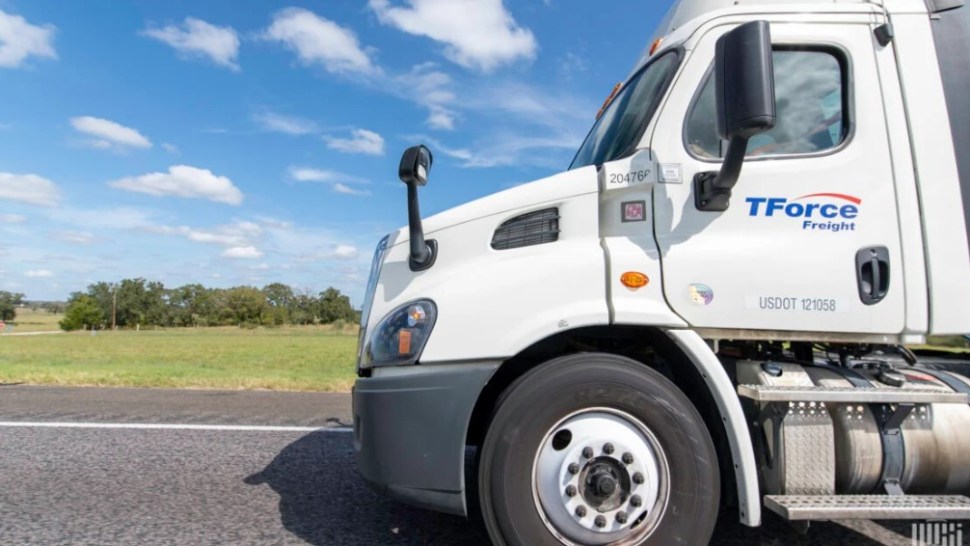
Alain Bedard, the CEO of TFI International, had been highly critical of his company’s U.S. LTL operations back in 2024, at one point referring to some of its practices as “stupid.”
As recently as April, he was far more optimistic about the segment that was built largely through the TFI acquisition of UPS Freight in 2021.
But on Friday, after a third quarter earnings report that had the performance of TFI’s LTL operations lagging well behind its Truckload segment, and with Wall Street punishing the stock almost as soon as the earnings were released late Thursday, Bedard on the company’s earnings call didn’t hold back in a candor that would be shocking in similar forums in almost any industry.
“Truckload is great,” Bedard said, discussing the quarter. “Logistics is great. U.S. LTL is not and I feel like I’m a broken record on that. We’ve got to correct the situation.”
New leader coming in
Bedard said a new manager of the U.S. LTL operations is being brought in by TFI (NYSE: TFII) though he would not disclose the person’s identity. “We need management to jump in and do the right thing,” he said.
Bedard referred to the U.S. LTL operations at TFI as “a rock in my shoe.”
At approximately 2:15 EDT, TFI stock was down 14.71%, or $16.55, to $95.99. Even with that decline, it is still up 11.24% for the last 52 weeks. It is also solidly above the 52-week low of $80.63, recorded almost a year ago on November 20.
While TFI does not break out an OR for U.S. and Canada separately, the company-wide OR for LTL in the third quarter was 91.3% compared to 88.8% a year earlier.
U.S. LTL OR pushing 100
But Bedard offered specifics during the call. “When we report a 91 OR, you can think that our U.S. operation is closer to a 97 and our Canadian operation is more like a sub 75,” he said. But he said Canadian shipments are about 10,000 per day, compared to about 20,000 in the U.S.
Bedard cited as a negative comparison the operating ratio at other LTL carriers without identifying them by name. But Old Dominion Freight Lines (NASDAQ: ODFL) reported a 71.5% OR for the quarter, while XPO (NYSE: XPO) was just over 80%.
Bedard took pains in the call to not attack the unions that represent the workers in its LTL operations, repeatedly saying that many of the group’s issues were with management.
But he also said in the U.S., “there’s nothing we can do except build some kind of non-union network in parallel to the network that we have.”
Hercules a key going forward
The key to that effort will be Hercules Forwarding, which TFI bought in 2024. Bedard said Hercules is a non-union operation that TFI now uses for about 1,000 LTL shipments per day.
“This is small,” he said.”But unless there is something of size that comes to us, the plan is going to be to slowly build that non-union company, like we do in Canada.”
Bedard said TFI’s Canadian LTL operations are both union and non-union, “so it’s OK. We’ll run a second network if we can.”
The goal, he said, “would be to bring more stability to TForce,” the name of the U.S. LTL operations.
In earlier criticisms of TForce operations, Bedard has focused on two key operational areas: density and weight. In both cases, Bedard’s complaint has been that there is too little of either.
Density was raised as an issue again by Bedard in the Friday call. One measure that illustrates the problem, according to Bedard: “the average mile that we drive today between each and every stop in our (U.S.) package and delivery operation is about twice as much as our Canadian operation.”
“In Canada, we focus on trying to do business with customers that are close by and not run 100 miles to do a delivery,” he said. TFI has been trying to change that sort of “culture” at US LTL, Bedard said, “but it seems difficult to do.”
The unidentified new hire “is hopefully going to be able to help us drive change.” But Bedard added that “there are more team members that we need to drive more change and to bring that density down.”
Density issues magnified by diesel
The issue of density in U.S. LTL has become an even larger issue at TFI because of fuel costs, Bedard said.
In response to an analyst question, Bedard said the new hire has been on the job since October 1. The executive’s identity will be revealed soon, with Bedard only saying the person had been retired from an industry peer.
“A new broom sweeps clean” he said. “We have got to change the recipe and that’s what we’re doing now.”
He said the U.S. LTL operations are beset by a “mentality of, we really don’t care.” Bedard said that was a legacy of the UPS (NYSE: UPS) ownership, which directed its interest and investment dollars to its more traditional business.
Not for sale
Bedard’s comments were stark enough that it led one analyst to ask a question that would have been unthinkable not all that long ago: might TFI divest its U.S. LTL operations?
Bedard gave a lengthy answer that eventually circled back to a “no.”
“If you look at TForce, we want to be in LTL,” he said. “So to me, it’s been a disappointment. I’m not happy with what’s going on, but it’s a fight. We’ve been fighting but losing.”
He wrapped up his response with a “no.”
“We have no intention of selling our US LTL operations at all,” Bedard said. “We want those guys to be efficient, to be productive and after improving everything except the human side of the business, it’s not working.”
The entire problem is “human,” he added. “There’s no more excuse on the fleet,” he said. “There’s no more excuse on the financial tools. It’s just that we have the wrong guys.”
Bedard did speak positively about the company’s Truckload operations, which recorded an OR of 86.7% for the quarter.
Positive words for Daseke
Part of the strength in Truckload is being driven by the operations that came with the purchase of flatbed operator Daseke in 2023, which had been a publicly traded company.
As recently as the first quarter of last year, Bedard said on the company’s earnings call that the integration of Daseke had been a struggle.
But that was not the message he delivered this year. “Daseke has been turned around very, very fast,” he said. He cited OR performance before the purchase of 97-98%
A review of FreightWaves articles on Daseke earnings from the quarters immediately before the TFI acquisition mostly shows OR performance at either side of 90.
While Daseke is not the only asset in TFI’s Truckload segment, it helped the operations come in with an OR of 86.7% for the quarter.
“The Canadian operation is doing even better, but our U.S. operation is slowly catching up,” Bedard said.
More articles by John Kingston
FMCSA’s Elison addresses Motus again, still no date on full repair
C.H Robinson and Landstar stock prices slammed; insurance a factor
Jacobs, RXO’s creator, backs its acquisition by C.H. Robinson